



If LEGO doesn’t make it:
My „First 12“ display as a LEGO Star Wars MOC
A Display Appears
Sometimes all it takes is a single LEGO rumor, and a complete MOC immediately takes shape in your mind. That’s exactly how this project began. I first heard about an upcoming LEGO Star Wars set numbered 75477 in a LEGO leak video. At the time, there was initial talk of a “minifigure vignette”—apparently a display for Star Wars minifigures. The LEGO NINJAGO set 71866, “Ninja Character Display 15th Anniversary,” which is also intended as a display model for minifigures, immediately came to mind as a comparison.
When I heard the terms “Star Wars,” “minifigures,” and “display,” however, something completely different immediately came to mind: the legendary 1978 Kenner mail-order display stand—featuring, of course, the famous First 12. For Star Wars collectors, this display stand is a true piece of history. Kenner offered it in the late 1970s as a mail-order item, among other things, and it was designed to showcase the twelve action figures.


The 1978 Kenner mail-order display stand is a vintage display piece designed for the first 12 action figures in the „Star Wars“ series. It features a cardboard backdrop with individual, swiveling pegs for securing the figures. This display stand was a mail-order offering from Kenner that showcased iconic „Star Wars“ figures.
It was exactly this connection that made the idea immediately interesting to me. If LEGO were to release a Star Wars minifigure display modeled after that old Kenner display—featuring the First 12 as LEGO minifigures—my reaction would have been pretty clear: Shut up and take my money.
However, a second thought followed almost immediately: LEGO would never do that, of course. Never ever!
After all, that would be too obvious, too nostalgic, and probably too perfectly tailored to the very people who would actually be willing to spend money on something like that. You might almost think it would be a sensible concept for an adult set.
It’s precisely this kind of uncompromisingly nostalgic take that would be the kind of set that could really win over us Ancient Sith fans—that is, those Original Trilogy fans who are excited by the classic collector’s toys from the late 1970s. And yes, some of us would probably even be willing to spend quite a bit of money on something like that. Maybe that’s exactly the problem: It would be too easy to give fans exactly what they actually want.
The Rumors Strike Back
Over time, the information about 75477 became more specific, and—unsurprisingly—it turned out that the project is apparently heading in a completely different direction. As things stand now, the set is set to be released under the name “Icons of Star Wars” and will include three small scenes set on Tatooine, Hoth, and Endor, along with microscale versions of classic Star Wars vehicles and several minifigures.
Even though this isn’t exactly what I had originally hoped for, the idea does sound quite promising at first glance. Three classic locations, a few iconic ships, and some fitting minifigures—you could actually put together a nice little Star Wars display with these. So the basic concept isn’t the problem at all.
Still, for now I’m assuming that LEGO will somehow manage to mess up this idea as well when it comes to bringing it to life. Maybe I’ve just been a LEGO Star Wars fan for too long by now, but experience tells me: Between a decent set idea and the finished product, there are still a surprising number of opportunities for questionable design decisions, unnecessary compromises, and a price that makes you wonder if there’s secretly a second set hidden in the box somewhere.
To me, though, the idea of a modern collector’s display featuring twelve minifigures is still much more exciting. A set that clearly references a historic Star Wars collectible, is instantly recognizable, and actually does something unique. So that’s probably exactly why LEGO wouldn’t make something like that.
And with that, the logical conclusion was really already clear: If LEGO doesn’t make it, you just have to make it yourself.
So I started designing a MOC digitally in Studio 2.0.
Building the Rebellion
As with my other models, there was a strict size limit from the very beginning. My MOCs are designed to fit into my TINGLAND acrylic display cases, which means I have a maximum base area of about 30 × 17 studs and a height of about 12 bricks.
At first glance, that sounds like plenty of space, but it becomes surprisingly tight once you have to fit twelve minifigures, a multi-tiered display area, and a large back wall into it. At the same time, despite the necessary adjustments, the model should remain clearly recognizable at a glance as a tribute to the old Kenner booth.
So simply copying the original’s arrangement of figures didn’t work particularly well. Two classic rows of six would have taken up too much space on the limited surface area and obscured the figures in the back too much. After a few attempts, I finally settled on an arrangement of three rows with five, four, and three figures.
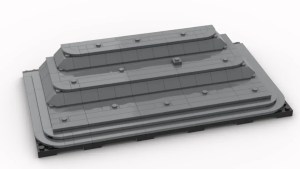
This makes all twelve characters easily recognizable and, at the same time, gives the model significantly more depth. The three levels are each spaced about one brick apart, while the front edges are beveled with slopes. As a result, the base doesn’t look like a simple rectangular block, but rather like a carefully designed display stand.
Behind the Figures
Of course, the back panel was particularly important, because on the historic Kenner display, it is one of the most distinctive design elements. Without that large, colorful Star Wars graphic, the display would ultimately be nothing more than a gray base with twelve figures.
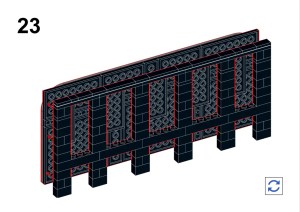
My back wall is therefore constructed as a vertical plate structure 30 studs wide and 13 studs high. To keep it as flat as possible while still ensuring it’s securely attached to the base, I used SNOT techniques. Modified bricks and appropriate connecting elements hold the vertical surface in place against the base’s supports, while the actual structure remains largely invisible from the front.
Once I was satisfied with the digital version, I moved on to building the physical model. As with many of my MOCs, I mainly used GoBricks bricks from Brickwith. Nevertheless, I had to make some adjustments to the digital design in a few places because not every LEGO element used in the studio was available as a suitable alternative. One example in this project was element 7904.
Such adjustments have become almost automatic at this point. Some LEGO elements are simply not available from alternative manufacturers, which quickly brings us to the issue of design protection. LEGO has been trying for years to secure legal protection for individual brick shapes—sometimes successfully, sometimes not. The extent of this protection continues to be a matter of debate in European courts.
In my opinion, LEGO sometimes has a rather broad interpretation of what should be considered exclusive to LEGO. Ultimately, however, it’s up to the courts to decide whether these claims hold up. For MOC builders, the outcome is much simpler: if the needed piece isn’t available, they just modify the design—sometimes changing a larger part of the structure just to accommodate a single specialty brick.
In the end, I’d much rather take a small, creative detour than help fund the LEGO logo on every single brick.
In contrast, GoBricks offers a significantly wider selection of colors—and, above all, color combinations for individual pieces—than the original LEGO lineup. Many of these bricks are available in colors that LEGO either doesn’t produce at all or hasn’t produced in a long time.
The First Twelve
A “First 12” display without the First 12 would, of course, be pretty pointless. When it came to the figures, however, I didn’t limit myself to original LEGO minifigures. The twelve characters consist of figures from two Chinese suppliers, as well as a few additional pieces from BrickLink.
For this specific project, some of these alternative figures simply appealed to me more visually, and at the same time were significantly cheaper than some comparable LEGO minifigures on the collector’s market. The prices some older LEGO Star Wars figures are now commanding have very little to do with a few grams of printed ABS anyway.
But my goal wasn’t to showcase twelve particularly rare or valuable original figures at the booth anyway. I wanted to recreate the classic „First 12“ as convincingly as possible as LEGO minifigures. Whether the correct company logo is on the back of each torso is far less important to me than whether the figures look good on the finished display.
The display as a whole should be the focal point. The figures are an important part of it, but it is only when combined with the base, layering, and back wall that the effect I wanted to replicate from the historical connoisseur’s display is achieved.
Art of Rebellion
However, one crucial element was still missing: the graphics. The original Kenner display stand really comes alive thanks to its large illustrated back panel, and that’s exactly the vibe I wanted to capture in my MOC as well.
Printing a graphic across numerous individual tiles was out of the question for me. I don’t trust my SteinDrucker that much (yet). That’s why I decided on three separate sections. The central motif is on a large 16 × 8 tile and forms the centerpiece of the back wall. To the left and right of it are two additional motifs that expand the overall composition while also incorporating additional classic Star Wars imagery.
For the central motif, I used ChatGPT to generate a LEGO-style interpretation of the historic Kenner artwork. For the two side sections, I used classic Star Wars posters as templates, which were also adapted to match the LEGO aesthetic.
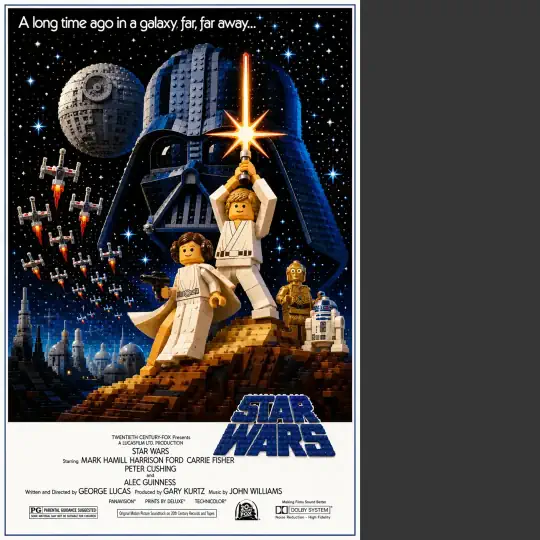
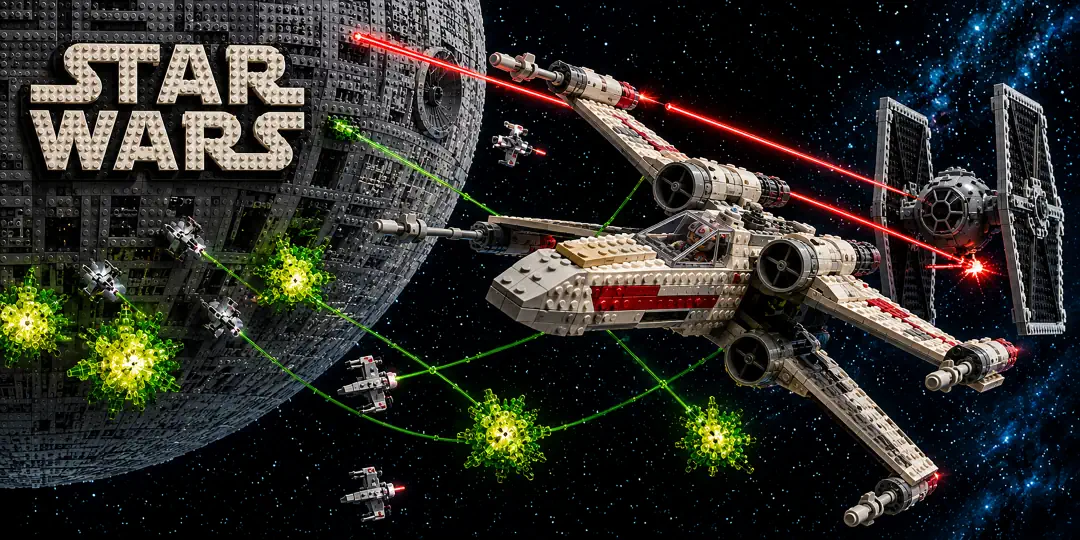

As a result, the back panel isn’t an exact replica of the historical original, but rather a reinterpretation. But that was exactly the intention. The model was meant to look as if this display might actually have existed at some point as a LEGO Star Wars collector’s set—only in an alternate reality where LEGO would have thought, “Let’s just go ahead and make this obviously cool thing.”
Kenner 1978 meets LEGO Star Wars. Without three mini-dioramas, without obsessively squeezing in a Microscale Millennium Falcon somewhere, and without spinning the idea around in product planning for so long that hardly anything remains of the original inspiration.
Return of Kenner
In the end, the result is pretty much exactly what I pictured in my mind right after hearing the first rumor about 75477: a compact Star Wars minifigure display featuring twelve classic characters, a large, eye-catching back panel, and a clear homage to the Kenner design of the late 1970s.


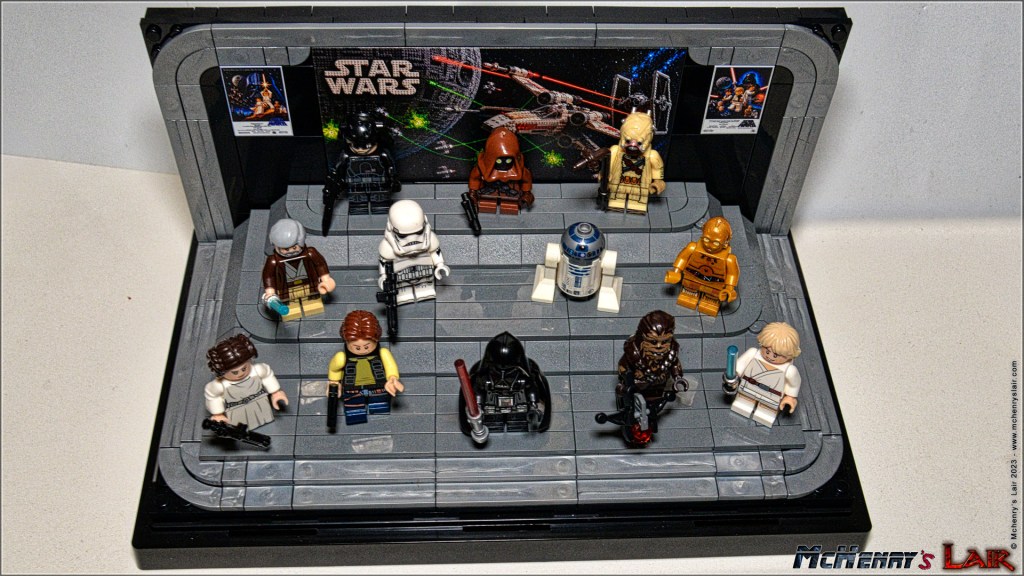


At the same time, it’s not a simple replica of the original, but an original MOC that works within my usual size constraints and fits easily into the acrylic display case.
Of course, LEGO would have designed a set like this differently. Probably with fewer minifigures, more pieces, a black 18+ box, and a price that would leave you needing an explanation that the model is, after all, intended for adult collectors.
And maybe the actual 75477 will turn out to be good in the end. I’m happy to be pleasantly surprised. But the direction we’ve seen so far confirms a pattern for me once again: LEGO has an interesting basic idea, and my first reaction is enthusiasm. Then you learn more about how it’s actually being implemented, and at some point you think to yourself: Oh, I see. Yeah. Of course.
But that’s exactly why I like MOCs.
You don’t have to wait for LEGO to eventually produce the exact set you’d like to have. You don’t need product managers, target audience analysis, or internal guidelines stipulating that Tatooine, Hoth, and Endor absolutely must all appear at the same time. You take the idea, think about what you’d like to make out of it, and build exactly that.
In this case, the initial idea I had was more compelling to me than what has emerged so far as the official concept—or at least the rumored one. So I built my own version.
Or to put it another way: Nice idea, LEGO. Thanks for the inspiration. I’d rather do the rest myself.
Another MOC Begins

And the next example of this is already on the horizon. I also have a few ideas of my own about the LEGO Star Wars Movie Theater, which is rumored to be planned for 2027.
Because even there, it currently looks as if LEGO has come up with what is actually a pretty good idea.
Experience has shown that this means it’s better to get started on your own MOC right away.
In any case, mine is already in the works …
Costs
- Bricks:
- Brickwith : 35€ (423 Bricks)
- Figuren:
- Bricksdealerz : 35€ (9 figures)
- Ebay: 12€ (2 figures)
- Bricklink 5€ (1 figures+ Headwear)
- Prints:
- Steindrucker: 20€
- Vitrine:
- TINGLAND: 13€
- Total: 115€





Kommentar verfassen