

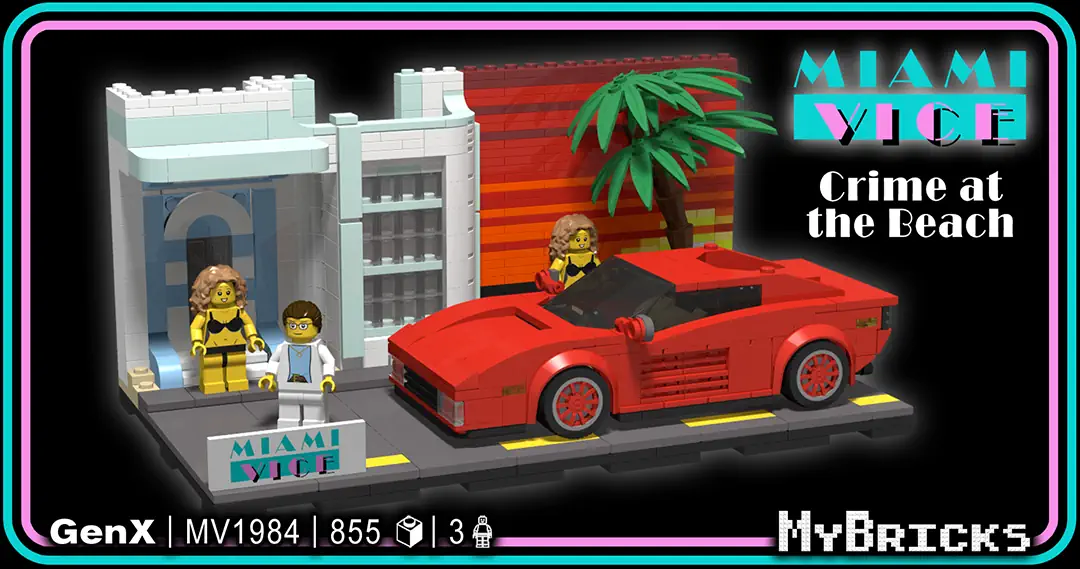
Miami Vice in Bricks

Few television series captured the look and atmosphere of the 1980s as perfectly as Miami Vice. Pastel-colored Art Deco architecture, palm trees, neon lights, expensive sports cars, tropical nights and, of course, the unmistakable fashion of Sonny Crockett and Ricardo Tubbs made the series visually unique.
I have always been a big fan of Miami Vice, so sooner or later I had to turn that fascination into one of my brick-built display models. The goal was not to recreate a particular scene from the series exactly, but rather to capture the feeling of Miami Vice in one compact diorama: a stylish Miami building, a colorful sunset, a palm tree, a sports car and a few characters that immediately give the scene that unmistakable South Florida atmosphere.
One important detail makes this MOC a little different from most of my builds: the entire model is made from non-LEGO parts, mainly GoBricks elements.
The Idea
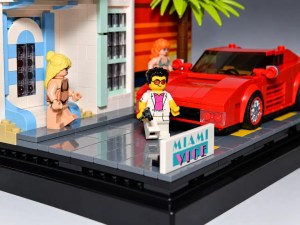
As with many of my MOCs, the project started digitally in Studio 2.0.
Before ordering any bricks, I first tried to define the elements that were absolutely necessary for the scene. With such a small available space, there was no room for unnecessary details. I wanted the finished model to be recognizable as Miami Vice almost immediately, even without reproducing a specific location from the television series.
For me, the essential ingredients were clear: pastel-colored Miami architecture, a strong sunset backdrop, a palm tree, a sports car and characters dressed in unmistakable 1980s Miami style.
The digital planning stage was particularly important because this model had to follow the same limitation as my other display MOCs.
Building Within the Size Limit
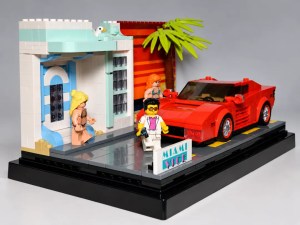
As with my other models, there was a strict size limit from the very beginning. My MOCs are designed to fit into my TINGLAND acrylic display cases, which means I have a maximum base area of about 30 × 17 studs and a height of about 12 bricks.
That may sound like a reasonable amount of space at first, but a sports car already occupies a large part of a 30 × 17-stud footprint.
The challenge was therefore to create enough scenery around the car without making the entire display feel overcrowded.
I eventually divided the model into two main visual areas. The left side contains the Miami-style building with its entrance and tall window section, while the right side is dominated by the red sports car, palm tree and sunset wall. A small section of road connects everything and gives the car a natural place within the scene.
The black display base frames the entire build and helps separate the colorful Miami scenery from its surroundings.
The Scene: Art Deco, Sunset and Palm Trees
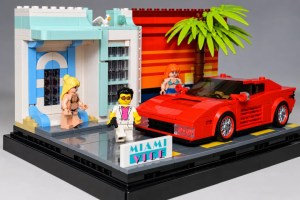
The building was probably the most important part of establishing the location.
Instead of trying to reproduce a real Miami building, I designed something inspired by the Art Deco architecture associated with Miami Beach. White walls are combined with light turquoise and blue elements, while rounded corners and decorative vertical sections give the façade the streamlined appearance I was looking for.
The large turquoise canopy creates one of the strongest architectural shapes in the model. Underneath it, the blue and white entrance provides additional contrast.
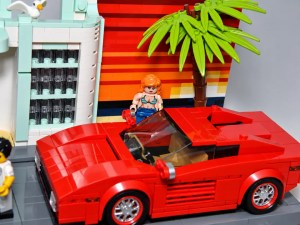
Next to the entrance is a tall window section built from transparent elements. This helps break up the otherwise solid façade and adds a little more depth to the building.
There is even a small seagull sitting on top of the building. It is a tiny detail, but it contributes surprisingly well to the coastal atmosphere.
Behind the car, however, the mood changes completely.
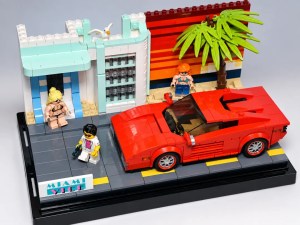
I wanted something that instantly suggested a Miami sunset without requiring additional lighting or a printed background. The solution was a brick-built gradient wall using dark red, red, orange, yellow and white elements.
The horizontal bands create a stylized sunset that feels deliberately graphic rather than realistic. This works especially well in such a small display because the colors remain visible from almost every viewing angle.
A large palm tree stands in front of the sunset. Its curved trunk and bright green leaves break up the straight lines of the background and give the scene some much-needed vertical detail.
Together, the pastel building and orange-red sunset create exactly the contrast I associate with Miami Vice: cool turquoise architecture on one side and warm tropical colors on the other.
The Red Testarossa

Of course, a Miami Vice-inspired scene needs a spectacular car.
The Ferrari Testarossa is one of the vehicles most strongly associated with the later seasons of the series, and normally the obvious choice would have been a white one.
Mine is red.
There is a very simple reason for that: I had already bought this red Testarossa as a non-LEGO brick set and wanted to incorporate it into the MOC.
And although it is not the television-accurate color, I actually like what the red car does for the finished scene.
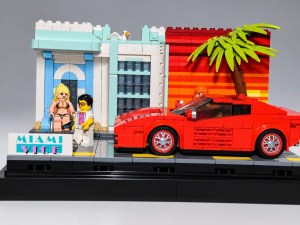
Because the car visually connects with the red and orange sunset wall behind it, it becomes an even stronger focal point. The bright red body contrasts sharply with the turquoise-and-white building, while the black base and grey road prevent the colors from becoming too overwhelming.
The model itself has all the classic Testarossa ingredients: the very low wedge-shaped body, wide rear section, black windscreen and, most importantly, the horizontal side strakes.
It takes up a substantial percentage of the available display area, but that was intentional. In Miami Vice, cars were never just background props. They were part of the visual identity of the show.
For that reason, I wanted the Testarossa to dominate the scene.
The Figures
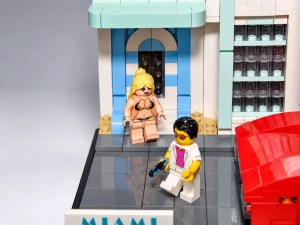
To make the display feel like a scene rather than a static architectural model, I added three minifigures.
The central character is my interpretation of a Miami Vice-style undercover cop. Instead of attempting an exact reproduction of one particular television character, I focused on the visual language of the series: white suit, bright shirt, dark hair and sunglasses.
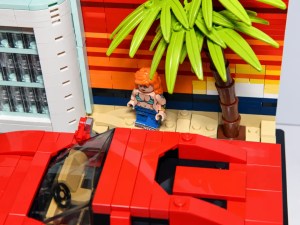
He is also carrying a weapon, giving the scene just enough of that police-action feeling associated with the show.
The two female figures wear beach outfits and help reinforce the Miami setting. One stands near the building entrance, while the other is positioned closer to the car and palm tree.
Their placement also helps balance the composition. Without them, the left side of the model would be dominated by architecture while the right side would contain almost nothing except the car. The figures add visual points of interest throughout the scene and make it feel much more alive.
I deliberately kept the number of characters low. With the limited footprint, adding too many minifigures would quickly have made the display look crowded.
A Small Miami Vice Sign

One of my favorite finishing details is the small MIAMI VICE sign at the front of the display.
The turquoise, pink, black and white design is inspired by the unmistakable graphic style associated with the series. It works almost like a title card for the whole diorama.
Because the display itself contains no large logos or other obvious references, the sign makes the theme immediately clear while still allowing the architecture and car to remain the main focus.
Building with GoBricks and Other Non-LEGO Parts

Another special aspect of this project is that I deliberately built it entirely from non-LEGO elements, with GoBricks making up the main part selection.
For a display MOC like this, the wide variety of colors and elements is especially useful. The light turquoise pieces were essential for achieving the pastel Art Deco appearance, while the many slopes, tiles and curved elements helped shape both the building and the surrounding scenery.
The red Testarossa itself also started as a third-party brick set, so using non-LEGO parts for the surrounding diorama made perfect sense.
For me, the important part of a project like this is not the logo on the studs, but whether the finished model captures the idea I had in mind.
Conclusion
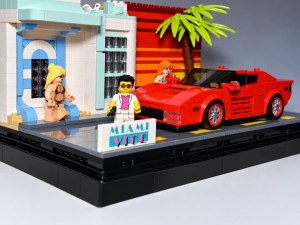
This MOC is less about recreating one exact moment from Miami Vice and more about compressing the entire visual character of the series into a very small display.
The pastel Art Deco building represents Miami Beach. The palm tree and brick-built sunset provide the tropical atmosphere. The white-suited vice cop and beach characters bring the scene to life. And the red Testarossa gives the model the dramatic centerpiece that a Miami Vice display simply needs.
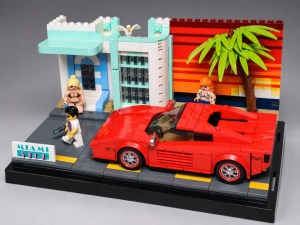
Yes, a white Testarossa would have been closer to the television series. But since I already owned the red non-LEGO version, I decided to use what I had—and in the finished model I think the red works surprisingly well. It ties directly into the sunset colors and gives the entire display an even stronger 1980s poster-like appearance.
Most importantly, everything still fits inside my approximately 30 × 17-stud, 12-brick-high TINGLAND display-case limit.
For such a compact model, there is quite a lot going on. From the turquoise architecture and little rooftop seagull to the sunset wall, palm tree, figures and oversized red sports car, every part contributes to the same idea:
A small piece of 1980s Miami, built from bricks.






Kommentar verfassen