

Man is more frightening than Gojira.
Toho Makes a Triumphant Return

With Shin Gojira, the Japanese studio Toho made a comeback in 2016 that can hardly be described as anything other than triumphant. Twelve years had passed since Godzilla: Final Wars, which had been the last Japanese live-action film featuring the famous monster up to that point. During that time, Legendary Pictures had begun developing its own American version of the character. To clearly distinguish between the two interpretations, the Japanese Toho version is referred to in this article as Gojira, while Godzilla refers exclusively to the films by Legendary Pictures.
This distinction is not merely a matter of name; it reflects two distinctly different visions of what the monster can be. The American Godzilla is often portrayed as a gigantic, almost heroic guardian of nature. He battles other titans, restores balance, and is increasingly becoming a sort of prehistoric superhero. Gojira, on the other hand, is traditionally more closely associated with fear, destruction, nuclear power, societal traumas, and political responsibility. It is precisely to these roots that Shin Gojira returns.
And Toho is indeed making a comeback “with a bang.” After Final Wars, one might have expected a nostalgic film combining familiar monsters, classic themes, and spectacular battles. Director Shinji Higuchi and screenwriter and co-director Hideaki Anno, however, opted for a bolder approach. Their film is not merely a rehash of past successes, but a complete reinterpretation of the character.
Shin Gojira is at once a disaster film, a political satire, a government thriller, a science-fiction horror film, and a social critique. The film respects the series’ history without being dependent on it. It takes up central ideas from the 1954 original but transposes them to modern-day Japan. As a result, it feels both familiar and radically new.

Especially when compared to the Godzilla films from Legendary Pictures, Shin Gojira feels significantly more focused, self-contained, and substantively significant. The American productions offer impressive monster battles and spectacular visuals, but Shin Gojira possesses a political edge and a terrifying immediacy that the Legendary films often lack. Here, the monster isn’t part of a larger superhero universe. Gojira is a national crisis, a biological impossibility, and a walking natural disaster.
A Disaster That Keeps Escalating

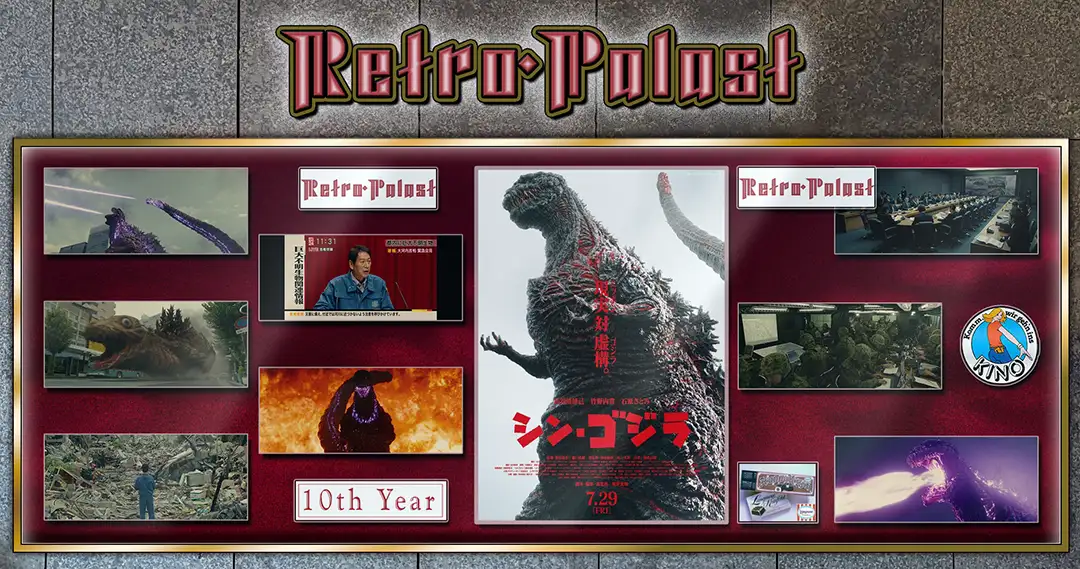
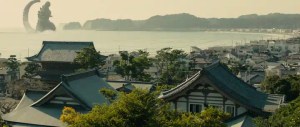
The plot begins unspectacularly—and is all the more effective for it. An abandoned boat is discovered in Tokyo Bay. Shortly thereafter, strange events occur in the water. Steam rises, tunnels are flooded, and a massive creature moves toward the city. At first, the authorities don’t know what they’re dealing with. Officials discuss the situation, form task forces, move from one meeting room to another, and try to control the situation using familiar administrative procedures.
The film’s great strength is already evident in these opening scenes. The threat is not fully revealed right away. Instead, it grows step by step. Just as slowly, the government comes to realize that its existing categories and measures are completely inadequate.

When Gojira first appears on land, it does not yet look like the monster we know. Its early form appears clumsy, unsettling, and almost pitiful. Its body is unfinished, its eyes are fixed, blood oozes from its gills, and its movements seem to be accompanied by pain. Yet the creature evolves at a terrifying pace. It adapts to its environment, grows, and alters its anatomy.
This evolution makes Gojira unpredictable. Every supposed solution loses its value because the monster has already evolved further. What seemed like an advantage just moments ago becomes meaningless a few minutes later. Gojira is not an opponent whose abilities can simply be analyzed and then countered with military superiority. He is a constantly changing crisis.

At the center of the human narrative is Rando Yaguchi, a young, ambitious government official. While many of his older colleagues are trapped in hierarchies, bureaucratic responsibilities, and political precautions, Yaguchi realizes early on that unusual problems require unusual solutions. He assembles a team of scientists, technicians, civil servants, and outsiders. This group works well not because its members are particularly glamorous, but because they are competent and willing to bypass traditional structures.
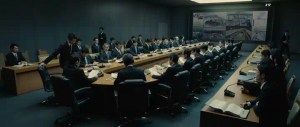
The film’s central conflict, therefore, is not merely between humans and monsters. It also revolves around the question of whether a modern society can learn quickly enough. Can it overcome its bureaucracy without sinking completely into chaos? Can it make decisions even when crucial information is missing? And can it take responsibility before a national disaster escalates into an international crisis?
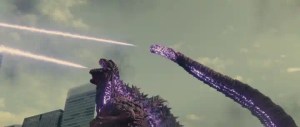
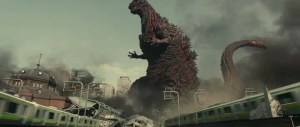
The most famous turning point is Godzilla’s attack on Tokyo. At first, the monster emits a dark cloud of smoke. Flames erupt from it before the attack develops into an extremely concentrated, violet beam of energy. Within a few moments, the city at night is transformed into a burning inferno. Buildings are sliced through, entire blocks are destroyed, and even modern military weapons prove to be virtually ineffective.
The scene is spectacular, but never triumphant. It does not celebrate the destruction. It shows a helpless metropolis and a creature that apparently understands its own powers just as little as humans do. Gojira comes across less as a victorious warrior than as a tormented organism whose very existence inevitably leads to catastrophe.
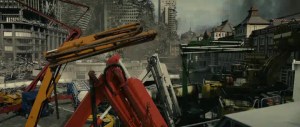
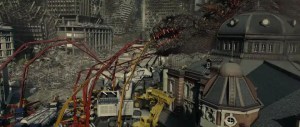
In the final act, Yaguchi’s team devises a risky plan. Instead of fighting Gojira with ever-more-powerful weapons, the goal is to halt its biological process. Trains, cranes, buildings, and specialized vehicles become tools in a joint operation. This makes the finale far more original than a typical monster battle. It is not a stronger creature that defeats Gojira, but human cooperation, scientific thinking, and an improvised plan.
The victory remains incomplete, however. Godzilla is frozen, but not permanently destroyed. The final shot of his tail suggests that the next stage of his evolution may have already begun. Thus, the film ends not with relief, but with a warning. The catastrophe has been halted, yet its causes and potential persist.
Effects with Destructive Force

Technically, Shin Gojira is a fascinating film because it combines modern digital effects with the visual language of classic Japanese monster movies. Here, Gojira was not portrayed, as in the past, by an actor in a heavy rubber suit. Instead, the monster was created primarily through computer-generated effects. Yet it does not come across as a sleek Hollywood creature.
The design deliberately retains a physical, heavy, and awkward quality. Gojira’s skin looks like burnt, torn tissue. Its body is crisscrossed by red, glowing fissures. Its arms are strikingly small, its tail is unnaturally long, and the entire organism appears to be perpetually caught between life, burning, and mutation.
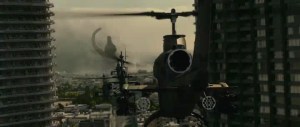
What’s particularly impressive is that the design doesn’t try to elicit sympathy. Legendary’s Godzilla possesses recognizable animalistic emotions, majestic poses, and almost regal features. You’re meant to admire his strength. Gojira, on the other hand, is intentionally hard to read. His face is rigid, his gaze is empty, and his movements seem mechanical. This distance makes him far more unsettling.
The various stages of its evolution are also superbly designed. The early creature looks grotesque and vulnerable, while the later form increasingly resembles a living nuclear ruin. The film makes the evolution visible without providing a fully scientific explanation. This keeps Gojira mysterious.

The destruction scenes benefit from a clever combination of digital imagery, real locations, models, and carefully staged reactions. Gojira’s path through the city, in particular, conveys a sense of mass. Streets crack open, roofs are pushed aside, vehicles fly through the air, and buildings vanish beneath the monster’s body. Not every effect has the flawless finish of an extremely expensive Hollywood production. But the images have character, clarity, and a strong sense of scale.
The camera work plays a decisive role in this. Gojira is often shown from a great distance—from helicopters, from rooftops, or through surveillance footage. The viewer doesn’t simply see a monster; instead, they get the impression of following a real-life disaster through news footage and government footage. This documentary-style effect makes the events more believable.

The staging of the government scenes is equally technically precise. Quick cuts, on-screen names, location details, official titles, and tightly worded dialogue create an enormous flow of information. People run through corridors, move from room to room, and pass on reports. These scenes could come across as dry, but their rhythm and editing transform them almost into action sequences.
Hideaki Anno’s influence is unmistakable here. Viewers familiar with his series Neon Genesis Evangelion will immediately recognize the strict visual composition, the unusual perspectives, and the combination of bureaucratic language with existential threat. However, the film does not simply copy Evangelion. Rather, Anno transfers his stylistic strengths to Gojira.
Another highlight is the music by Shirō Sagisu. His dramatic compositions lend the crisis meetings, military operations, and scenes of destruction an almost operatic intensity. At the same time, the film incorporates classic themes by Akira Ifukube. In this way, the soundtrack bridges the past and the present. The familiar sounds serve as a reminder that this is still Toho’s Gojira, while the new pieces make it clear that a new era has begun.
Fascinating Behind-the-Scenes Details

Even the title Shin Gojira has several possible meanings. Depending on the characters used, the Japanese word “Shin” can be associated with “new,” “true,” or “divine,” among other things. This ambiguity fits the film perfectly. This is a new Gojira—a return to the character’s true essence and, at the same time, a being whose power makes it seem almost like an incomprehensible deity.
The film was the first Japanese live-action Gojira movie since Godzilla: Final Wars in 2004. Toho therefore had to not only develop a new story but also decide what significance the character should hold in modern Japan. Instead of imitating the American Godzilla films, the studio deliberately took a different direction.

Among others, the Kyōgen actor Mansai Nomura was enlisted to help with Gojira’s movements. His controlled, traditional physical performance helped give the digitally created monster an unusual demeanor and presence. This explains why Gojira moves neither like an ordinary animal nor like a human fighter.
It’s also striking that the film almost entirely avoids classic monster battles. Gojira doesn’t fight Mothra, King Ghidorah, or Mechagodzilla. The only real adversary is organized human society. In this respect, the film follows the 1954 original more closely than many later installments in the series.
The large number of characters is also a deliberate choice. Individual characters are given only limited personal backstories because the film does not aim to tell the story of a single hero. Japan itself is the true human protagonist. Government officials, scientists, soldiers, and technicians together form a national crisis team.
The English-language scenes featuring Kayoko Anne Patterson, played by Satomi Ishihara, have drawn some criticism. Her character, however, serves an important function. She embodies both Japan’s close ties to the United States and the political pressure that arises once Gojira is no longer viewed solely as a Japanese problem.

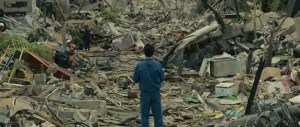
The development of the military response is particularly interesting. The film shows in detail how difficult it is to deploy the Self-Defense Forces within a densely populated city. Civilians must be evacuated, responsibilities clarified, and risks assessed. As a result, the attack becomes not merely a demonstration of power, but a moral and political decision.
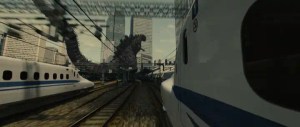
At first glance, the finale featuring unmanned trains seems almost absurd. Within the context of the film, however, it is entirely consistent. The trains symbolize infrastructure, organization, and technical creativity. An everyday symbol of modern Japan becomes a weapon against disaster.
Controversy as a Particular Strength

Reactions to Shin Gojira were predominantly positive, but the film was not received equally by all viewers. The large number of government meetings was a particularly frequent point of criticism. Those expecting a classic monster movie with plenty of battles might be surprised by the lengthy dialogues, political proceedings, and scientific discussions.
Yet this is precisely what makes the film unique. The meetings are not an unnecessary detour, but the core of the story. Shin Gojira shows that disasters do not occur solely on the streets and between skyscrapers. They also arise in decision-making processes, information chains, and institutional boundaries.
Another point of criticism concerns the character development. Many characters remain functional and are defined primarily by their professional roles. Compared to conventional Hollywood dramas, there are no detailed family backstories or romantic subplots. Yet this decision also strengthens the film. Personal melodramas would have diverted attention from the national crisis. The characters gain their humanity through their behavior under pressure.
Some digital effects also appear less photorealistic than in Legendary Pictures’ productions. Nevertheless, the effects in Shin Gojira are often more cinematic. Legendary’s Godzilla is technically impressive, but is frequently shown in dark, rainy, or highly dynamic scenes. Toho, on the other hand, repeatedly presents Gojira in daylight and in clear long shots. The monster is allowed to look otherworldly. It doesn’t have to appear completely realistic, as long as its presence is convincing.

In terms of content, Shin Gojira is clearly superior to the Legendary films. The American films have larger budgets and more elaborate monster battles, but their human stories often feel interchangeable. Shin Gojira has a clear perspective. Every scene deals with the question of how people, authorities, and governments react to an unprecedented threat.
The humor is also sometimes overlooked. The film isn’t simply a serious exercise in bureaucracy. Many scenes possess a dry, satirical humor. New titles are constantly flashing on screen, new experts keep appearing, and important decisions are delayed by formal procedures. The humor doesn’t make the characters look ridiculous. It shows how absurd even well-intentioned systems can seem when reality moves faster than their regulations.
Godzilla’s Renewed Cultural Power
Godzilla has always been more than just a movie monster. The 1954 original addressed the fear of nuclear weapons and uncontrollable destruction. Shin Godzilla updates this theme for the 21st century. The monster can be interpreted as a symbol of nuclear disasters, natural disasters, political overload, and international interdependence.
The connection to Japan’s modern experiences with disasters is particularly strong. The film depicts evacuations, overwhelmed authorities, destroyed infrastructure, and the fear of radioactive contamination. It makes it clear that advanced technology does not guarantee complete safety. At the same time, it does not remain pessimistic. Its key message is that competence, cooperation, and adaptability can make a difference even in a seemingly hopeless situation.
Shin Gojira also revitalized the character’s cultural significance. After several years in which Hollywood, in particular, had shaped Godzilla’s international image, Toho served as a reminder of who the monster originally belonged to and what it could represent. The studio proved that Gojira did not need an American template to be relevant.
At the same time, the film ushered in an experimental new phase for the series. Gojira no longer had to exist within a fixed continuity. Different directors were able to experiment with new designs, themes, and historical contexts. This creative courage was of great significance for the further development of Japanese productions.
Another culturally notable aspect is that the film does not fundamentally portray government and science as enemies. While it criticizes rigid hierarchies, it celebrates expertise. The solution does not come from a lone action hero, but from a team of specialists. People with unconventional ideas, technical skills, and scientific curiosity are given the opportunity to work together.
This clearly distinguishes Shin Gojira from many American blockbusters. In the Legendary films, a monster’s physical superiority often proves decisive in the end. In Shin Gojira, it is the humans’ ability to combine information and develop a plan that makes the difference. The film is therefore surprisingly optimistic, despite all the destruction.
The image of Godzilla has also been permanently transformed. His various forms, the purple energy beam, the beams shooting from his back and tail, and his scorched skin are now among the most recognizable modern interpretations of the character. This version is unmistakable. It cannot be confused with Legendary’s Godzilla.
A Stunning Masterpiece

Shin Gojira is one of the boldest, most intelligent, and most impactful films in the entire series. After Final Wars, Toho did not return cautiously, but with full force. The film relies neither on nostalgia nor on an endless parade of familiar monsters. It reinvents Gojira while simultaneously reminding us why the character became so significant in 1954.
The plot builds steadily from a mysterious incident to a national catastrophe. The special effects combine modern technology with the aesthetics of classic Toho productions. The music bridges the gap between generations, while the political satire lends the film a depth of content rarely found in this genre.
Of course, Shin Gojira is no ordinary entertainment film. It demands attention and patience. Its fast-paced dialogue, numerous characters, and detailed government scenes can be exhausting. Yet it is precisely these elements that make it extraordinary. The film does not treat its audience as mere spectators of a simple monster spectacle. It invites viewers to reflect on responsibility, power, bureaucracy, and societal resilience.

In direct comparison, the Godzilla films from Legendary Pictures are bigger, louder, and more geared toward international blockbuster entertainment. But Shin Gojira is more precise, more original, and more emotionally unsettling. Legendary offers spectacular titanic battles. Toho offers an idea, a warning, and a monster that lingers in the memory long after the credits roll.
Here, Gojira is neither hero nor villain. He is a consequence. He is evolution without control, energy without responsibility, and destruction without discernible purpose. That is precisely why he seems so powerful.
With Shin Gojira, Toho has not only staged a successful comeback. The studio has proven that the Japanese version of the character can still be the strongest, most versatile, and culturally most significant. After a twelve-year hiatus, Gojira returned—more alien, more terrifying, and more fascinating than ever before.
Toho is back. And indeed, with a massive bang.






Kommentar verfassen