


Stay here. I’ll be back.
We’re not gonna make it, are we? People, I mean.
The Movie Theater as an Event

There are movies you watch, enjoy, and eventually forget. And then there are movies that burn themselves into the collective memory because they appear at the right time with the right impact. “Terminator 2: Judgment Day” clearly belongs to the second category. James Cameron’s 1991 science-fiction action film is not just a sequel, but a rare example of how a second installment expands upon, deepens, and—in some people’s eyes—even surpasses the original.

The first “Terminator” from 1984 was already an intense, dark, and astonishingly effective genre blend of science fiction, horror, and action. But “Terminator 2” took it further. The film became bigger, more emotional, technically more spectacular, and narratively more mature. It combined explosive action with a surprisingly human story about responsibility, family, fate, and the possibility of changing the future.

What’s particularly impressive is how well the film still holds up today. Although it comes from an era when digital effects were by no means commonplace, much of it still feels powerful and convincing. This is due not only to the groundbreaking special effects, but also to the clear direction, the memorable characters, and the emotional core of the story. “Terminator 2” is a blockbuster that’s never just all noise. Behind every car chase, every explosion, and every famous line of dialogue lies a sense of urgency.
That’s why the film is more than just an action classic. It’s a milestone in modern cinema. It shows that great entertainment cinema can be intelligent, emotional, and visually revolutionary all at once. It is precisely this blend that makes it a work that continues to fascinate even decades later.
Man vs. Machine

The plot of “Terminator 2: Judgment Day” picks up several years after the events of the first film. Sarah Connor now has a son, John Connor, who will play a decisive role in the future. He is destined to one day lead the human resistance against the machines. But in the present, John is still a rebellious boy living with foster parents who doesn’t really understand the significance he holds for the future.

Sarah, on the other hand, knows the truth. She knows that a nuclear war is looming, triggered by the Skynet computer system. Because no one believes her, she is labeled dangerous and mentally ill and committed to a secure psychiatric facility. This opening scenario immediately lends the film a tragic dimension. Sarah isn’t crazy; she’s perhaps the only person who truly understands what’s at stake.

Once again, machines are sent from the future into the past. This time, however, there’s a crucial twist: the famous T-800, played by Arnold Schwarzenegger, returns not as a killer but as a protector. His mission is to save John Connor. The real enemy is the T-1000, a more advanced Terminator made of liquid metal that can take on any form and seems nearly indestructible.

This reversal of roles is one of the film’s most ingenious ideas. What was the embodiment of fear in the first film now becomes a protective figure. The T-800 remains a machine, but through his contact with John, he develops a kind of understanding of human behavior. John teaches him simple rules, but also small gestures, humor, and loyalty. This gives rise to an unusual relationship that lends the film its emotional warmth.
The plot oscillates between spectacular action sequences and existential questions. Can humans change their destiny? Is violence inevitable? Can a machine learn why human life is valuable? What’s particularly powerful is that the film doesn’t treat these questions abstractly, but makes them directly tangible through its characters. Sarah fights not only against machines, but also against her own despair. John must learn to take responsibility. And the T-800, of all characters, becomes the one who ultimately comes to understand something about humanity.
Icons at Their Best

A major reason for the film’s enduring impact lies in its ensemble cast. Arnold Schwarzenegger was already an international action star before “Terminator 2,” but this film made his on-screen character truly iconic. As the T-800, he possesses a physical presence that perfectly suits the role. Every movement seems controlled; every word is concise and precise. At the same time, Schwarzenegger reveals a new side to the character here. His Terminator is still dangerous, but no longer a threat to the heroes. He becomes a protector, a sort of surrogate father, and ultimately a tragic figure.

As Sarah Connor, Linda Hamilton delivers one of the most powerful performances in the history of action cinema. Her transformation from the first film is enormous. The frightened young woman has become a determined fighter, physically and emotionally scarred by her knowledge of the future. Hamilton doesn’t play Sarah as a simple heroine, but as a broken, angry, passionate, and at the same time deeply vulnerable woman. It is precisely this mix that makes her so fascinating. Her scenes show just how high the price of knowledge can be.

Edward Furlong is convincing as the young John Connor, thanks to a natural blend of defiance, vulnerability, and youthful energy. John is no perfect hero. He’s cheeky, impulsive, and sometimes naive. But that’s precisely what makes him believable. As the film progresses, he visibly matures in the face of the situation. He begins to understand that he’s not just a child, but someone whose decisions matter.

Robert Patrick is perfectly cast as the T-1000. He plays the new Terminator not with brute force, but with cold elegance. His facial expressions are sparse, his movements fluid and precise. This creates an eerie presence. The T-1000 doesn’t come across as an ordinary opponent, but as an inescapable threat. He hunts his targets with a calmness that is almost more terrifying than open aggression.
Together, these actors create characters who are clearly defined and emotionally relatable. In many action movies, actors are merely there to serve the special effects. In “Terminator 2,” it’s different. The effects are impressive, but the characters carry the film.
Technology and Courage

“Terminator 2” is rightly considered a technical milestone. The portrayal of the T-1000, in particular, was revolutionary for its time. Its ability to shapeshift, instantly heal wounds, and form new shapes from liquid metal opened up new possibilities for cinema. The digital effects didn’t come across as mere gimmicks; instead, they were closely integrated with the character and the plot. That’s one of the reasons why they still work so well today.

James Cameron didn’t rely exclusively on computer technology, however. The film combines digital effects, practical special effects, makeup, miniatures, stunts, and classic action choreography. It is precisely this blend that lends many scenes a physical impact. When motorcycles race through canals, trucks explode, or characters are hurled through walls, you can feel the weight and the space. The film feels grand because it wasn’t just conceived digitally but was also crafted with precise artistry.

The collaboration with visual effects specialists like Stan Winston and Industrial Light & Magic also played a decisive role in its success. The machines, endoskeletons, and transformations feature designs that are instantly recognizable. The Terminator’s metallic skull, the red eye, the reflective surface of the T-1000: all these images have long been part of pop culture.

The film’s tone is also interesting. Despite its dark underlying premise, “Terminator 2” is peppered with humor. Many of its most famous moments arise from the contrast between the emotionless machine and human habits. When the T-800 learns to express himself more casually, it creates comedy without making the character seem ridiculous. This balance is difficult to achieve, but Cameron masters it flawlessly.
The film was also an example of taking a major risk in Hollywood cinema. It was expensive, ambitious, and technically challenging. But it was precisely this risk that paid off. “Terminator 2” proved that a blockbuster doesn’t simply have to be bigger than its predecessor. It must have a new idea. And the film had that idea: the monster becomes the protector; the chase story becomes a story about hope.
Bigger Than the Movie

Within the “Terminator” franchise, “Terminator 2” holds a special place. The first film laid the groundwork: the dystopian future, Skynet, the war between humans and machines, and Sarah Connor as the target of a time-travel mission. The second film, however, built upon this to create a mythology that extended far beyond the original.

“Terminator 2” expands the world without making it unnecessarily complicated. It explains enough to make the threat understandable, but doesn’t get lost in excessive details. Skynet remains a terrifying idea, precisely because it appears as the logical consequence of human hubris. Humans create a technology they can no longer control. This basic idea is perhaps even more relevant today than it was in 1991.

The film also had a strong influence on how later installments were perceived. For many fans, “Terminator 2” is the high point of the series. This is because it tells a very emotionally complete story. Sarah, John, and the T-800 are fighting not only for survival, but for the possibility of a different future. The ending isn’t a simple triumph, but a bittersweet moment. Victory comes at a cost.

Later films attempted in various ways to build on this success. Some expanded the futuristic world, while others once again played with time travel and alternative scenarios. Yet hardly any of them matched the elegance and emotional clarity of “Terminator 2.” This isn’t necessarily a criticism of the later films; rather, it shows just how exceptionally powerful Cameron’s work was.
As a cornerstone of the franchise, “Terminator 2” is therefore central. It defined what the series can be at its best: hard science fiction, intense action, strong characters, and a moral question at its core. The film proved that a franchise doesn’t thrive solely on repetition. It thrives through evolution.
Enthusiasm and Awe
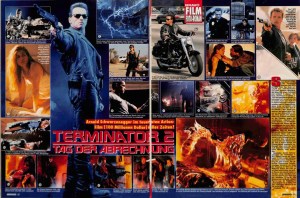
Even upon its release, “Terminator 2: Judgment Day” was perceived as an extraordinary cinematic event. Many critics praised its technical brilliance, spectacular action sequences, and astonishing emotional depth. They particularly highlighted that, despite its enormous budget, the film did not feel soulless. On the contrary: it combined visual spectacle with character development.

Audiences also reacted enthusiastically. The film became a worldwide success and cemented James Cameron’s reputation as a director who could combine technical innovation and popular storytelling exceptionally well. Here, Cameron demonstrated a knack for pacing, suspense, and visual clarity. Every major action scene has its own structure, its own concept, and a clear sense of spatial orientation. This sets “Terminator 2” apart from many later action films, in which editing and sound often seem more important than clarity and dramatic structure.

At the time, the T-1000’s effects were particularly awe-inspiring. The transformations from liquid metal were something many viewers had never seen before. But the fascination at the time wasn’t based solely on novelty. It stemmed from the fact that the effects were used in a way that made narrative sense. The T-1000 isn’t impressive simply because it’s digital. It’s impressive because its digital nature makes it more dangerous, more alien, and more unpredictable.
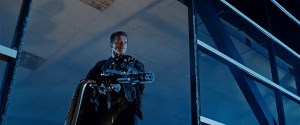
Linda Hamilton’s performance also drew significant attention. Her Sarah Connor was a far cry from the typical portrayal of female supporting characters in action movies. She wasn’t merely decorative; she was a central, complex character. Through her determination, her pain, and her toughness, she became one of the most iconic action heroines in film history.
Of course, there were also voices that viewed the violence or the enormous production scale critically. Yet even many skeptical observers had to acknowledge that “Terminator 2” was made with exceptional mastery. The film was discussed not just as a sequel, but as an event. And that is exactly what it has remained.
Images Endure

The cultural influence of “Terminator 2” can hardly be overestimated. Many of the film’s images, lines, and motifs have long been part of pop culture. The line “Hasta la vista, baby” became world-famous. The T-800’s sunglasses, leather jacket, and motorcycle became symbols of a certain kind of cool action iconography. The T-1000, in turn, became the archetype of the seemingly unstoppable, shape-shifting adversary.

But its influence runs deeper than individual quotes. “Terminator 2” shaped the way Hollywood thought about sequels. It demonstrated that a sequel can be bigger and more spectacular without losing the essence of the original. Many subsequent blockbusters attempted to follow this model: more action, more emotion, a larger world, but still a clear character arc. Few, however, achieved the same balance.

The film was also groundbreaking in the realm of special effects. It helped establish digital effects as a serious tool of narrative cinema. Without films like “Terminator 2,” the development of the modern blockbuster would be hard to imagine. It paved the way for an era in which computer-generated imagery became increasingly important. At the same time, it serves as a reminder that technology alone is not enough. Effects must support a story; otherwise, they remain empty.

The film’s content also leaves a lasting impression. Its themes are surprisingly relevant today: artificial intelligence, military technology, loss of control, the responsibility of scientists, and the question of whether humanity can learn from its mistakes. The famous idea that the future is not set in stone gives the film a humanistic message. Despite all its bleak visions, “Terminator 2” believes in change.
The theme of the chosen family is also particularly powerful. John, Sarah, and the T-800 aren’t an ordinary family, but they develop bonds, trust, and a willingness to make sacrifices. Ironically, a machine becomes a father figure to John. This emotional core explains why the film isn’t just a spectacular action spectacle, but truly moves many viewers.
A Perfect Blockbuster

“Terminator 2: Judgment Day” is one of those rare films where nearly every element comes together. The action is spectacular, but never gratuitous. The effects are revolutionary, but never an end in themselves. The characters are iconic, but not one-dimensional. The story is simple enough to grab you immediately, yet rich enough to linger in your mind long after the credits roll.

With this film, James Cameron created a nearly perfect blockbuster. He understood that great cinema isn’t just about being bigger, louder, and more expensive. It must resonate emotionally. It needs characters you care about, a conflict that matters, and images that stick in your memory. “Terminator 2” has all of that.

What’s particularly impressive is how positive the film ultimately feels, despite its bleak vision of the future. It deals with war, machines, and the threat of annihilation, but hope is at its core. Sarah Connor realizes that even a machine can learn the value of life. If that’s possible, then humans, too, can learn to shape their future differently.

Therein lies the film’s timeless power. “Terminator 2” is not only a landmark of action cinema but also a story about responsibility. It reminds us that technological progress without morality is dangerous, that violence doesn’t have to be the only answer, and that the future doesn’t simply happen—it is created.
That is why “Terminator 2: Judgment Day” remains a masterpiece. It is thrilling, moving, style-defining, and astonishingly modern. Many films age because their effects become outdated or their ideas lose their impact. This film ages differently. With every rewatch, it becomes increasingly clear what it has always been: a great, bold, and emotional classic of popular cinema.
More
Trailer
Notice Regarding Image Rights and Copyrighted Material
All images, film stills, posters, logos, trailer excerpts and other copyrighted materials used in this article are used solely for editorial reporting, film criticism, review and illustrative purposes related to the respective content.
Unless otherwise stated, all copyrights, trademark rights and other intellectual property rights in the materials used remain with their respective rights holders, including film studios, distributors, production companies, photographers, artists or other licensors.
The materials are used in good faith and with regard to applicable legal limitations, licence terms and source attributions. If, despite careful review, any rights have been infringed or any attribution is incomplete, please contact me. Upon review, the relevant content will be removed or corrected promptly.








Kommentar verfassen