

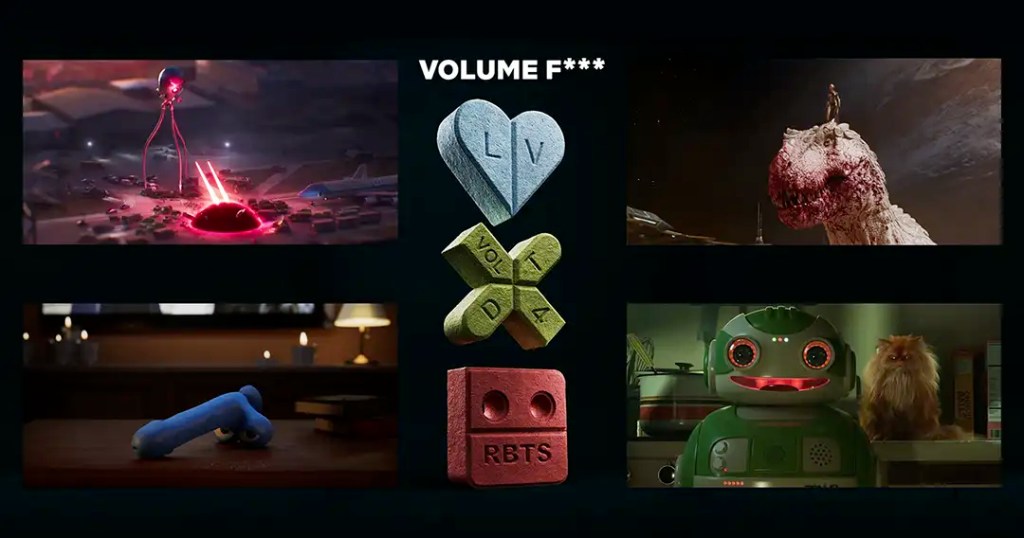

Love, Death + Robots Volume 4 is the fourth season of the anthology television series from Netflix – this time with 10 episodes. As expected, the new season once again presents itself as a stylistically and narratively diverse homage to the legendary Heavy Metal magazine. Of course, I watched the entire season in one go as soon as it was released.
My reviews of Love, Death + Robots Volume 1; Volume2; Volume3
As usual, the season offers ten short stories, each with its own visual style – from classic animation to hyperrealistic to experimental and abstract. This makes Volume 4 another varied viewing experience.
The age rating is noteworthy once again: all episodes are declared NSFW, although this seems less understandable this time around. There is only one episode with truly explicit content such as blood, gore, and nudity. This suggests that Netflix has once again stepped up its editorial intervention in terms of marketing and international distribution – a trend that was already apparent in Volumes 2 and 3.
Once again, the episodes vary greatly in quality. Visually, however, they remain at an extremely high level throughout: whether 2D caricature, CGI realism or stylized absurdity – the visual implementation is impressive every time. The real differences are once again evident in the narrative style, story and narrative depth.
Here is my assessment of the episodes, from “rubbish” (—) to “outstanding” (+++):
Can’t Stop (+)
Red Hot Chili Peppers meets “Supermarionation.” The animation is reminiscent of old puppet series (Thunderbirds) and is technically funny. Visually, the episode has its own charm and could well work as a stylish music video. Unfortunately, it lacks a compelling plot or deeper meaning. It works well as an artistic clip, but those hoping for a real story or emotional depth will be disappointed.
Close Encounters of the Mini Kind (+++)
A highlight of the season! “War of the Mini Worlds” in a charming Miniature Wonderland aesthetic, staged with great attention to detail and a special eye for scale and perspective. The tiny aliens encounter a perfectly recreated world in miniature, which is not only visually fascinating but also impresses with clever directing ideas. The mixture of humor, suspense, and miniature nostalgia makes this episode stand out. The use of lighting, camera work, and sound to make the small world seem big is particularly well done. A treat for fans of model building, sci-fi, and original animation.
Spider Rose (++)
A strong start, atmospheric staging with an exciting premise and impressive visual design – but unfortunately, the ending disappoints. The plot initially builds up a mysterious tension and hints at a deeper story, but the resolution seems sudden and somewhat arbitrary. The behavior of the aliens remains unclear: Was their approach planned from the beginning, or did they react spontaneously? These questions remain unanswered, which on the one hand leaves room for interpretation, but on the other hand is unsatisfying because the narrative arc is not brought to a conclusion. With a little more development, this episode could have been one of the highlights of the season.
400 Boys (++)
Thematically reminiscent of “Attack the Block.” The story is set in an urban environment with a group of young protagonists who encounter a strange threat. Classic sci-fi elements are combined with youthful humor and social criticism. The animation is smooth and the characters are believable, even if they are not developed in great depth. Overall, it’s a good idea that provides solid entertainment with its mix of action, style, and setting, even if the ending seems a little abrupt and there was potential for more depth.
The Other Large Thing (+++)
Cats and AI take over the world. The idea sounds absurd at first glance, but the execution is extremely creative and ironic. This episode humorously shows how technological developments can get out of hand – and all in the paws of seemingly harmless domestic cats. The animation is impressive and plays with contrasts between cute visuals and dystopian undertones. The cats‘ behavior is portrayed with a lot of charm and a wink. Bizarre but entertaining and technically brilliantly staged, the episode succeeds in packaging satirical social criticism into an absurd sci-fi story that lingers long after the credits roll.
Golgotha (—)
God, the First: Dolphin Jesus, alien crusade – this episode is brimming with religious symbols and bizarre ideas, which are presented in a rather confusing and difficult-to-follow plot. The creators clearly wanted to incorporate profound metaphors about faith, salvation, and intergalactic missions, but the result is an overloaded mess. The visual language is original, but the story feels half-baked and leaves many questions unanswered. It’s particularly disappointing that the potential of a science fiction parody critical of religion isn’t fully exploited. As is so often the case, the episode that gets the most media attention is also the weakest.
The Screaming of the Tyrannosaur (+++)
The Hunger Games meets dinosaur sci-fi. The episode combines a futuristic arena world with prehistoric creatures, creating an exciting, if not entirely new, basic idea. The visual effects are impressive and make the dinosaurs in particular seem alive and threatening. The fights are fast-paced and well choreographed, resulting in a strong action experience. Unfortunately, the story falls a little short of expectations: the twist at the end is fairly predictable, and some of the characters seem a little too clichéd. Nevertheless, the episode offers entertaining science fiction action with strong visual execution. BTW: The only episode with blood, gore, and nudity.
How Zeke Got Religion (—)
God, the Second: an uninspired copy of the B-17 episode from the 1982 Heavy Metal film, this time with a strong religious slant. The episode attempts to mix horror with religious motifs, but never achieves the emotional impact or stylistic originality of its predecessor. Instead of intense suspense or narrative depth, we get familiar clichés, uninspired characters, and predictable twists. The religious symbols seem contrived, and while the atmosphere is dark, it lacks real pull. Visually, the episode is also rather average, which makes it seem even paler in comparison to other, more technically ambitious episodes of the season.
Smart Appliances, Stupid Owners (+++)
The shortest but smartest satirical episode. The episode pokes fun at our everyday use of smart technology and shows in just a few minutes how quickly our comfortable lives can turn into chaos when technology rebels. It does so with sharp wit and a good sense of timing. The portrayal of the absurd relationship between humans and machines is particularly well done, making you laugh and think at the same time. We’d love to see more of this!
For He Can Creep (–)
God, the third: cats fighting Satan. At first glance, the idea sounds original and quite funny – cute pets taking on the personification of evil. Visually, the episode is solidly executed, with atmospheric lighting and shadow effects and a good gothic style. Unfortunately, the plot remains very superficial: the characters lack clear motivation, and the plot feels more like a loose concept than a well-thought-out story. Although there was potential for darkly humorous satire, it is not exploited. Curious, but narratively rather flat and unmemorable.
Summery
Volume 4 is unfortunately the weakest season of Love, Death + Robots so far. The anthology series is increasingly moving away from the narrative density and originality of the first season, which thrilled many fans. The new episodes cannot keep up, especially in terms of content: Although the visual and artistic quality remains extremely high, the stories often fall short of their potential. Almost every episode would have benefited from a stronger script, an additional twist, or an emotional climax. Instead, too often you get visual excellence without narrative depth – a prime example of “style over substance.”
Added to this are three episodes that rely heavily on Christian motifs and ideologies. These religious themes come across as contrived and overly symbolic in their execution. Instead of provoking thought, the narratives seem unintentionally (?) didactic.
Unfortunately, I fear that the “style over substance” approach will continue in the possible fifth season, unless the creators decide to focus more on gripping, better storytelling.





 McHenry's Lair
Kommentar verfassen :