

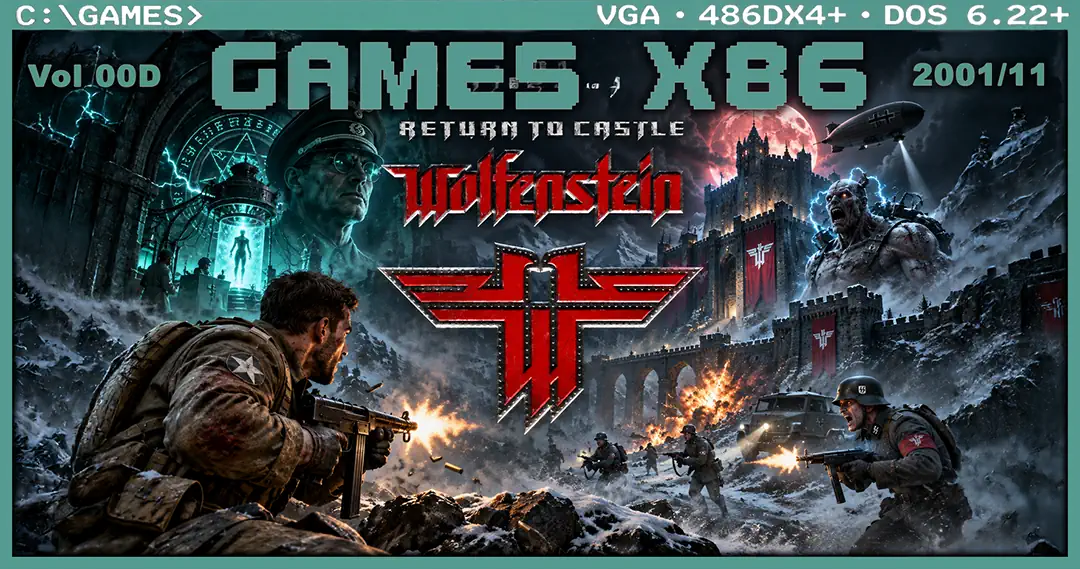
Mission Briefing
Office of Secret Actions, 1943. Close the door, gentlemen. The map stays on the table.
The photograph being passed around shows Castle Wolfenstein. You can make out the cable-car station below the walls. The white marks on the print are snow. That leaves the question of what the Germans are digging for underneath it. Our people have identified personnel attached to an SS paranormal unit. Somebody in Berlin has seen fit to give these people a budget, a garrison and permission to excavate. Until yesterday, that was the most disturbing item in the file.
Two of our agents are now prisoners there. One is an American, B.J. Blazkowicz. If he gets out, he is to find a resistance contact named Kessler and establish what has been taken out of the ground. Headquarters would appreciate photographs. In view of the circumstances, we shall settle for a reliable description. 🔗
One last matter. The intelligence summary on your desk uses the word dead in two different senses. Read the surrounding sentence carefully. That will be all.
Operation Resurrection
Released for Windows in November 2001, Return to Castle Wolfenstein gets considerable mileage out of the distance between an intelligence officer’s desk and a dungeon floor. At headquarters, the war proceeds through folders, maps and men taking turns to speak. Downstairs, Agent One has died under interrogation, B.J. has an opportunity to escape, and the player would quite like to know what is on the other side of that door. It is an economical beginning for a story that will eventually require a thousand years of backstory and a trip to Norway. 🔗
The first good twist comes after the escape. Kessler points B.J. toward a village excavation, where Helga von Bülow’s SS detachment has disturbed the catacombs. By the time you get underground, German soldiers are fighting for their lives against the things they came to find. For a moment you can stand at the edge of a room and watch the plot carry on without you. Helga’s certainty that the next relic will be the one she can control makes her an ideal pulp villain. You can guess the broad outline of her fate the instant a frightened expert advises her to leave something alone. 🔗
Then the scenery changes. Wilhelm “Deathshead” Strasse conducts his experiments under electric light, grafting machinery onto human bodies in pursuit of an army of supersoldiers. Following him takes B.J. through the ruined city of Kugelstadt and into the Norwegian X-Labs. The two investigations converge in Operation Resurrection, a scheme to raise the game’s fictionalized Saxon king Heinrich I. By then the castle has acquired a second meaning. You spent the opening hour desperate to get beyond its walls. Having seen what the Nazis are preparing elsewhere, you understand why somebody has to go back. 🔗
Field Operations
The most revealing button in Return to Castle Wolfenstein is the one that makes B.J. kick. Try it on a piece of furniture. There is something wonderfully impatient about a secret agent who can interrupt his inspection of the premises by putting a boot through the woodwork. The levels reward that curiosity with concealed rooms and treasure, then end with a tally of what you overlooked. Few things can undo the satisfaction of a clean getaway quite like learning that somewhere in a building you searched thoroughly, somebody managed to hide an entire room. 🔗
Gunfights have a similarly physical rhythm. A German soldier ducks behind cover and stays there. You wait for him to show his head. He waits for you to come looking. Occasionally he kicks your grenade back, an unusually concise expression of enemy intelligence. The undead change the timing. A corpse advancing down a narrow passage can make you surrender ground you spent the previous minute securing. Later, the electrically charged Lopers cross a room with such alarming speed that the generous floor space in the laboratories starts to look like an accommodation somebody made for them. 🔗
The forest infiltration is a more divisive pleasure. B.J. must slip aboard a supply truck, and an alarm can end the attempt. Suddenly a sentry walking away from you deserves more attention than an enemy shooting straight at you. There is real suspense in letting him go about his business. There is considerably less in repeating the stretch you already understand because somebody farther along saw you at the wrong instant. This is a fine place to discover how often your left hand remembers the quicksave key. 🔗
Online, an entirely different skill becomes valuable. On the Beach map, the Allies need to recover documents from a bunker and transmit them. Soldiers provide heavy firepower, engineers open the way, lieutenants distribute ammunition, and medics get fallen teammates back on their feet. Imagine reaching the documents, going down, and seeing a medic round the corner with seconds left. That stranger now matters to you more than anyone at Allied headquarters did in seven missions. In Stopwatch mode, the teams change sides and race the time set in the first round. Everybody gets to discover exactly how irritating their own defense was. 🔗
Technical Intelligence
Underneath the masonry sits id Software’s Quake III Arena technology, now known as id Tech 3. Its original showcase was a competitive arena shooter. One of the pleasures of Wolfenstein is seeing what that technology could do with a place where people ostensibly worked. A guardroom has papers to read. A cable car has somewhere to go. Through a window, the mountains give you a sense of the drop beyond the castle wall. Coming indoors again, you can almost feel the relief of finding a room with a stove. 🔗
Fire remains the showpiece. The flamethrower sends a rolling plume along a corridor, briefly occupying enough of the screen to obscure whatever persuaded you to use it. Character animation does quieter work. A soldier breaking for shelter communicates a decision you can read from halfway across a courtyard. Close-ups during conversations are less kind to the models. Give an officer a speech and there is ample time to study the stiffness in his face. Give him a doorway to dash through and the illusion holds. 🔗
Some of the smartest engineering barely announces itself. In multiplayer, calling for medical help puts information on the medic’s compass. Reinforcements arrive in waves, which gives strangers a natural opportunity to leave spawn together. Both features address a mundane problem familiar to anybody who has joined an online match halfway through. You may have missed the briefing, and nobody knows your name, but somebody nearby needs help and the game can show you where to go. 🔗
Barracks Curiosities
If two old friends remember different opening missions, both may be right. The original PC campaign deposits B.J. in captivity. The later Xbox and PlayStation 2 editions added an Egyptian prologue covering the investigation that led to his capture. The distinction makes for two rather different introductions to the same man. Console players had an adventure with Agent One. On PC, you arrive in time to discover what happened to him. The blank space in the PC version does a surprising amount of dramatic work. 🔗
Another clue to the game’s split personality is sitting in the credits. Gray Matter created the solo campaign, Nerve Software built multiplayer, and id oversaw both. The separation was substantial enough that the teams could pursue different ideas about what a return to Wolfenstein ought to feel like. One studio sent a near-silent American into a crypt with all the equipment he could carry. The other built a beach where that same lone-wolf attitude could leave an entire team standing outside a wall, waiting for somebody who had thought to choose engineer. 🔗
Contemporary Dispatches
What did a buyer get for the money in 2001? Reading Erik Wolpaw’s November review for GameSpot, you might struggle to guess the score from the opening paragraphs. He found the headquarters scenes tedious, the characters forgettable and the impact of gunfire oddly muted. Then he got to multiplayer. The distinct jobs, readable team information and stable online experience impressed him enough to justify buying the whole package. His final score was 9.2 out of 10. It sounds extravagant until you realize where he expected readers to spend their evenings. 🔗
Other reviewers found more to admire on the solo assignment. Li C. Kuo at PC Gamer singled out the fine texture work and animation, including the fire effects. Richard Shoemaker at PC Zone appreciated the breathing space the stealth sections introduced, while finding fault with the campaign’s pacing. The difference is easy to understand in the forest. A player happy to watch a patrol complete its circuit gets a few minutes of unusually concentrated suspense. A player keen to see the rocket base has just been asked to wait for a man to finish his walk. 🔗
Lasting Influence
The clearest line from Return to Castle Wolfenstein into gaming culture runs through a community-made map. Splash Damage built Operation Marketgarden, then contributed three maps to the Game of the Year edition. The studio went on to develop Wolfenstein: Enemy Territory, released in 2003 as a free standalone multiplayer game. Someone who had never bought Return could now learn the peculiar satisfaction of spending an evening as the person who kept everybody else supplied. A set of ideas once tucked into the multiplayer menu had acquired its own front door. 🔗
Sometimes the inheritance was literal. Splash Damage writer Ed Stern recalled that Enemy Territory’s Fuel Dump grew out of a single-player Return level. Landscape built around the progress of one hero became ground that two teams could argue over repeatedly. In 2010, id released the source code for both games under the GPL. For players who had begun by wondering how a favorite map worked, it became possible to look underneath the map itself. That journey from playing to making is as much a part of Wolfenstein’s history as any of B.J.’s subsequent adventures. 🔗
Mission Debriefing
Office of Secret Actions. Final assessment. The officer taking minutes may resume.
Blazkowicz has returned. His account of the excavation agrees with the surviving evidence. Please amend the intelligence summary accordingly. The cable-car installation was exactly where our photographs placed it. Our estimate of the age and condition of the personnel beneath the castle will require a more substantial correction.
For the record, the operation had its delays. Headquarters talked too long. One journey through the woods took rather more attempts than the official report will show. Nevertheless, the agent’s account contains details worth preserving. A sentry who declined to come out from behind a crate. The instant an excavation crew realized which side of a sealed door it occupied. A light in a castle window, seen from a cable car already moving away. Those details will outlast several of the names in this folder.
One commendation remains. During the beach exercise, an unnamed medic crossed the bunker floor and brought the document carrier back to his feet. The transmission went through. The results sheet records the team’s time. It has no column for the moment the carrier saw the medic coming. If anyone asks why people kept returning to Castle Wolfenstein, see that this detail makes it into the report.
Dismissed.







Schreibe einen Kommentar