

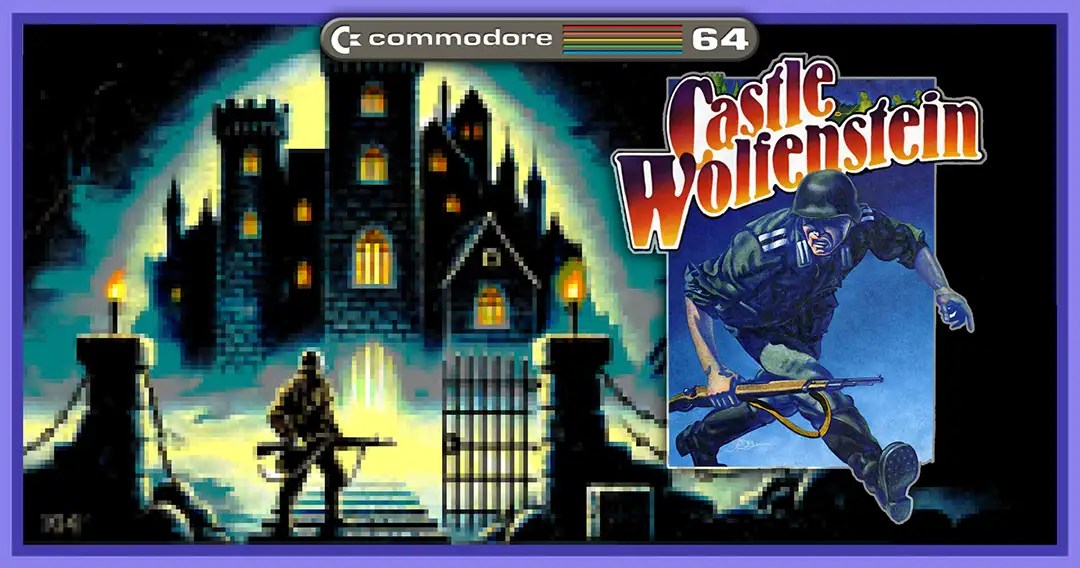
Your Mission:
Find the war plans and escape from
Castle Wolfenstein – ALIVE!
The classic that laid the foundation
In the early days of home computers, around 1983, people often met in stores to swap the latest games or play together. When playing in a group, our enthusiasm could get the better of us. So it sometimes happened that someone would shout across the store: “„Achtung! Der SS-Mann!“ (Watch out! The SS man!) It’s understandable that customers and employees in the store didn’t always appreciate this behavior.
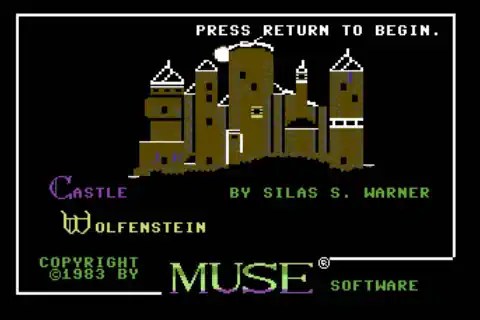
This warning was part of Castle Wolfenstein, a title that set new standards both technically and in terms of gameplay, boldly departing from classic arcade formulas. Developed by Silas Warner, one of the early pioneers of game design, and published by Muse Software, it was one of the first games to not only be based on a real historical scenario – World War II – but also to combine profound narrative and gameplay elements. Instead of relying on frantic action, it offered a thoughtful, suspenseful experience where planning, caution, and timing meant the difference between life and death. The fact that it incorporated early stealth game mechanics—including avoiding enemies, searching for uniforms, and gathering specific information—makes Castle Wolfenstein a pioneer of the stealth genre. Especially on the Commodore 64, one of the most popular home computers of its time, the title achieved cult status and quickly became a topic of conversation among tech and gaming fans alike.
Gameplay
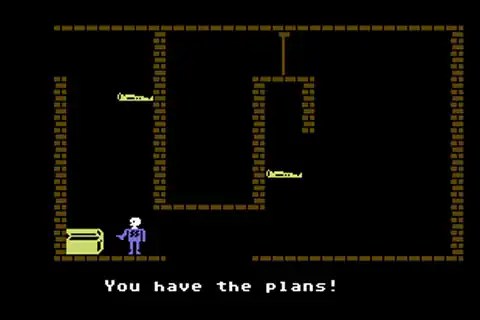
Castle Wolfenstein puts the player in the role of an Allied prisoner who finds himself in the middle of a heavily guarded Nazi fortress. The main task is to escape from the gloomy castle, which is secured by armed guards and numerous checkpoints. The player must not only save their own skin, but ideally also steal secret war documents that are of great importance to the Allied forces. The mission is dangerous, and careless actions can quickly spell the end. Camouflage, patience, and good timing are essential to achieve the goal.
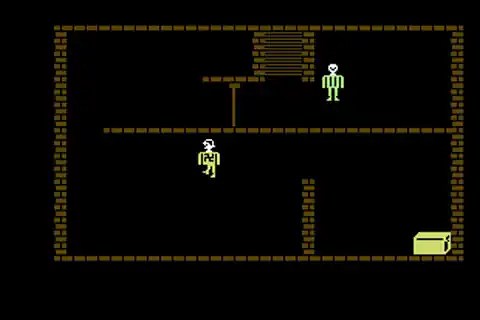
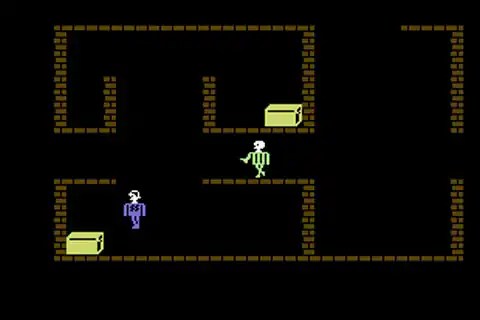
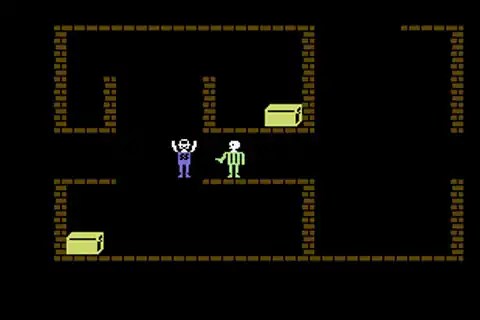
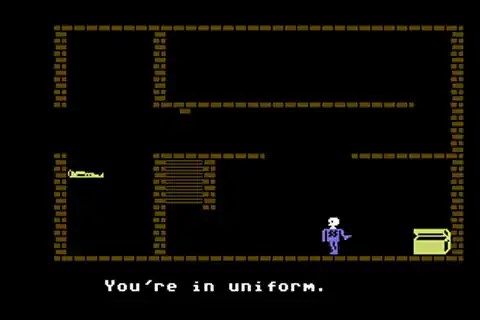
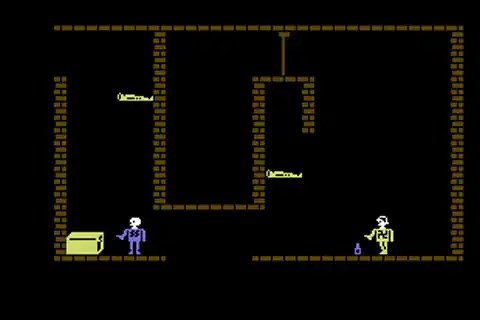
The game was presented from a top-down perspective, which was a popular form of presentation at the time for clearly displaying complex areas. It consisted of a multitude of rooms that were randomly generated each time the game was played – a feature that significantly increased its replay value. Players could sneak around, hide in dark corners, ambush enemies, or even deceive them with stolen uniforms. It was also possible to bribe guards or intimidate them with a drawn weapon. However, weapons and ammunition were extremely scarce, which shifted the focus from pure combat to a tactical approach. Those who fired wildly risked triggering alarms and being quickly overwhelmed.
One particularly noteworthy aspect was the voice acting: the Nazi soldiers shouted “Halt!” or “Achtung!” in German, which was extremely immersive for the time – especially since voice acting in games was still a rarity at the time and was completely absent in most titles. These short audio snippets created an oppressive atmosphere and gave the game a level of realism that far exceeded the standard at the time. Overall, the gameplay offered a dense mix of suspense, strategy, and innovation that was far ahead of its time.
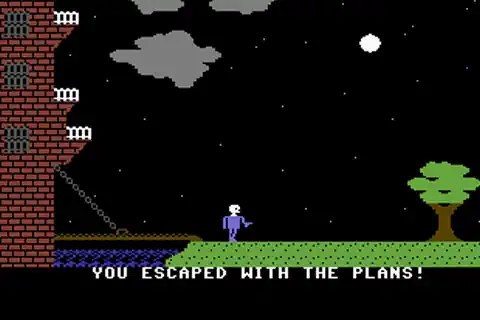
Technology
For its time, Castle Wolfenstein was remarkably ambitious on a technical level and clearly stood out from the competition. The Commodore 64 version impressed with a number of innovations that were rarely seen in this form. The voice output was particularly striking: although it was crude and technically limited, it was an absolute highlight on the C64. The guards‘ brief German exclamations not only lent the game authenticity, but also created an oppressive atmosphere that was unique in an era of mostly silent games.
Procedural generation was also a groundbreaking feature: each time the game was restarted, the structure of the castle was randomly rearranged. This meant that no two playthroughs were alike, which significantly increased the replay value and conveyed a feeling of genuine unpredictability. This was complemented by an integrated save function—a rarity at the time—which allowed players to interrupt longer gaming sessions or retry difficult passages. This was a great advantage, especially in a game with a high frustration potential.
The graphics were simple but functional: the rooms and characters were drawn in a functional manner, with a clear focus on clarity and playability. Despite the simple visual presentation, the game managed to create a dense and believable game world through clever design.
Finally, the artificial intelligence of the enemies deserves special mention. They reacted not only to the direct appearance of the player, but also to noises, shots, or open doors. They could raise the alarm, search for the player, and comb the area—an exceptionally complex behavior for a game from 1981. This early form of reactive AI contributed significantly to the tension and tactical depth and was a true precursor to modern enemy behavior in today’s stealth games.
Trivial
The developer, Silas Warner, was not actually a typical game developer, but a trained physicist with a deep passion for computer technology and language processing. His unusual academic career and technical interests enabled him to bring innovative ideas to the young world of computer games, which at that time was still heavily oriented towards simple game principles.
One of these innovations was the integration of voice output – Castle Wolfenstein was one of the first games ever to feature real German voice samples. The Nazi guards shouted “Halt!” or “Achtung!” in a frighteningly authentic tone, which was a technological breakthrough at the time. These acoustic elements not only reinforced the game’s dark atmosphere, but were also an early precursor to the immersive sound that is now an integral part of modern games.
The game was originally developed for the Apple II, one of the more powerful platforms of the era. It was later ported to the Commodore 64 and other home computers, with each version having its own technical characteristics. Thanks to its superior sound and graphics capabilities, the C64 was predestined to make the game accessible to a wider audience.
Despite – or perhaps because of – its Nazi theme, Castle Wolfenstein was met with reluctance in Germany. Due to its sensitive historical connotations and the symbolism it depicted, the game was difficult to obtain in this country for a time, but this did not completely prevent its distribution. In fact, this exclusivity even contributed to the game’s mystical aura and made it all the more interesting for collectors and fans.
Criticism at the time
Upon its release, Castle Wolfenstein received much praise from the trade press. Particular mention was made of the innovative game mechanics, which differed greatly from the arcade titles that dominated at the time, as well as the dense and suspenseful atmosphere, which was significantly influenced by the unusual use of voice acting and the oppressive setting of a Nazi prison. The tactical depth of the game was also praised – a novelty at a time when many titles still relied purely on reaction speed and high scores. The targeted avoidance of guards, the sensible use of scarce resources, and the ability to make decisions based on the situation were recognized as milestones in game design. Added to this was the technical sophistication with which the game was realized: procedural level structure, AI reactions to sounds, and non-linear gameplay were considered innovative and ahead of their time.
At the same time, however, the game was not without controversy. Its dark theme—in particular, the depiction of Nazi symbolism and the explicit killing of enemies—drew criticism from conservative circles. Some media outlets accused the game of glorifying violence or trivializing historical content. Despite, or perhaps because of, these discussions, the game attracted a great deal of attention and thus contributed significantly to the debate about the responsibility of video games in terms of content.
Reputation today
Today, Castle Wolfenstein is considered one of the forefathers of the stealth genre. Many modern games – from Metal Gear Solid to Thief to Hitman – draw on mechanics that Castle Wolfenstein introduced for the first time, such as silently taking out enemies, hiding in shadows, or using disguises. The game thus laid the foundation for an entire genre that developed into an integral part of the video game world in the following decades.
The title still enjoys cult status within the retro community today. This is evident in numerous forum posts, YouTube retrospectives, and rankings of classic games. Platforms such as Lemon64, Retro Gamer, and Archive.org regularly feature the game in their top lists or dedicate entire dossiers to it. Retro fans also share their memories on social media and discuss speedruns, technical details, and modifications. In addition, Castle Wolfenstein can still be played on emulators and modern mini consoles such as the C64 Mini or TheC64, ensuring its accessibility for new generations of players. This enduring relevance underscores the game’s profound impact to this day – not only as a historical document, but as an active source of inspiration.
Legacy
The greatest legacy of Castle Wolfenstein is arguably its direct influence on the later development of action and shooter games. The best-known successor is undoubtedly Wolfenstein 3D (1992) from id Software – a milestone in the history of video games and one of the first true first-person shooters. While the original still relied heavily on stealth mechanics and suspense, Wolfenstein 3D shifted the focus significantly to fast-paced action, direct confrontations, and more aggressive gameplay. The labyrinthine levels, striking design, and iconic enemies helped establish a new subgenre that was later developed further by titles such as DOOM, Quake, and Duke Nukem 3D.
This gave rise to a long-running series that continues to spawn new offshoots to this day, including modern interpretations such as Wolfenstein: The New Order, The New Colossus, and Youngblood, which combine the original theme with contemporary gameplay, political satire, and cinematic staging. These reboots owe their success not least to the strong foundation laid by the original.
Without Castle Wolfenstein, not only would there be no Wolfenstein 3D, but many other developments in the genre might have taken a different course or occurred much later. Even the legendary DOOM, which was based on the Wolfenstein 3D engine and revolutionized the shooter genre once and for all, is directly linked to Silas Warner’s pioneering work. This makes Castle Wolfenstein not only a game with its own merits, but also a crucial link in the evolution of modern gaming.
Conclusion
Castle Wolfenstein is more than just an old C64 game. It is a milestone in video game history, creating an astonishingly deep and atmospheric gaming experience with limited technical means. The game eclipsed its contemporaries with its innovative mechanics and proved that computer games could be more than just simple high score chases. It combined excitement, skill, and strategy in a way that hardly any game had dared to do before.
Its influence on later genres—especially stealth and shooter games—cannot be overestimated. The basic mechanics of hiding, listening, and advancing step by step laid the foundation for countless games that were later developed with significantly larger budgets and technical resources. Many modern game design principles, such as non-linear freedom of choice, AI reactions to player behavior, emergent gameplay, and the targeted use of resources, have their early roots here and show just how visionary Castle Wolfenstein really was.
Anyone seriously interested in the history of gaming cannot ignore this title. It is not only a relic of the early home computer scene, but a piece of interactive cultural history that demonstrated the courage to innovate and inspired the creativity of entire generations of developers. It is a game that not only evokes memories, but also sets standards that are still recognized today – a milestone that paved the way for many modern classics.







Kommentar verfassen