


You’re our best man.
This is Operation Counterstrike and you’re in charge.
Find Quake, and stop him… or it..
You have full authority to requisition anything you need.
If theeggheads are right, all our lives are expendable.
A Dark Leap Forward
When Quake was released in the summer of 1996, the game was immediately more than just the next big first-person shooter from id Software. It was a turning point. Following Wolfenstein 3D and Doom, Quake felt like the moment the genre reached a new level: more spatially believable, more technically ambitious, darker in tone, and more uncompromising in its impact. The game took the raw speed and directness of its predecessors and transported them into a world that no longer just looked like an illusion of three-dimensionality, but—for the first time—actually felt three-dimensional.
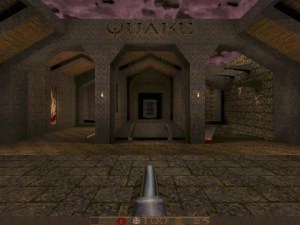
That was precisely where its historical significance lay. Quake wasn’t simply “more Doom with better graphics.” It transformed the genre’s sense of space. Suddenly, it was no longer just about horizontal mazes and sprite-based enemies, but about architecture with real depth, about enemies and projectiles in a fully realized 3D space, and about game physics that allowed for new forms of movement. Today, this seems obvious, but in 1996, it was a small revolution.
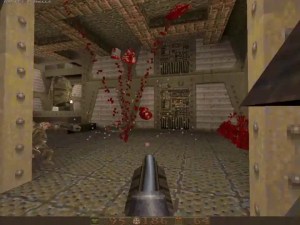
Added to this was an atmosphere that differed significantly from the pop-culture-influenced harshness of Doom. Quake was colder, more alien, harder to grasp. Instead of a clear-cut science-fiction hell, a mix of medieval vaults, Lovecraftian elements, industrial settings, cursed dimensions, and grotesque creatures dominated. As a result, the game felt less like an action movie and more like a nightmare made of metal, stone, and the clang of machinery.
Quake also marked a turning point in multiplayer gaming. Deathmatch wasn’t new, but here it took on a new precision, a new pace, and a new level of intensity. Many ideas that later became standard in competitive shooters found their archetypal form in Quake. That’s why the game remains not only a classic but also a foundational work of modern shooter culture.
Labyrinths, Weapons, Portals
At its core, Quake is a fast-paced, uncompromising first-person action game. The player controls a nameless fighter through four episodes, each consisting of a series of dark levels. The game begins in a sort of hub with portals, each leading to a different thematic world. There is no elaborately told storyline in the modern sense. The story is more of a rough framework: An enemy force threatens reality, and the player ventures through portals into alien dimensions to combat this threat at its source.
It is precisely this narrative economy that is typical of the era. Quake tells its story not through cutscenes or dialogue, but almost entirely through rhythm, environment, and atmosphere. The story is felt rather than explained. You move through castles, dungeons, slaughterhouses, lava fortresses, and metallic complexes, encountering deformed soldiers, hellhounds, ogres, knight-like creatures, or floating monsters—and all the while, you constantly sense that this world is not logical, but hostile. It is not meant to be understood, but to be survived.
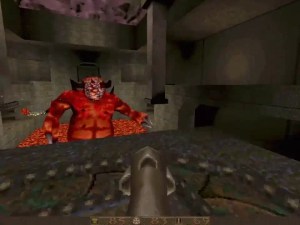
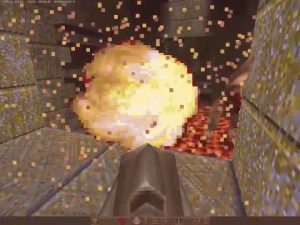
The gameplay is based on a simple yet extremely effective loop: explore, find keys, survive traps, fight enemies, manage resources, and reach the exit to the next level. The weapon arsenal is iconic and clearly tiered. From the axe for emergencies to shotguns and nail guns, all the way to the grenade launcher and the infamous rocket launcher, the arsenal covers a wide range of distances and situations. The weapons feel massive. Shots pack a punch, explosions control the space, and every fight demands constant movement.
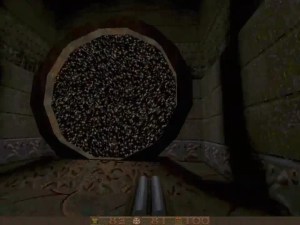
What’s particularly important is that Quake makes its enemies seem more aggressive and dynamic than in many earlier shooters. Enemies don’t just charge head-on; they use their mobility to ambush the player from unexpected angles or put pressure on them with patterns of projectiles. Because the environment is truly three-dimensional, players must pay closer attention to elevation changes, jumps, and vertical threats. This fundamentally changes the feel of combat.
Add to that the speed. Quake isn’t a cautious tactical shooter, but a game of constant kinetic tension. If you stand still, you lose. If you read the rooms, maintain your pace, and master weapon switching intuitively, you’ll experience a flow that still feels astonishingly modern today. It was precisely this pace that later made the game so significant in multiplayer as well.
Real Time, Lighting, Dimensions
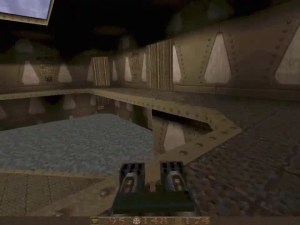
Technically, Quake was a game-changer for 1996. While Doom still simulated a 3D world using clever tricks, Quake relied on polygonal environments—and thus on a space that was actually rendered as a 3D structure. That sounds obvious today, but back then it was an enormous achievement. Spaces could now be shaped differently, nested on top of one another, and designed much more convincingly in vertical dimensions. Stairs, bridges, shafts, and chasms no longer looked like well-disguised tricks, but like real architecture.
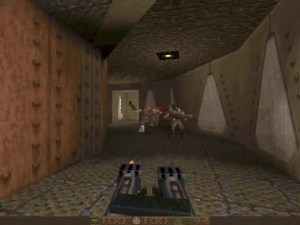
Equally important was the lighting. Quake used pre-rendered lighting effects that gave the levels depth and materiality. Shaded areas, flickering brightness, and the gradations of dark corridors lent the game an oppressive sense of depth and texture. Especially in combination with the angular, rough textures, this created a look that was technically limited but aesthetically extremely striking. Many modern retro shooters still try to emulate precisely this impression of grime, stone, metal, and darkness.
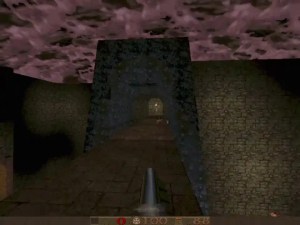
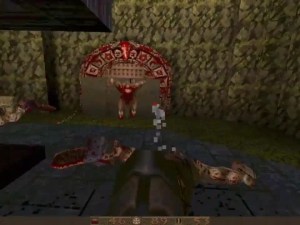
The enemies, too, were now polygonal models rather than sprites that only looked convincing from certain angles. This allowed them to move more freely within the environment and appear more believable, even if they seem rough and angular by today’s standards. By the standards of the time, however, this sense of physicality was impressive. The same was true for projectiles, explosions, and general movement within the environment.
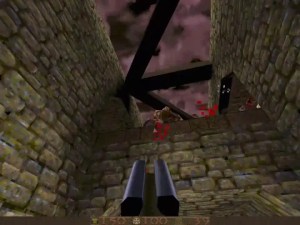
Another important element was the game’s technical openness. Quake quickly became the foundation for mods, custom maps, total conversions, and technical experiments. The game’s architecture—and later, the release of its source code—made it a product that didn’t end with its launch but continued to live on within the community. It was, therefore, not just a game but also a platform.
Graphically, Quake thus marks an exciting transitional phase: still raw, still visibly from the early days of polygonal 3D graphics, but already with a clear vision of spatiality, materials, and atmosphere. Its beauty lies not in detailed realism, but in its consistency. Quake doesn’t look pretty in the traditional sense. It looks determined.
Bizarre Behind-the-Scenes Stories
Over the years, numerous details have accumulated around Quake that contribute to the game’s mythos. Particularly well-known is the involvement of Trent Reznor and Nine Inch Nails in the sound design and music. The soundtrack doesn’t rely on catchy melodies, but rather on industrial drones, dark pads, and a soundscape that’s almost physically palpable. This greatly enhances the game’s otherworldly feel. Anyone who hears Quake usually immediately recalls this mixture of coldness, reverb, and latent mechanical life.
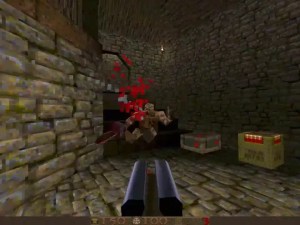
In this context, the Nine Inch Nails logo on the Nailgun’s ammo crates has become almost legendary. It’s one of those small details that are actually incidental yet have left a deep mark on the game’s pop culture history. They show just how much Quake stood at the intersection of gaming, technology, and alternative music culture.
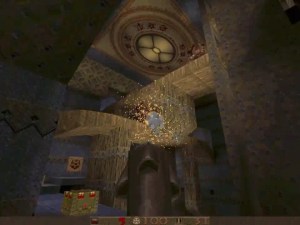
Equally famous was “rocket jumping”—the technique of using the explosion of one’s own rocket launcher to catapult oneself to hard-to-reach spots or to travel at high speed across the map. Such movement styles emerged in part from the game’s system itself but quickly became an integral part of gaming culture. In hardly any other game was it so clear how a mechanical quirk could become an art form.
Added to this is the game’s reputation for being mod-friendly. Mapmakers, programmers, and fans turned Quake into far more than just the original game from the very beginning. New episodes, multiplayer modes, graphical experiments, and total conversions kept it alive for years. The fact that a game from 1996 still has an active community today is no coincidence, but rather a testament to its exceptionally open structure.
From Corridor to Depth
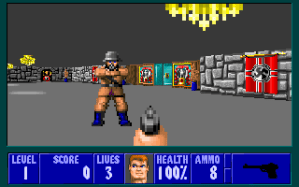
To truly understand Quake, it’s worth looking at the evolutionary line from Wolfenstein 3D through Doom to Quake. These three games not only represent three major id Software successes but also, in almost their purest form, the evolution of the early first-person shooter.
Wolfenstein 3D from 1992 was the explosion of the basic idea. The player ran quickly through right-angled corridors, shot enemies, and searched for exits. The game was basic, direct, and sensationally fast, but technically very limited. There were no rooms of varying heights, hardly any vertical complexity, and an architecture consisting almost entirely of right-angled corridors. Its strength lay in its immediacy.
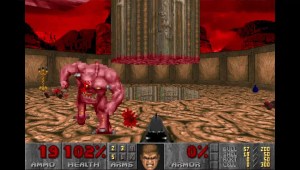
Doom, released in 1993, was then the decisive expansion. The levels became significantly more sophisticated, the rooms more complex, the lighting more dramatic, the enemies more aggressive, and the atmosphere more intense. Although the engine didn’t yet offer true 3D, Doom felt much more spatial and flexible than Wolfenstein 3D. Furthermore, the game combined technological sophistication with perfect pacing. Many would say that Doom was the moment when the first-person shooter found its classic form.
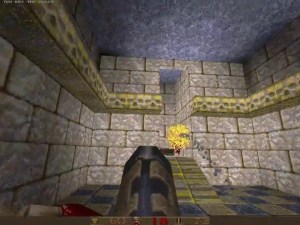
Quake finally took the step that Doom had only hinted at: it turned the illusion into reality. The rooms were now truly three-dimensional, the combat became more vertical, the enemies more physical, and movement freer. At the same time, the tone also changed. Where Wolfenstein 3D felt pulpy and Doom felt comically brutal, Quake was more abstract, colder, and almost eerily serious. It was less of an arcade shooting gallery and more of a grim combat machine.
One could therefore say: Wolfenstein 3D defined the basic form, Doom perfected the rhythm, and Quake opened the door to the modern 3D future. Without this development, the subsequent path to arena shooters, 3D engines, LAN culture, and online FPS games would have been virtually inconceivable in this form.
Successors and Side Paths
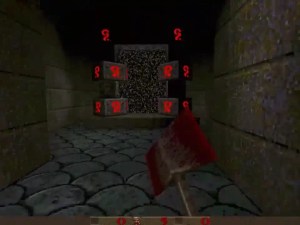
The success of Quake quickly led to further games under the same name, but the series did not evolve in a linear fashion. Even Quake II from 1997 was less of a direct narrative sequel and more of a standalone game that carried on the name but felt distinctly different in style and setting. The medieval-Lovecraftian scenario of the first installment gave way to a more military-style science fiction aesthetic.
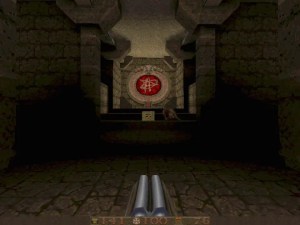
With Quake III Arena, the focus shifted even more clearly: away from a classic single-player campaign and toward pure multiplayer competition. This finally established Quake as an esports brand, whose name stood for precision, speed, and technical dominance. Quake 4 later attempted to reunite the campaign and the series’ identity, while Enemy Territory: Quake Wars and Quake Champions each set different priorities.
That is precisely why the first installment remains a special case. It is the origin of a series, but at the same time a work with a very distinct atmosphere that was never exactly replicated by its direct successors. When people think of Quake, they often don’t mean the entire series, but specifically this first, dark, alien, and technically groundbreaking game from 1996.
Enthusiasm and Reservations
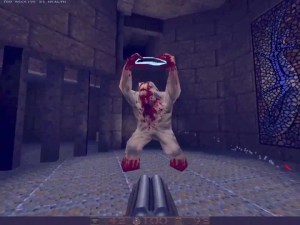
The contemporary reception of Quake was overwhelmingly enthusiastic. Many critics saw the game as setting a new standard for first-person shooters: faster, more atmospheric, and technically more advanced than almost anything else on the market in 1996. Particular praise was given to the fluid action, the new sense of space, the power of the weapons, the multiplayer mode, and the uncompromising intensity.
At the same time, however, there were also points of criticism that remain interesting from today’s perspective. Some reviewers and players found the single-player structure monotonous over time. While the levels were impressive, not everyone appreciated the often gray-brown, somber visuals and the rather loosely told campaign. Compared to Doom, Quake seemed less colorful in places, less varied, and more focused on atmosphere than on variety.
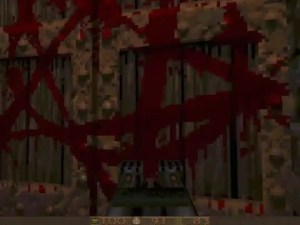
The story was also perceived as thin even back then. While this wasn’t an unusual problem for the genre, it stood out in Quake because the game built such a strong atmosphere that some would have liked more narrative context. In addition, the technology placed high demands on the hardware of the time. Not everyone could experience the game with the same quality or fluidity. What looked like the future to some was, at first, primarily expensive to others.
Nevertheless, this did little to change the overall assessment. Even skeptical voices generally acknowledged that Quake was a technological and gameplay milestone. The question was less whether it was important, and more whether one preferred its grim austerity to the more direct charm of Doom.
From Game to Culture
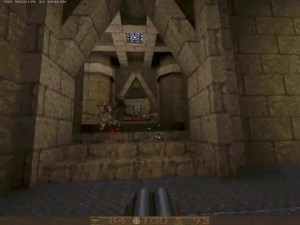
The cultural influence of Quake extends far beyond its original release year. The game shaped not only shooter design but also gaming communities, online culture, and digital creativity. LAN parties, clan structures, and competitive one-on-one play gained new visibility and professionalism thanks to Quake. For many PC gamers, it became a social hub, not just a single-player experience.
Added to this was its role in the modding and mapping scene. Quake was one of those games through which a generation of hobbyist developers learned how games could be built, modified, and expanded. Those who designed maps, wrote scripts, or tested mods were not only working on fan projects but often on an early form of digital craftsmanship. Numerous later developer biographies trace their beginnings to precisely such communities.
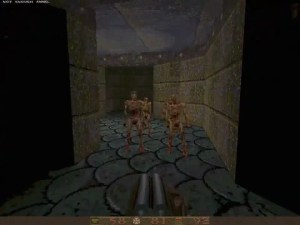
The topic of machinima is also closely linked to Quake. The ability to record gameplay scenes and place them in new contexts made the title an early tool for cinematic experiments within the game engine space. In this sense, Quake was not merely a game, but a medium that was creatively repurposed by its community.
Added to this is its aesthetic legacy. The dark blend of industrial, gothic, horror, and abstract strangeness continues to resonate to this day. Modern “boomer shooters,” retro FPS games, and numerous indie titles directly or indirectly draw on the style of Quake: the blocky architecture, the brutal weapons, the jagged movement, and the sensation of racing through a hostile dreamscape.
Even its continued existence in the form of Source ports, fan-made episodes, and community projects shows that Quake is far more than a nostalgic museum piece. It remains playable, malleable, and culturally relevant. That is precisely what distinguishes a mere classic from a living monument.
A Monument to the PC
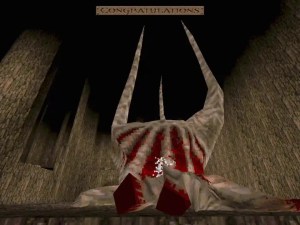
Quake is important today not because it was the most beautiful or, in every respect, the most perfect game of its time. It is important because it made a developmental leap visible. It combined technical boldness with clear design, a dark atmosphere, and an openness that kept the game relevant far beyond its original lifespan.
Its single-player campaign isn’t flawless, its plot is minimal, and its visuals are archaic by today’s standards. Yet all of that is overshadowed by its historical significance. Quake demonstrated how the first-person shooter could evolve from a cleverly simulated spatial illusion into true 3D space. It created a new language for speed, verticality, multiplayer duels, and community creativity.
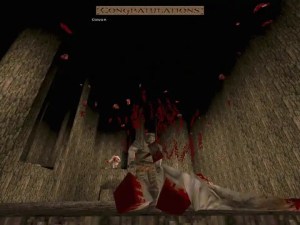
Above all, however, it still possesses something that many technically more advanced games fail to achieve: an unmistakable aura. When you play Quake, you’re not entering a neutral amusement park, but a cold, aggressive, alien world with its own acoustic and visual identity. That is precisely why it remains fascinating to this day.
You can view Quake as a technical monument, an early building block of esports, an incubator for modding culture, or a dark work of art from the ’90s. It’s probably a little bit of everything. One thing is certain: without Quake, the history of the PC shooter would look very different.








Kommentar verfassen