

A Hero’s Toll
One of the best encounters in Dragonstomper is with a man who would prefer to see some identification. He guards the bridge into town. Produce the right papers and you can cross. Otherwise, passage costs 600 gold pieces, and the hero sent to save the kingdom begins the game with only 400. It is a fine indignity to inflict on a legendary dragon hunter. It also gives the countryside an immediate purpose. Somewhere beyond those woods lies a monster of extraordinary power, but for the moment you would be glad to find your wallet a little heavier or your paperwork in order.
Released by Starpath in 1982, Dragonstomper was Stephen Landrum’s attempt to bring fantasy role-playing to the Atari 2600. Its premise has something of the bridge guard’s dry humor. A druid makes an amulet powerful enough to subdue a dragon, carries it into the creature’s cave, and promptly falls into a trap. The amulet lands in the dragon’s claw. Soon crops are failing and travelers are disappearing into quicksand, all because somebody took a valuable piece of equipment into a dungeon he was poorly prepared to enter. The player who reads the manual has already received the game’s most important piece of advice.
Three-Part Quest
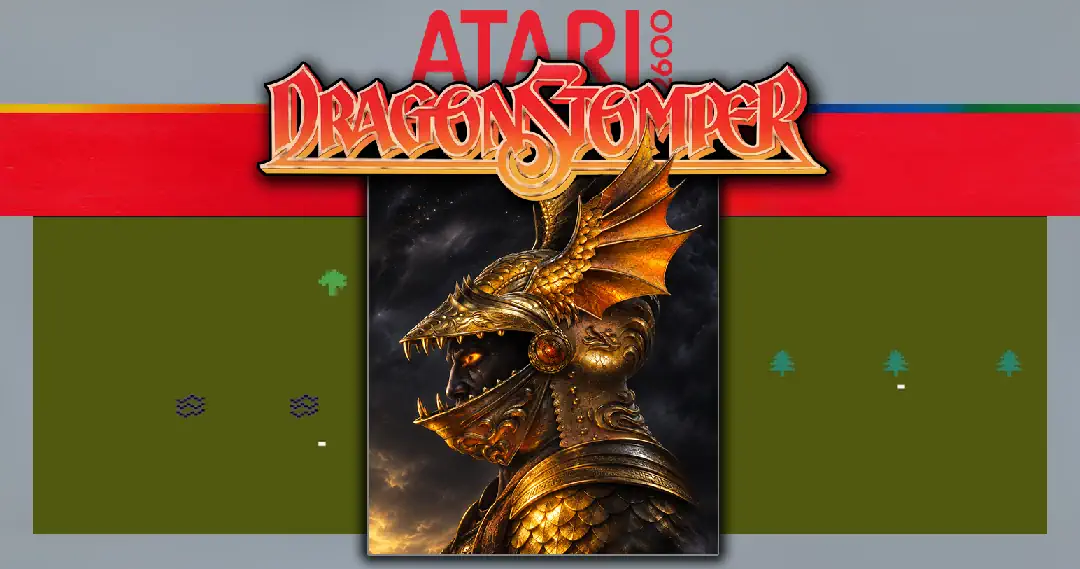
Out in the countryside, your hero is a small mark near the center of a scrolling landscape. You steer among buildings and patches of woodland until a few words at the bottom of the screen change the situation. A creature has found you. The joystick directions now correspond to commands, allowing you to fight, use something you carry, check your status, or try to move on. The distinction matters because strength doubles as a measure of how much punishment you can survive. A fight can leave you richer and considerably closer to death, an awkward combination when you still have a toll to pay.
Across the bridge, the pace slackens. The village has a trade shop, a magic shop, and a hospital, each making a plausible claim on what remains of your fortune. Goods collected on the road can be bartered, and local warriors can be persuaded to accompany you. This is where the bridge guard’s fee acquires its full significance. Finding identification back in the countryside leaves you with 600 gold pieces to spend precisely when money offers the widest range of possibilities. A scrap of paper can turn out to be the best piece of equipment you found all afternoon.
The cave changes the demands on your hands as well as on your supplies. Its passages scroll vertically, and the traps require you to pay attention to where you step. Once through the gate, you cannot return to town to correct an oversight. At the end, however, the game grants an unexpected freedom. You can slay the dragon or steal the amulet and break its hold over the creature. The second solution rewards anyone who remembers how the trouble began. The druid put that object within the dragon’s reach. Getting it away again is a perfectly good way to finish the job.
Starpath’s Cassette
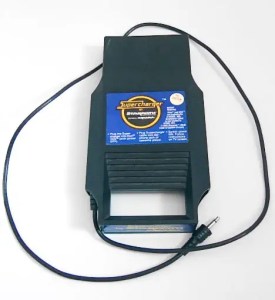
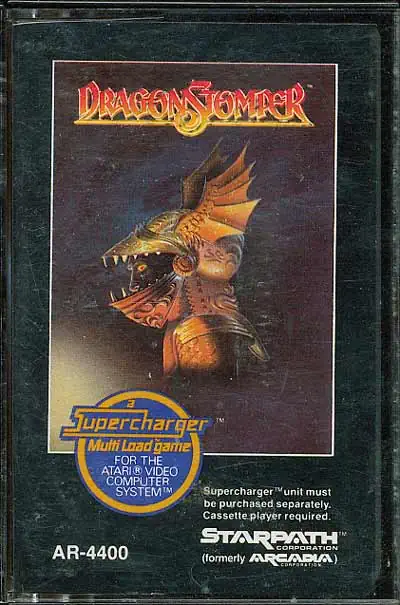
On the original hardware, crossing from one chapter to the next meant reaching for a cassette player. Starpath’s Supercharger was a long cartridge that plugged into the Atari, with a cable running from it to the player’s earphone jack. The attachment supplied six kilobytes of writable memory to a console with just 128 bytes of built-in RAM. Pressing Play sent an audio signal down the cable, which the Supercharger interpreted as program data. A household tape recorder, ordinarily employed to play music or capture someone’s voice, could now deliver an entire village to the television.
Landrum divided the adventure into three separately loaded sections. When the hero reached town, the machine could give over memory used for the countryside to the shops and their wares. At the cave entrance, it could exchange those routines for traps and a dragon. The joins fall at precisely the moments when a traveler might naturally pause, which makes the structure feel considered even when the apparatus demands attention. The screen instructed players when to stop the tape. Let it run past the start of the next section and the remedy involved rewinding, pressing Play again, and waiting while the Supercharger found its place.
Hidden Signatures
An early title for the game was Excalibur, and a surviving July 1982 prototype bears the name EXCALIBUR39. It suggests a rather different adventure, one in which a famous sword might settle the question of what to do with a dragon. The eventual title sounds more like an occupation, perhaps even one with a going rate and travel expenses. That suits a hero who spends a fair portion of the quest bargaining for supplies. Landrum also tucked his initials into the finished game. Issue the command to use a shield while an axe is pictured on the screen, and “SHL” appears at the bottom of the command box.
The cassette itself concealed a thoughtful detail. Both sides contained the game, but Starpath recorded them at different speeds. Side A loaded faster, while the slower recording on Side B gave a temperamental cassette player a better chance of reading the signal. A player dealing with a worn or slightly misaligned tape head could therefore fix a loading problem by turning the cassette over. The manual offered that suggestion alongside advice to check the batteries and move the recorder farther from the television. Even a properly equipped Dragonstomper occasionally had to attend to matters outside the kingdom.
Contemporary Verdicts
Writing in Video Games in November 1983, Dan Persons identified a risk that a list of features would have missed. He had expected the joystick menus to get him killed. With several actions assigned to different directions, a player under pressure might easily give the wrong command. In practice, he found the arrangement flexible and surprisingly close to the convenience of a keyboard. His enthusiasm had limits. He considered the graphics and sound ordinary, although one of the cave’s sudden traps made him jump in his seat. It is a wonderfully specific judgment on the presentation. An unremarkable picture could still give its reviewer a fright.
Britain’s TV Gamer approached the game through a different question. What sort of software actually justified buying a Supercharger? Its autumn 1983 review singled out Dragonstomper as the sort of project Starpath ought to pursue, reporting that the adventure players who tried it appreciated both the challenge and the humor. The Electronic Games 1983 Software Encyclopedia was more generous than Persons about the audiovisual work and awarded the game nine out of ten overall. Across those judgments, the most telling compliment was the attention reviewers paid to activities as unglamorous as reading a menu. Getting that part right made a long and complicated journey possible.
Cultural Afterlife
Landrum later recalled that he spent about seven months making Dragonstomper. Atari’s Adventure was already familiar to him, but he saw room on the machine for the kind of fantasy role-playing he wanted to play. The distinction comes into focus in the village. For a stretch, the television shows a person considering purchases, weighing the value of medicine, and looking for company on a dangerous trip. At a tabletop, such preparations could fill an evening and furnish half the stories afterward. In a 1983 review, Videogaming Illustrated explicitly recognized something of the spirit of Dungeons & Dragons in Landrum’s game.
Its most tangible legacy came through players who wanted others to experience it on an Atari. In the 1990s, enthusiasts brought Supercharger software to audio CD in a collection called Stella Gets a New Brain. The accompanying booklet assigned separate track numbers to the countryside, village, and cave. Connect a CD player to the Supercharger and a later generation of audio equipment could perform the old cassette recorder’s job. The collection also helped preserve the Excalibur prototype, giving players access to an earlier stage of the design. An eccentric choice of format in 1982 had given the game an unusually practical route into the future.
Final Reckoning
There are stretches of countryside where another encounter feels like an inconvenience, particularly when you have already decided what you want from town. Yet that impatience is part of what makes the village feel like a destination. By the time you reach the shops, you have plans for the money. By the time you reach the dragon, you have a history with the objects you brought along and some grounds for regretting the ones you left behind. Landrum gives the player room to develop intentions of that ordinary, absorbing kind. The ending supplies the neatest touch of all. After three cassette loads spent earning the name Dragonstomper, you can look the dragon in the eye, take the amulet, and let the beast live.
More
Box and Cartridge / Cassette







Schreibe einen Kommentar