


Beneath the Surface
Five divers aboard. Oxygen almost gone. One more rescue would make the trip worthwhile, but a shark is crossing your escape route. Somewhere above, safety is waiting—or at least you hope it is. This is the appeal of Seaquest: an apparently simple shooting game that keeps turning confidence into hesitation.
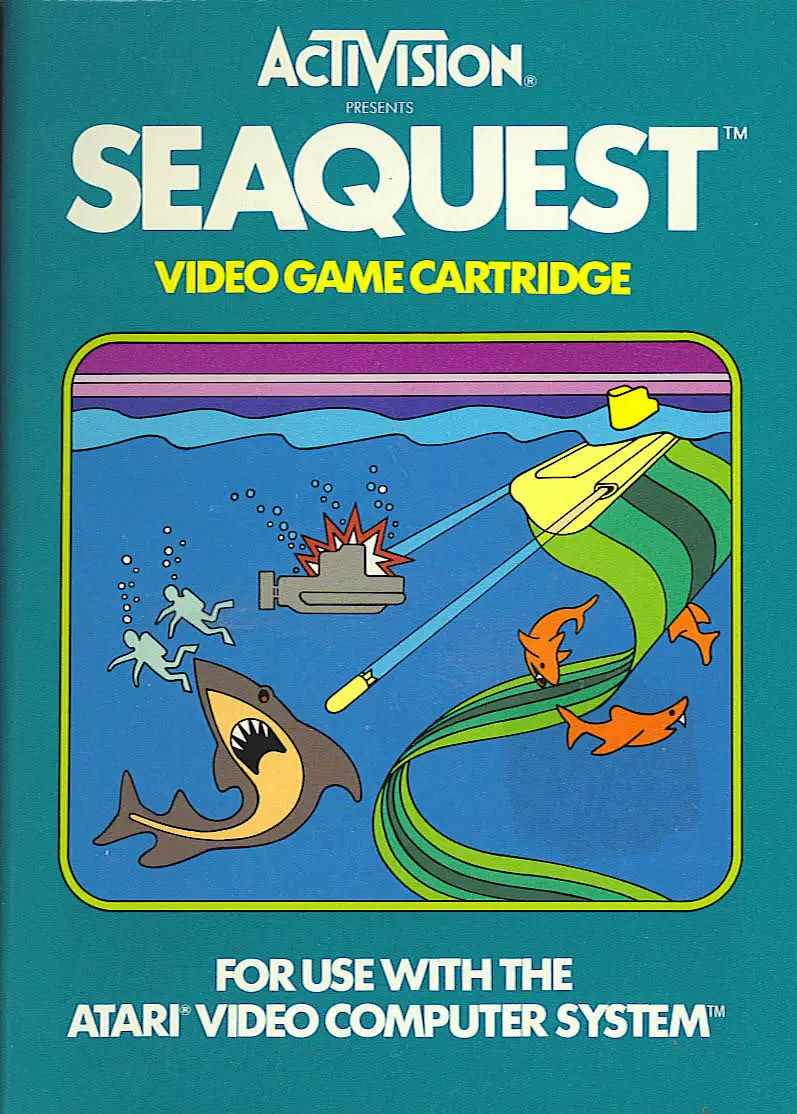
Designed by Steve Cartwright and published by Activision for the Atari 2600 in 1983, Seaquest puts you in command of a submarine rescuing divers from hostile waters. Its premise offers an immediately understandable mixture of danger and responsibility. You have a weapon, but protecting yourself is only part of the job.
The underwater setting gives that job a distinctive character. Moving sideways to intercept a target feels different when every second also brings you closer to suffocation. The upper edge of the screen becomes a destination you must keep in mind, even while concentrating on everything below it.
That tension makes Seaquest an excellent subject for a closer look. Its appeal depends on how a handful of rules interact, creating decisions that feel larger than the small screen containing them.
Rescue Under Pressure
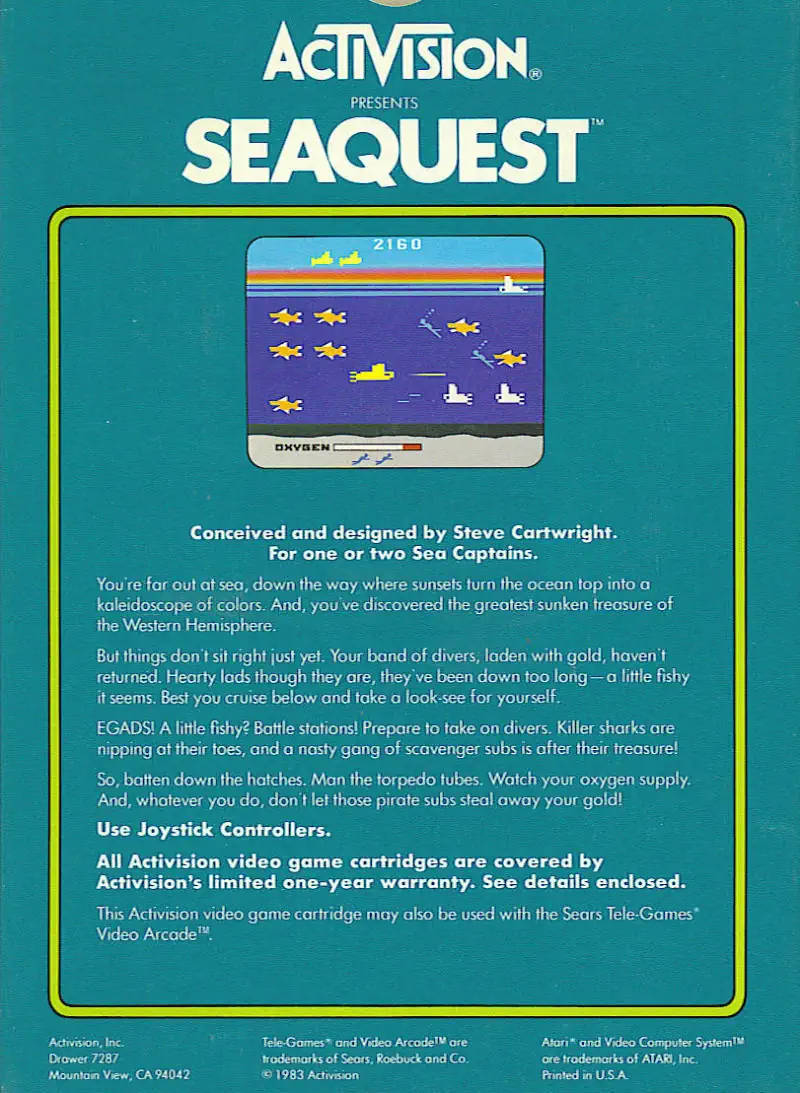
You steer the submarine through the water, fire torpedoes at sharks and enemy submarines, and collect divers by touching them. Oxygen steadily decreases while submerged. Your submarine carries up to six divers; surfacing with fewer costs you one passenger. Successful full-load rescues reward you with points, including a bonus linked to your remaining oxygen.
The resulting rhythm is easy to understand: descend, collect, evade, return. Mastering it requires judgment. An enemy directly ahead invites you to keep firing, while a diver elsewhere demands a change of direction. Oxygen turns every detour into an expense.
Imagine having five passengers and spotting the sixth near the bottom. Going after that diver promises a satisfying completion, but the journey down also lengthens the journey back. The decision depends on your position, the approaching hazards, and how accurately you judge the remaining time. Greed becomes something you express through movement.
The surface adds another complication. Returning without any divers destroys your submarine. Later, an enemy patrol submarine threatens the surface itself; while refilling oxygen, you cannot simply move out of its way. Choosing where to emerge therefore matters as much as deciding when.
This is where Seaquest becomes more interesting than its shooting initially suggests. Good play means arranging an escape before you need it. A narrow survival can feel like a triumph, yet it can also expose a mistake made several seconds earlier. The best runs come from combining accurate movement with the willingness to abandon a tempting opportunity.
Technical Ingenuity
The Atari 2600 demanded an unusual kind of craftsmanship. Its TIA chip generated graphics from information supplied as the television picture was being drawn. Programmers had to coordinate their work with the display’s scanlines, rather than simply hand over a finished image. The hardware provided a playfield and five basic movable objects: two players, two missiles, and a ball. Those labels describe hardware resources, not a strict limit on the characters a clever program could depict.
That context helps explain why visual organization matters so much in a game like Seaquest. A busy underwater encounter must remain understandable at a glance. Players need to recognize what they can collect, what they must avoid, and where their own submarine is facing. Detail is useful only when it supports those distinctions.
The game’s presentation works through economical suggestions. Small swimming figures and an open expanse of water establish the scene without elaborate scenery. The space between objects becomes part of the visual design: it is where you read possible routes and anticipate collisions.
Sound also has a practical role. The manual specifies an audible oxygen warning and a signal when the sixth diver is collected. These cues deliver information while your eyes are occupied with navigation.
Viewed this way, the technical achievement is closely tied to usability. Seaquest needs to communicate several kinds of urgency through limited visual and audio resources. Its compact presentation supports a surprisingly demanding act of divided attention.
Hidden Treasures
One delightful detail sits outside the cartridge. Activision offered membership in its “Sub Club” to players who reached 50,000 points. To claim the emblem, you sent the company a photograph of your television screen, together with your name and address. The manual also identifies Cartwright as the designer of Barnstorming and MegaMania, and includes his personal playing advice.
The photograph requirement gives the achievement a wonderfully physical quality. A good performance had to survive the journey from television to camera to postal envelope. Recognition arrived later, as something you could hold. It is easy to understand why such rewards could turn a private score into a personal milestone.
Another revealing connection concerns the game’s design. In a later interview, Cartwright described Seaquest as a reworking of Defender. That comparison provides a useful way to think about its combination of combat and rescue.
The change of setting does meaningful work. Beneath the sea, the need to return for air makes intuitive sense, giving the rescue mission a recurring deadline. The lesson is appealingly straightforward: moving an idea into a different environment can create new decisions when the rules take that environment seriously.
Contemporary Reactions
Contemporary opinion was mixed. As documented in the historical reception summary, Jim Clark of Video and Computer Gaming Illustrated praised the underwater atmosphere, whereas fellow reviewer E. C. Meade considered the game too slow and insufficiently challenging. Electronic Fun with Computers & Games admired the graphics but questioned the difficulty once players understood the game. TeleMatch found the imagery somewhat abstract.
These disagreements are more revealing than a simple verdict of “classic” would be. Atmosphere and pacing are closely connected here. A player who enjoys planning a dive may appreciate the moments between emergencies. Someone looking for constant, escalating gunfire may experience those same moments as a loss of momentum.
The criticism also raises a fair question about longevity. How much variation can one rescue routine sustain? Learning to read the screen more efficiently offers satisfaction, but it does not necessarily provide the sense of discovery that every player wants. Refinement and surprise are different pleasures.
Looking back, it is worth preserving that distinction. Later affection does not erase the reservations of people encountering the cartridge as a new purchase. Seaquest can be admired for the precision of its central idea while still leaving room for players who find that idea too repetitive. Its historical reception reminds us that even an elegant design depends on an audience willing to enjoy its particular rhythm.
Cultural Afterlife
Seaquest is especially interesting as an example of how a small game can remain useful beyond its original entertainment setting. It is included in the Arcade Learning Environment, where Atari games serve as environments for studying artificial agents. The project’s documentation specifies the game’s available actions, observations, and scoring.
The connection is fitting. Consider everything a player must coordinate: immediate threats, valuable passengers, limited oxygen, and the route to safety. Shooting effectively solves only one part of the problem. A successful strategy must balance activities whose benefits arrive at different times.
That does not mean Seaquest was designed as a scientific experiment. Its later use illustrates how a clear set of game rules can provide a rich problem. The same competing demands that make a human hesitate over one more diver also make the game interesting to analyze.
Its cultural value can therefore be understood without inflating its influence. We do not need to claim that every later underwater adventure descends from it. The cartridge preserves a particular approach to play: a compact arena, readable dangers, and a score that encourages increasingly disciplined decisions.
For a modern reader, that is a useful reminder of what older games can offer. Their small scale makes the relationship between rules and experience unusually visible. You can study the design while feeling its pressure.
Final Ascent
Seaquest earns its appeal through the relationship between rescue, danger, and time. Each element changes the meaning of the others. A diver becomes more tempting when the submarine is almost full; an ordinary obstacle becomes terrifying when oxygen is nearly exhausted.
Its limitations remain easy to identify. The setting offers little room for exploration, and repeated dives ask you to become better at a familiar task. Players who need frequent new scenery or narrative developments may lose interest before that process becomes rewarding.
But for those who enjoy improving a route, judging a risk, and recovering from a bad decision, the design has plenty to offer. Its strongest moments require very little explanation: you know where safety is, you know what you stand to gain, and you know you might have waited too long.
That final ascent captures the game beautifully. The submarine is small, the destination is close, and the remaining distance suddenly feels enormous.
More
Box and Cartridge









Kommentar verfassen