

Escape from Atlantis
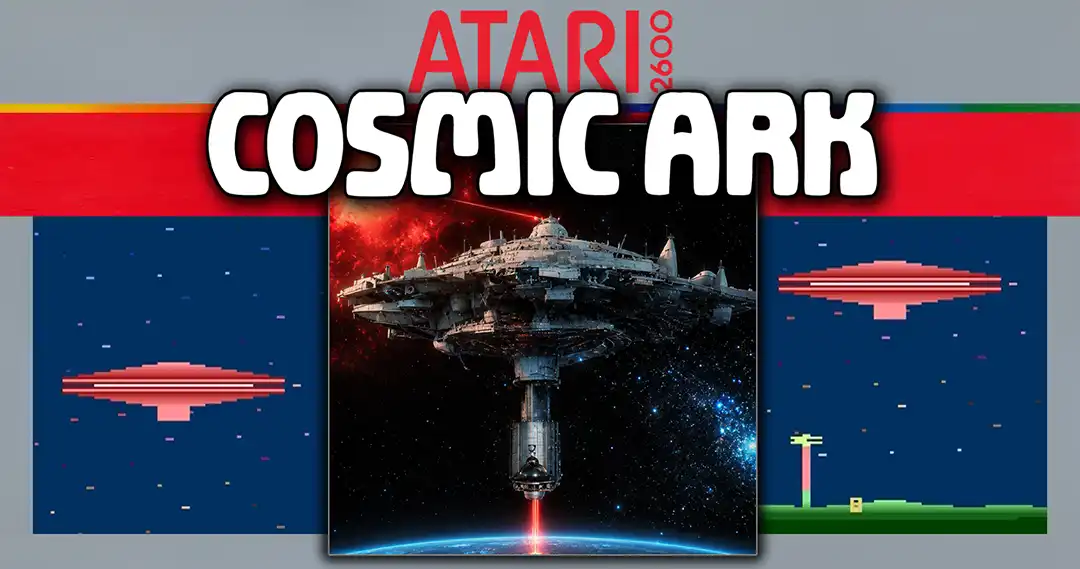
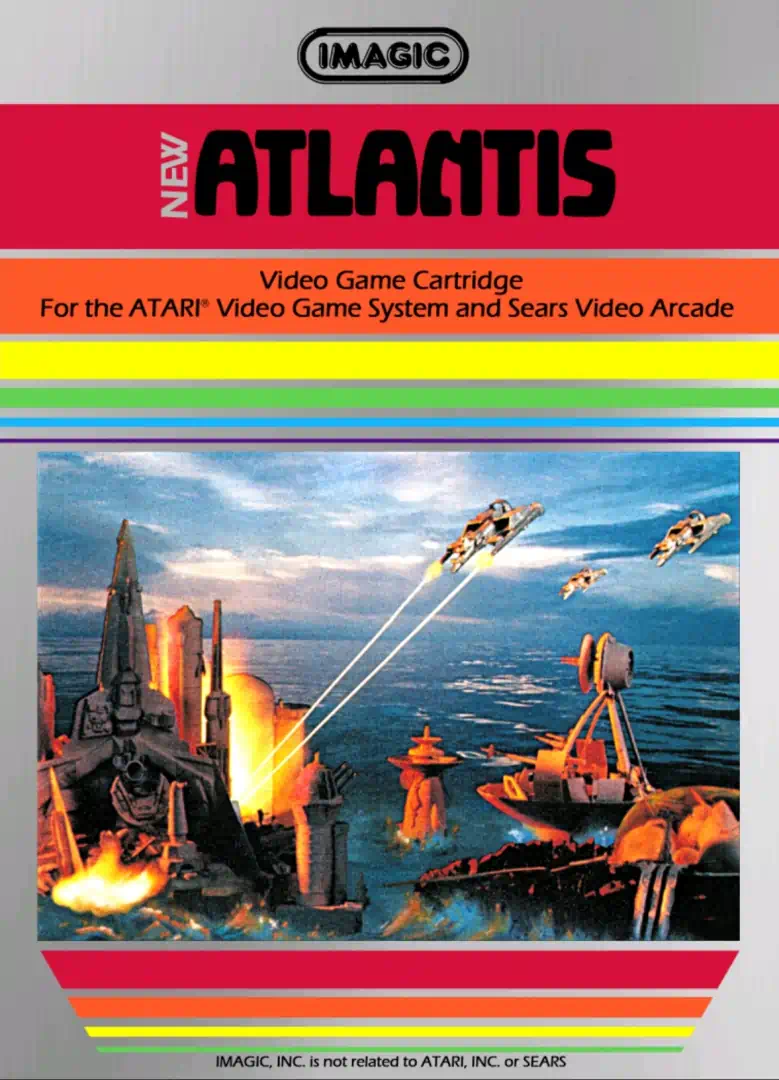
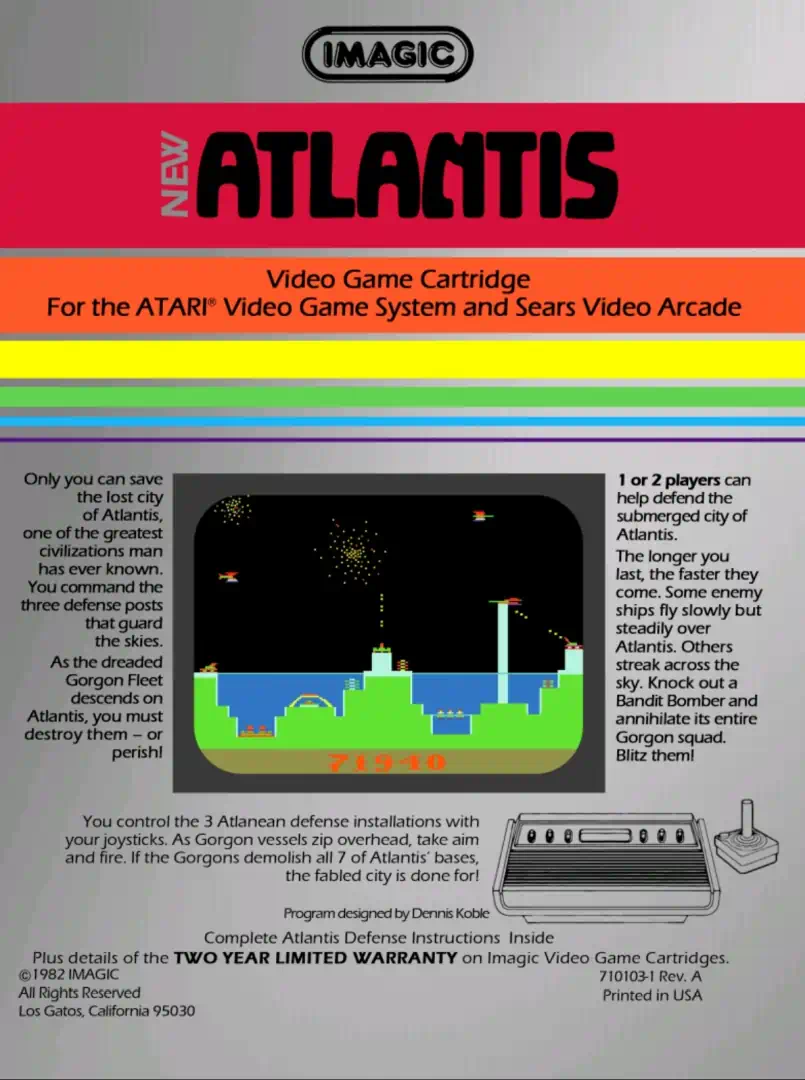
At the end of “Atlantis,” there was no real victory. No matter how long the player defended the legendary city against a never-ending stream of attackers, its destruction eventually became inevitable. But Imagic left behind a small detail that turned the apparent ending into a beginning: A spaceship escaped the doomed city and vanished into space. That’s exactly where “Cosmic Ark” picks up. The survivors of Atlantis have lost their home, but their journey is far from over. Aboard the eponymous Cosmic Ark, they now embark on a mission that is far greater than the defense of a single city.
The sun of the Alpha-Ro system is nearing the end of its life. As soon as it goes out—or becomes a nova—the life forms on the surrounding planets will be doomed. The crew of the Cosmic Ark is therefore attempting to save as many of these exotic creatures as possible. The defensive battle of “Atlantis” turns into an interstellar evacuation mission—a sort of futuristic Noah’s Ark.
This connection was remarkable for a 1982 console game. Instead of simply releasing a similar game under a new name, Imagic revisited a narrative element from its predecessor. “Cosmic Ark” is therefore often regarded as the spiritual or narrative successor to “Atlantis.” Even the instruction manual explicitly refers to the “Atlantean crew,” the crew originating from Atlantis. This created a small shared science-fiction world between two otherwise very different action games.
Two Game Phases
In terms of gameplay, “Cosmic Ark” consists of two constantly alternating sections. Initially, the ark is in open space and gets caught in a meteor shower. The large spaceship remains nearly stationary in the center of the screen. Meteors hurtle in from above, below, left, and right and must be shot down. The controls are unusual: the joystick’s fire button isn’t needed at all during this phase. Instead, you move the stick in the direction you want to fire. Afterward, you must return it to the center position before the next shot is possible. This is clearly reminiscent of Midway’s 1980 arcade game “Space Zap.”
Once the Cosmic Ark has survived the barrage, it reaches a planet. Now the rescue phase—which is structured completely differently—begins. A small shuttle detaches from the mothership and flies down to the surface. There, strange creatures roam about, two of which must be captured using a tractor beam. At the same time, automatic defense systems fire at the shuttle. A hit costs energy and can release creatures that have already been captured.
A warning signal adds extra pressure. As soon as meteor activity threatens again, the shuttle should return to the Ark as quickly as possible. Anyone who stays on the surface too long risks the next attack. After that, the cycle starts over: fend off meteors, reach a planet, rescue creatures, and continue flying.
The energy system is particularly clever. There are no traditional “lives.” Instead, the Ark starts with 40 units of fuel. Each shot you fire costs energy; destroyed meteorites restore some of it, and rescued creatures provide a larger bonus. Rescuing two creatures in time can even fully replenish your supply. This penalizes blind, continuous firing. Precision is important not only for scoring points but also for survival itself.
Hardware Tricks
“Cosmic Ark” was released in 1982 for a console whose technical limitations were already considerable even back then. The Atari 2600 had only 128 bytes of RAM, and the version of “Cosmic Ark” had to make do with a program module just 4 KB in size. Nevertheless, with its various game phases, creatures, defensive structures, meteors, and graphical effects, the game gives the impression of a much larger program.
The starry sky, in particular, became famous. In the background of the space section, numerous small points of light twinkle, creating the impression that the ark is floating through an astonishingly vivid universe. This effect was not originally intended as a standard feature of the hardware at all.
During the development of “Demon Attack,” programmer Rob Fulop discovered an unusual behavior in the Atari graphics chip. By manipulating the player/missile registers in a specific way, he created a seemingly random star pattern. Fulop was so impressed by the effect that he made a note of how to reproduce it. For “Cosmic Ark,” he turned it into a graphical trademark. He later explained that two different clocking processes within the hardware work against each other, thereby generating the characteristic pattern.
According to Fulop’s recollections, this experiment initially resulted in a variation of “Space Zap,” a game he admired. A simple cannon became the large spaceship in the center. But Fulop found this version too monotonous. So, over the course of several months, he developed the second section featuring a shuttle, planets, and creatures. In this way, a technical demonstration became a full-fledged game. This is precisely what characterizes the best Atari 2600 programs: hardware limitations were not only accepted but occasionally even deliberately exploited.
Curious Details
A number of interesting peculiarities have accumulated around “Cosmic Ark.” For instance, there are different versions of the cartridge. In one variant, the star field can be turned off using the Atari 2600’s Color/B&W switch, while in another, this switch does not work. Even Fulop expressed surprise in a later interview that different versions existed.
The multiplayer mode is also unusual. Instead of two players simply taking turns performing the same task, responsibilities can be divided: one player defends the Cosmic Ark during meteor showers, while the other pilots the shuttle during rescue sequences. For a game of this generation, this is a charming form of cooperation.
Then there are the creatures themselves. According to Fulop, Imagic even organized a contest to come up with names for the various beings. This fits a game that, despite its very simple pixel graphics, deliberately presents its extraterrestrial inhabitants as little characters.
And then there’s the ending. Just like “Atlantis,” “Cosmic Ark” also denies a definitive triumph. Eventually, the great ark is destroyed. But once again, a smaller ship escapes into the depths of space. This would have provided the perfect transition to a third installment. However, it was never realized. The brief escape sequence therefore remains, to this day, an open ending to the unofficial “Atlantis” saga.
Voices from Back Then
When “Cosmic Ark” was released in 1982, the market for Atari 2600 games was already highly competitive. Imagic had to hold its own not only against Atari itself, but above all against Activision and a growing number of other manufacturers. Nevertheless, the contemporary response to the game was overwhelmingly positive.
The American magazine “Video Games” particularly highlighted the game’s originality in December 1982. The editorial staff found the unusual central theme particularly noteworthy. While most action games focused on destroying enemies, the actual goal of “Cosmic Ark” was to save living beings from the destruction of their planets. Although the magazine did not consider the game quite on par with “Atlantis,” it acknowledged that it could very well stand on its own.
“Cosmic Ark” also garnered attention in Europe. The German magazine “TeleMatch” rated “Cosmic Ark” a 2 on its rating scale in early 1983—higher than the Atari 2600 versions of “Atlantis” and “Demon Attack,” which each received a 3. The French magazine “Tilt” awarded it four out of six points in March 1983. “Electronic Fun with Computers & Games” also gave it a solid rating of three out of four points.
Richard A. Edwards also reviewed the game in issue 59 of “The Space Gamer.” His assessment highlighted one of the game’s key appeals: what initially seems relatively straightforward becomes significantly more challenging at higher levels. It was precisely this combination of a simple core concept and steadily increasing pressure that was one of the great strengths of many early Atari games.
An Early Sense of a Series
The cultural influence of “Cosmic Ark” should not be confused with that of “Space Invaders,” “Pac-Man,” or “Pitfall!” The game did not spark a new mass phenomenon nor did it become a symbol of an entire console generation. Nevertheless, it occupies a remarkable place in the early history of video games.
Above all, its connection to “Atlantis” was ahead of its time. “Cosmic Ark” is even occasionally cited as one of the earliest examples of a narratively connected console sequel. Whether one actually wishes to award it the title of “the first video game sequel for home consoles” depends on the definition chosen. More importantly, Imagic understood as early as 1982 how a small, recurring element could connect two games into a shared world. The spaceship from the destruction of Atlantis became the narrative link.
The game also left its mark technically. The so-called “Cosmic Ark Starfield” effect is still well-known among Atari 2600 programmers today. Even emulators had to account for this unusual hardware behavior correctly in order to reproduce the game faithfully. What originally stemmed from a glitch in the graphics chip thus became, decades later, a small lesson in how creatively developers worked with the architecture of early consoles.
Last but not least, “Cosmic Ark” is emblematic of Imagic itself. Founded in 1981 by former Atari and Mattel employees, the company was one of the first independent game developers in the console industry. Titles such as “Demon Attack,” “Atlantis,” “Dragonfire,” and “Cosmic Ark” demonstrated that attractive and technically interesting Atari games did not necessarily have to come from Atari.
A Small but Great Ark
“Cosmic Ark” is one of those Atari 2600 games whose significance extends beyond the immediate gameplay. At first glance, it consists solely of two simple action sequences: shooting down meteors and collecting small creatures. Yet it is precisely the constant alternation between these tasks that makes the cartridge feel more varied than many comparable titles of its time.
The energy system forces you to shoot strategically; the rescue segment combines dexterity with time pressure; and as the speed increases, what was initially a manageable task transforms into a demanding test of reflexes. At the same time, the game features an unusually endearing narrative framework. You don’t travel through space to conquer alien worlds, but to save their inhabitants from a catastrophe.
Above all, however, “Cosmic Ark” reveals a great deal about the creative mindset of early video game developers. Rob Fulop took a hardware glitch, turned it into a star field, built a shooter around it reminiscent of “Space Zap,” and finally added a second gameplay idea because the result still didn’t seem varied enough to him. From just a few kilobytes, a small science-fiction adventure with its own distinct identity was born.
As a sequel to “Atlantis,” “Cosmic Ark” also expands on a story that actually seemed to have already come to an end. Atlantis has been destroyed, its inhabitants are drifting through space, and somewhere amid meteor showers and dying suns, they’re trying to at least preserve life on other worlds. For an Atari game from 1982, that’s an astonishing amount of story—and a good reason to launch the Cosmic Ark once again, even more than four decades later.
More
Box and Cartridge








Schreibe einen Kommentar