

The Shadow of Zaxxon
When talking about Desert Falcon for the Atari 2600, there’s one name you simply can’t ignore: Zaxxon. Sega’s 1982 arcade hit was famous for its isometric perspective, its use of elevation and shadows, and the sensation of flying in a three-dimensional world. It was precisely these elements that were considered nearly impossible to achieve on the Atari 2600. The official 2600 version of Zaxxon therefore did not take the decisive step: It dispensed with the slanted isometric view and transformed the game into a more conventional behind-the-plane shooter.
Desert Falcon is so interesting because, years later, it shows that the endeavor might not have been entirely hopeless after all. Admittedly, it is not an official Zaxxon clone, but a standalone shooter with an ancient Egyptian theme. But in terms of movement, perspective, and gameplay concept, it feels like a belated counterexample: A credible, isometrics-inspired Zaxxon-style game was not only conceivable on the Atari 2600, but actually playable.
The game was created at a time when the Atari 2600 was already considered technically obsolete. Nintendo had redefined the market with the NES, home computers were becoming increasingly powerful, and many developers had long since shifted their focus to more modern systems. That is precisely why Desert Falcon feels like a belated statement. It shows that even a ten-year-old console could still surprise if talented programmers were willing to push its limits.
For retro fans, the game therefore holds a special appeal. It is not only a shooter with an unusual theme, but also a fascinating “what if?” scenario. What if more developers had tried to creatively—rather than uncompromisingly—translate the ideas of great arcade games to the Atari 2600? Desert Falcon offers one possible answer.
Flying Over the Desert
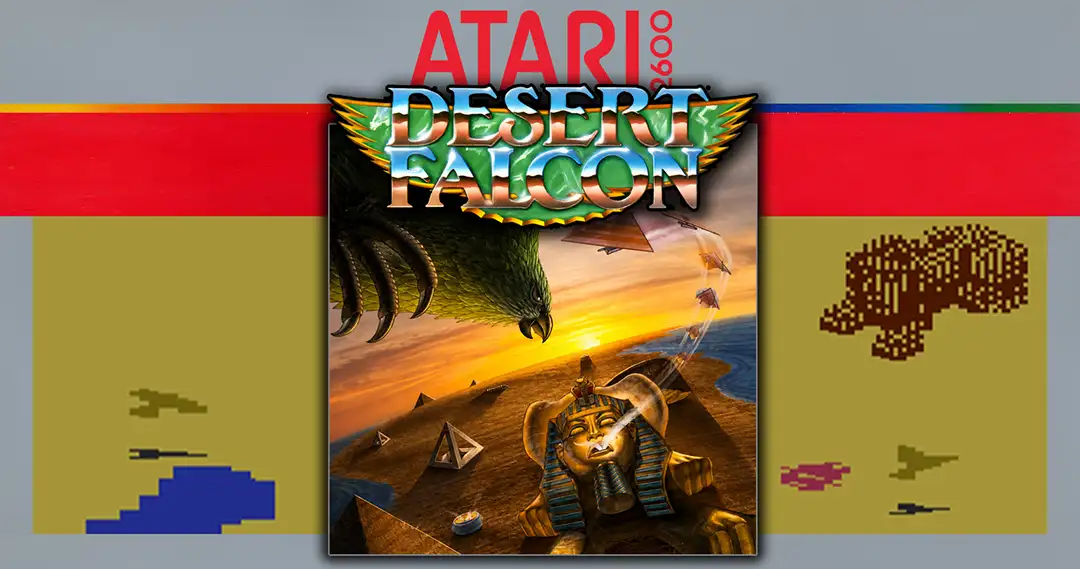
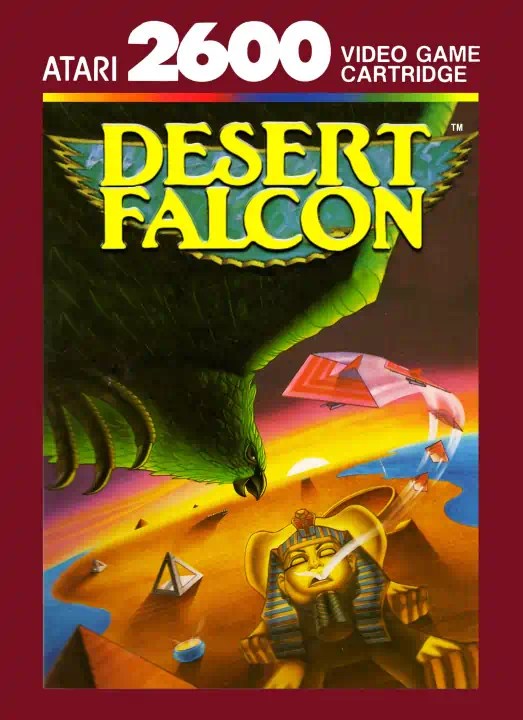
In Desert Falcon, the player controls not a spaceship, but a mythical falcon flying over an Egyptian desert landscape. Amid pyramids, obelisks, bodies of water, and enemies, you collect treasures: gems, golden eggs, and silver bars. At the same time, you shoot, dodge, and control your altitude.
The basic principle is strongly reminiscent of Zaxxon: You move diagonally through a perspective-rendered landscape, must dodge obstacles, and keep an eye on your altitude. The shadows of the enemies help you gauge whether they are on a collision course. It is precisely this altitude aspect that makes Desert Falcon more interesting than many other 2600 shooters. It’s not just about steering left and right and firing, but also about deciding when to fly, land, hop, or glide over bodies of water.
The landscape itself is more than mere decoration. Pyramids block the path, bodies of water alter movement options, and numerous obstacles force the player to constantly adjust their flight path. This creates a gameplay flow that relies more heavily on navigation than many classic shoot-’em-ups of the era.
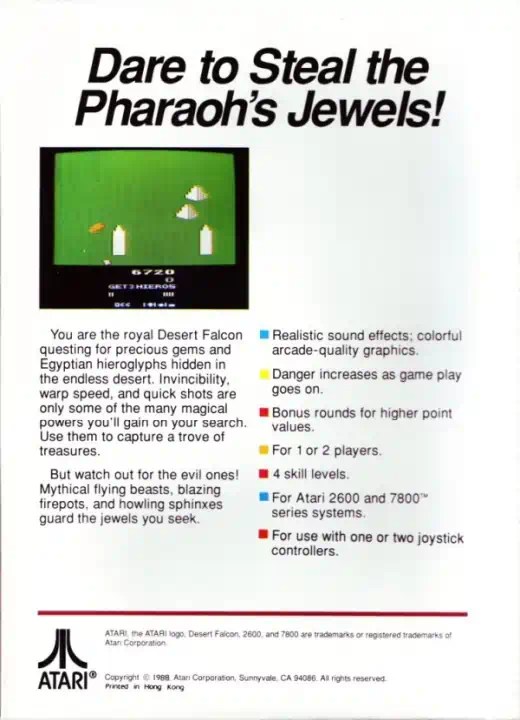
A unique feature is the hieroglyphs. Collecting three of them grants a superpower. This can be useful, such as through invincibility, a screen-wide attack, or paralyzing the Sphinx. However, some powers also have drawbacks, making the system more than just a bonus. It adds a small strategic layer to the game: those who know the right combinations can play more strategically.
What’s interesting is that the game doesn’t hold the player’s hand. Many of the hieroglyph combinations originally had to be discovered through experimentation or by studying the manual. This gives Desert Falcon a touch of mystery that has almost been lost today. In a time before internet walkthroughs, discovering such mechanics was part of the gaming experience.
At the end of each section, the Howling Sphinx awaits. It serves as the boss enemy; you must hit it between the eyes, and defeating it opens the path to the next round or a bonus round. As a result, Desert Falcon features a surprisingly modern structure for a late Atari 2600 game: level sections, boss battles, bonus phases, a power-up system, and increasing difficulty.
As you progress through the game, the pace increases significantly. Enemies appear more frequently, obstacles are placed closer together, and mistakes are punished more harshly. As a result, the game develops a surprisingly high level of difficulty. If you want to achieve high scores, you must not only react quickly but also master the quirks of the controls.
It is precisely this blend of shooter, skill game, and collection mechanics that makes Desert Falcon unusual. It is not a pure shooter but demands attention to multiple systems simultaneously. This sets it apart from many other games in the genre on the Atari 2600.
Late 2600 artistry with limitations
Technically, Desert Falcon is one of those games that demonstrate just how far developers were able to push the Atari 2600 toward the end of its commercial lifespan. The console was not originally built for freely scrolling, perspective-based worlds. It had extremely limited RAM, no traditional screen buffer, and forced programmers to render the screen practically line by line during the display process.
This makes the illusion created by Desert Falcon all the more remarkable. The desert scrolls diagonally, obstacles and enemies move in a way that at least conveys the impression of spatial depth, and the shadows serve as a gameplay aid. This isn’t true 3D, but a very clever 2D simulation of space.
Particularly impressive is the way the game handles scale. Objects appear different sizes depending on their position, creating an illusion of depth that one wouldn’t really expect on the Atari 2600. The developers used every available technique to create the impression of a three-dimensional world.
Of course, this comes at a price. The graphics are choppy, enemies aren’t always easy to distinguish, and the controls take some getting used to. The altitude control, in particular, can feel imprecise at first. Readability also suffers because many objects consist of very simple shapes. Nevertheless, the technical achievement is remarkable. Desert Falcon doesn’t look like a typical early 2600 game. It feels like a late experiment from a time when programmers had come to understand the hardware down to its quirks.
The sound also deserves a mention. While the audio cannot compete with the capabilities of later systems, the effects effectively support the action. Gunfire, hits, and the sounds of the Sphinx ensure that the game feels lively despite the limited hardware.
This is particularly exciting when compared to the 2600 version of Zaxxon. While Zaxxon on the 2600 capitulated to the isometric challenge, Desert Falcon takes it on. It isn’t perfect, but it shows that the console was capable of more than many ports gave it credit for.
One could even argue that Desert Falcon doesn’t so much try to imitate an arcade machine as it does develop its own solution. That is precisely where its strength lies. Instead of overtaxing the hardware, it creatively exploits its capabilities, thereby achieving results that seem surprisingly modern at first glance.
Trivia
Desert Falcon was released for several Atari systems, including the Atari 2600, Atari 7800, and Atari 8-bit computers. The versions differ significantly, with the 7800 version naturally appearing more colorful and graphically elaborate. The 2600 version, however, is the more fascinating one because it attempts to implement a similar gameplay concept on the weaker hardware.
Prior to release, the game had various working titles, including “Nile Flyer” and “Sphinx.” These names fit the concept even more directly: a flying creature, an Egyptian setting, and the Sphinx as a recurring central motif.
A small Easter egg references Bob Polaro: Under certain conditions, the initials “BP” may appear. Such signatures and hidden references were more than just a gimmick in the Atari era. They were often a silent form of authorship in an industry where, for a long time, developers were not automatically credited on packaging and title screens.
The thematic blend is also interesting: Desert Falcon takes the mechanics of a futuristic arcade shooter and transplants them into a pseudo-mythological Egyptian world. Spaceships become falcons, space stations become pyramids and sphinxes. This makes the game feel both familiar and strangely foreign.
It is also noteworthy that the game was one of Atari’s last major in-house productions for the 2600. While many manufacturers had already abandoned the platform, Atari continued to invest in new ideas. As a result, Desert Falcon is now regarded as a late prestige project.
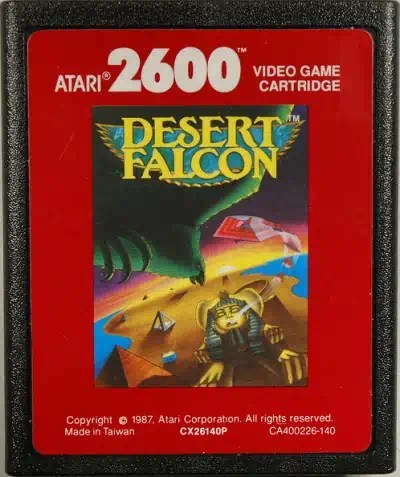
The cartridge enjoys a good reputation among collectors. While it is not one of the rarest releases for the console, it is frequently cited as an example when discussing technically ambitious late-period titles for the Atari 2600.
Contemporary Reviews
At the time, Desert Falcon received attention primarily in the Atari press, though reviews often focused on the versions for the Atari 8-bit or Atari 7800. The comparison to Zaxxon was obvious even then. Critics recognized the similarity in gameplay but also saw its limitations.
The graphics, the falcon’s animation, the perspective effect, and the presentation—which was unusual by Atari standards—were particularly praised. Critics emphasized that the game offered something special visually and remained playable, even though the perspective and controls demanded more than a simple horizontal or vertical shooter.
Another plus was the atmosphere. The Egyptian setting differed significantly from the science-fiction scenarios common at the time. While the theme wasn’t entirely new, the combination of mythology and shooter gameplay was perceived as refreshing.
The criticisms were just as clear. Even back then, some considered the theme a bit tired; the enemies were sometimes hard to tell apart, and the basic idea didn’t feel truly new despite the Egyptian packaging. Anyone familiar with Zaxxon saw Desert Falcon less as a revolution and more as a variation. The fascination therefore lay less in the originality than in the execution: it was impressive that such a game worked on Atari hardware at all.
Some reviewers also criticized the learning curve. New players could easily become frustrated because the perspective was unfamiliar and the altitude control seemed difficult to grasp at first. However, those who invested time discovered a significantly deeper game than the first few minutes suggested.
For the 2600 version, the assessment shifts even more toward the technical aspects. In terms of gameplay, it is rough, sometimes confusing, and not always fair. But it is also bold. On a console that launched in 1977, it attempts once again in the late 1980s to capture an arcade feel that was actually a whole hardware generation ahead.
Looking back, it’s striking that many reviews at the time judged the game primarily on its weaknesses. Modern retro gamers, on the other hand, often view it as a technical demonstration and appreciate more fully just how ambitious the project actually was.
Cultural Influence
Desert Falcon never became a major classic like Adventure, Pitfall!, Yars’ Revenge, or River Raid. It is not a game that shaped pop culture or redefined a genre. Its cultural influence lies more in hindsight: it is an example of just how much was still possible in the late Atari 2600 era.
For collectors and Atari fans, Desert Falcon is therefore an interesting late-period title. It is one of those games that demonstrate the 2600 wasn’t just about the early, blocky classics, but also about ambitious latecomers that experimented with scrolling, perspective, and more complex rule systems. Desert Falcon is an important point of comparison, especially in discussions about failed arcade ports. It raises the question: If this game could achieve a Zaxxon-like perspective, why was the official Zaxxon on the 2600 so far removed from its arcade counterpart?
In the retro scene, the game is often referred to as an insider tip. It isn’t among the best-known Atari titles, but it regularly surprises players who try it for the first time. Many expect a simple shooter and instead discover a technically sophisticated experiment.
Modern retro releases and collections have also kept the game in the public eye, albeit more as a curiosity than a main attraction. It remains a title for players interested in technical edge cases: not the best game on the console, but one of the most compelling arguments that the hardware was often less limited than the imagination of the porters.
Furthermore, Desert Falcon is frequently cited today as an example in discussions about the importance of good adaptations. The game demonstrates that successful ports do not necessarily have to be identical to their originals. It often makes more sense to preserve the core idea and adapt the rest to the available hardware.
A good 2600 Zaxxon would been possible
Desert Falcon is not a perfect game. The controls take some getting used to, the graphics can become cluttered, and the gameplay gets repetitive quickly. Yet as a technical and historical document, it is remarkable. It shows that the Atari 2600 was certainly capable of delivering a credible isometric shooter experience if the design was adapted to the hardware instead of simply scaling down an arcade template.
That is precisely why Desert Falcon is so important in retrospect. It does not prove that a 1:1 Zaxxon would have been possible on the Atari 2600. That would be asking too much. But it does prove that a good, independently conceived Zaxxon would have been possible on the 2600: with a diagonal landscape, shadows, a sense of depth, obstacles, firefights, and clear adaptation to the console’s strengths and weaknesses.
The game thus stands as representative of an entire generation of later Atari 2600 titles that are often overlooked. While the early classics laid the groundwork, the later releases showed just how far the hardware could be pushed through experience and creative programming. Desert Falcon is one of the most impressive examples of this evolution.
The real punchline, therefore, is this: The best Zaxxon-style game on the Atari 2600 isn’t called Zaxxon. It’s called Desert Falcon.
And that is precisely why this unusual title is still worth exploring today. Not because it ranks among the greatest games of its time, but because it impressively demonstrates just how much potential can lie even in seemingly outdated technology. Anyone who wants to understand why the Atari 2600 has remained such a fascinating platform to this day will find one of the most compelling arguments in Desert Falcon.
More
Box and Cartridge







Kommentar verfassen