

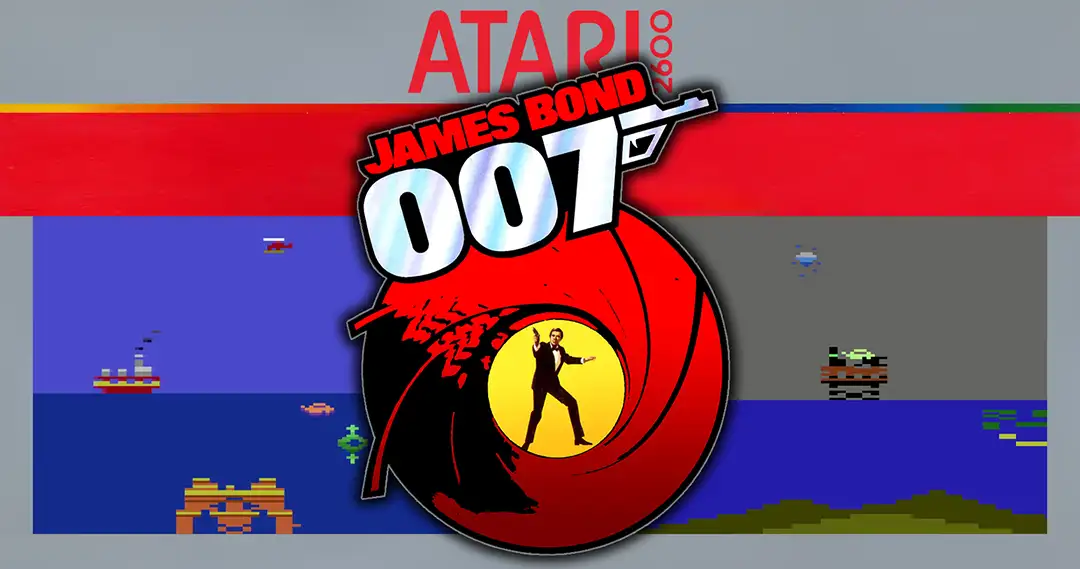
Bond Enters the Gaming World
When James Bond 007 was released for the Atari 2600 in the early 1980s, two very different forms of popular entertainment collided. On one hand, there was the elegant, globe-spanning film series featuring exotic locations, high-tech gadgets, and a hero whose appeal relied heavily on dialogue, acting, and elaborate production values. On the other hand, there was a game console with severely limited technical capabilities, forced to make do with blocky pixel graphics, limited memory, and a joystick with just a single fire button.
Parker Brothers therefore did not attempt to fully recreate a single Bond film. Instead, the developer pieced together elements from several adventures of the Roger Moore era into a side-scrolling action game. The Atari 2600 version contains three missions based on Diamonds Are Forever, Moonraker, and The Spy Who Loved Me. Versions for other systems added an additional mission based on For Your Eyes Only, which is missing from the 2600 version.
The result is less of a spy story and more a series of short, increasingly difficult obstacle courses. Bond himself is barely recognizable as a human character during the actual gameplay. The lead role is played by a multipurpose vehicle designed by Q that combines the characteristics of a car, an aircraft, and a submarine. In this way, the game translates the 007 brand into the language of early home consoles: Instead of conversations with M, secret investigations, or stealth sequences, there are projectile patterns, jumps, diving maneuvers, and points.
Depending on the source, the release date is listed as either 1983 or 1984. What is certain is that Parker Brothers released the title for multiple platforms and that On-Time Software worked on the Atari version. As one of the first officially licensed and internationally distributed Bond productions, the game holds a special place in the series’ history.
Driving, Diving, and Shooting
The basic gameplay is clearly reminiscent of arcade games like Moon Patrol and Scramble. The landscape scrolls across the screen while Bond’s vehicle moves to the right. Use the joystick to drive forward or back a short distance. Moving the joystick up makes the vehicle jump or ascend, while moving it down causes it to dive below the water’s surface. Gravity and buoyancy then bring it back to its normal driving or swimming level.
The single fire button serves two purposes. Pressing it once fires a projectile upward at a fixed angle; pressing it again drops a bomb downward. The sequence then repeats. The player must therefore not only aim at enemies but also keep in mind which weapon will be fired with the next press. This unusual solution makes clever use of the simple Atari controls, but can also lead to frustration in hectic situations.
The first mission is based on Diamond Fever. Bond traverses a desert at night, punctuated by glowing craters. At the same time, he must dodge laser attacks, helicopter bombs, and other obstacles. Large diamonds hang in the sky, which glow when hit. They not only serve as sources of points but also later reveal Seraffino’s oil rig. In the end, the vehicle must land on the platform of the island to rescue Tiffany Case. Completing the mission thus requires a specific action and not merely reaching a certain score.
In the Moonraker mission, Bond fights above and below the water’s surface against ascending space shuttles, poison bombs, submarines, and torpedoes. The goal is to destroy Hugo Drax’s three rotating satellites. The dangers strike at different altitudes. Players who stay at the surface are hit by falling bombs; those who dive carelessly end up in the line of fire of the submarines. The game thus forces players to regularly alternate between surfacing, diving, and firing.
The final section draws on The Spy Who Loved Me. Rockets rise from the ocean floor, transform into firebombs, and explode at the surface. Tankers block the path, while helicopters drop explosive charges. Finally, Stromberg’s underwater laboratory must be bombed. The explosion releases a capsule containing agent Anya Amasova, which must be reached within a few seconds. Only then is the mission considered complete.
The difficulty levels “Novice” and “Agent” are available. After the game ends, British intelligence assigns a rating. In the easier mode, the player can reach a maximum rank of 006. Only on the more difficult “Agent” level is the perfect score of 007 possible—a small but effective link between the scoring system and the film license.
Technology Facing Severe Limitations
Technically, James Bond 007 is a typical—yet quite ambitious—Atari 2600 game. The console has only 128 bytes of RAM. Furthermore, there is no modern frame buffer in which a complete scene could be pre-rendered. Large portions of the graphics had to be controlled during the ongoing frame rendering process. The developers thus literally worked in sync with the TV scanline and had to manage positions, colors, and objects with extremely limited resources.
The preserved ROM image of the game is eight kilobytes in size. Since the Atari 2600 could directly access only four kilobytes of a cartridge without additional technology, larger games relied on so-called bank switching. This involved loading different memory areas of the cartridge as needed. This technique allowed for more program code and additional game data, even though only a portion of it was visible at any given time.
These limitations are clearly visible on the screen. Backgrounds remain flat, objects consist of a few monochromatic shapes, and some graphical elements are reused for different enemies. Nevertheless, the desert, sea, sky, and underwater areas can be clearly distinguished. The transition between the surface and the depths is particularly well done. With minimal resources, the game actually creates the impression of piloting a special amphibious vehicle.
The varied mission objectives are also noteworthy. Many early action games continued until the player had lost all their lives. James Bond 007, on the other hand, has distinct end points: you must fly to an oil rig, destroy a certain number of satellites, and rescue a prisoner from a capsule. These tasks at least give the levels a simple narrative structure.
Less convincing are the field of view and collision detection. Some obstacles appear very late, while successful jumps and diving maneuvers often require memorizing fixed sequences. The weapons, which are activated alternately, exacerbate the problem. If you urgently need a bomb, you may first have to fire a useless shot. The high level of difficulty therefore stems not only from the need for quick reactions, but also from trial and error and memorizing enemy patterns.
Curiosities and Detours
The game’s development history is almost more exciting than its plot. Parker Brothers initially planned a version titled James Bond 007 As Seen in Octopussy. Western Technologies worked on a scene for this that was intended to recreate the fight on a moving train from the 1983 film. The project was announced and promoted but never completed. Parker Brothers subsequently commissioned On-Time Software to develop a fundamentally new game. The planned adaptation of the current movie evolved into a collection of themes from older Bond adventures.
There are significant differences between the platforms. While the Atari 2600 version offers three missions, some other versions include an additional section based on For Your Eyes Only. Enemy placements, transitions, and individual mission details were also simplified for the Atari. In retrospect, the streamlined version is sometimes even considered more playable because its controls and enemy placement are slightly tighter.
Another unique feature is hidden within the program code. The names “JOE GAUCHER LOUIS MARBEL” are concealed in the ROM file. Joe Gaucher served as a programmer and designer, while Louis Marbel was the producer. Such signatures were not uncommon at a time when developers were often not credited at all on packaging or title screens.
Another curiosity is the villain Seraffino in the section on Diamond Fever. He takes on the role one would normally associate with Blofeld. This was due to the complicated legal circumstances surrounding Blofeld and the SPECTRE organization at the time. The manual, however, treats Seraffino quite naturally as the one responsible for the dangerous diamond satellites.
Contemporary Reviews
Contemporary reviews specifically for the Atari 2600 version are hard to find today. A frequently cited review appeared in November 1984 in the magazine Computer Games, but it referred to the technically more powerful Atari 8-bit version. The magazine awarded it an “A” rating. Although the graphics and sound were described as simple and a permanent leaderboard was missing, the editors praised the variety of weapons, missions, and specific objectives. They were particularly impressed that, at the end of a mission, the player had to complete a specific task rather than simply shoot everything that moved.
This assessment cannot be fully applied to the Atari 2600. The computer version offers an additional mission as well as better audiovisual capabilities. Nevertheless, the praise from that time highlights a strength that is also evident on the console: despite a largely consistent basic premise, the challenges of the three sections vary. Sometimes the focus is on jumps and landing maneuvers; other times, it’s on satellite hunting and underwater battles.
Later reviews are generally much harsher. Criticisms include unfair combinations of terrain and enemies, landing points that are difficult to spot, the unusual weapon controls, and the heavy reliance on memorization. Some retrospectives describe the game as too difficult for its own good, though they consider the Atari 2600 version more playable than some other adaptations due to its tighter controls. The game’s reputation therefore continues to fluctuate to this day between that of a failed licensed title and an appealing challenge for particularly patient Atari players.
An Early Licensed Title
The immediate cultural impact of James Bond 007 remained limited. The game did not establish a new genre and did not achieve the fame of major Atari hits such as Pitfall! or Space Invaders. Its historical role is nonetheless significant. It demonstrates how a famous film character could be adapted into a video game, even though the technology was unable to convincingly render actors’ faces, dialogue, or cinematic staging.
Instead, the developers focused on easily recognizable elements of the brand: exotic missions, megalomaniacal villains, rescued allies, armed vehicles, and high-tech gadgets. Bond didn’t need to appear visibly in a tuxedo as long as his vehicle could jump, dive, fly, and drop bombs. The game transformed the character less into a secret agent and more into an abstract action hero.
Also noteworthy is the compilation of several films into a single game. Later Bond titles revisited this principle, combining locations, enemies, and events from different eras. While a direct influence from the Atari game cannot be proven, it represents an early embodiment of the idea of a playable Bond “best-of” collection. Modern retrospectives accordingly regularly cite it as the starting point of the long and varied history of Bond video games.
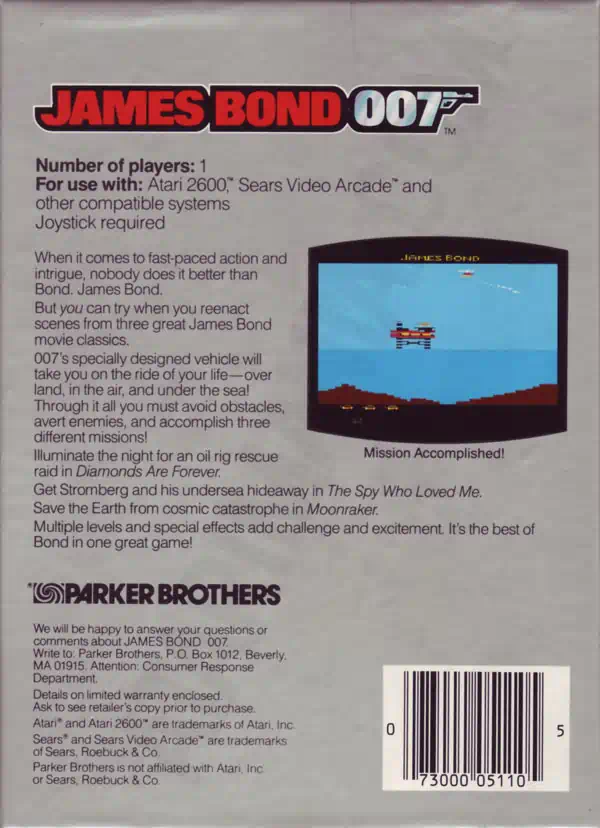
For collectors and media historians, the title is also a good example of the early licensing industry. The well-known name on the packaging promised a greater adventure than the hardware could display on the screen. Consequently, the manual had to provide a significant portion of the atmosphere. It explained characters, locations, and mission backgrounds in detail, while the TV screen often displayed only a few pixelated objects. The actual Bond experience arose from the interplay of packaging, the manual, knowledge of the films, and imagination.
A Charming, Challenging Start
James Bond 007 for the Atari 2600 is not an elegant spy adventure in the modern sense. It is a compact, challenging side-scroller that reduces Bond’s world to an amphibious vehicle, two weapons fired alternately, and three missions. The controls feel finicky, some situations seem unfair, and success depends heavily on memorizing specific sequences. Anyone expecting a plot faithful to the movies or a recognizable portrayal of Bond’s personality will find little of that here.
As a historical game, however, the title still has its charm. It shows how developers, working under extreme technical constraints, attempted to squeeze multiple movies, various locations, and specific mission objectives into a single module. The multipurpose vehicle is a fitting 007 concept, and the final agent ranking system—which takes players all the way up to rank 007—even ties the straightforward scoring system to the license.
James Bond 007 is therefore neither a forgotten masterpiece nor merely a trivial curiosity. It is a challenging, at times uncooperative, but inventive beginning. The game was not yet able to convincingly recreate the James Bond myth—but it did help to translate it into a new media format.
More
Box and Cartridge










Kommentar verfassen