

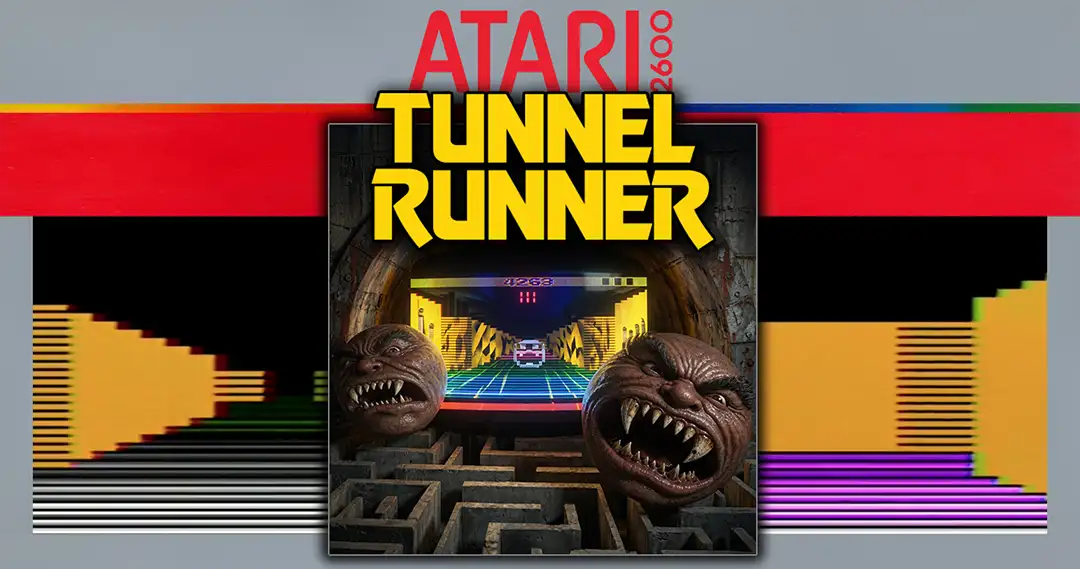
3D on the Atari?
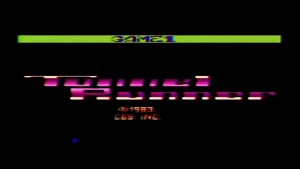
Just the thought of it sounds almost like a typo in gaming history: a first-person perspective, corridors that appear three-dimensional, and a sense of depth on a console that was released in 1977 and operated within technical limitations that are almost unimaginable today. The Atari 2600 was famous for making a lot out of very little. But even in that context, Tunnel Runner seemed like a small miracle in 1983.
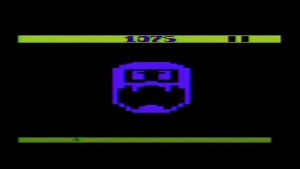
The game was developed by Richard K. “Dick” Balaska Jr. for CBS Electronics. At first glance, it’s “just” a maze game: You run through corridors, search for a key, avoid enemies, and try to find the right exit. But the way this happens is what makes all the difference. While many other maze games of that era relied on a top-down view, Tunnel Runner forces the player inside the tube. You’re not looking at a dot moving through a maze—you’ve become that dot yourself.
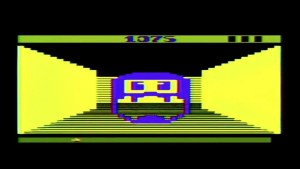
This shift in perspective is the true stroke of genius. It changes not only the visuals but the entire feel of the game. Orientation becomes more difficult, threats feel more immediate, and every mistake feels more personal. When a Zot—that’s what the enemies are called—appears in the distance, it’s not just a symbol on a map, but suddenly a creature blocking the passageway. The game’s claustrophobia doesn’t stem from the story or cutscenes, but from the sheer presentation.
That’s precisely why Tunnel Runner remains more than just a technical curiosity to this day. It’s one of those games where you immediately understand why retro fans love to talk about “engineering mastery.” The game exemplifies how designers and programmers in the early days of the medium didn’t let hard limitations be an excuse, but instead turned them into a style. Tunnel Runner isn’t just interesting because it’s old. It’s interesting because it pursues an idea that actually seems far too ambitious for the 2600 in 1983—and yet implements it with astonishing conviction.
Escape Through the Tunnel

The basic principle of Tunnel Runner is quickly explained and is all the more effective for it. Each round—called a “run” in the game—consists of a three-dimensionally rendered maze. The goal is to find the hidden key and then escape through the correct exit. At the same time, the clock is ticking, and several Zots are chasing the player through the corridors. If you get caught, you lose a life and start over somewhere in the same run.
Controls are handled with the joystick: forward, backward, left, and right. It sounds simple, but in practice it becomes surprisingly challenging. That’s because you’re not moving in a clear top-down view, but from a first-person perspective. You have to take turns at just the right moment, anticipate intersections, and if you react too late, you’ll run straight into a wall. The game thrives on this interplay between movement and split-second decisions. A fraction of a second can determine whether you take the corner elegantly or run straight into the Zot’s arms.
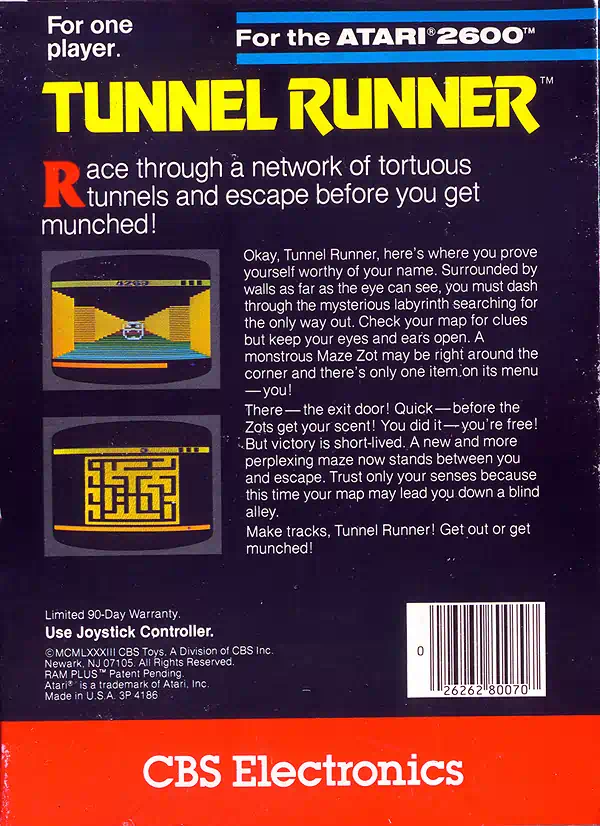
The map, which can be brought up with the push of a button, is helpful. It shows—at least in the early runs—the layout of the maze, the player’s position, and the enemies’ movements. But this is precisely where the ingenuity of Tunnel Runner shines through: the map isn’t a convenient, one-size-fits-all solution. While you’re looking at it, you can’t move, but the Zots can. So if you rely on the map for too long, you lose immediate control. The game forces you to switch between abstract orientation and instinctive running. That’s what makes it so appealing.
Added to this are various types of doors. Normal upward-opening doors take you to the next run, while double-arrow doors take you two levels further. Transport doors teleport the player to a random spot in the maze—sometimes a lifesaver, sometimes fatal. Downward doors, on the other hand, send you back to the previous run and feel more like traps. This turns the search for the exit into more than just a simple trial-and-error process. You don’t just have to find a door—you have to find the right one.
The enemies also add variety. The gray Zots are relatively harmless at first, but faster and smarter variants are introduced later on. It’s not just about seeing—it’s about hearing, too. Tunnel Runner relies heavily on audio cues. Different enemies have distinct acoustic signatures, and their proximity becomes audibly more threatening. This creates a sense of tension that feels surprisingly modern. You react not only to the visuals but also to an auditory warning system that transforms the tunnel into a resonating chamber of danger.
The progression is particularly clever. With each run, the pace and pressure increase. The player gets faster, the Zots become more aggressive, and the information available deteriorates. Maps become less reliable, visibility worsens, and orientation becomes more precious. What starts as a straightforward maze game gradually turns into a stress test for perception, memory, and nerves. It is precisely this that keeps Tunnel Runner exciting for longer than its simple basic structure would initially suggest.
The Engine Behind It

The technical legend of Tunnel Runner begins with the hardware. The Atari 2600 had only 128 bytes of RAM—a figure that seems almost absurd today. Even ordinary action games had to resort to tricks on this machine just to appear smooth, colorful, and varied. But Tunnel Runner wanted more: a believable first-person perspective, different runs, enemy behavior, a map, sound cues, and even a random mode.
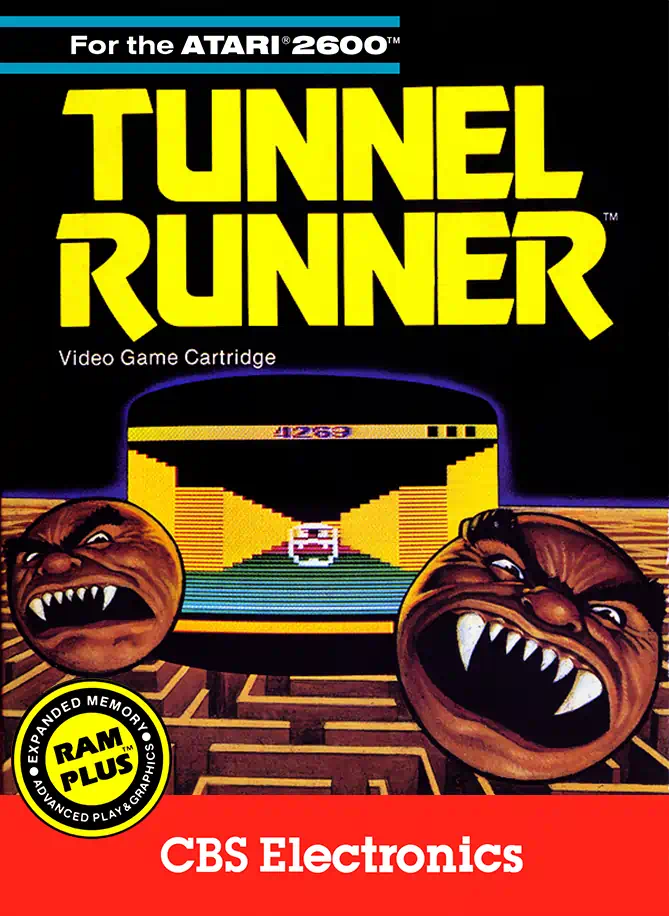
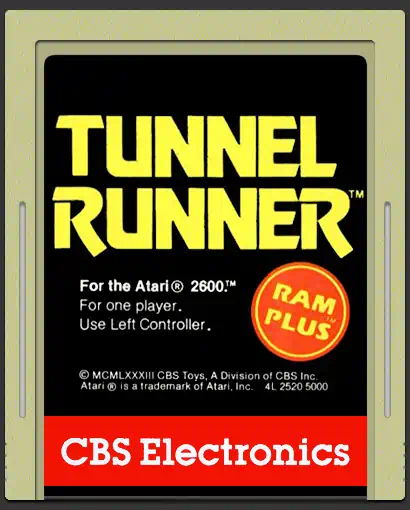
At CBS Electronics, the solution was called “RAM Plus.” The Tunnel Runner cartridge came with an additional 256 bytes of RAM. That still sounds tiny by today’s standards, but on the Atari 2600 it was a crucial luxury. Balaska later even said that he had to help design the RAM Plus chip. This additional hardware wasn’t just a marketing gimmick, but part of the actual design. Without it, the game would have been virtually unthinkable in this form.
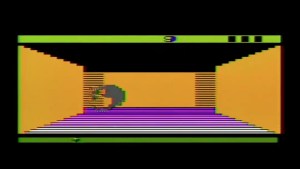
It’s important to note that Tunnel Runner, of course, doesn’t render a true 3D world in the modern sense. There are no polygon models, no dynamically generated spaces, and no camera as we know it from later 3D games. The “3D engine” is, rather, a brilliant illusion. The game uses corridor segments, repeating patterns, color changes, and perspectively arranged wall shapes to simulate depth. The tunnels therefore look three-dimensional, even though they consist of strictly calculated graphical building blocks.
It is precisely this illusion that is so convincing because it remains functional. Many early pseudo-3D effects are only impressive for a short time and then become impossible to make out. Tunnel Runner, on the other hand, turns its trick into a playable system. You can reliably distinguish side walls, openings, curves, and dead ends well enough to actually navigate them. That is the engine’s true achievement: not merely a “wow” effect, but orientation under the most challenging conditions.
Add to that the speed. In later recollections, people often emphasized how fast Tunnel Runner felt compared to other experimental perspective games on the system. The game doesn’t linger to painstakingly build up the next viewpoint; instead, it conveys a fluid rhythm of movement. That’s exactly what transforms a technical demonstration into an action game. You’re not thinking about the technology the whole time—you’re running.
The second game mode is also technically remarkable. While Game 1 relies on fixed mazes, Game 2 offers randomly generated “Torture Tunnels.” For an Atari 2600 game of this kind, that was a strong selling point. The additional memory not only helped with the visuals but also with variety. Instead of memorizing the same paths over and over, players actually had to improvise in the second mode. This significantly increased the game’s scope and replay value.
Another interesting point is what the technology couldn’t achieve. Balaska later explained that he actually wanted to experiment even more with true spatial movement—not just forward, backward, left, and right, but also up and down. The Atari 2600, however, couldn’t handle that effectively. This detail in particular is revealing: Tunnel Runner feels so bold because it pushes the limits without blindly crossing them. The game doesn’t try to do everything. It focuses precisely on the illusion that the system can just barely support.
Curious Side Notes
Like many Atari classics, Tunnel Runner thrives not only on its mechanics but also on its little side stories. Even the story of its creation is remarkable. Balaska later recalled sketching out the basic idea in a laundromat. The early working title—or code name—was reportedly “cave.” That fits: Tunnel Runner still feels like a technical expedition into an underground space whose form first existed as a sketch and then as code.
The anecdote about the Zots is also charming. Originally, Balaska apparently wanted to call the monsters “Zits,” but the marketing team changed it to “Zots.” This is more than just a joke. It shows how strongly games of that era were still caught between a DIY spirit and commercialization. A developer invented a quirky internal world, and the company gave it the final, market-ready polish.
The sound also has its own story. The game is often remembered for its eerie soundscape, and rightly so: the Zots sound menacing, footsteps make the room audible, and the distance to enemies is communicated acoustically. Balaska later explained that the increasing volume as enemies approached was his idea. It’s precisely these kinds of details that make it clear why Tunnel Runner felt not just “impressive” but actually “creepy” to many players.
Added to this are hidden quirks and secrets. Reports of Easter eggs, special rooms, and hard-to-reach features in later runs have been circulating in fan circles for years. This fits well with a game that even hints in its manual that experienced players would encounter “mysterious maze magic.” While such phrasing is typical of early-’80s marketing language, it feels surprisingly fitting for Tunnel Runner. The game has an air of mystery because it doesn’t fully reveal its rules.
Not to be overlooked is the cartridge’s unique status. Tunnel Runner is one of the few CBS-2600 games with RAM Plus and is therefore often automatically regarded as a collector’s item. Among retro fans in particular, it enjoys a reputation as a title that is technically and historically more interesting than its unassuming name would suggest. Anyone who sees only the label might expect run-of-the-mill fare. But when you start the cartridge, you get a game that is significantly more ambitious.
Praise and Skepticism

The contemporary reaction to Tunnel Runner was largely one of amazement. Critics certainly recognized that something unusual was happening here on the Atari 2600. The game stood out from the usual maze or action titles. The first-person perspective, the sense of space, and the atmosphere were seen as distinctive features, not mere gimmicks.
At the same time, it was already clear back then that Tunnel Runner wouldn’t immediately appeal to everyone. The game requires a learning curve. Players expecting a straightforward, self-explanatory arcade experience might find it confusing at first. You have to learn to read the curves, use the map effectively, and judge the Zots by sound. For many, that was precisely the source of its fascination—but for others, it was also the hurdle.
Furthermore, the game was early on overshadowed by an obvious comparison: Starpath’s Escape from the Mindmaster had already drawn attention with its pseudo-three-dimensional maze effect. Contemporary reviews noted that Tunnel Runner was technically strong, but that the illusion didn’t quite have the same effect as Starpath’s more elaborate approach using additional hardware. That’s a fair and interesting critique. It doesn’t diminish the achievement of Tunnel Runner, but it does place it in the proper context of its time.
Another potential point of criticism was the monotony of the basic gameplay loop. As impressive as the perspective is, at its core the game repeatedly cycles through the pattern of searching, dodging, and escaping. Anyone who defines variety primarily through new scenarios, new rules, or spectacular set pieces will see this as a limitation. On the other hand, this very simplicity is also a strength. Tunnel Runner makes a lot out of very little because it derives its tension not from ever-changing content, but from ever-increasing pressure.
Looking back, therefore, it can be said that the criticism at the time was neither blindly euphoric nor dismissive. It recognized Tunnel Runner as unusual, technically ambitious, and atmospherically dense—while also acknowledging that the game could not rely solely on its novelty. It is precisely this mix that makes its reception interesting. It was not merely a trade show gimmick, but neither was it a universal crowd favorite.
Echoes in the Retro Scene
The cultural influence of Tunnel Runner is more subtle than that of major genre milestones. It would be an exaggeration to attribute to it the same direct significance as later 3D or first-person classics on more powerful hardware. Tunnel Runner did not change the mainstream vocabulary of the medium. But it has a different, no less fascinating resonance: It has become a point of reference when it comes to the question of how early and how creatively developers experimented with the first-person perspective.
In the retro scene, the game therefore pops up time and again, often met with a mixture of admiration and amazement. Admiration, because it actually works on the Atari 2600. Amazement, because such an early game—and one that seems so simple on paper—can actually create such an immersive atmosphere. Many players today discover Tunnel Runner not as a historical must-play, but as a surprise: You expect a technical curiosity and get a frantic, unconventional action game.
It’s fitting, then, that the game has continued to inspire remakes and reinterpretations to this day, such as Tunnel Runner Redux for modern platforms. Such projects show that more than just a name lives on here. The basic concept—a minimalist, first-person maze runner with high-pressure gameplay and a powerful soundscape—still holds appeal. Precisely because it’s so clear and pure, it’s easy to revisit.
Tunnel Runner has also endured as a collector’s item and a topic of conversation. It’s one of those games that, in retrospectives on the Atari 2600, regularly serves as proof that the console was capable of far more than simple Pong clones or crude arcade adaptations. In this sense, its cultural influence isn’t primarily one of direct imitation, but rather one of historical correction. Tunnel Runner serves as a reminder of just how experimental the early home console era actually was.
Conclusion After the Escape
Tunnel Runner is one of those games that can’t be neatly pigeonholed. As a game concept, it’s simple, almost archaic. As a technical achievement, it’s astonishing. In terms of atmosphere, it’s strangely intense. And as a historical artifact, it’s a rare example of a title that remains both interesting to play and technologically significant.
Its greatest strength lies in the fact that it isn’t a sterile tech demo. Yes, you’ll marvel at the perspective, the speed, the RAM Plus module, and what Balaska managed to squeeze out of the Atari 2600. But that sense of wonder only lasts because underneath it all lies a functioning game—one that organizes suspense, pressure, and disorientation with astonishing precision.
Of course, Tunnel Runner has its limitations. It gets repetitive, it takes some getting used to, and from today’s perspective, it seems both visionary and rough around the edges. Yet it is precisely this mix that makes it so appealing. What you see here isn’t the fully realized future of 3D gaming, but a bold step in that direction. And that is exactly why the game is memorable.
Anyone who wants to understand why retro games can be more than just objects of nostalgia should check out Tunnel Runner. It shows just how much character can emerge from limitations. On the Atari 2600—that small, severely limited machine—a maze suddenly became a space. And a simple escape game became an early glimpse into the future of perspective.
More
Box and Cartridge








Kommentar verfassen