

We are the Borg.
Lower your shields and surrender your ships.
We will add your biological and technological distinctiveness to our own.
Your culture will adapt to service us.
Resistance is futile.
An Unlikely Pioneer
Somewhere in the future, there’s a statue of Zefram Cochrane, the man who built Earth’s first warp ship. Geordi La Forge can describe it from memory. He’s been to the spot where Cochrane made history, sat in the great man’s cockpit, and imagined what it must have felt like to be there. When time travel finally gives him the chance to tell his hero all this in person, the effect is disastrous. Cochrane takes one look at the future Geordi has described for him and heads for the woods. It’s a lovely joke at the expense of anyone who has ever cornered an idol, and it gets at something unusually generous about Star Trek: First Contact. The people who bring about a better world are allowed to be thoroughly unprepared for it.
Released in November 1996, First Contact was the eighth Star Trek film and the first to give the cast of The Next Generation the big screen entirely to themselves. Director Jonathan Frakes celebrated the occasion by giving his old colleagues two very different evenings. Half the crew gets to meet a historical figure and discover his considerable appetite for liquor. The other half spends the night aboard a darkened starship, listening for the mechanical footsteps of people who used to be their friends. The surprising thing, thirty years on, is how naturally those two films belong together.
Two Fronts
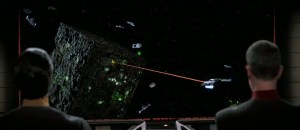
The trouble begins when the Borg attack Earth. Years earlier, this collective of cybernetic beings captured Captain Jean-Luc Picard, assimilated him, and used his knowledge against his own fleet. Starfleet considers that history reason enough to keep him away from the battle. Picard disobeys, helps destroy the Borg cube, and follows a smaller vessel back through time. Its destination is Montana in April 2063, where a community of survivors is still picking through the wreckage of World War III. The following day, Cochrane is due to take his ship, the Phoenix, to warp speed. A passing Vulcan vessel will detect the flight and come down to investigate. The Borg mean to prevent that meeting.
On the ground, Commander Riker and his team have a damaged spacecraft to repair and an increasingly reluctant pilot to coax aboard. In orbit, Borg drones infiltrate the Enterprise, taking it deck by deck. Their Queen has particular plans for Data, an android who has spent years wondering what it feels like to be human. Picard, meanwhile, finds himself explaining the situation to Lily Sloane, Cochrane’s collaborator, who has come aboard from Earth. He can explain a force field to her in seconds. He has considerably more trouble explaining why his crew should die defending a ship they could evacuate. By the time Lily asks that question, the prospect of seeing a celebrated captain change his mind is every bit as suspenseful as the launch.
Changing Course
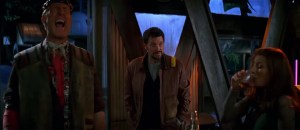
Screenwriters Brannon Braga and Ronald D. Moore took a winding route to Montana. An early concept sent the Borg back to Renaissance Europe, and one version of the developing story left Riker aboard the Enterprise while Picard went down to Earth. Swapping their assignments sounds obvious in retrospect, which is usually a sign that a rewrite worked. Picard’s history with the Borg gave the siege an emotional logic no amount of combat choreography could supply. The change also liberated Riker. Watch the pleasure he takes in seeing the prim and ordinarily perceptive Counselor Troi gloriously drunk after an evening spent trying to establish diplomatic relations with Cochrane. It would have been a shame to keep him upstairs.
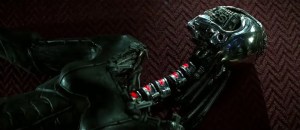
Frakes had directed episodes of The Next Generation, but this was his first feature. One of his smartest decisions was to let an action sequence unfold at walking pace. When Picard, Worf, and Lieutenant Hawk venture onto the hull, their magnetic boots make every step a commitment. The great curve of the ship falls away beneath them, the Borg are busy just ahead, and anyone accustomed to a quick sprint down an Enterprise corridor has time to appreciate the distance involved. There’s a similar patience in the first appearance of the Borg Queen. Frakes lets us watch her head and spine descend into a waiting body. By the time she speaks, we’ve already had several uncomfortable seconds to wonder what being her might feel like.
Familiar Faces
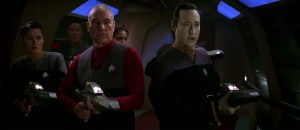
Patrick Stewart gives his most revealing performance in the stretch where Picard still believes he’s behaving reasonably. His voice retains its reassuring precision even as his orders grow more reckless. Alfre Woodard, playing Lily, catches the ugly discrepancy before he does. Their confrontation over Captain Ahab works because Woodard allows Lily to be angry, frightened, and slightly embarrassed about the limits of her literary knowledge all at once. She knows enough of the story to recognize a man chasing his whale. Stewart’s wonderful answering gesture is to pick up the thread of the book himself. For a moment, you can see the reader in Picard grasp what the captain has been doing.
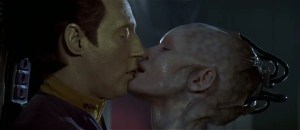
Elsewhere, James Cromwell gives Cochrane the stooped posture of a tall man hoping to escape notice, an increasingly hopeless ambition once LeVar Burton’s Geordi starts beaming at him. Their scenes have the awkward sweetness of a family reunion where only one party remembers being related. Aboard the ship, Alice Krige and Brent Spiner play an altogether stranger courtship. The Queen grafts a patch of human skin onto Data’s arm and blows across it. Spiner lets the sensation register before Data has words for it. Krige barely raises her voice. Between them, they make a small current of air feel more intimate, and more alarming, than anything the film could have achieved with another bank of flashing machinery.
Hidden Details
The Phoenix owes some of its ungainly grandeur to an inspired piece of location scouting. The production filmed at the Titan Missile Museum south of Tucson, Arizona, using a real decommissioned missile and its silo to stand in for Cochrane’s launch facility. Look at how little romance there is in the surroundings. The cramped industrial space makes it easy to believe that Lily has spent years scrounging materials and that the people who built this thing might want to be paid. It also gives the launch a peculiar beauty. A machine designed to carry destruction across continents gets to announce, to anyone out there listening, that Earth has company to offer.
The soundtrack plays its own joke on posterity. Jerry Goldsmith, with contributions from his son Joel, gives the picture a main theme stately enough for the unveiling of Geordi’s beloved statue. Cochrane’s personal choice for liftoff is Steppenwolf’s “Magic Carpet Ride.” Once the guitar kicks in, it becomes difficult to imagine any other music in that cockpit. For a few glorious seconds, Geordi gets to discover something about his hero that a museum visit could never quite communicate. This is what the man wanted blasting in his ears when he stepped on the gas.
Opening Verdicts
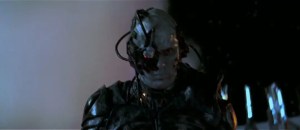
In his November 1996 review for the Chicago Sun-Times, Roger Ebert placed First Contact alongside The Voyage Home, the exuberant adventure involving humpback whales and a visit to twentieth-century San Francisco. It’s an unexpected pairing for a film full of punctured skin and severed limbs. What Ebert admired was the ingenuity of the plotting and the clarity Frakes brought to it. He also singled out the chemistry between Stewart and Woodard, going so far as to hope the filmmakers could find a way to bring Lily back. Joe Leydon, reviewing the film for Variety, likewise praised the first-time feature director’s command of the two simultaneous stories.
The film’s accessibility divided reviewers. Lisa Alspector of the Chicago Reader thought the screenplay gave newcomers enough background while sparing regular viewers a tiresome refresher. Janet Maslin of The New York Times found the adventure more derivative and saw less in its complications to entice anyone outside the faithful. You can understand both reactions during the opening battle. An old friend arrives on a battered ship, uniforms and orders fly past, and the audience has seconds to catch up. Yet when Picard hears the Borg in his head, the look on Stewart’s face tells a newcomer almost everything that matters.
A Shared Anniversary
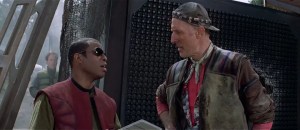
Few science-fiction films have left fans a holiday quite like First Contact Day. April 5 now gives people an annual occasion to commemorate an event still decades in the future. In 2021, the franchise marked the date with a twenty-fifth-anniversary panel that reunited Frakes, Stewart, Spiner, and Krige. There’s a pleasing modesty to the occasion they were celebrating. The great historical event at the end of this expensive space adventure consists of a visitor stepping out of a spacecraft and two people figuring out what to do with their hands.
One measure of how firmly that image took hold came in 2005. The Star Trek: Enterprise episode “In a Mirror, Darkly” reused footage of the Vulcan landing, allowing viewers to settle into a scene they recognized. Then its alternate-history Cochrane pulled a gun. The reversal is shocking precisely because the original greeting feels so familiar, almost like archival footage everyone has seen at school. It also reveals how much freedom there was in the original encounter. Warp drive got the Vulcans’ attention. What happened after the hatch opened was up to the people waiting outside.
The Handshake
The moment I come back to is Cochrane trying to return the Vulcan salute. His fingers won’t cooperate, and for an instant the father of human spaceflight looks like anyone who has ever fumbled a greeting in an unfamiliar language. Then he offers his hand. Cromwell has spent the whole picture establishing how badly this man wants to get away from people who expect something grand of him. When the grand occasion finally arrives, he stays where he is and finds a gesture he can manage. Somewhere down the line, somebody will put up that statue. First Contact earns its place among the best Star Trek films because it lets us know the fellow who would have hated posing for it.
More
Trailer
Notice Regarding Image Rights and Copyrighted Material
All images, film stills, posters, logos, trailer excerpts and other copyrighted materials used in this article are used solely for editorial reporting, film criticism, review and illustrative purposes related to the respective content.
Unless otherwise stated, all copyrights, trademark rights and other intellectual property rights in the materials used remain with their respective rights holders, including film studios, distributors, production companies, photographers, artists or other licensors.
The materials are used in good faith and with regard to applicable legal limitations, licence terms and source attributions. If, despite careful review, any rights have been infringed or any attribution is incomplete, please contact me. Upon review, the relevant content will be removed or corrected promptly.







Schreibe einen Kommentar