

Forbidden Forest – Terror Beneath the Trees
Into Darkness
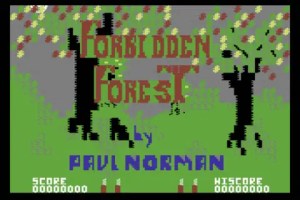
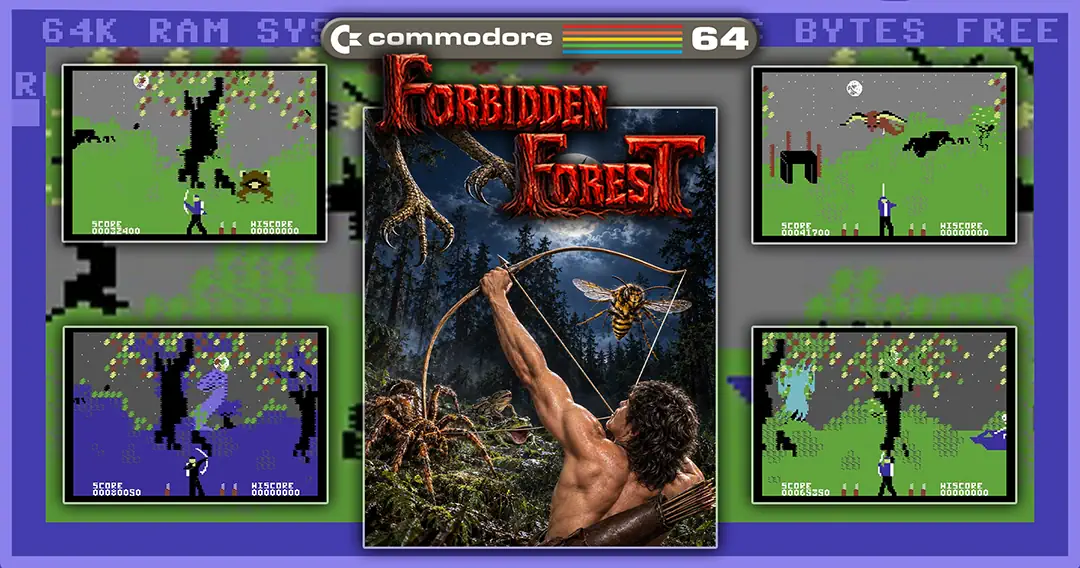
When Forbidden Forest appeared for the Commodore 64 in 1983, computer games were still learning how to frighten their players. Most action titles of the period relied on abstract spaceships, colourful mazes or recognisable arcade formulas. Paul Norman’s sinister journey into a monster-infested woodland felt markedly different. Published by Cosmi and designed and programmed by Norman, Forbidden Forest attempted something unusually cinematic: it wanted to create tension, atmosphere and even horror rather than simply offer another test of reflexes.
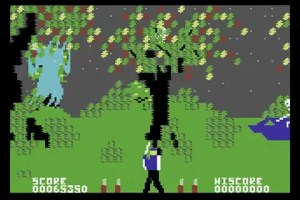
The premise could hardly be simpler. The player enters a forest armed only with a bow and a limited supply of arrows. Unfortunately, the local wildlife includes enormous spiders, monstrous insects, aggressive frogs, dragons, skeletons, phantoms and snakes. Waiting beyond them is the Demogorgon, the supernatural master of the forest.
What made the game memorable was not this collection of monsters alone, but the way they were presented. The forest gradually grows darker. Music announces danger. Creatures appear from different depths of the landscape. Death can be surprisingly graphic. Instead of feeling like a collection of disconnected screens, the game resembles a sequence of scenes from a low-budget horror film.
By modern standards its visuals are crude and its mechanics occasionally awkward. In 1983, however, Forbidden Forest demonstrated that a home-computer game could have something resembling direction, pacing and mood. C64.COM would later describe the game as an early example of bringing “movie-like features” to Commodore 64 software.
Hunting Monsters
The player controls an archer who can move left and right through the forest, turn around, prepare an arrow and fire at approaching enemies. Shooting is more complicated than simply pressing the fire button. The trajectory of the arrow has to be adjusted vertically, making timing and positioning important. A badly aimed shot is not merely wasted ammunition: it also gives an approaching monster additional time to close the distance.
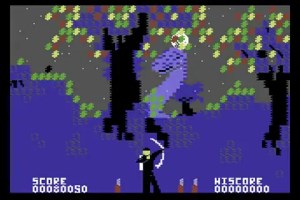
The adventure is effectively structured as a series of encounters. Giant spiders provide the first taste of combat, followed by increasingly dangerous creatures including a huge flying insect, jumping frogs, dragons, skeleton warriors, a phantom and enormous snakes. Eventually the player confronts the Demogorgon itself. Different difficulty settings alter the number and speed of enemies, ranging from the relatively forgiving “Innocent” setting to the appropriately named “Crazy.”
There is a distinctive rhythm to combat. The archer cannot simply spray projectiles across the screen. An arrow must be prepared, aimed and released, and the restricted ammunition encourages reasonably careful shooting. According to surviving game documentation, the player begins with three lives and up to four quivers of arrows. The game therefore combines arcade action with a small element of resource management.
Failure is also part of the spectacle. Being caught by one of the monsters results in unusually violent death animations for an early home-computer game. Blood splashes across the screen, creatures maul the unfortunate archer, and the accompanying audio turns defeat into a miniature horror sequence.
That violence was quite deliberate. Norman later recalled testing an early spider encounter in which he simply allowed the archer to be killed; the shocked laughter the blood effect produced convinced him that it worked.
There is even a touch of dark humour. After overcoming a major danger, the tiny archer performs an enthusiastic victory dance. The result is an unusual combination of menace, gore and absurdity that gives Forbidden Forest considerably more personality than its basic run-and-shoot structure might suggest.
Technical Sorcery
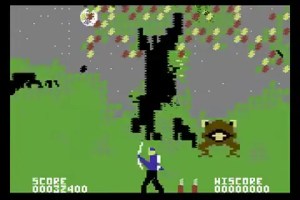
Technically, Forbidden Forest is interesting because its most impressive effects are not necessarily the most sophisticated ones. The graphics are chunky even by later C64 standards, and the characters cannot compete with the detailed sprite artwork that programmers would produce once developers had spent several more years mastering the machine.
Instead, Norman concentrated on presentation.
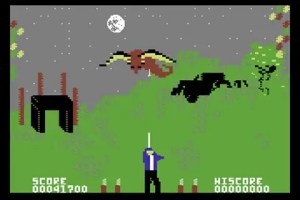
The forest uses layered movement to produce a convincing suggestion of depth. Foreground and background elements scroll at different rates, giving the landscape a parallax effect, while some enemies appear to approach from deeper within the scene. The result is not genuine three-dimensional graphics, but it creates enough spatial separation to make the forest feel more like a place than a flat shooting gallery. Contemporary and retrospective descriptions frequently emphasise this pseudo-3D quality.
Even more important is the passage of time. The game begins with some daylight remaining, but the sky gradually darkens as the adventure continues. Stars appear and the moon travels across the night sky. Today this may look like a modest cosmetic touch; in an early 1980s action game it was an effective piece of environmental storytelling. The changing background quietly tells the player that the journey is progressing deeper into both the forest and the night.
Then there is the sound.
The Commodore 64’s SID chip was capable of far richer audio than many competing home computers, and Norman used music as part of the game’s dramatic structure rather than merely as decoration. Different situations receive different musical cues and threatening effects. Repetitive motifs become part of the tension, while attacks and deaths are punctuated with dramatic sounds. Later commentators have repeatedly singled out the soundtrack as one of the game’s strongest features.
That combination of graphics, movement, changing light and audio is the real technical achievement of Forbidden Forest. None of its individual components is astonishing in isolation. Together, however, they produce atmosphere—and atmosphere was something many games of 1983 barely attempted.
Strange Facts
Forbidden Forest was one of Paul Norman’s earliest C64 projects and helped establish his reputation as one of Cosmi’s most distinctive developers. Norman was not interested solely in programming technique. In later interviews he repeatedly described his work in terms that suggest a fascination with cinema, performance and the overall effect of a scene. That philosophy is easy to recognise in Forbidden Forest, where individual moments often matter more than mechanical complexity.
Its monsters also have cinematic roots. Sources on the game connect their inspiration to fantasy and monster films including Jason and the Argonauts, Mysterious Island and Night of the Demon. The skeleton warriors in particular inevitably recall Ray Harryhausen-style stop-motion fantasy creatures.
The final enemy’s name is another memorable detail. Long before “Demogorgon” became familiar to mainstream audiences through Stranger Things, C64 players were already firing arrows at a monster bearing that name.
The game was successful enough to receive a sequel, Beyond the Forbidden Forest, in 1985. Norman expanded the depth concept considerably, allowing movement into and out of the screen and marketing the system with the wonderfully extravagant name “OmniDimension 4D.”
Nearly two decades later the series was revived again with a 2003 Windows title commonly regarded as a third Forbidden Forest game.
Period Reviews
Contemporary reviewers generally reacted warmly to Forbidden Forest, although opinions varied depending on how much importance a critic placed on graphics, playability or atmosphere.
A surviving index of magazine reviews records Computer & Video Games giving the game 7/10, while Commodore User and Home Computing Weekly both awarded it 4/5. Personal Computer Games was even more enthusiastic, rating it 9/10. Your Commodore subsequently gave it the maximum 5/5 in its November 1984 issue.
One recurring theme was that the graphics themselves were not necessarily exceptional, but the complete experience was. That distinction is important. Forbidden Forest did not impress simply by putting attractive sprites on the screen; reviewers responded to its combination of danger, music and gruesome surprises.
The game retained its reputation beyond its initial release. In the first issue of the influential British magazine Zzap!64 in 1985, it appeared at number 21 in the magazine’s selection of 64 leading C64 games. When Zzap!64 reviewed a budget re-release in 1987, the magazine acknowledged the blocky graphics but still praised the atmosphere, sound and gameplay, awarding an overall score of 82 percent.
Those reviews underline an interesting aspect of the game’s history. Even only a few years after release, its graphics were beginning to look primitive. Its ability to create tension had aged far better.
Lasting Shadows
The cultural importance of Forbidden Forest lies less in introducing a single revolutionary technology than in demonstrating a different way of constructing a computer game.
It treated presentation as part of the design.
The changing sky was not essential to scoring points. The frightening soundtrack was not essential to calculating collisions. Blood did not change the rules. The moon crossing the sky did not make an arrow fly differently. Yet remove these elements and much of what players remember about Forbidden Forest disappears.
In that sense Norman anticipated a philosophy that would become increasingly important in later game development: mechanics and atmosphere do not have to exist separately. Music can react to events. Environments can change with the progression of the game. Enemies can be introduced theatrically. Death can become a dramatic event rather than simply a “Game Over” message.
The game also occupies an interesting position in the early history of horror gaming. It is not survival horror in the later Resident Evil sense, nor does it create psychological terror comparable to modern horror games. Its method is much simpler: darkness, grotesque monsters, threatening sound and the constant possibility of a spectacularly unpleasant death.
Yet those ingredients proved remarkably effective. Retrospective accounts frequently focus less on scores or technical achievement than on memories of being genuinely unsettled by the game, particularly when playing alone. Lemon64’s retrospective review, for example, recalls how frightening the combination of music, monsters and gore could feel at the time.
Its influence can also be seen directly. The 1985 C64 title Amazon Warrior adopted an extremely similar structure and control system, replacing the forest archer with a jungle warrior armed with a blowpipe.
More broadly, Forbidden Forest belongs to the group of early C64 games that helped establish the computer’s identity as more than a machine for arcade conversions. Developers such as Norman discovered that the SID sound chip, scrolling graphics and flexible presentation could create experiences with a personality quite different from contemporary coin-operated games.
Decades later, retrospectives still regularly identify Forbidden Forest as a defining or memorable Commodore 64 title. Retro Gamer, for example, has continued to highlight it for its atmosphere and surprisingly graphic violence.
Final Arrow

Playing Forbidden Forest today requires some historical imagination. The animation is rough. Hit detection can feel unpredictable. Movement is slow, aiming takes practice and the forest contains far fewer surprises than its ominous presentation initially suggests. Anyone approaching it after decades of increasingly sophisticated action and horror games will immediately see the technical limitations.
But concentrating on what it cannot do misses what made it special.
In 1983, Paul Norman took a straightforward action game about shooting monsters with arrows and surrounded it with theatre. The forest darkens. The moon rises. Music warns that something horrible is approaching. A creature emerges from the scenery. The player hurriedly prepares an arrow—and if the shot fails, the resulting death may be almost as entertaining as victory.
That combination gave Forbidden Forest an identity that many technically superior games never achieved.
It is therefore remembered not because it perfected arcade combat, nor because it pushed the Commodore 64 to its absolute technical limits, but because it understood something surprisingly early in the history of home gaming: players remember how a game makes them feel.
And more than forty years later, Paul Norman’s forbidden forest can still feel like a very unpleasant place to spend the night.






Kommentar verfassen