

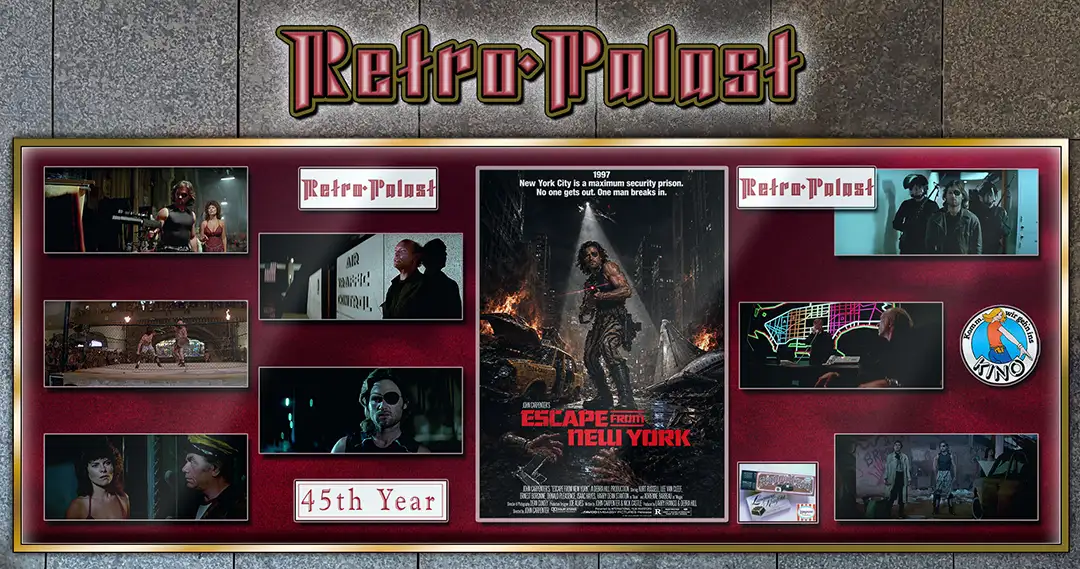
In 1988, the crime rate in the United States rises four hundred percent.
The once great city of New York becomes the one maximum security prison for the entire country.
A fifty-foot containment wall is erected along the New Jersey shoreline, across the Harlem River,
and down along the Brooklyn shoreline. It completely surrounds Manhattan Island. All bridges and waterways are mined. The United States Police Force, like an army, is encamped around the island. There are no guards inside the prison, only prisoners and the worlds they have made.
The rules are simple: once you go in, you don’t come out.
A Bleak Vision of the Future

John Carpenter’s “Escape from New York” from 1981 is one of those films that have transcended their own genre. At first glance, it’s a gritty science fiction action film with B-movie energy, a gritty urban aesthetic, and a laconic antihero at its center. But after just a few minutes, it becomes clear that Carpenter has more in mind here than mere suspenseful entertainment. The film depicts an America shaped by fear, mistrust, and authoritarian harshness. In this vision, Manhattan is no longer a metropolis of opportunity, but a gigantic maximum-security prison—a symbol of the moral and political decay of a society that doesn’t solve its problems but simply locks them away.
It is precisely this blend that continues to make the film so compelling to this day. “Escape from New York” is at once an adventure film, a futuristic satire, a swan song to the urban America of the late 1970s, and a character study of a man who no longer truly belongs in any social order. John Carpenter captured the uncertainty of his time—the loss of trust in political institutions, the fascination with violence in cinema, the fear of crime in cities—and translated all of that into a cold, bleak vision of the near future. The fact that this future, from today’s perspective, is long past does nothing to diminish the film’s power. On the contrary: precisely because his vision of the future was so clearly born of the concerns of the time in which it was created, the film comes across as a condensed snapshot of an entire era.

Added to this is the central character Snake Plissken, played by Kurt Russell, who here finally shed his image as a wholesome Disney teen star. Snake is no classic hero. He doesn’t rescue the president out of patriotism, but because he’s forced to. He’s cynical, taciturn, distrustful, and seems as though he’s long since withdrawn from society on the inside. That’s exactly why he fits perfectly into Carpenter’s worldview: in a broken social order, only someone who no longer believes in it can survive.
“Escape from New York” is not just a cult film because it features cool visuals, striking characters, and iconic synthesizer music. It’s a cult classic because it uses simple means to create a world that’s instantly recognizable and, at the same time, seems larger than the film can actually depict. Every aside, every set, every glance at the ruins of Manhattan hints at an entire story. Therein lies its special quality—and its lasting influence.
Manhattan as Hell

The plot is quickly told, yet its simplicity is one of the film’s great strengths. In the futuristic year of 1997, crime in the U.S. has skyrocketed. The government has completely sealed off Manhattan from the rest of New York and turned the island into a massive prison. There are no guards within the walls, no rehabilitation, no hope of return. Once thrown in, you stay there—in an anarchic world of gangs, looters, and improvised power structures.
When Air Force One is hijacked by revolutionaries and forced to crash over Manhattan, the President of the United States suddenly finds himself in the midst of this nightmare. For the government, this is a catastrophe, because the president is carrying a tape that is of enormous importance for an international peace conference. Time is running out, so the government resorts to a radical measure: Snake Plissken, a former soldier and current convict, is to infiltrate the city, rescue the president, and get out again within a few hours.

Of course, Snake doesn’t accept this offer voluntarily. To prevent him from attempting to escape, he is injected with explosive capsules that will kill him if he fails to complete the mission in time. This plot device alone reveals the film’s core theme: the government uses the outsider, yet despises him at the same time. Snake is both a tool and a disposable commodity. His mission takes him through the most diverse zones of “Prison Manhattan”—across dark streets, dilapidated buildings, makeshift arenas, and grotesque centers of power—until he encounters characters who are partly allies, partly traitors, and partly mere survivalists.
Among them are the taxi-driving Cabbie, the shady Brain, whose pragmatic loyalty can shift at any moment, and Maggie, who is more determined and dangerous than many of the men around her. Looming over it all is the Duke of New York, a charismatic gangster king who rules the prison with flamboyant self-aggrandizement. A narrative unfolds among these characters that, while not particularly complex, is highly effective: a race against time in which it remains constantly unclear whom Snake can trust—and whether the president’s life is even more important than the moral condemnation the film passes on his political world.

The atmosphere is particularly powerful. Carpenter is less interested in spectacular futuristic technology than in the feeling of an urban apocalypse. Manhattan is not a gleaming science-fiction scenario, but a landscape of ruins. Neon lights, fire, shadows, rubble, shattered facades, and empty streets paint a picture of a civilization that did not perish in a great war, but slowly decayed. It is precisely this that gives the film an almost mythical power. Snake moves not only through a prison island, but through the physical embodiment of societal decay.
In the end, “Escape from New York” is therefore more than just a rescue mission. The real tension lies not in whether the president is saved, but in what the film reveals about power and morality. For the closer Snake gets to his goal, the clearer it becomes that the difference between official order and organized violence isn’t nearly as great as it initially seems.
Faces of the Nightmare

Kurt Russell carries the film almost single-handedly, and that is precisely one of its greatest strengths. As Snake Plissken, he combines physical presence with ironic detachment. Russell doesn’t portray the character as an invincible muscle hero, but as a seasoned professional who is dangerous only because he thinks faster, reacts faster, and harbors no illusions whatsoever. His terse dialogue, the famous eye-patch look, and his gravelly voice make Snake one of the most iconic figures of 1980s cinema.
It’s remarkable how deliberately Russell subverts classic hero archetypes. Snake never really comes across as heroic in the traditional sense. He’s exhausted, irritable, and often visibly annoyed by the stupidity or arrogance of others. That’s precisely what makes him believable. He doesn’t fight for ideals, but for his sheer survival. In many scenes, a single glance or a dryly delivered line is all it takes for Russell to define this character’s cynicism.
In addition, Carpenter assembles an excellently chosen ensemble. Lee Van Cleef embodies Bob Hauk, the police chief, with cold authority. His character is not just a superior but the personification of the interests of the state: matter-of-fact, efficient, and morally questionable. Donald Pleasence deliberately plays the President of the United States as an unappealing figure. He is not a strong leader, but a man whose political office makes him seem more important than his personality. It is precisely this that gives the film its edge, for Snake is not risking his life for an admirable person, but for a symbol of power.

Ernest Borgnine, as the cabbie, adds an almost tragicomic touch. Amid the film’s darkness, his character brings warmth, chattiness, and a hint of old-fashioned big-city charm. Harry Dean Stanton, as Brain, lends the film that nervous ambivalence that makes its supporting characters so interesting: Brain is intelligent, opportunistic, and never entirely trustworthy. Adrienne Barbeau plays Maggie with a feisty energy and refuses to be reduced to a mere sidekick. Finally, Isaac Hayes makes an unforgettable impression as the Duke of New York. With his blend of gangster swagger, political symbolism, and theatrical coolness, the Duke is more than just a run-of-the-mill villain—he is a grotesque king in a crumbling alternative world.
This cast showcases Carpenter’s knack for faces and voices. Many characters have relatively little screen time, yet they immediately stick in the memory. That’s because Carpenter clearly defines them without over-explaining them. In “Escape from New York”, a single appearance, a costume, or a single line is often enough to permanently anchor a character in the cinematic memory.
Fun Facts About the Shoot

The story behind the film’s creation is almost as interesting as the film itself. John Carpenter wrote the screenplay as early as the mid-1970s, long before actual production began. He was inspired by the political climate following Watergate, by urban anxiety, and by a general loss of trust in government institutions. The fact that the film could only be made after the success of “Halloween” shows just how risky the project initially seemed. Too dark, too strange, too unsettling—that’s how the idea must have appeared to many producers.
Although the film is set in Manhattan, a large portion of the exterior shots were filmed in St. Louis. This was for both practical and aesthetic reasons. Parts of the city center appeared heavily damaged following a devastating fire and provided exactly the post-apocalyptic, ruin-like look Carpenter was seeking. This created the paradoxical image of a New York that, in reality, is largely not New York at all—and that is precisely why it appears so dreamlike in the film.
Technically as well, the film is a remarkable example of how to create a believable world on a limited budget. Carpenter relies not on expensive, over-the-top special effects, but on miniatures, matte paintings, lighting atmospheres, and clever editing. The sequence in which the glider flies over Manhattan became particularly famous. Parts of this effect were created using models and unusual photographic techniques that give the image a stylized, almost ghostly character. Today, some of the effects may look visibly “analog,” but that is precisely where their charm lies. They belong to an era when science fiction was still defined by craftsmanship and ingenuity.
It’s also interesting that Kurt Russell declared the role of Snake Plissken to be his personal favorite character. This comes as no surprise, as hardly any other role at the time gave him such an opportunity to combine toughness, laconicism, and ironic self-assertion. Snake became the character that finally established Russell as being in a league of his own.
There is another fascinating aspect: The film made such a striking impression that it later became not only a cultural reference but also legally significant. Decades after its release, a French court ruling determined that key elements of Luc Besson’s science-fiction film “Lockout” were too similar to “Escape from New York”. This speaks volumes about how clearly Carpenter’s film is structured and how recognizable its motifs have become.
Reactions from the Summer of 1981

Critics at the time did not react uniformly, but they did respond very attentively to the film. Many reviewers immediately recognized that Carpenter was not presenting a prestigious futuristic film in the style of a major studio spectacle, but rather a gritty, idiosyncratic, and deliberately pulpy take on science fiction. This very aspect was praised by some and viewed with skepticism by others.
The atmosphere was frequently highlighted as a positive aspect. Critics praised the dense, paranoid mood and the visual consistency with which Carpenter designed his prison-like Manhattan. Contemporary reviews described it as a raw, effective, and unusually gripping summer film. Kurt Russell’s presence was also widely noted, as he showcased a new, tougher on-screen persona here.
But there were also reservations. Some critics felt that, narratively, the film consisted more of episodes than of a truly gripping dramatic structure. Roger Ebert, for example, saw it as a technically well-crafted and at times effective film, but criticized the fact that the story, as a grand adventure, never quite achieved the emotional impact that its premise promised. Others were bothered by the fact that Carpenter preferred to hint at his world rather than explore it psychologically. Those expecting classic character development or a more morally structured adventure might have found the film cold or unfinished.

It is precisely this ambivalence that is interesting in retrospect. “Escape from New York” became significant not because it was immediately hailed as an undisputed masterpiece, but because many critics sensed that it functioned differently from the typical mainstream film. It was stylistically distinctive, politically cynical, and strikingly dry in tone. Some saw this as a strength; others, as a limitation. Yet almost no one mistook it for run-of-the-mill assembly-line fare.
Added to this was the timing of its release. In 1981, blockbuster cinema was heavily dominated by spectacular adventures, optimism, or at least clearly defined heroic figures. Carpenter’s film countered this with a grumpy, distrustful worldview. This might have seemed off-putting at first, but in the long run, it ensured that the film stuck in people’s minds. What may have seemed too harsh, too cold, or too malicious to some reviewers at the time is now an essential part of its appeal.
Traces in Pop Culture

The cultural influence of “Escape from New York” is enormous and extends far beyond the cinema. First, the film established Snake Plissken as a archetype of the modern antihero, a figure who spawned countless variations in the 1980s and 1990s: taciturn, disillusioned, yet highly competent; a man with a past, scars, and utter skepticism toward all institutions. Many later action heroes owe Snake at least an indirect debt.
The film’s visual language also had a lasting impact. The motif of the decaying metropolis as an arena of the near future was taken up in numerous genre works. This is less about direct copies than about an attitude: the future appears not as progress, but as an intensified version of the present. Carpenter’s Manhattan is not a distant fantasy, but a darkened mirror of real social fears. This aesthetic became formative for cyberpunk, dystopian action films, and urban science fiction as a whole.
The film’s influence on video game culture is cited particularly often. The similarity between Snake Plissken and Solid Snake from the Metal Gear series is hard to miss—from their names to their aura to the demeanor of the isolated elite fighter. Added to this are references such as the name “Pliskin” in later games. Even though game developers often draw their influences from many sources, the connection to Carpenter is particularly clear here.
Furthermore, the film influenced writers and filmmakers through its art of suggestion. Author William Gibson pointed to the impact of the casual bits of world-building scattered throughout “Escape from New York”. It was precisely this technique—not explaining a world completely, but making it seem larger than what is immediately shown—that later became a core principle of many cyberpunk narratives.

Last but not least, the film has remained a fixture in the history of music and style. John Carpenter’s electronic score, with its cold, driving synthesizer pads, is among the genre’s most distinctive soundscapes. It lends the film a mechanical, relentless momentum and became an important reference point for later synthwave and retrowave aesthetics, which continue to draw on 1980s cinema to this day.
It is therefore no coincidence that “Escape from New York” continues to be remade, continued, referenced, and discussed decades later. The film offers such a clear central concept and such a distinctive atmosphere that it repeatedly resurfaces as a point of reference. It is one of those works that, with modest means, generated a cultural resonance that far more expensive productions never achieved.
More Than Just a Cult Classic

Ultimately, “Escape from New York” remains a film of contradictions—and that is precisely why it is such a compelling classic. It is raw yet precise. It appears low-budget yet is stylistically masterful. It is both popcorn cinema and political dystopia, an action thriller and a bitter commentary on state brutality, urban anxiety, and social decay. John Carpenter pulls off the feat of not neatly separating all these elements, but rather fusing them into a single, unmistakable experience.
What truly makes the film stand the test of time is its stance. It believes neither in heroic institutions nor in simple redemption. Even the rescue of the president, in Carpenter’s world, ultimately appears not as a moral victory, but as part of a cynical game of power, control, and symbolic order. Snake Plissken is the ideal protagonist in this context: a man who admires no one, glosses over nothing, and precisely for that reason comes across as one of the most honest characters in his genre.

Today, “Escape from New York” can be viewed as a time capsule of the early 1980s, as a style-defining cult film, or as a bridge between New Hollywood cynicism, science fiction, and modern action cinema. It works surprisingly well in each of these interpretations. It shows what’s possible when a director works with a clear vision, a strong sense of rhythm, and a flair for iconic imagery.
Perhaps that’s the real reason why the film has never completely faded from view: It doesn’t feel like a product, but rather like a warning, a nightmare, and an adventure all at once. And it is precisely this blend that makes “Escape from New York” far more than just a nostalgically revered genre classic to this day. It is a film that not only entertains its audience but also presents them with a world in which order and barbarism lie frighteningly close to one another.
More
Trailer
External links
Notice Regarding Image Rights and Copyrighted Material
All images, film stills, posters, logos, trailer excerpts and other copyrighted materials used in this article are used solely for editorial reporting, film criticism, review and illustrative purposes related to the respective content.
Unless otherwise stated, all copyrights, trademark rights and other intellectual property rights in the materials used remain with their respective rights holders, including film studios, distributors, production companies, photographers, artists or other licensors.
The materials are used in good faith and with regard to applicable legal limitations, licence terms and source attributions. If, despite careful review, any rights have been infringed or any attribution is incomplete, please contact me. Upon review, the relevant content will be removed or corrected promptly.







Schreibe einen Kommentar