

The First Key
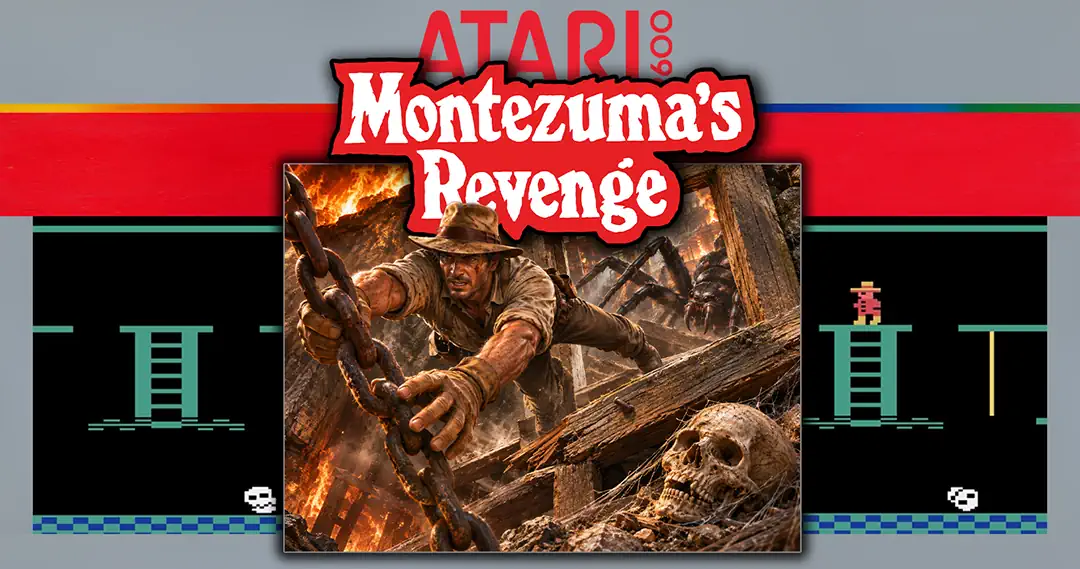
The first key in Montezuma’s Revenge looks close enough to collect in seconds. Panama Joe stands on a platform near the top of the screen. The key hangs off to his left, a ladder leads down, and a skull rolls across the floor below. From the sofa, you can see almost everything that matters. From Joe’s position, the key might as well be on the far side of a ravine. Getting to it means working out how to descend safely, when to cross the skull’s path, and where to climb again. By the time you pick it up, those few inches of television screen have acquired a geography. You also have a fresh problem. The doors are back up at the top.
Parker Brothers released the Atari 2600 edition in 1984, adapting an adventure that teenage programmer Robert Jaeger had developed on an Atari home computer. The premise belonged to the treasure-hunting tradition of Saturday matinees. An explorer in a hat ventures into an emperor’s fortress, hoping to come out rich. What gave that familiar setup its personality was the amount of thought required to move through a single room. Joe could run into danger as readily as any arcade hero. He could also stand perfectly still on a ledge while the person holding the joystick considered whether a key seen three rooms earlier was worth going back for.
Inside the Fortress
Joe walks with the joystick and jumps with its single button. He can climb ladders, catch hanging chains, and fall just far enough to make a shortcut a terrible idea. Each creature asks for a slightly different response. A rolling skull invites a jump, while a bouncing one leaves room for Joe to walk underneath. A stationary snake is particularly mean. It gives you all the time in the world to line up the jump, then kills you if you get it wrong. Conveyor belts complicate the familiar business of approaching an edge. Ride one in its direction of travel and the place where you meant to take off comes up alarmingly fast.
The four-slot inventory gives these small encounters consequences beyond the current screen. A sword can get Joe past a skull or spider, but the blade is spent on contact. A torch lasts for the rest of the level and reveals the architecture of the dark chambers below. Even collecting jewels requires some forethought. Although a jewel never appears in the inventory window, Joe cannot pick one up while all four spaces are occupied. A player who has carefully gathered every available tool can find himself standing under a perfectly good jewel with no way to claim it. Suddenly there is something to be said for having used that sword upstairs.
At the bottom of the fortress, the pace changes. The treasure chamber gives Joe just a few seconds to grab flashing jewels before the next difficulty level begins. After a descent spent watching enemies, weighing detours, and waiting for openings, it feels wonderfully reckless to hurl him at everything in reach. The jewels matter beyond the satisfaction of a high score. Every 10,000 points earns another Joe, up to a maximum of six. A good haul can buy the life that lets you survive an unfamiliar hazard on the next trip down.
Cartridge Craft
The Atari 2600 had 128 bytes of built-in RAM and no frame buffer in which to assemble a complete picture. To produce a stable image, the program had to supply instructions to the video hardware as the television drew its scan lines. Consider what the cartridge puts on screen under those conditions. You can follow the progress of a rolling skull, judge the distance between Joe’s feet and the lip of a platform, and glance up to see what he is carrying. All three can affect your next move. The coarse graphics serve the player particularly well at the edge of a pit, where a clean horizontal line is about the most valuable detail an artist could provide.
The clearest concession to the hardware is the size of the fortress. The 2600 edition fits its adventure into 24 rooms, a substantial reduction from the roughly 100 associated with the larger versions. Each chamber occupies a fixed screen. Cross a boundary and the next room appears in full, giving you an instant to take in its arrangement. The same floor plan returns on harder levels with changes to the hazards, so the effort of learning your way around pays off. Sound supplies one of the port’s most personable touches. Picking up an item triggers a snatch of “La Cucaracha,” an unexpectedly jaunty accompaniment to the business of staying alive underground.
Becoming Panama Joe
Before he was Panama Joe, the explorer was Pedro. Jaeger recalled that Parker Brothers also tried out Panama Jack, only to discover that a clothing company had already claimed the name. The eventual choice stuck well enough for the publisher to send a model dressed as Panama Joe to the Consumer Electronics Show. The costume inevitably called Indiana Jones to mind, even for Jaeger. His own account of the character’s origins points somewhere more eccentric. One figure he had in mind was Bobo Belinski, a character by underground cartoonist Robert Crumb. The little man on the cartridge thus had a rather different family tree from the movie adventurer a shopper might have recognized on the box.
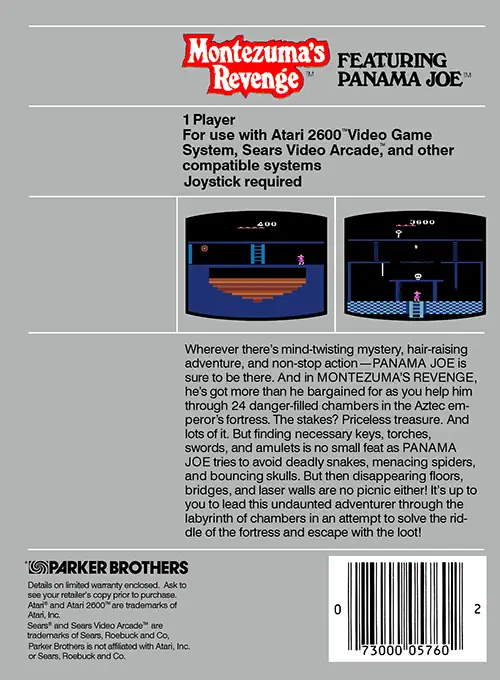
Montezuma himself had an even stranger journey. Jaeger’s early computer version contained an enormous figure of the emperor, but the programmer had yet to devise a way for the player to defeat him. When Parker Brothers took over the adaptations, Jaeger was relieved to be told he could stop worrying about the ending. The commercial cartridge gives Joe a treasure chamber to raid, and the emperor gets to keep his name in the title. There is another small mystery for anyone who reads the 2600 instruction booklet closely. Its description awards 300 points for collecting a torch. The scoring table at the back promises 3,000. On the subject of taking one into a dark room, however, the instructions are admirably clear.
The 1984 Verdict
In September 1984, The Video Game Update described Montezuma’s Revenge as a pleasant surprise from an industry that had given its readers little to get excited about in recent months. Its review covered several editions and specifically flagged the Atari 2600 version for separate treatment. What pleased the reviewer about the adventure was how its demands developed. The joystick was straightforward, and the player could soon learn what to do about an individual creature. The real test came when a room combined a creature, a difficult jump, and an obstacle that kept its own time. The reviewer singled out that escalation as a reason to keep playing.
One example from the review captures the mood of those early encounters. A player crossing a patch of disappearing floor also has to deal with a rolling skull. Anyone who watches only the skull risks landing where the floor used to be. The critic admired the satisfaction of learning to handle both at once, along with the gradual discovery of safe routes through the fortress. The newsletter’s year-end awards add some perspective to that enthusiasm. Montezuma’s Revenge took the Atari 5200 award, while Pitfall II won on the 2600. For someone choosing a cartridge in 1984, the older console had two rather good answers to the question of what might lie beneath a hole in the ground.
An Unlikely Afterlife
Jaeger named Donkey Kong, Adventure, and Superman among his inspirations. You can see the attraction each held for someone designing this fortress. A ladder and a moving enemy are enough to stage a little piece of arcade theatre. Give the climber an object he can carry through a doorway, though, and what happens on that ladder can matter several rooms later. Players familiar with Metroid will recognize the pleasure of remembering an obstacle and realizing they now have a means of getting past it. Montezuma’s Revenge offered an early, compact expression of that pleasure, with a disposable key doing much of the work a permanent new ability might perform in a later adventure.
Decades later, the 2600 cartridge acquired an audience with a professional interest in that first key. Researchers training artificial intelligence systems on Atari games found Montezuma’s Revenge exceptionally difficult. A human spots a key and already has a reason to go looking for a way down. A program learning from the score can climb partway, make a promising jump, and die without receiving a single point to distinguish that attempt from aimless wandering. In 2018, researchers reported that their Go-Explore algorithm could complete all three distinct levels. Its approach included keeping track of places it had reached and returning to promising ones to explore further. There is something pleasingly familiar in that idea for anyone who ever sketched the fortress on paper and pencilled a question mark beside an unopened door.
One More Descent
There are good reasons to put the joystick down. A fatal fall can feel severe when Joe’s feet have missed a ledge by a sliver, and on the harder levels an enemy can catch him almost as soon as he enters a room. Yet the compact fortress gives failure an unusually precise remedy. You can often name the thing you want to try next, right down to the spot where you mean to stand while the skull rolls past. Starting over with that small experiment in mind is much more inviting than a bald instruction to beat your score.
The nicest measure of progress comes when you return to the opening room after a few trips below. On your first visit, getting the key was enough to occupy your whole attention. Now you can take in the room at a glance and think about which door you want to open once you have it. The skull still rolls at your feet. The jump still needs a steady hand. Somewhere along the way, though, a player who was happy just to reach the floor has begun making plans for the far side of the fortress. Few Atari cartridges make that change quite so satisfying.
More
Box and Cartridge









Schreibe einen Kommentar