

Computer! Computer?
Hello, computer.
Just use the keyboard.
Keyboard. How quaint.
An Unlikely Homecoming
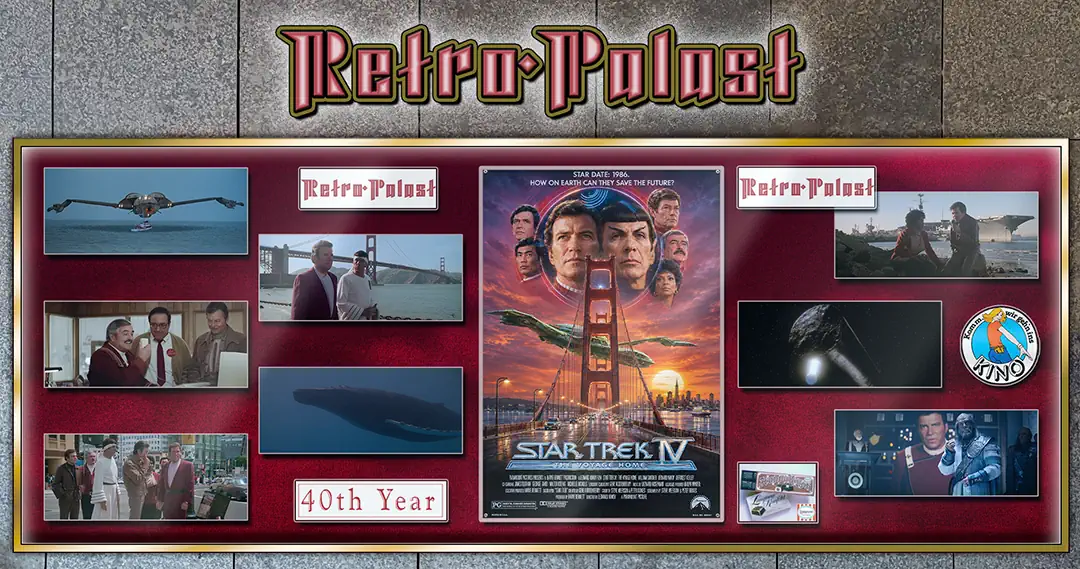
One of the best jokes in Star Trek IV: The Voyage Home involves a computer that works perfectly well. Scotty, chief engineer of the starship Enterprise, sits down at a twentieth-century desktop and politely addresses it. Nothing happens. Someone points him toward the mouse, which he raises to his mouth like a microphone. James Doohan gives the machine every chance to redeem itself. By the time Scotty reluctantly reaches for the keyboard, we have seen several centuries of technological progress from the uncomfortable perspective of the people who bought the wrong computer. We have also learned something about a man who has spent his career coaxing temperamental machinery into doing him favors. Apparently, he starts by asking nicely.
Released in 1986 and directed by Leonard Nimoy, the fourth Star Trek feature finds an entire adventure in that change of perspective. San Francisco becomes the strange new world, and the people in the audience get to recognize their own habits through the eyes of seven bewildered visitors. It was an unexpected destination for a series that had recently buried Spock, resurrected him and destroyed the Enterprise in the process. Yet the change feels natural once the crew reaches California. Having spent two films discovering what these friends would sacrifice for one another, we finally get to spend an afternoon in their company. As it turns out, the prospect of watching Kirk explain Spock to a woman he hopes to impress is quite enough to keep a movie going.
The Silent Ocean
The story begins on Vulcan, where Admiral James T. Kirk and his officers have decided to return to Earth and face the consequences of disobeying orders to save Spock. Their transport is a captured Klingon Bird-of-Prey, an awkward vessel in which to arrive for a disciplinary hearing. Before they can get there, a vast probe approaches Earth, disabling ships and sending a powerful signal into the oceans. Storms gather, power fails, and the Federation can find no way to answer. Spock recognizes a possibility everyone else has overlooked. Heard underwater, the signal resembles the song of a humpback whale. The callers may have been holding a conversation with Earth for longer than humans have been listening, only to discover on this visit that the other party has fallen silent. Humpbacks are extinct in Kirk’s century.
Kirk orders a slingshot around the sun that carries the ship back to 1986. Across the Golden Gate Bridge, marine biologist Dr. Gillian Taylor introduces visitors to George and Gracie, two captive humpbacks soon to be released into the wild. She takes a dim view of Spock climbing into their tank, and a considerable part of Kirk’s mission consists of persuading her that his explanation is even stranger than the sight she has just witnessed. Meanwhile, Scotty and McCoy need materials for an enormous onboard aquarium, and Uhura and Chekov need energy from a nuclear reactor to get the ship home. These errands gradually collide. Chekov lands in the hospital, the whales are released ahead of schedule, and Gillian must decide what she believes quickly enough to act on it. By the time a whaling ship closes in on George and Gracie, the audience knows exactly how many unlikely things had to go right for a Klingon spacecraft to materialize over that particular patch of sea.
Finding the Story
Nimoy and producer Harve Bennett had several possible destinations in mind while developing the film. Nimoy later recalled considering both the Stone Age and the 1890s. The appeal of contemporary Earth was the freedom it gave the filmmakers to dispense with explanations. Put Kirk on a twentieth-century bus and the audience already knows the fare is going to be a problem. Finding a reason for the journey took longer. A conversation with a friend about endangered species brought humpback whales and their mysterious songs to Nimoy’s attention. Here was a sound that people could record, study and recognize while remaining uncertain about its meaning. Imagining a distant intelligence that understood every note gave him a science-fiction premise and a reason to care about two individual animals.
Steve Meerson and Peter Krikes worked on early drafts before Nicholas Meyer, who had directed The Wrath of Khan, joined the writing process. Meyer and Bennett divided the screenplay geographically and chronologically. Bennett took the opening and closing passages in the twenty-third century, while Meyer tackled the adventure in the twentieth. He had one understandable reservation. Having already sent H. G. Wells to San Francisco in his time-travel film Time After Time, he wondered whether the Enterprise crew might consider Paris. San Francisco stayed, a decision that pays off beautifully in the finished picture. The Golden Gate Bridge helps orient us as the crew scatters across the bay, and the water is always close at hand. Even the most earthbound errands take place in a city whose geography keeps quietly pointing us back toward the whales.
Friends Among Strangers
William Shatner understands how funny Kirk can be when charm gets him only halfway through a conversation. Over pizza with Gillian, he has the full attention of an intelligent woman, which is usually a promising development in his experience. Unfortunately, the subject on which she would like him to elaborate is the transportation of two adult humpbacks through time. Catherine Hicks gives their scenes a lovely, uneven rhythm. Gillian enjoys Kirk’s company, grows impatient with an evasive answer, then finds herself curious enough to ask another question. Her affection for the whales also gives her an independent stake in the adventure. When she eventually decides to go forward in time, it feels entirely in character that she should take the decision out of Kirk’s hands. She has listened to his plans long enough to have developed a few of her own.
Nimoy has the more delicate assignment of directing the comedy while playing a man who rarely realizes he is participating in it. His Spock treats profanity as a branch of linguistics requiring field practice, and his careful delivery suggests he would welcome corrections on usage. Around him, the ensemble finds humor in professional pride. DeForest Kelley’s McCoy passes a patient in a hospital corridor and becomes so appalled by twentieth-century medicine that he has to intervene. George Takei lets Sulu admire a helicopter with the enthusiasm of a pilot who knows a beautiful machine when he sees one. Nichelle Nichols keeps Uhura composed through a precarious mission, while Walter Koenig gives Chekov an unguarded friendliness that makes his predicament particularly funny. Everyone in Cold War America understands why a Russian asking directions to nuclear vessels might attract attention. Chekov, who grew up in the future that Star Trek imagines for us, has every reason to expect a helpful answer.
Movie Magic
The whales presented a problem that even Scotty might have preferred to leave to someone else. George and Gracie had to swim on cue, occupy convincing space beside human performers and survive a close encounter with a harpoon. Much of what appears on screen was achieved with remote-controlled models, supplemented by footage of real whales, particularly in the breaching shots. Their slow turns are especially persuasive. The body seems to follow a decision the head made a moment earlier, giving an impression of weight that sheer size alone could never convey. According to a production retrospective, some viewers even wrote to complain that the filmmakers had taken their cameras too close to the animals. The fictional Cetacean Institute was another successful substitution. The Monterey Bay Aquarium stood in for the facility in Sausalito, with artists adding the distant San Francisco skyline to complete the view.
A smaller piece of production ingenuity supplied the loudest passenger on Kirk and Spock’s bus. The punk with the boombox was played by associate producer Kirk Thatcher, who also helped create the music blasting from his character’s speakers. Much of the scene’s pleasure comes from the time Nimoy allows before Spock administers the Vulcan nerve pinch. Kirk tries courtesy, receives an unmistakable reply and exchanges a look with his friend. For anyone who has ever considered asking a stranger to turn down their music, that pause contains a familiar calculation about how much worse the next thirty seconds might get. The other passengers supply the punchline with their applause. For one brief stretch of the journey, Spock has understood local sentiment perfectly.
Opening Night Notices
When the film opened in November 1986, Roger Ebert found its outlandish premise a considerable part of its appeal. He judged it the funniest and most enjoyable Star Trek story yet, responding especially to the pleasure of watching the characters negotiate ordinary human situations. Rita Kempley of The Washington Post heard echoes of the television series in the film’s warmth and easy comedy. That observation helps explain an apparent paradox in its reception. A movie that spends much of its running time away from Starfleet, strands the crew without the Enterprise and dresses Spock in a headband could still feel to a longtime viewer like a return to familiar territory. The actors carried much of what people remembered about the series with them when they stepped off the ship.
Michael Wilmington of the Los Angeles Times identified a weakness that remains apparent today. There is a fair amount of unfinished business to clear up in the opening sequences, especially for somebody who has come along on the promise of a comedy about whales. Once the adventure got underway, however, Wilmington admired the assurance with which it played to an audience. The film went on to earn approximately $109.7 million at the domestic box office and received four Academy Award nominations, for cinematography, original score, sound and sound effects editing. Those last two seem particularly apt. The sound department had to create a call that could frighten us when we first heard it and move us when we finally heard an answer.
Beyond the Screen
In 1987, someone buying the film on home video in New York could also contribute to whale conservation. Retailer RKO Warner Theatres Video announced a drive pledging one dollar from each copy it sold to the Animal Welfare Institute’s Save the Whales campaign. The American Cetacean Society and Greenpeace USA had praised the film for drawing public attention to humpbacks, and its environmental reach extended to another unlikely venue when it screened at the Moscow Film Festival. The World Wildlife Fund helped sponsor that showing in recognition of the Soviet government’s recent whaling ban. There is a pleasing historical footnote in the sight of a film that found comedy in Chekov’s Cold War predicament traveling to Moscow with a conservation organization’s backing.
For viewers who came out of the theater wanting to hear more, there was also Whales Alive, an album by Paul Winter and Paul Halley featuring humpback recordings made by biologist Roger Payne. Nimoy provided narration, and a share of the proceeds went to the World Wildlife Fund. The album makes an unusually fitting companion to the movie because it invites a different kind of attention. In the theater, we wait for a whale to sing because Earth is in danger and the plot requires an answer. At home, with the voyage over and Kirk safely back on his bridge, there is time to listen to the length of a phrase, the interval before the next call and the strangeness of hearing an animal make a sound one might recognize again.
Coming Up Laughing
The moment I return to comes just after Kirk releases George and Gracie into San Francisco Bay. The whales have answered, the probe is leaving, and the crew is soaking wet. With the planet saved and their stolen ship sinking beneath them, these officers begin splashing one another. Even Spock gets caught up in it. Earlier, on Vulcan, his mother had asked how he felt, a question for which all his recovered knowledge supplied precious little guidance. Here in the water, surrounded by people delighted to have him back, he seems considerably closer to an answer. Nimoy lets the scene run long enough for us to enjoy something adventure films often hurry past. We get to see what relief looks like once the people who have earned it can finally let themselves be ridiculous.
Four decades on, The Voyage Home has acquired an extra layer of comedy. The streets, computers and everyday inconveniences that a 1986 audience could recognize at a glance now belong to a period as available for discovery as any other on Kirk’s travels. The friendships are easier to recognize than ever, and the ending still shows admirable restraint. George and Gracie sing. The probe replies. Nobody on the bridge supplies subtitles, and for once even Spock is content to let a mystery stand. After an adventure spent watching humans explain themselves, misunderstand each other and talk their way out of trouble, it is a pleasure to leave the last conversation to somebody else.
More
Notice Regarding Image Rights and Copyrighted Material
All images, film stills, posters, logos, trailer excerpts and other copyrighted materials used in this article are used solely for editorial reporting, film criticism, review and illustrative purposes related to the respective content.
Unless otherwise stated, all copyrights, trademark rights and other intellectual property rights in the materials used remain with their respective rights holders, including film studios, distributors, production companies, photographers, artists or other licensors.
The materials are used in good faith and with regard to applicable legal limitations, licence terms and source attributions. If, despite careful review, any rights have been infringed or any attribution is incomplete, please contact me. Upon review, the relevant content will be removed or corrected promptly.







Schreibe einen Kommentar