

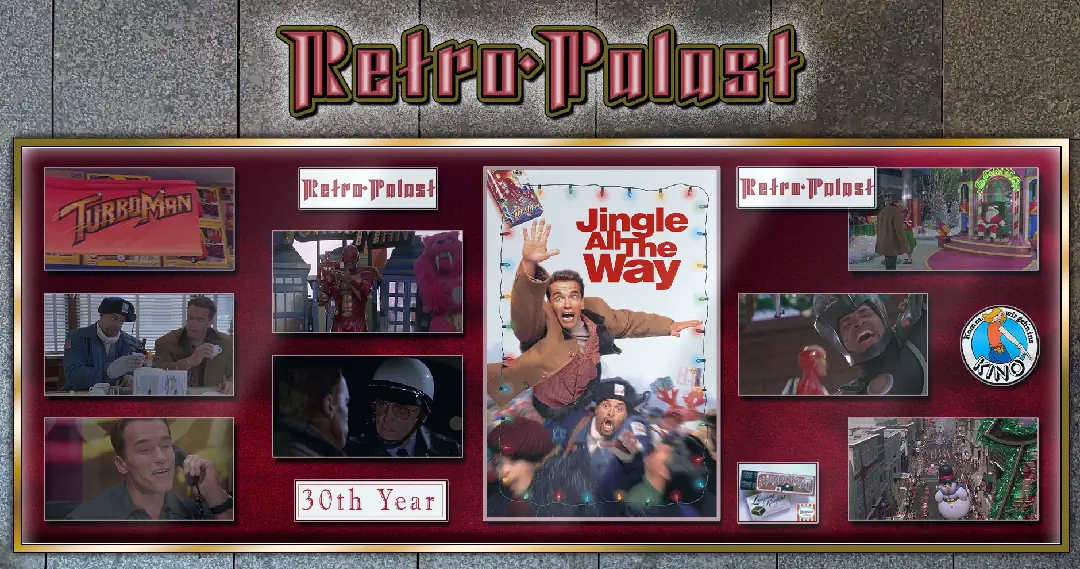
Why Jingle All the Way Belongs on the Christmas List.
Four December Favorites
Every year, as December draws to a close, I make time for four films: Die Hard, National Lampoon’s Christmas Vacation, Trading Places, and Jingle All the Way. Looking at that list, I clearly like a little trouble with my Christmas lights. John McClane can barely get through an office party alive, Clark Griswold risks life and limb to illuminate his house, and the Duke brothers make the season considerably less merry for everyone around them. Then there’s Howard Langston, whose entire ordeal could have been avoided if he’d picked up one present when his wife asked him to. Of the four predicaments, that’s the one I can most easily imagine getting myself into.
Part of the pleasure of watching Jingle All the Way again is knowing exactly how much trouble lies ahead while Howard still thinks he can sort things out before lunch. I always look forward to the moment he walks into a toy store and asks for a Turbo Man. Arnold Schwarzenegger delivers the request with the confidence of somebody ordering a cup of coffee. The employees laugh in his face. Somewhere in those few seconds, a man who has spent the whole film telling people how important they are to him discovers exactly where he ranks in the Christmas retail business.
The Last Toy
Howard sells mattresses for a living, and he’s much better at reassuring customers than he is at keeping promises to his family. After missing his son Jamie’s karate ceremony, he offers to make it up to him. Jamie wants the talking action figure of his favorite television superhero, Turbo Man, complete with the accessories he can recite from memory. Howard’s wife, Liz, asked him to buy one weeks ago. By the time he remembers, it’s Christmas Eve, the shelves are bare, and even the suggestion that Jamie might settle for Turbo Man’s sidekick, Booster, strikes everybody as faintly insulting.
The hunt introduces Howard to Myron Larabee, a postal worker trying to get the same toy for his own son. For a few minutes they have all the makings of friends. Then comes the possibility of an actual doll, and each would happily climb over the other to reach it. Their increasingly undignified competition takes in a radio giveaway, a warehouse full of crooked Santas, and a Christmas parade where Howard ends up wearing the Turbo Man suit. Meanwhile, his neighbor Ted is back at the house helping Liz and making himself thoroughly comfortable. Of all the indignities Howard suffers that day, somehow the hardest to bear is hearing another man on the phone enjoying his wife’s cookies.
From the Queue
Screenwriter Randy Kornfield found his story while looking for Power Rangers figures for his child. The Red and Green Rangers were particularly elusive, and the lines gave him plenty of time to consider what otherwise sensible parents might do to get their hands on one. Even Jamie’s name came from Kornfield’s own son. Getting the idea onto a screen took some persistence. After prospective buyers passed on his pitch, Kornfield wrote the screenplay anyway and sent it out under a pseudonym. He was working as a story analyst at Fox, the very studio that eventually bought it, and waited until the deal had closed to reveal his identity.
Chris Columbus, who had directed Home Alone, came aboard as a producer, and Brian Levant took the director’s chair. Much of the filming took place around Minneapolis and St. Paul in April and May 1996. There’s something pleasing about the crew having to manufacture Christmas in spring, only for the finished movie to arrive just as American shoppers were scrambling for Tickle Me Elmo. That coincidence gave the comedy an extra kick. You could buy a ticket to see a wildly exaggerated account of Christmas shopping, walk out of the cinema, and find a reasonably faithful reenactment underway at a toy counter.
Comic Heavyweights
Schwarzenegger’s great contribution is his willingness to let Howard look ridiculous for long stretches of time. Watch how carefully he listens when somebody offers him a lead on a toy. The narrowed eyes and the set of his jaw belong to a man receiving the coordinates of an enemy base. Apply that level of concentration to a department-store raffle and half the scene is funny before anybody moves. Sinbad gives him a wonderful change of rhythm. Myron can work his way through a grievance about the toy industry, a painful childhood memory, and a justification for his own terrible behavior while Howard is still deciding whether he ought to answer.
My favorite performance, though, belongs to Phil Hartman. His Ted has apparently mastered decorating, baking, parenting, and being available whenever somebody else’s wife could use a hand. Hartman’s genius is the little note of concern he puts into every courtesy. He makes an offer of help sound like a confidential agreement that Howard is a disappointment to them both. Rita Wilson gives Liz enough warmth to make her patience believable and enough steel to make its limits clear. As Jamie, Jake Lloyd supplies one of the film’s quieter details. The boy has heard his father’s excuses so often that he barely needs to listen to the end of one. For a comedy full of people shouting, that small reaction carries a surprising distance.
Inside Turbo Man
In an early version of the screenplay, the hero was called Turbo Tom, and Howard’s adventure ended at a factory with a full-size robotic opponent. Columbus preferred the Christmas parade. I think the switch bought the film its best idea. A factory showdown would have given Schwarzenegger another large object to fight. The parade lets us see him from the pavement, through the eyes of a boy who sincerely believes the fellow waving from the float can fly. For once, Howard has to live up to an even more extravagant set of promises than the ones he makes at home.
Designing Jamie’s hero presented a peculiar problem. He had to look familiar enough for us to believe we’d missed his Saturday morning show, yet distinctive enough to justify all that fuss in the toy aisle. Levant recalled drawing on the styling of a 1959 Cadillac and the Batman suit worn by Michael Keaton. Once you know about the Cadillac, it’s hard to miss the automotive swagger in all that polished red and gold. I’m especially fond of the visor. It gives Turbo Man just enough anonymity for an enthusiastic child to overlook the fact that the superhero towering over him has his father’s rather distinctive Austrian accent.
Opening Weekend
In November 1996, several reviewers found the film an exhausting way to spend the holidays. Roger Ebert enjoyed its energy and good humor, but the emphasis on acquiring a product left him feeling rather gloomy, and he wished the filmmakers had given the dialogue as much attention as the action. The New Yorker was harsher, arguing that the picture got swept up in the very shopping frenzy it had set out to mock. Steve Persall, writing in Florida, saw an upside to that same fixation. Here, at least, was a Christmas movie willing to acknowledge how much of the holiday takes place within reaching distance of a cash register.
I can see Ebert’s point most clearly during the parade. The movie has spent an hour finding laughs in the way ordinary people behave under pressure, and suddenly there’s a jetpack to operate and a child dangling high above the street. I would gladly trade a minute of flying for another minute of Hartman on the telephone. Even so, the film earns some of that extravagance. We’ve spent the afternoon seeing how much grief Turbo Man causes grown-ups. It seems only fair that Jamie gets a few minutes to show us what’s so wonderful about him.
Turbo Man Returns
Years later, Levant described meeting college students who brought battered VHS copies to his lectures for him to sign. I like that detail more than any retrospective declaration that the critics got it wrong. A worn cassette tells you something quite specific about a comedy. Somebody rewound it, somebody put it on again, and some household probably knew exactly when to join Schwarzenegger in yelling, “Put that cookie down! Now!” The toy enjoyed a second life, too. Tiger made a talking Turbo Man in 1996, and Funko released a new version in 2021. A quarter of a century later, you could buy the thing because you loved the movie about the perils of wanting the thing.
Worth the Rewatch
What brings me back every December is the film’s affection for people who have made a mess of Christmas. Howard deserves the laughter he gets in that first toy store. He also deserves the moment when his son looks up at him in wonder, and I enjoy the unlikely journey between the two. By the end, Jamie can give the precious figure away. He has spent the afternoon with more pressing concerns, including whether his dad knows how to land a jetpack. The gift has finally shrunk back to its proper size.
For me, Jingle All the Way is one of the best Christmas movies ever made. It understands the particular madness of wanting to give somebody a perfect morning and losing an entire day with them in the attempt. It also understands that, after a little seasonal reflection, there’s considerable pleasure in watching Arnold Schwarzenegger pick a fight with a reindeer. Every year I make room for both.
More
Trailer
External links
Notice Regarding Image Rights and Copyrighted Material
All images, film stills, posters, logos, trailer excerpts and other copyrighted materials used in this article are used solely for editorial reporting, film criticism, review and illustrative purposes related to the respective content.
Unless otherwise stated, all copyrights, trademark rights and other intellectual property rights in the materials used remain with their respective rights holders, including film studios, distributors, production companies, photographers, artists or other licensors.
The materials are used in good faith and with regard to applicable legal limitations, licence terms and source attributions. If, despite careful review, any rights have been infringed or any attribution is incomplete, please contact me. Upon review, the relevant content will be removed or corrected promptly.







Schreibe einen Kommentar