


The Controversial Arcade Classic That Took the War on Drugs Too Far
Explosive Arrival

Few arcade games capture the contradictions of late-1980s popular culture quite like NARC. Arriving in 1988, Williams Electronics’ action game turned the campaign against illegal drugs into a spectacle of automatic weapons, flying limbs, and extravagant destruction. Its heroes supposedly represented law and order, yet their methods made the streets resemble a battlefield. Even among arcade machines competing through louder sounds and bigger explosions, NARC had a confrontational personality. It wanted to impress, provoke, and persuade players to insert another coin, preferably before they had time to question what its version of justice actually involved.

Designed by Eugene Jarvis, whose earlier work included Defender and Robotron: 2084, NARC also represented a new beginning for Williams’ video game operation. Its combination of digitized imagery and aggressive action helped establish a direction that would become increasingly recognizable in the company’s subsequent arcade output. Beneath its deliberately outrageous surface, it was an ambitious production with considerable technical significance. The premise was straightforward: take down a criminal organization and its leader, Mr. Big, while collecting drugs and money as evidence. The presentation made that familiar assignment feel unusually excessive.
That excess remains the best starting point for understanding the game. NARC combines the appeal of an action movie with the bluntness of an anti-drug advertisement, then pushes both toward grotesque comedy. Its fascination lies in how uneasily those elements coexist. You can admire the visual ambition, enjoy the immediate chaos, and still find its assumptions about crime and punishment disturbing.
Street Warfare

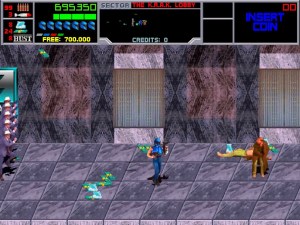
Players control Max Force or Hit Man, either alone or together, advancing through hostile environments with an automatic weapon and a missile launcher. Ordinary gunfire handles the constant pressure of approaching enemies, while missiles produce the game’s most notorious results: bodies disintegrating into scattered parts. Arrests provide an alternative, and the scoring system rewards taking suspects alive more generously than simply killing them. Drugs and cash left behind contribute to the end-of-stage tally, making the collection of evidence another part of the action.
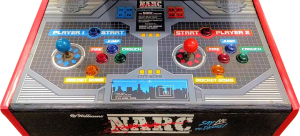
This creates a more interesting tension than the screenshots suggest. The game acknowledges the distinction between arresting and killing, but its most immediate visual rewards come from spectacular destruction. There is little room to contemplate restraint when the screen becomes crowded and another threat is closing in. The result is a peculiar form of arcade policing: the score encourages one kind of behavior while the spectacle enthusiastically advertises another. That contradiction is central to the experience, whether players notice it consciously or simply keep firing.
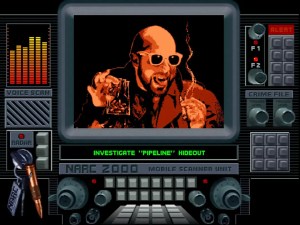
Variety comes through the parade of exaggerated opponents and increasingly bizarre situations. Attack dogs, syringe-throwing enemies, armed criminals, and a knife-wielding clown give the adventure the atmosphere of an exploitation film that has abandoned any commitment to plausibility. A drivable sports car briefly changes the rhythm, while the confrontation with Mr. Big turns the crime-busting premise into outright grotesquerie. These flourishes make progression entertaining even when the underlying business of moving forward and shooting becomes familiar.
Cooperative play suits this approach especially well. Sharing the screen turns the action into a noisy joint performance, with survival and spectacle competing for attention. Nevertheless, NARC’s appetite for overwhelming the player can undermine its pleasures. Its difficulty often feels better suited to encouraging another credit than to demonstrating an impeccably balanced test of skill. The energy is undeniable, but the distinction between satisfying pressure and exhausting punishment becomes increasingly important during longer sessions.
Digital Firepower

NARC’s visual identity depended on the development of digitized graphics at Williams. Instead of relying exclusively on characters drawn from scratch, the production process could convert captured video imagery into usable game art. Programmer Warren Davis developed tools for this work, including software that helped reduce captured images to a suitable color palette. His account also makes clear that digitization did not eliminate artistic labor: captured material still needed substantial preparation and cleanup. The photographic starting point was only one stage in producing a convincing arcade image.
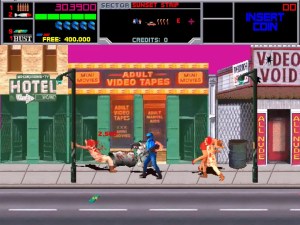
The hardware was equally important. Davis recalls that Jarvis wanted a system built around Texas Instruments’ TMS34010 graphics processor, but its built-in graphics functions could not move imagery quickly enough for the intended game. Hardware engineer Mark Loffredo therefore developed a custom blitter to support the required performance. This is a useful reminder that NARC’s achievement cannot be reduced to having a powerful processor. Its appearance depended on the relationship between image-capture tools, carefully prepared artwork, and hardware designed to put those assets into motion.
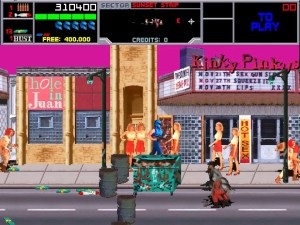
The resulting aesthetic occupies a fascinating middle ground. Characters have recognizable human proportions and photographic detail, yet their repeated movements and exaggerated deaths make them look like performers trapped inside a violent mechanical theater. That combination gives the destruction a different texture from the brightly illustrated action of many contemporary games. Sampled voices, gunfire, and explosions reinforce the effect, giving events an insistent, abrasive presence. Today, the visuals reveal their limitations immediately, but those limitations have become part of their appeal. NARC looks unmistakably like a particular moment when developers were discovering how captured reality could be reshaped into arcade fantasy.
Strange Connections
One of NARC’s most unexpected connections reaches beyond video games into alternative rock. The Pixies recorded “Theme from NARC,” based on Brian L. Schmidt’s game music, and released it on the Planet of Sound EP in 1991. For a title so closely associated with dismemberment and anti-drug rhetoric, this is a surprisingly distinctive musical afterlife. It also makes aesthetic sense: the game’s abrasive energy and peculiar atmosphere translate naturally into a short instrumental by a band comfortable with unsettling contrasts.
Another revealing detail appears in Davis’s development memoir. Loffredo, the engineer responsible for important elements of the hardware, also appeared as a digitized figure in an intermission image. Davis notes that artist Jack Haeger extensively cleaned up the captured picture. The anecdote gives a human scale to the technology: the people building these machines could also become part of their visual worlds. Behind the intimidating arcade cabinet stood a team experimenting with cameras, software, hardware, and whatever useful material was available.
NARC also spread beyond its original cabinet through conversions for home computers and the NES. These versions helped sustain its visibility, although their differing capabilities inevitably changed how its spectacle was delivered. A much later reinterpretation arrived in 2005, moving the name into a different style of action game. GameSpot’s review sharply distinguished that revival from the bizarre appeal of the original. The comparison highlights how difficult it is to reproduce a game whose identity depends so heavily on its historical setting. Retaining the title and drug-war premise does not automatically recover the atmosphere created by a specific cabinet, visual technique, and moment in arcade culture.
Contemporary Reactions

Contemporary responses become more revealing when the arcade original and its home conversions are kept separate. Sinclair User praised the arcade game’s graphics and anti-drug theme, showing that its moral framing could be accepted alongside its violence. The home versions subsequently produced their own reviews, which reflected both attitudes toward the premise and judgments about conversion quality. Those scores should not be treated as interchangeable verdicts on the arcade machine.
The contrast between two Spectrum magazines is particularly striking. In its December 1990 issue, Crash celebrated the conversion’s detailed graphics, enemy variety, and cooperative action; its two reviewers awarded 94 and 95 percent. Matt Bielby’s review in the February 1991 issue of Your Sinclair was considerably less enthusiastic, awarding 72 percent. He criticized repetition, but his deeper objection concerned the trivialization of real social problems. His argument was not simply that the game contained gore: he questioned the suggestion that widespread killing offered a meaningful answer to drug-related harm.
These reactions expose a disagreement that still shapes discussions of NARC. One reading treats the premise as a convenient excuse for cartoonish entertainment, with technical execution and immediate enjoyment providing the main standards of judgment. Another asks whether a game changes the meaning of its violence by attaching it to recognizable social groups and real political campaigns. Both responses existed near the time of release. The discomfort surrounding NARC is therefore more than a modern interpretation imposed on an innocent relic; contemporary criticism already identified the uneasy relationship between its declared purpose and its actual pleasures.
Cultural Shockwaves

NARC’s clearest influence lies in the production techniques and visual language associated with Williams and Midway. Davis’s digitization work developed beyond this game and contributed to the broader lineage that included Mortal Kombat, NBA Jam, and other prominent arcade releases. NARC belongs near the beginning of that story, demonstrating how photographic imagery could become a distinctive commercial attraction. It helped establish an approach in which recognizable bodies, exaggerated performances, and immediate visual impact could distinguish a machine on a crowded arcade floor.
Its cultural significance extends beyond that technical inheritance. Read against the rhetoric of the American War on Drugs, the game presents a revealing fantasy of control. Complex urban problems become visible enemies, the enemies become targets, and progress becomes something that can be measured through arrests, confiscations, and destruction. A scholarly discussion of Jarvis’s work likewise places NARC within the atmosphere of the “Just Say No” campaign and its surrounding political contradictions. The game’s simplicity is effective as an arcade structure, but it becomes troubling when interpreted as a picture of the society it claims to defend.
Whether that excess amounts to satire is harder to establish. The absurd names, grotesque enemies, and impossible firepower make a satirical reading plausible, yet exaggeration alone does not prove that the underlying message is being criticized. NARC can appear to mock authoritarian action fantasies while simultaneously inviting players to enjoy one. That ambiguity gives it lasting interest. It offers no stable distance between the ridiculousness of its world and the satisfaction of participating in it, leaving players to decide how much of the joke belongs to the game and how much emerges from looking back.
Lasting Contradictions

NARC remains more compelling as a complete cultural object than as a flawless shooting game. Its strongest qualities are inseparable: the digitized imagery gives the violence its particular texture, the violence gives the police fantasy its unsettling force, and the bizarre humor prevents the whole production from becoming straightforward propaganda. Its weaker qualities are equally apparent. Repetition can flatten the excitement, and sustained pressure can make advancement feel less like mastery than endurance. The memorable presentation does considerable work in carrying the experience.
Yet reducing NARC to either an important technical milestone or an offensive curiosity misses what makes it worth discussing. It captures an industry learning to display more convincing human imagery while still organizing that imagery around simple, lucrative cycles of destruction. It also captures a cultural moment in which an anti-drug message could serve as a reassuring explanation for remarkably extreme entertainment. Those two histories meet inside the same cabinet, each making the other harder to ignore.
Ultimately, NARC endures because its contradictions remain visible. It is inventive, crude, funny, repetitive, and uncomfortable, sometimes within the same few seconds. Returning to it offers more than the pleasure of recognizing an old arcade spectacle: it provides an opportunity to examine how technical ambition and familiar political assumptions can reinforce one another. Few games make that relationship quite so loud, and fewer still do it while handing their supposed peacekeepers a missile launcher.







Schreibe einen Kommentar