


Astron Belt (1983): Sega’s forgotten LaserDisc revolution.
Take a journey back to the early days of cinematic arcade gaming,
when Sega attempted to bring the spectacle of science fiction movies to the video arcade.
Into the Unknown:
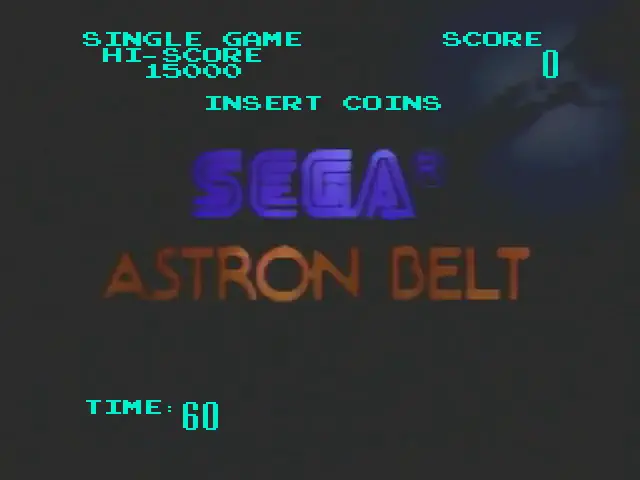
In the early 1980s, arcade gaming was undergoing a technological revolution. Games such as Pac-Man, Defender and Galaga had already captured the imagination of millions, but developers were constantly searching for ways to push the boundaries of interactive entertainment. While most arcade machines relied on relatively simple pixel-based graphics, Sega had a far more ambitious vision: a video game that looked and sounded like a science fiction movie.
The result was Astron Belt, a pioneering space shooter developed by Sega and released in Japanese arcades in 1983. Demonstrated for the first time in 1982, it was one of the earliest major arcade games to utilise LaserDisc technology, combining prerecorded cinematic footage with computer-generated graphics and interactive gameplay.
While most video games at the time displayed colourful sprites against comparatively basic backgrounds, Astron Belt offered spectacular spacecraft, planetary landscapes, explosions and dramatic space battles. Players were no longer just controlling a tiny spaceship against a black background; they were taking part in something that resembled a Hollywood science fiction adventure.
Although Astron Belt was eventually overshadowed by more famous LaserDisc titles, particularly Dragon’s Lair, its contribution to arcade history remains significant. It was an early attempt to merge cinema and video games, anticipating developments that would become increasingly important in the following decades.
Galactic Combat
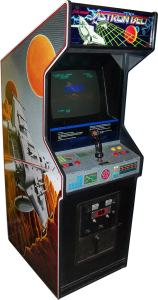
At its core, Astron Belt is a fast-paced third-person rail shooter in which players control a spacecraft and fight against an enormous alien armada. The objective is simple: destroy enemy fighters, evade incoming attacks and survive long enough to overcome increasingly formidable opponents.
Unlike traditional space shooters, where players can often navigate freely around the screen, Astron Belt follows a predetermined flight path. Cinematic background footage advances automatically while players manoeuvre their spacecraft and fire at enemies appearing ahead of them.
The adventure unfolds across a variety of environments, including open space, planetary surfaces, narrow trenches and dangerous tunnels. Enemy spacecraft attack from all sides, while obstacles and incoming projectiles force players to react quickly.
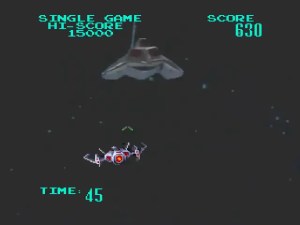
The action is divided into several waves, each culminating in a confrontation with a larger enemy command ship. As the game progresses, enemy formations become more aggressive and their attacks become harder to avoid.
One of the game’s more unusual features is its approach to player lives. Rather than penalising every mistake immediately, Astron Belt begins with a timed period during which players can lose their spacecraft repeatedly without exhausting their lives. Once this introductory period expires, the mission continues for a limited number of lives.
This system allows newcomers to experience the game’s impressive audio-visual presentation before facing the full consequences of their mistakes. It also makes the opening moments particularly accessible, encouraging players to experiment with the controls.
Nevertheless, the gameplay remains relatively simple. The challenge primarily comes from positioning, timing and memorising enemy movements, rather than making complex tactical decisions.
It is not the sophistication of Astron Belt’s mechanics that makes it memorable, but the sensation of participating in a cinematic space battle. Massive explosions, dramatic camera movements and colourful laser fire create an atmosphere that conventional arcade hardware could rarely reproduce at the time.
LaserDisc innovation
The most revolutionary aspect of Astron Belt was undoubtedly its technology. Rather than generating every visual element through traditional arcade graphics hardware, Sega used a LaserDisc player to display pre-recorded video footage as the game’s background.
The LaserDisc was an optical video format capable of storing high-quality analogue video. Although it was primarily developed for home entertainment, it offered arcade manufacturers the exciting opportunity to display detailed moving images that went beyond the capabilities of contemporary real-time graphics systems.
Astron Belt combined these cinematic backgrounds with computer-generated elements, including the player’s spacecraft, laser fire and other interactive objects. These graphics were superimposed onto the LaserDisc footage to create the illusion of a unified, three-dimensional environment.
This hybrid approach was remarkably ambitious for 1983. While the underlying video sequences were predetermined, players could still interact with the enemies and obstacles displayed during gameplay.
The arcade hardware employed compatible LaserDisc players from manufacturers including Pioneer and Hitachi. However, the technology also presented significant challenges. LaserDisc mechanisms were expensive, mechanically complex and more difficult to maintain than conventional arcade circuit boards.
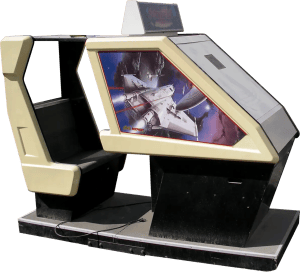
The game was available in upright and cockpit-style cabinets. The standard upright model featured a 19-inch monitor, whereas the elaborate cockpit version offered a larger 25-inch display, illuminated controls, stereo sound and a vibrating seat.
The cockpit cabinet was particularly impressive. Explosions and other dramatic events were accompanied by physical vibrations, adding another sensory dimension to the experience.
Visitors to the arcade, accustomed to relatively simple machines, would have felt as though they were entering the cockpit of a futuristic spacecraft when sitting inside Astron Belt.
However, LaserDisc technology had one key limitation: prerecorded footage could not respond to player actions with the same flexibility as fully computer-generated environments. The game therefore sacrificed freedom of movement in exchange for an unparalleled visual spectacle.
This compromise would ultimately define the strengths and weaknesses of the entire LaserDisc arcade generation.
Cosmic Curiosities
Beneath its futuristic exterior, Astron Belt boasts a fascinating array of historical details.
One of the most interesting is its connection to real-life science fiction films. Rather than creating every scene from scratch, Sega incorporated footage from several film productions, including Star Trek II: The Wrath of Khan (1982), Battle Beyond the Stars (1980) and the Japanese science fiction film Message from Space (1978).
These sequences were combined with material produced specifically for the game. The result is an unusual visual mixture that contributes to the game’s cinematic atmosphere.
Another curiosity concerns its release history. Sega first presented Astron Belt at the Amusement Machine Show in Tokyo in September 1982, followed by a demonstration at the AMOA exhibition in Chicago that November. Although the technology attracted considerable attention, the game’s North American release was delayed while hardware and software issues were resolved.
Consequently, Dragon’s Lair reached American arcades before Astron Belt, despite Sega having demonstrated its project earlier.
In North America, the game was distributed by Bally Midway, while Sega handled the original Japanese release.
An MSX home-computer adaptation of Astron Belt was released in 1984. As expected, the home version could not reproduce the original machine’s elaborate LaserDisc presentation, highlighting the significant technological difference between arcade systems and consumer hardware at that time.
Sega later expanded on this concept with Star Blazer, another LaserDisc space shooter introduced in 1983 and released in North America as Galaxy Ranger.
Contemporary Reactions

When Astron Belt first appeared, its audiovisual presentation attracted considerable excitement. For many observers, the prospect of combining realistic film footage with interactive entertainment suggested a whole new direction for the arcade industry.
Early coverage emphasised the spectacular visuals, powerful sound and futuristic cockpit design. The game appeared to offer a glimpse of what video games might become if cinematic imagery replaced conventional graphics.
The British magazine Computer and Video Games praised the pioneering technology and immersive presentation, but also noted that the gameplay was imperfect. Additional points of criticism were the relatively high cost of playing and the occasionally excessive vibrations of the cockpit cabinet.
The American response was more complicated. By the time Astron Belt reached the United States, players had already encountered other LaserDisc attractions, most notably Dragon’s Lair and M.A.C.H. 3.
Consequently, the technological novelty that had initially set Sega’s game apart was no longer quite as remarkable.
Reviews in Computer Games magazine were mixed. Designer Eugene Jarvis, known for his work on Defender and Robotron: 2084, criticised the collision detection and limited gameplay freedom, though he did appreciate the powerful sensation created by the action and explosions.
Commercially, the game performed particularly well in Japan. The Japanese arcade trade publication Game Machine ranked it among the leading upright and cockpit arcade attractions in 1983, with several periods at the top of its charts.
Its performance in America was more uneven, reflecting intense competition and declining enthusiasm for expensive LaserDisc machines.
Ultimately, contemporary reactions revealed a recurring problem: players were impressed by the spectacle, but impressive technology alone could not guarantee long-term entertainment.
Lasting legacy
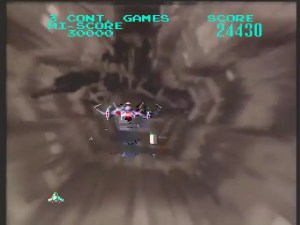
Although Astron Belt never achieved the enduring popularity of Dragon’s Lair, its historical importance should not be underestimated.
Its demonstrations in 1982 helped to ignite industry enthusiasm for LaserDisc arcade games, encouraging manufacturers to explore cinematic imagery as an alternative to conventional computer graphics.
The game’s influence is particularly evident in the short-lived LaserDisc boom of the early 1980s. Titles such as Dragon’s Lair, Space Ace and M.A.C.H. 3 all interpreted the same central idea differently: combining prerecorded visual sequences with interactive player input.
However, the technology proved difficult to sustain. Expensive equipment, reliability concerns, limited interaction and competition from increasingly sophisticated conventional arcade hardware gradually undermined the commercial appeal of LaserDisc games.
Nevertheless, the underlying ambition survived.
During the 1990s, the widespread adoption of CD-ROM technology revived interest in full-motion video games. Developers once again experimented with filmed sequences, cinematic presentation and interactive storytelling, creating a new generation of titles that shared conceptual similarities with Sega’s initial experiments in this area.
Later arcade rail shooters also sought to transport players through spectacular environments, focusing player interaction on aiming and shooting. Games such as Sega’s Starblade and The House of the Dead employed different technology but belonged to a broader tradition of cinematic, guided action.
In retrospect, Astron Belt represents an important stage in the ongoing relationship between cinema and interactive entertainment.
It demonstrated the extraordinary appeal of realistic audiovisual presentation, as well as the limitations of building gameplay around predetermined imagery.
For collectors and video game historians, surviving Astron Belt cabinets are fascinating artefacts from a time when arcade manufacturers embraced expensive, experimental technologies in pursuit of the next major breakthrough.
Final Verdict
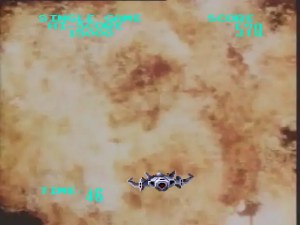
More than four decades after its release, Astron Belt remains one of Sega’s most intriguing arcade experiments.
Judged purely as a shooter, it is relatively straightforward. Its predetermined flight paths, repetitive encounters and occasionally awkward collision detection do not match the precision and flexibility of the best conventional arcade games of that time.
However, evaluating Astron Belt solely through its gameplay would overlook what made it exceptional.
In 1983, seeing enormous spacecraft fly across cinematic backgrounds, accompanied by stereo sound and physical cockpit vibrations, was extraordinary. Sega had created an experience that challenged contemporary expectations of what an arcade game could look and feel like.
Its greatest achievement was demonstrating that interactive entertainment could borrow the visual language of cinema without sacrificing the immediacy of arcade action.
However, the LaserDisc revolution was shorter-lived than its supporters had hoped, and ultimately, Astron Belt became a technological curiosity rather than the foundation of a lasting hardware standard.
However, its ambition helped to expand the industry’s imagination.

For retro gaming enthusiasts, Astron Belt is therefore much more than an obscure space shooter. It is a remarkable snapshot of an era defined by experimentation, spectacle and the belief that the future of video games might lie among the stars.
It may not have conquered the arcade universe, but Astron Belt helped pave the way for the cinematic gaming experiences we know today.








Schreibe einen Kommentar