

Arcade Fever:
In the early 1980s, the video game industry experienced an explosion of creativity, competition and technological experimentation. Arcade machines dominated entertainment venues, while home computers promised to bring the excitement of amusement arcades into people’s homes. One of the most influential games of this period was Nintendo’s Donkey Kong, released in 1981. Its blend of platform jumping, obstacle avoidance and memorable characters established a formula that would influence countless subsequent games.
Naturally, software developers were eager to recreate that success on home computers. One company participating in this rapidly expanding market was Anirog Software, a British publisher renowned for creating accessible arcade-style games for popular 8-bit machines.
In 1983, Anirog released Kong for the Commodore 64, offering computer owners their own interpretation of Nintendo’s arcade phenomenon. Developed by Jeff Gamon, the game attempted to reproduce the familiar combination of ladders, platforms, dangerous obstacles and a giant gorilla standing between the player and victory.
Although Kong was neither an official Nintendo conversion nor a particularly original concept, it was released during an exciting period in home computer history. Commercial software was still developing its identity, and players often judged games by how successfully they recreated their favourite arcade experiences.
Today, Kong offers more than a simple exercise in nostalgia. It provides a fascinating insight into the early Commodore 64 software market, when ambitious programmers, limited resources and strong arcade influences shaped a whole generation of games.
Climbing higher
The gameplay of Kong follows the established conventions of the early single-screen platform genre. Players control a small character whose objective is to navigate a series of increasingly hazardous environments, avoid enemies and ultimately overcome the enormous gorilla responsible for the chaos.
The similarities to Donkey Kong are immediately apparent. Platforms stretch across the screen, ladders connect different elevations, and dangerous obstacles impede the player’s progress. Success requires accurate timing, quick reactions and careful observation.
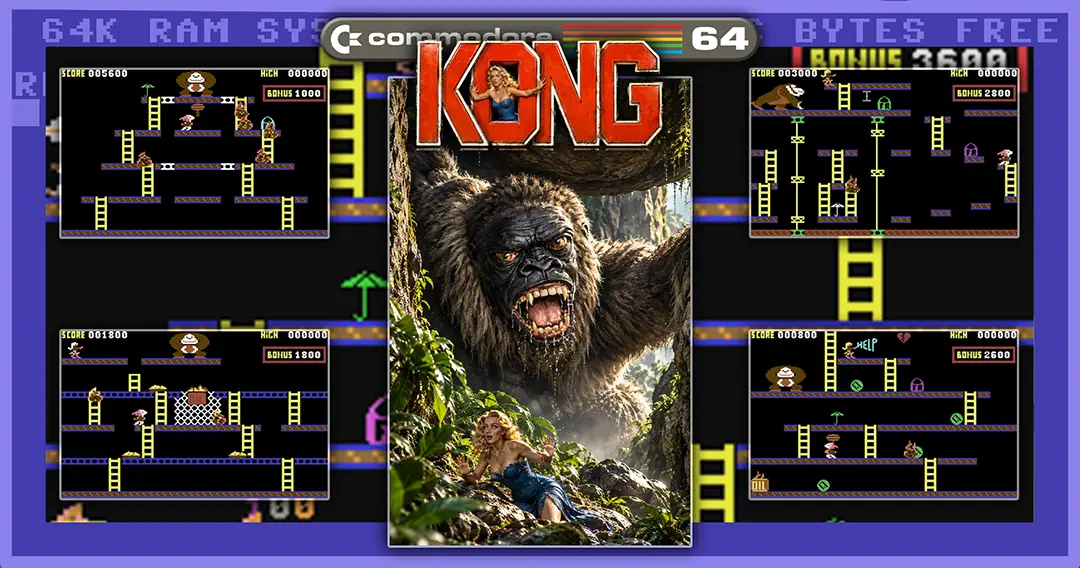
The Commodore 64 version features four familiar arcade-style stages, each with unique challenges.
The opening stage features the classic construction-site setup. Players must climb a network of platforms and ladders while avoiding barrels falling from above. The most important skills are knowing when to jump, when to retreat and when to take advantage of a brief opening.
The second stage dramatically changes the environment. Conveyor belts create additional movement challenges, while dangerous fireballs further complicate the journey. Players must adapt to machinery influencing their movement rather than simply avoiding objects travelling along predictable paths.
The third stage introduces elevators and a more complicated arrangement of platforms. Movement becomes less straightforward, requiring players to judge the timing of moving platforms while avoiding hazards. This represents a significant change from the relatively simple climbing challenge of the first level.
Finally, the confrontation takes place in the gorilla’s stronghold. Rather than simply climbing to the top, players must remove a series of rivets from the structure. Once these supporting connections have disappeared, the gorilla loses his footing and falls, providing a satisfying conclusion to the sequence.
Scattered bonus objects, including umbrellas and other familiar arcade collectibles, encourage players to take additional risks in pursuit of higher scores. A decreasing time bonus also discourages excessive hesitation.
Controlling the character requires a joystick that is traditionally connected to Port 2 of the Commodore 64. The basic actions are straightforward: moving horizontally, climbing ladders and jumping over obstacles.
However, simplicity does not necessarily equate to an easy experience.
The game demands considerable precision, particularly when hazards approach from multiple directions. Players accustomed to the responsiveness of the original arcade machine may find certain movements less forgiving.
Nevertheless, the central gameplay loop remains compelling. Each unsuccessful attempt encourages another try, while the pursuit of a higher score provides motivation beyond simply completing the stages.
This is classic early arcade design: easy to understand, difficult to master and capable of turning a few minutes of play into a surprisingly lengthy challenge.
Eight-Bit Engineering
From a technical perspective, Kong represents an interesting example of early Commodore 64 game development.
The Commodore 64 was remarkably capable for its time. With its MOS Technology 6510 processor, 64 kilobytes of RAM, VIC-II graphics chip and famous SID sound chip, it offered considerable potential for colourful arcade conversions.
However, exploiting this potential was not always straightforward. Programmers had to balance visual complexity, animation, responsiveness and available memory, often while working alone or in extremely small teams.
Jef Gamon is credited with programming and composing the music for Kong. His work exemplifies the practical challenges involved in adapting an arcade game for a significantly different hardware environment.
Visually, the game favours recognisable layouts over elaborate graphical experimentation. Platforms, ladders, conveyor belts and moving hazards are presented as colourful, clearly defined graphics.
The single-screen structure enables players to see immediate dangers without relying on scrolling. This approach was particularly well-suited to early platform games, where understanding the entire playfield was an integral part of the challenge.
Character animation is functional rather than sophisticated. Although the protagonist’s movements communicate the necessary actions, the animation and controls lack some of the fluidity that players might expect from more advanced Commodore 64 titles.
Nevertheless, the effort to reproduce the arcade game’s distinctive environments is noteworthy. Rather than reducing the entire experience to a single, repetitive screen, Anirog’s version retains the variety of the original game’s major stages.
Sound plays a similarly straightforward role. Rather than providing an elaborate musical soundtrack, Kong relies on the familiar sounds associated with early arcade gaming. The game’s audio is primarily concerned with supporting the action and reinforcing familiar events.
It is important to judge these features within their historical context. In 1983, the Commodore 64 was still a relatively new machine, and developers had not yet developed many of the sophisticated programming techniques that would characterise its later masterpieces.
Compared with the technically impressive games that appeared in the latter half of the decade, Kong looks modest. However, viewed as an early commercial release, it demonstrates how quickly developers were attempting to bring complex arcade concepts to home computers.
Curious Kong facts
One of the most interesting aspects of Kong is the number of different names associated with Anirog’s gorilla-themed games.
Depending on the platform and release, related titles appeared under names such as Kong, Kong 64 and Krazy Kong. This variation reflects an era when branding across different home computer formats was inconsistent.
Anirog also released versions for machines including the VIC-20 and ZX Spectrum. While these versions were inspired by the same concept, their gameplay and level design were not necessarily identical.
The Commodore 64 edition is particularly interesting because it recreates all four of the original arcade game’s environments. Other versions used substantially modified stage designs to accommodate their respective hardware.
Another curious detail concerns the game’s distribution. Anirog offered a double-sided cassette containing both the Commodore 64 and VIC-20 versions — a cost-effective solution reflecting the popularity of cassette-based software distribution in Britain at the time.
The title also appeared on Anirog’s Select 1 compilation, providing an additional way for players to acquire it.
The original cassette price was around £7.95, positioning it within the familiar commercial software market of the time.
Perhaps the most important historical curiosity is that Kong existed alongside numerous other unofficial attempts to recreate Nintendo’s success. Titles with remarkably similar names competed for attention, which makes it easy for modern collectors to confuse different games and publishers.
For example, Anirog’s Kong should not be confused with Interceptor Software’s Crazy Kong 64, another Commodore 64 title released in 1983.
These overlapping names reveal just how intense the demand for arcade-style platform games had become.
Contemporary Critical Reception
When Kong appeared in 1983, video game journalism was still in the process of establishing its conventions. British computing magazines regularly reviewed cassette releases, often providing relatively brief assessments alongside straightforward numerical ratings.
The response to Anirog’s game was notably divided.
Home Computing Weekly, issue 36, published in November 1983, awarded the Commodore 64 version an impressive 5 out of 5. The review regarded it as a particularly successful attempt to recreate Donkey Kong on the machine.
This enthusiastic response suggests that, for some contemporary reviewers, successfully capturing the structure and excitement of the original arcade game was more important than introducing new ideas.
Other publications were considerably less impressed, however.
Computer & Video Games, issue 26, dated December 1983, awarded Kong only 5 out of 10. The magazine was less convinced by the overall execution, particularly the controls and playability.
Personal Computer Games, issue 4, published in March 1984, also gave the game a score of 5 out of 10.
Taken together, these three scores produce an average of approximately 67 per cent, but the substantial difference between the individual assessments tells a more interesting story than the average alone.
This disagreement reflects a recurring problem in reviewing early arcade adaptations. Should a game be praised for providing a familiar experience on affordable home hardware, or criticised for not matching the original arcade game?
For players who wanted a game similar to Donkey Kong without visiting an arcade, Anirog’s version could be an attractive proposition. However, for those expecting flawless movement and exceptional technical presentation, its limitations were more apparent.
Modern retrospective assessments have sometimes been more forgiving, particularly when comparing Kong with the numerous less accomplished arcade imitations of the period.
Ultimately, contemporary critics could not agree whether it was an excellent conversion-style experience or merely an adequate imitation. This mixed reception remains an essential part of the game’s history.
Arcade Legacy
Although Anirog’s Kong never achieved the same level of cultural recognition as Nintendo’s original, it belongs to an important chapter in video game history: the rapid spread of arcade-inspired games across the emerging home computer market.
During the early 1980s, official arcade conversions were not available for every computer. Smaller publishers responded by producing their own interpretations of popular concepts, which sometimes remained remarkably close to the originals.
This helped familiarise home computer owners with gameplay ideas that would eventually become central to the platform genre.
Games such as Kong demonstrated the appeal of jumping between platforms, climbing ladders, avoiding moving obstacles and navigating environments constructed around precise movement.
Of course, Anirog did not invent these mechanics. However, its contribution was to make an established arcade formula accessible to a new audience.
The game’s historical importance also lies in its relationship with British software publishing. Companies such as Anirog helped to create a commercial ecosystem in which relatively small development teams could develop, market, and sell games to a growing number of computer owners.
By the middle of the decade, the Commodore 64 was home to increasingly sophisticated platform adventures, spectacular audiovisual productions and ambitious arcade experiences.
Kong belongs to the earlier generation that helped establish the market for such games.
Today, its influence is primarily historical, rather than being directly traceable to individual later releases. There is little evidence that it inspired major franchises or introduced revolutionary programming techniques.
Instead, its cultural value lies in what it represents: the enthusiasm of an industry discovering how to bring the magic of arcade gaming to the home.
For retro gaming enthusiasts, Kong also provides an interesting point of comparison with other unofficial Donkey Kong adaptations, revealing how different programmers approached similar technical and design challenges.
It remains a small but distinctive part of Commodore 64 history, preserved through game databases, emulation, gameplay recordings and the ongoing passion of 8-bit collectors.
Final Verdict
More than four decades after its original release, Kong by Anirog Software is best appreciated as a product of its time.
It is neither the most technically impressive Commodore 64 platform game nor does it offer particularly innovative gameplay. Its inspiration is unmistakable, and its controls and animation occasionally reveal the limitations of early home computer development.
However, dismissing it as just another Donkey Kong imitation would mean overlooking its historical charm.
Anirog successfully brought the core elements of the renowned arcade experience to the Commodore 64, incorporating multiple distinctive stages, recognisable hazards, and the familiar satisfaction of overcoming seemingly insurmountable challenges.
While the result may lack the refinement of Nintendo’s original, its ambition is undeniable.
What makes Kong particularly fascinating today is the contrast between its modest presentation and the excitement that such software could generate in 1983. For many home computer owners, having a colourful, arcade-style platform game on cassette was attractive in itself.
Its mixed reviews at the time also make it an intriguing subject for modern reassessment. Some players will appreciate its adherence to the arcade formula, while others may find its unforgiving movement and straightforward presentation challenging.
Both reactions are understandable.
Ultimately, Kong is neither a forgotten masterpiece nor a historical embarrassment. It is a fascinating early example of the creativity, imitation, commercial ambition and technical compromise that defined the first wave of Commodore 64 gaming.
For collectors, historians and curious retro gaming fans, it remains worth revisiting — not necessarily because it surpasses the arcade classic that inspired it, but because it captures something equally valuable: the pioneering spirit of the early home computer revolution.
Sometimes the most interesting retro games are not the ones that changed gaming history, but the ones that show us how that history was made.








Schreibe einen Kommentar