


Corman’s Nightmare Planet
There are respectable science-fiction films, and then there are movies that grab you by the collar, drag you through a puddle of slime and scream, “ALIEN WAS ONLY THE BEGINNING!” Roger Corman’s 1981 Galaxy of Terror belongs emphatically to the second category.
Produced by Corman and directed by Bruce D. Clark, the film arrived during the inevitable post-Alien feeding frenzy, when low-budget producers across the world were trying to bottle Ridley Scott’s mixture of space travel, industrial grime and biological horror. Galaxy of Terror made no great secret of the connection. One advertising campaign even trumpeted: “ALIEN was the beginning … Hell Has Just Been Relocated!” Yet dismissing it as merely another bargain-bin Alien imitation misses much of its peculiar charm. Beneath the dripping tunnels, exploding heads and rubber monstrosities lies something stranger: a haunted-house movie in space, a psychological horror story disguised as an interplanetary slaughterhouse.

It also happens to be a fascinating fossil from Roger Corman’s legendary talent factory. Behind the camera was a young James Cameron, years before The Terminator, Aliens and Titanic. In front of it were Robert Englund before Freddy Krueger, cult icon Sid Haig, Twin Peaks future regular Grace Zabriskie, Happy Days star Erin Moran and veteran Ray Walston. The result is one of those B-movies whose credits became considerably more impressive with age.
Nightmare Planet
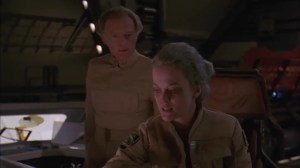
The story begins with disaster. A spacecraft has crashed on the desolate planet Morganthus, leaving its crew dead. Somewhere far away, the mysterious ruler known simply as the Master orders a rescue mission. The spaceship Quest is dispatched carrying a collection of specialists who appear to have been chosen according to the Corman principle that no expedition into deep space should contain two psychologically stable people if one will do.
The crew includes the level-headed Cabren, empath Alluma, technical officer Dameia, crystal-weapon specialist Quuhod, Ranger, Baelon, Commander Ilvar and Captain Trantor, herself haunted by an earlier space catastrophe. Accompanying them is Kore, an apparently humble cook played with suspicious serenity by Ray Walston.
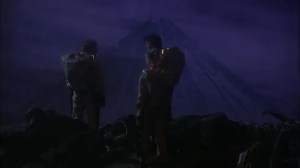
After landing on Morganthus, the rescuers discover the wrecked vessel and the mutilated remains of its crew. Nearby stands an enormous alien pyramid. Naturally, everybody goes inside.

That decision proves unwise.
The pyramid is less a conventional alien base than a supernatural or psychological machine. It reaches into the minds of the visitors and gives physical form to their deepest fears. The crew consequently does not face one monster but a personal catalogue of nightmares. One man confronts a murderous double. Another battles his own severed arm. Quuhod’s deadly crystal weapon turns against him. Alluma is crushed by constricting tentacles. Captain Trantor encounters flames. Dameia meets an enormous worm-like creature in the film’s most infamous sequence.

This structure is one of the reasons Galaxy of Terror is more interesting than its reputation as an Alien clone suggests. The basic premise owes at least as much to Forbidden Planet and its “monsters from the id” as it does to Ridley Scott. Instead of a single biological predator hunting the crew, Morganthus weaponizes the victims’ own minds.
The final revelation pushes the film still further into metaphysical pulp. Kore is connected to the mysterious Master, and Cabren eventually discovers that the pyramid functions as a brutal test: survival depends upon mastering fear rather than simply defeating a creature. What begins as a rescue mission ends as a grotesque rite of succession.
It is barely coherent. It is also exactly coherent enough.
Faces of Fear

Edward Albert anchors the film as Cabren, playing the closest thing Galaxy of Terror has to a conventional hero. His relatively restrained performance is valuable because nearly everyone around him is either terrified, eccentric, secretive or waiting to die horribly.
Erin Moran, famous as Joanie Cunningham on Happy Days, plays the empathic Alluma. Casting Moran in such grim material gives the movie an additional jolt of strangeness; the wholesome television association clashes effectively with the film’s dank atmosphere and gruesome violence.
Robert Englund appears as Ranger several years before A Nightmare on Elm Street transformed him into horror royalty. Watching him here carries a retrospective joke that Corman could never have planned: the future Freddy Krueger is trapped inside a movie about people literally being killed by manifestations of their fears.
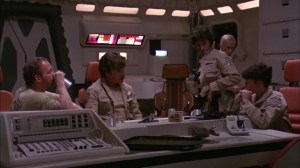
Sid Haig, already well established in exploitation cinema, plays Quuhod with almost no dialogue, allowing his physical presence and peculiar crystal throwing-stars to do the work. Grace Zabriskie brings nervous intensity to Captain Trantor, while Zalman King—later better known for his work in erotic cinema—plays the increasingly unstable Baelon. Bernard Behrens, Jack Blessing and Taaffe O’Connell round out the doomed expedition.
Then there is Ray Walston. As Kore, Walston initially seems to occupy the old science-fiction position of the eccentric supporting character. His performance becomes more significant as the film approaches its final revelations, and his calm manner gives Kore an oddly mythic quality.
Seen today, the ensemble is part of the movie’s appeal. Many of its performers either already had cult credentials or would acquire them later.
Cheap Miracles
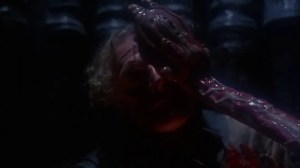
If Galaxy of Terror has one genuinely impressive technical achievement, it is how expensive it occasionally looks while remaining unmistakably a Roger Corman production.
James Cameron was central to that achievement. He worked on the film as a production designer and second-unit director, contributing heavily to its visual world and effects work.
Cameron and the art department created a world of claustrophobic corridors, glowing consoles, dripping walls, tilted passageways and monumental alien architecture. The approach anticipates the blue-collar, mechanically dense environments that Cameron would refine spectacularly in Aliens five years later.

The secret was not money. It was ingenuity.
One famous example involves the spaceship interiors. Sections of the walls were reportedly assembled from discarded Styrofoam fast-food containers. Carefully arranged, painted and lit, anonymous packaging became futuristic machinery.
The physical creature effects are equally characteristic of the era: wet, rubbery, tactile and proudly disgusting. Heads rupture. Bodies are pierced. Limbs detach. Slime flows with industrial generosity. Even when the illusion is obvious, the physical presence of the effects gives them a weight that digital imagery would struggle to reproduce.
Cameron reportedly devised simple practical tricks when conventional methods failed. One frequently repeated production story concerns live maggots that refused to wriggle satisfactorily for the camera; an improvised electrical setup was used to make them move on cue. Whatever one thinks of the film, the anecdote captures the Corman school perfectly: if you cannot afford the correct solution, invent a cheaper one before lunch.
Jacques Haitkin’s cinematography also deserves attention. Darkness hides the budget but creates genuine atmosphere, while Barry Schrader’s electronic score contributes an abstract, uneasy texture. Morganthus feels damp, hostile and unhealthy—the sort of planet where even the architecture appears infected.
Backlot Secrets

Like many Corman productions, Galaxy of Terror accumulated almost as many stories behind the camera as it did bodies in front of it.
Its title alone underwent mutations. The movie circulated under titles including Mindwarp: An Infinity of Terror and Planet of Horrors before Galaxy of Terror became the title most widely associated with it. The changes reflected Corman’s willingness to repackage a movie if its first marketing approach failed to connect.
The picture also illustrates Corman’s habit of extracting maximum value from physical assets. Sets and production resources could migrate from one low-budget film to another rather than being destroyed after shooting. Elements associated with Galaxy of Terror subsequently turned up elsewhere in the New World production ecosystem.
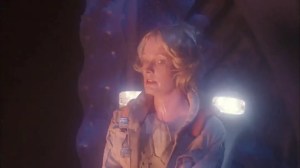
Even more interesting is the future talent roaming the set. Cameron was still years from becoming one of Hollywood’s biggest directors. Bill Paxton, later one of Cameron’s most familiar actors, also worked behind the scenes on the production.
That makes Galaxy of Terror a kind of accidental film-school yearbook. People who would later help shape mainstream genre cinema were learning how to fabricate worlds using junk, ingenuity, long hours and extremely limited resources.
Worm Trouble
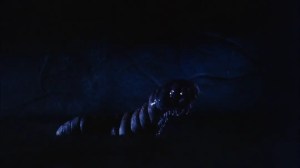
No discussion of Galaxy of Terror in its original exploitation context can avoid the sequence that immediately became its most notorious attraction.
Dameia, played by Taaffe O’Connell, encounters a gigantic worm-like creature. The scene combines nudity, monster effects, sexuality and violence in a manner designed to push the limits of an R-rated exploitation picture.
That combination was hardly accidental.

By 1981, horror and exploitation filmmakers were competing aggressively for attention. A memorable death was valuable. A grotesque monster was valuable. Nudity was valuable. A scene that combined all three was almost guaranteed to be discussed after the screening.
Producer Roger Corman reportedly pushed for a more explicitly sexual sequence, while director Bruce D. Clark objected to the material. Accounts of the production state that Corman personally took control of the scene and that material was later reduced in order to avoid an X rating.

Viewed within the exploitation marketplace of the period, the reasoning is easy to understand. Shock value was currency. Films were often promoted around one outrageous image, one forbidden moment or one sequence that audiences were unlikely to forget.
The worm scene became exactly that.

Within the plot, the filmmakers had a convenient justification: the pyramid turns subconscious fear into physical reality. That allowed virtually any nightmare image to appear without extensive explanation. In commercial terms, however, the sequence was also a calculated escalation of the sex-and-horror mixture that had become increasingly prominent in late-seventies and early-eighties genre cinema.
Whatever its dramatic function, the sequence did what exploitation filmmaking required it to do.
People remembered it.
Critical Bloodbath
Contemporary critics were not especially kind.
Many period reviews treated Galaxy of Terror as a derivative assembly of then-fashionable science-fiction and horror ingredients. The common complaint was that more imagination had gone into the grisly effects than into the story.
Other reviews followed a similar pattern. Critics noted the debt to Alien, mocked the often bewildering plot and questioned the movie’s originality. At the same time, even skeptical responses occasionally acknowledged its pace, production design and unusually elaborate effects for a low-budget feature.
Those reactions make sense. Judged as conventional science fiction, Galaxy of Terror is structurally messy. Characters receive minimal development. Exposition comes and goes. The Master’s cosmology remains hazy. The ending raises questions faster than it answers them.

But exploitation cinema operates according to different mathematics. Narrative elegance matters less than velocity, atmosphere and memorable incidents. On those terms, the movie is much harder to forget than many more polished productions from the same period.
Later criticism has accordingly become more interested in the craftsmanship. Retrospective reviews increasingly highlight Cameron’s production work, the practical effects and the strange psychological premise while still acknowledging the film’s excesses and troubling sexual content.
The critical story of Galaxy of Terror is therefore almost a textbook example of cult-film evolution: dismissed first as trash, rediscovered later as interesting trash, and finally studied as an unexpectedly important training ground for major filmmakers.
Future Echoes

The cultural influence of Galaxy of Terror is inseparable from James Cameron.
It would be absurd to claim that the film somehow “invented” Aliens. Ridley Scott’s Alien clearly predates it and was itself the obvious commercial catalyst for Corman’s production. But the relationship becomes fascinating when the arrow is reversed.
Cameron spent Galaxy of Terror solving problems involving dark corridors, industrial spacecraft interiors, hostile planetary landscapes, miniature work, creature effects and armed humans moving through enclosed alien environments. Five years later he directed Aliens, a vastly more sophisticated film built from many of the same visual and logistical ingredients.
In that sense, Galaxy of Terror can be seen as an early workshop whose practical lessons echoed through Cameron’s later work.
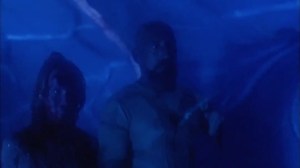
The movie also fits a wider history of Corman productions functioning as unofficial apprenticeships. Constraints forced young filmmakers to think quickly, improvise constantly and learn multiple departments. Corman’s pictures may have been designed to exploit current trends, but the people making them were acquiring skills that would later reshape those trends at studio scale.
Its influence is therefore less about direct imitation than about personnel and process.
Meanwhile, the film itself survived through VHS, cable television, fan conventions and later DVD and Blu-ray releases. Its practical effects, bizarre deaths, pre-fame cast and sheer excess made it ideal cult material.
For genre fans, Galaxy of Terror has become a missing link: halfway between seventies drive-in exploitation and the muscular science-fiction horror of the following decade.
Last Transmission

Galaxy of Terror is not a lost masterpiece. It is too derivative, too uneven and, in its most notorious sequence, too cynically exploitative to deserve romantic revisionism.
But neither is it disposable junk.
It is a spectacularly revealing piece of B-movie archaeology—a place where Roger Corman’s ruthless economics, the post-Alien horror boom and the emerging talents of a new generation collided. Its story may be flimsy, yet the central idea of a pyramid turning private fears into physical predators is strong enough to support some genuinely imaginative horror. Its cheap sets are frequently atmospheric. Its practical gore remains gloriously revolting. Its cast now looks almost impossibly rich in future cult associations.
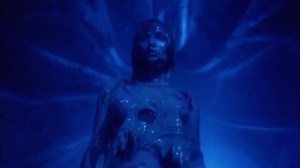
And somewhere in those wet corridors, surrounded by foam packaging masquerading as starship hardware, James Cameron was learning how to make a science-fiction world seem bigger than the money available to build it.
That may ultimately be Galaxy of Terror’s strangest triumph. Corman set out to cash in on Alien. Instead, he helped provide a rehearsal room for one of the men who would reinvent Alien for the next generation.
Cheap. Nasty. Ingenious. Offensive. Atmospheric. Frequently ridiculous.
In other words: pure Corman.
More
Trailer
External links
Notice Regarding Image Rights and Copyrighted Material
All images, film stills, posters, logos, trailer excerpts and other copyrighted materials used in this article are used solely for editorial reporting, film criticism, review and illustrative purposes related to the respective content.
Unless otherwise stated, all copyrights, trademark rights and other intellectual property rights in the materials used remain with their respective rights holders, including film studios, distributors, production companies, photographers, artists or other licensors.
The materials are used in good faith and with regard to applicable legal limitations, licence terms and source attributions. If, despite careful review, any rights have been infringed or any attribution is incomplete, please contact me. Upon review, the relevant content will be removed or corrected promptly.








Kommentar verfassen