

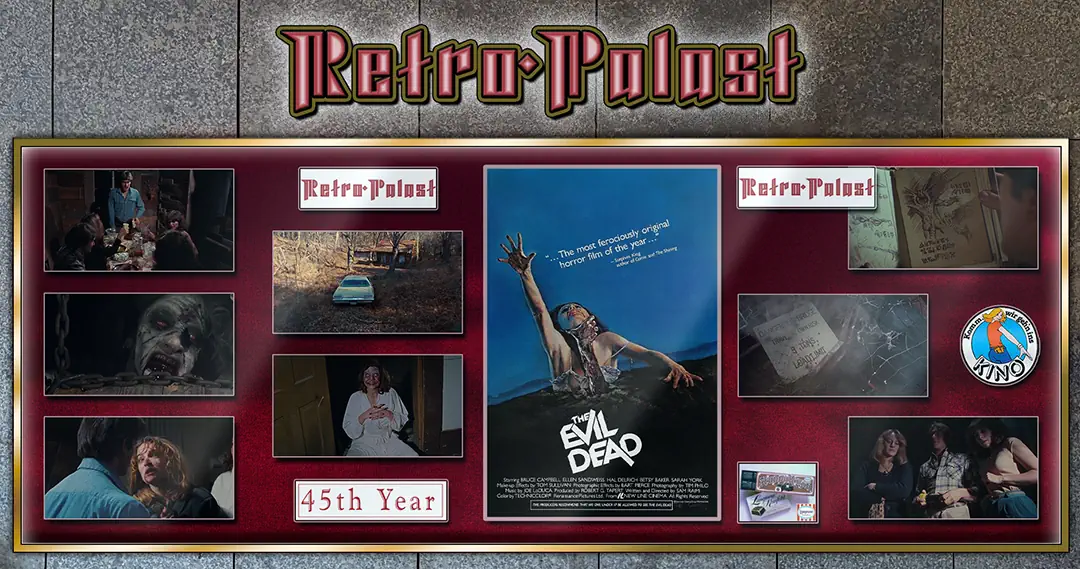
„Let no mortal disturb the pages of the dead, for the spirits that dwell beyond the veil know neither mercy nor rest.“ When the ancient words are spoken, the forest shall awaken, the flesh shall become a prison and the living shall envy the dead. What has been summoned cannot be forgotten. What has been awakened shall never truly die.‘
— The Necronomicon
The Forbidden Words
Some books are better left unopened, some recordings should never be played and some cabins should remain abandoned forever. On 15 October 1981, a group of ambitious young filmmakers unleashed a nightmare that would permanently change the landscape of horror cinema. Directed by the then-unknown Sam Raimi, The Evil Dead emerged from the shadows of independent filmmaking to become one of the most influential and notorious horror movies ever made. Armed with little more than determination, imagination and an extraordinary amount of artificial blood, Raimi and his collaborators created a cinematic experience that pushed the boundaries of low-budget horror.
Forty-five years later, the film has lost none of its nightmarish fascination. Its relentless atmosphere, frantic camerawork, grotesque practical effects and uncompromising brutality continue to captivate audiences, proving that genuine cinematic terror does not depend on expensive technology. What began as a modest experiment in supernatural horror evolved into a worldwide phenomenon, inspiring sequels, remakes, television shows and generations of filmmakers. Even after four and a half decades, the evil lurking in those Tennessee woods refuses to stay buried.
Nightmare Unleashed
The premise of The Evil Dead is deceptively simple, yet its execution transforms a familiar horror scenario into an increasingly disturbing descent into madness. Five college students travel to an isolated cabin deep in the woods, hoping to spend a peaceful weekend away from civilisation. Ash Williams, his girlfriend Linda, his sister Cheryl, and their friends Scotty and Shelly initially seem destined for nothing more sinister than an uncomfortable holiday in a dilapidated building. However, their temporary sanctuary soon reveals a horrifying secret when they discover a mysterious ancient book and a tape recorder containing the research of a missing professor.
The tape contains an incantation from the Book of the Dead, and playing it unwittingly awakens a malevolent force lurking in the surrounding forest. What follows is a relentless supernatural assault, as the evil presence begins to possess the students and transform them into grotesque, sadistic creatures known as Deadites. Friends become enemies, familiar faces turn into monstrous masks, and the isolated cabin gradually becomes a prison from which escape seems impossible. Unlike the confident, wisecracking action hero that audiences would encounter in later instalments, the original Ash is frightened, vulnerable and frequently overwhelmed by the horrors surrounding him. His desperate struggle to survive gives the film an unexpectedly human dimension, while Raimi’s increasingly frantic direction ensures neither Ash nor the audience is ever safe.
Born from Madness
Long before The Evil Dead became a celebrated horror classic, Sam Raimi, Bruce Campbell and producer Robert Tapert were simply a group of young filmmakers from Michigan with enormous ambitions and almost no financial resources. Their creative partnership developed through homemade Super 8 productions, eventually leading to the short horror film Within the Woods in 1978. Designed as a demonstration of their abilities, it served as a prototype for the feature film they hoped to create, helping to persuade private investors to finance their ambitious project. Originally developed under the title Book of the Dead, the production was eventually renamed The Evil Dead, a title considered more commercially appealing and less likely to suggest a literary adaptation.
Principal photography began in November 1979 near Morristown, Tennessee, where the filmmakers transformed a remote, dilapidated cabin into one of the most recognisable locations in horror cinema. The production quickly became an endurance test involving freezing temperatures, exhausting working hours, unreliable equipment and persistent financial difficulties. Several participants eventually left, leaving the remaining crew members to take on extra responsibilities. Nevertheless, these seemingly impossible circumstances encouraged remarkable technical creativity. Unable to afford sophisticated camera systems, Raimi built improvised rigs that enabled the camera to race through the forest and across the cabin, creating the impression of an invisible demonic entity pursuing its victims. Special-effects artist Tom Sullivan contributed grotesque make-up, handmade props and elaborate practical effects, while the filmmakers relied on inventive editing and unconventional camera angles to disguise their limited resources.
The lengthy production and post-production process tested everyone’s patience, but the finished film finally premiered at Detroit’s Redford Theatre on 15 October 1981. Few of those involved could have imagined that their chaotic, independently financed project would eventually become a milestone in horror filmmaking recognised around the world.
Faces of Terror
At the centre of The Evil Dead stands Bruce Campbell, whose performance as Ashley ‚Ash‘ Williams would ultimately transform him into one of the most recognisable cult icons in horror history. Interestingly, Campbell’s original interpretation bears little resemblance to the sarcastic, chainsaw-wielding hero who would later define the franchise. Instead, he portrays an ordinary young man who is gradually pushed beyond the limits of physical and psychological endurance. His increasingly desperate reactions provide a convincing emotional anchor amid the surrounding supernatural chaos, making his transformation throughout the series particularly fascinating.
The supporting cast also plays a key role in creating the film’s unsettling atmosphere. Ellen Sandweiss delivers a memorable performance as Cheryl, Ash’s sister, whose terrifying possession produces some of the film’s most disturbing scenes. Betsy Baker plays Linda, Ash’s girlfriend, and her transformation is especially cruel due to the emotional connection between the characters. Richard DeManincor, credited as Hal Delrich, plays the impulsive Scotty, while Theresa Tilly, credited as Sarah York, appears as Shelly. While the relatively inexperienced performers occasionally display theatrical exaggeration, their raw energy complements Raimi’s feverish approach to filmmaking perfectly. Together, they create a sense of genuine desperation, making the cabin feel less like a conventional movie set and more like a nightmare from which nobody can awaken.
Gruesome Little Secrets
Behind the film’s nightmarish imagery lies a remarkable collection of production stories that have become almost as legendary as the film itself. The terrifying white eyes of the possessed characters, for example, were achieved using extremely uncomfortable contact lenses that could only be worn for short periods. The large quantities of artificial blood were often made from corn syrup mixed with colouring and other ingredients, creating a sticky substance that made the already challenging shoot even more unpleasant. Meanwhile, Raimi’s beloved 1973 Oldsmobile Delta 88 made an appearance in the film, beginning a recurring tradition that would continue throughout his filmmaking career.
Another fascinating detail concerns the so-called ‚Fake Shemps‘, stand-ins used to complete scenes when the original performers were unavailable. This nickname was inspired by Shemp Howard of the Three Stooges, reflecting Raimi’s lifelong enthusiasm for slapstick comedy. The infamous Book of the Dead was meticulously constructed by effects artist Tom Sullivan, whose creations became essential to the film’s distinctive visual identity. However, perhaps the most impressive technical achievement remains Raimi’s innovative moving camera, which transformed simple wooden supports and improvised equipment into something genuinely revolutionary. These unconventional methods demonstrate how the filmmakers turned financial limitations into artistic opportunities, creating memorable images through ingenuity rather than expensive machinery.
Outrage and Censorship
Few horror films of the early 1980s generated as much controversy as The Evil Dead. Its graphic violence, grotesque bodily destruction and relentless atmosphere made it a prominent target during Britain’s infamous “Video Nasties” panic, when politicians, campaigners and tabloid newspapers increasingly portrayed violent home video releases as a threat to public morality. British censors demanded cuts for its theatrical release in 1982, and the film subsequently became embroiled in the wider campaign against supposedly obscene video entertainment. These legal issues resulted in the film’s disappearance from the legitimate British home video market for years, although a heavily censored version was released again in 1990. It would not receive a British classification for an uncut home-video release until 2001.
Germany also subjected the film to severe restrictions, further reinforcing its reputation as forbidden entertainment. Yet one particular sequence remains controversial beyond the historical debate over censorship: Cheryl’s sexual assault by a demonically possessed tree. This scene has attracted repeated criticism for its depiction of sexual violence, and Raimi himself later expressed regret about including it. This aspect of the film continues to raise uncomfortable questions about the distinction between provocative horror and exploitation. Nevertheless, the surrounding controversy has also contributed to The Evil Dead becoming an underground phenomenon, with its reputation for extreme content attracting curious viewers and turning the film into an enduring symbol of transgressive cinema.
First Critical Reactions
Despite its reputation for excessive violence, The Evil Dead received surprisingly enthusiastic reviews from several contemporary critics, many of whom recognised the considerable filmmaking talent beneath its gruesome surface. One of its most influential early supporters was the legendary horror author Stephen King, who saw the film at the 1982 Cannes Film Festival and famously praised it as the year’s most original horror film. King’s endorsement provided invaluable publicity for the struggling production, helping to attract the attention of international distributors and significantly improving its commercial prospects.
Trade publication Variety recognised Raimi’s energetic direction and imaginative camerawork, while Los Angeles Times critic Kevin Thomas described the film as an ‚instant classic‘ in 1983. These positive responses contrasted sharply with those of viewers and commentators who considered the film’s graphic content to be excessive, tasteless or artistically unjustifiable. Nevertheless, its admirers saw something far more significant than a conventional exploitation film. The relentless editing, unusually mobile camera, imaginative sound design and sheer intensity of the filmmaking revealed a director with a distinctive visual style. Over time, this critical recognition helped to establish The Evil Dead as an important achievement in independent cinema, rather than merely another controversial horror release.
Horror’s New Language
The cultural influence of The Evil Dead extends far beyond its notorious violence and memorable monsters. Perhaps Raimi’s greatest innovation was his ability to transform the camera from a passive observer into an active participant in the horror. Racing through forests, twisting around doorways and approaching terrified characters at impossible angles, the camera frequently appears to embody the supernatural force threatening the protagonists. This kinetic visual approach gave the film a distinctive identity, demonstrating how unconventional cinematography could create terror without relying on elaborate special effects.
Equally important was the film’s demonstration that independent filmmakers could achieve extraordinary results through originality, determination and technical experimentation. The film’s blend of demonic possession, grotesque physical transformation, isolated settings, and mounting psychological pressure has inspired generations of genre filmmakers. Although considerably darker than its sequels, the original film also contains early traces of the grotesque slapstick humour that would later become a defining characteristic of the franchise. The combination of extreme violence, frantic physical performances and absurd situations established a creative foundation that Raimi developed further in subsequent productions. Meanwhile, the isolated cabin, the cursed book and the invisible evil stalking the surrounding woods became enduring symbols of supernatural horror, referenced and reinvented repeatedly throughout popular culture.
The Undying Curse
The true measure of The Evil Dead’s legacy becomes apparent when examining the extraordinary franchise that emerged from its modest beginnings. Evil Dead II (1987) revisited the original nightmare with greater technical sophistication, spectacular practical effects, and a much stronger emphasis on outrageous black comedy. Army of Darkness (1993) subsequently transported Ash into a medieval fantasy adventure, transforming the once-terrified survivor into an unlikely action hero armed with a chainsaw, a shotgun and an unforgettable collection of sarcastic one-liners. While these sequels were increasingly removed from the uncompromising terror of the original, they expanded the series‘ personality and introduced its distinctive mythology to a much wider audience.
Decades later, Fede Álvarez’s Evil Dead (2013) returned the franchise to its brutal horror roots, while the television series Ash vs Evil Dead (2015–2018) reunited audiences with Campbell’s wonderfully battered character. Evil Dead Rise (2023) showed that demonic possession could be just as effective outside the familiar woodland setting by moving the action to an urban apartment building. The franchise’s continued expansion, including Evil Dead Burn (2026), further illustrates the enduring appeal of its supernatural mythology. Beyond film and television, the series has inspired video games, comic books, collectibles and even a stage musical, becoming a recognisable cultural institution within the horror community.
Perhaps its greatest legacy, however, lies in the careers it helped establish. Raimi went on to become a major Hollywood director, responsible for films such as the original Spider-Man trilogy, while Campbell developed an exceptionally loyal international fanbase. Their achievements remain closely connected to the ambitious, chaotic project that first brought them widespread attention.
The Final Incantation
Forty-five years after its original premiere, The Evil Dead remains an extraordinary triumph of independent horror filmmaking. Its imperfect performances, occasionally rough editing and unmistakably handmade effects are not simply weaknesses to overlook — they have become essential elements of the film’s strange and enduring appeal. Unlike contemporary digital horror spectacles, Raimi’s debut has an almost tangible sense of danger, as though its creators were pushing themselves and their equipment to the limit. This raw unpredictability gives the film a unique intensity that sets it apart from countless imitators.
Furthermore, The Evil Dead stands as evidence that financial limitations need not restrict artistic ambition. Raimi and his collaborators transformed a remote cabin, a handful of performers and a collection of improvised filmmaking techniques into something genuinely unforgettable. Its influence is still evident wherever filmmakers embrace inventive camerawork, outrageous practical effects, dark humour and the limitless possibilities of supernatural horror. What began as an underground curiosity has become an essential chapter in the history of genre cinema, celebrated not merely for its shocking content, but for the remarkable imagination behind it.
Perhaps the ultimate secret of The Evil Dead is that its monsters can be destroyed, its cabin can crumble and the pages of its ancient book can burn, but the nightmare itself refuses to disappear. Forty-five years, countless victims and one cursed book later, the message remains as terrifyingly simple as ever: The dead may fall silent, but evil never truly dies.
More
Trailer
External links
Notice Regarding Image Rights and Copyrighted Material
All images, film stills, posters, logos, trailer excerpts and other copyrighted materials used in this article are used solely for editorial reporting, film criticism, review and illustrative purposes related to the respective content.
Unless otherwise stated, all copyrights, trademark rights and other intellectual property rights in the materials used remain with their respective rights holders, including film studios, distributors, production companies, photographers, artists or other licensors.
The materials are used in good faith and with regard to applicable legal limitations, licence terms and source attributions. If, despite careful review, any rights have been infringed or any attribution is incomplete, please contact me. Upon review, the relevant content will be removed or corrected promptly.






Schreibe einen Kommentar