


Arcade Beginnings
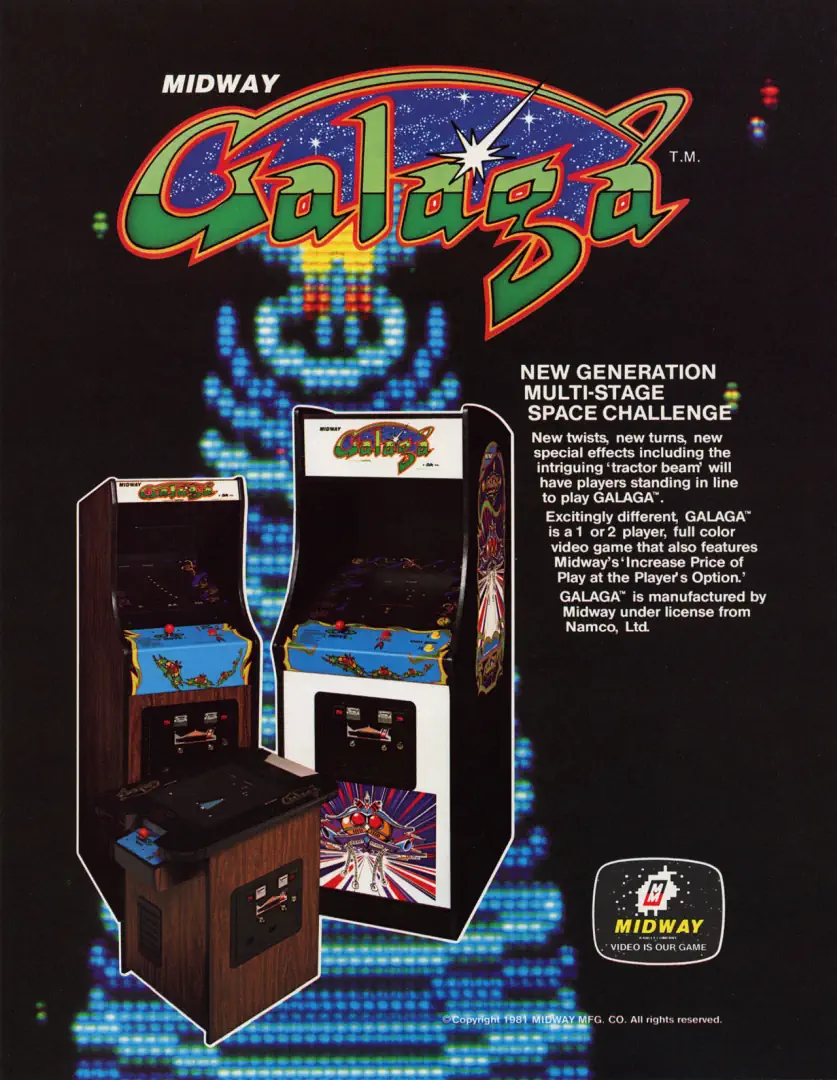
When Galaga appeared in arcades in 1981, it entered a market already crowded with space-themed shooting games. Titles such as Space Invaders, Galaxian, and Asteroids had established a simple but highly successful formula: the player controlled a small spacecraft and tried to survive waves of attacking enemies. Yet Galaga, developed and published by Namco, managed to stand out almost immediately. Instead of merely copying its predecessors, it refined the fixed-shooter concept with faster action, more complex enemy behavior, recognizable sound effects, and one of the most memorable risk-and-reward mechanics of the early arcade era.
Galaga was created as a follow-up to Namco’s 1979 game Galaxian. While Galaxian had already improved on the basic Space Invaders formula by giving enemies individual colors and allowing them to break formation and attack the player directly, Galaga expanded these ideas considerably. Enemy ships now attacked in coordinated patterns, stages became increasingly demanding, and the game introduced bonus rounds and the famous ability to combine two player ships into a more powerful fighter.
The result was an arcade game that was simple enough to understand within seconds but difficult enough to keep experienced players interested for hours. More than four decades later, Galaga remains one of the best-known games of its generation and continues to appear in arcade collections, museums, retro consoles, and popular culture.
Core Gameplay
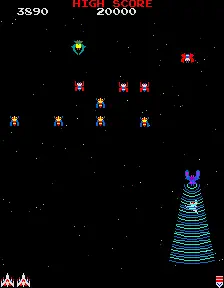
The basic objective of Galaga is straightforward. The player controls a small fighter spacecraft positioned near the bottom of the screen. Movement is limited to the left and right, while a button fires shots upward. At the beginning of each stage, groups of insect-like alien enemies fly onto the screen in elaborate patterns before settling into a formation near the top.
Once the formation is complete, enemies periodically leave their positions and dive toward the player. These attacking movements make Galaga more dynamic than many earlier fixed shooters. Enemies do not simply move from side to side as a single block. They curve, loop, accelerate, and sometimes attack in groups. As later stages are reached, their movements become faster and more aggressive.
The most distinctive enemy is the Boss Galaga. This larger alien requires two hits to destroy under normal circumstances and is capable of using a tractor beam. When it dives toward the player, it can stop above the ship and project a beam downward. If the player remains inside the beam, the fighter is captured and carried back into the enemy formation.
At first, losing a ship in this way seems like a punishment. However, the mechanic also creates one of Galaga’s most important strategic opportunities. If the player still has another fighter available, the captured ship can potentially be rescued. When the Boss Galaga carrying it later dives toward the player, destroying the boss without hitting the captured fighter releases the ship. It then joins the player’s current fighter, creating a dual-fighter configuration.
The dual fighter is wider and therefore easier for enemies to hit, but it can fire two shots at once. This dramatically increases the player’s offensive power. Skilled players therefore often deliberately allow a ship to be captured in order to obtain the double fighter.
Another important feature is the Challenging Stage. These bonus stages appear periodically and temporarily remove the danger of being attacked. Instead, groups of enemies fly across the screen in carefully designed formations. The goal is to destroy as many as possible before they escape. Shooting every enemy in a Challenging Stage awards a large bonus, making these sections especially important for players attempting to achieve high scores.
This combination of simple controls and advanced scoring strategies gave Galaga considerable depth. Beginners could enjoy shooting enemies immediately, while experienced players could study attack patterns, optimize bonus stages, and take calculated risks with the tractor-beam system.
Arcade Technology
From a technical perspective, Galaga was an impressive arcade game for 1981. It used dedicated arcade hardware designed to handle multiple moving sprites, colorful graphics, sound effects, and increasingly complicated enemy patterns. Compared with many earlier shooters, the screen felt much more active.
The visual design was particularly important. Enemy ships were represented using brightly colored sprites that made them easy to identify. Different enemy types had distinct appearances and movement patterns, helping players understand what was happening even during fast sections of the game. The black background created a convincing impression of deep space while also allowing the colorful ships and explosions to stand out clearly.
The animation of the enemies was another major improvement over earlier fixed shooters. Instead of simply appearing in rows, aliens entered the screen through carefully choreographed flight paths. Some approached from the sides, others curved downward before returning upward, and entire groups could move together in symmetrical patterns. These movements gave the game a sense of performance and spectacle that helped attract attention in noisy arcade halls.
Sound also played an important role. Galaga used distinctive electronic effects for firing, explosions, enemy movement, stage introductions, and successful actions. Although technically simple by modern standards, the sounds were carefully matched to gameplay events. They provided immediate feedback and contributed heavily to the game’s identity.
The hardware still imposed strict limitations. The screen resolution was low, memory was extremely limited, and the game could not display anything close to modern visual complexity. Yet these restrictions encouraged precise design. Every sprite, sound, and animation served a recognizable purpose. As a result, the game remains visually understandable even today.
Galaga Trivia
Several details have become part of Galaga legend. One of the most famous is the so-called “no-fire” or enemy-stop trick found in some versions of the original arcade game. Under certain circumstances, a player can allow specific enemies to continue attacking for an extended period without destroying them. Eventually, the enemies may stop firing, making later survival much easier. The process can take considerable time and does not work identically on every version or hardware revision.
Another famous aspect of Galaga is its importance to high-score competition. Because the game continues through increasingly difficult stages and rewards precise play, experienced players developed detailed strategies for maximizing points. Memorizing enemy entrance patterns and mastering Challenging Stages became essential techniques.
The game also contains a hit-rate statistic. When a game ends, Galaga displays the number of shots fired and the percentage of those shots that successfully hit enemies. This small feature gives players an additional measure of performance beyond the final score. Accuracy therefore became another informal challenge among skilled players.
The title itself is closely connected to Galaxian. Galaga was designed as a successor rather than an entirely separate concept, and it carried forward the visual theme of colorful alien fleets attacking a lone spacecraft. Namco later continued the series with games such as Gaplus, sometimes known as Galaga 3.
Like many successful arcade games, Galaga was eventually converted for numerous home platforms. It appeared on computers, consoles, handheld systems, plug-and-play devices, mobile platforms, and retro game compilations. As technology changed, the original game remained commercially valuable because its basic design was easy to understand and did not depend on realistic graphics.
Early Reception
Contemporary players responded strongly to Galaga, and the game became one of the major arcade successes of the early 1980s. Its popularity was partly based on familiarity. Anyone who had played Space Invaders or Galaxian could immediately understand the basic concept. At the same time, its faster pacing and additional mechanics made it feel more advanced than many competitors.
The enemy movement received particular attention. Games of the period were often based on predictable repetition, but Galaga made enemies appear more independent. The way they broke formation and attacked individually created a stronger feeling of danger and unpredictability.
The tractor-beam system was another major strength. Arcade games were designed to encourage repeated play, and memorable mechanics were extremely valuable. The possibility of intentionally sacrificing a fighter and later recovering it as part of a dual ship added an unusual tactical decision. It rewarded players who understood the game rather than those who merely reacted quickly.
However, like many arcade titles from the period, Galaga was also highly repetitive. The basic goal never changes dramatically: destroy formations, avoid attacks, survive, and increase the score. Players looking for narrative development or large changes between levels would find relatively little variety.
At the time, however, repetition was not necessarily considered a major weakness. Arcade games were built around short sessions, mastery, high scores, and competition. Within those expectations, Galaga offered considerable variety and complexity. Its lasting popularity suggests that its mechanics were particularly well balanced.
Cultural Legacy
Galaga became much more than a successful arcade machine. Over time, it developed into a symbol of the golden age of arcade gaming. Its colorful alien formations, distinctive sounds, and simple control scheme became immediately recognizable to generations of players.
One reason for this longevity is accessibility. Unlike many modern games, Galaga requires almost no explanation. The player moves left and right and fires upward. Within moments, the objective is clear. Yet mastering the game can take years. This balance between simplicity and depth is one of the reasons classic arcade games continue to attract players.
Galaga has also appeared in films, television programs, advertisements, and other forms of popular culture. Arcade cabinets are frequently used in movies and television to establish an early-1980s or retro atmosphere. The game itself has occasionally been shown directly, sometimes as a nostalgic reference and sometimes as a joke recognizable to audiences familiar with arcade culture.
Its influence on game design is equally significant. The concept of enemies breaking formation and attacking individually became common in later shooters. Bonus stages, high-risk power upgrades, recognizable enemy patterns, and accuracy-based scoring also appeared in many subsequent games.
The game has been preserved through countless re-releases. Namco and later Bandai Namco repeatedly included Galaga in classic game collections. It has appeared on major console families and digital platforms, allowing younger players to experience a game originally designed for coin-operated machines.
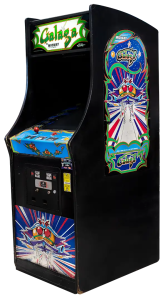
Modern retro arcades also continue to feature Galaga cabinets. For some players, the machine represents childhood memories; for others, it is an opportunity to experience an important part of video-game history on original-style hardware.
Perhaps the greatest sign of its cultural importance is that Galaga remains playable rather than merely historical. Many influential games are remembered mainly through screenshots, documentaries, or museum displays. Galaga, by contrast, still works extremely well as a game. Its controls remain responsive, its visual information remains clear, and its scoring system still encourages improvement.
Lasting Appeal
More than forty years after its release, Galaga remains one of the defining arcade games of the early 1980s. It did not invent the fixed shooter, but it demonstrated how an established genre could be transformed through careful refinement. More intelligent enemy movement, distinctive audiovisual design, bonus stages, high-score strategy, and the memorable dual-fighter mechanic gave it an identity of its own.
Technically, the game now appears extremely simple compared with modern productions. Yet this simplicity is part of its strength. There are no complicated menus, lengthy tutorials, cinematic introductions, or complex control combinations. Everything important appears directly on the screen.
Its continued popularity also demonstrates an important principle of game design: technological sophistication does not automatically determine longevity. Graphics and hardware inevitably become outdated, but strong mechanics can remain entertaining long after the technology that created them has disappeared.
Galaga belongs to a period when arcade games were designed to capture a player’s attention within seconds and encourage repeated attempts through challenge and scoring. Few games achieved that goal as successfully. What began as a sequel to Galaxian eventually became one of Namco’s most recognizable titles and one of the enduring icons of arcade history.
Even today, the appearance of a Galaga cabinet still invites the same basic challenge it offered in 1981: move the fighter, watch the enemy patterns, fire carefully, and try to beat the score displayed at the top of the screen.







Schreibe einen Kommentar