


Air Combat Through Time
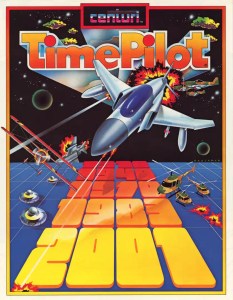
When Time Pilot hit arcades in 1982, arcade culture was in the midst of what was perhaps its most creative phase. Pac-Man, Donkey Kong, Galaga, Defender, and countless other titles were vying for players’ coins. In this environment, a new game had to explain within a matter of seconds why players should insert their next coin into this particular machine. Konami’s Time Pilot achieved this with an idea as simple as it was memorable: The player pilots a modern fighter jet not only through endless airspace but simultaneously through the history of aviation.
The game was developed at Konami with significant input from designer Yoshiki Okamoto. At first glance, the basic premise resembles a classic shoot ’em up: enemies appear, the player dodges their attacks, and fires back. But Time Pilot differs significantly from the space shooters common at the time, which featured fixed screen boundaries or strictly predetermined flight paths. The player’s aircraft remains almost constantly at the center of the screen, while the entire environment moves around it. This creates the impression of an open sky in which the player can fly in any direction.
Even more important, however, is the theme. Instead of shooting down the same alien formations over and over, the pilot travels from era to era. Biplanes, propeller-driven fighters, helicopters, modern jets, and finally UFOs mark the progression through time. In this way, Time Pilot combined instantly understandable gameplay mechanics with a touch of science fiction fantasy—and gave a seemingly simple high-score game a surprisingly strong character.
A Chase Through Five Eras
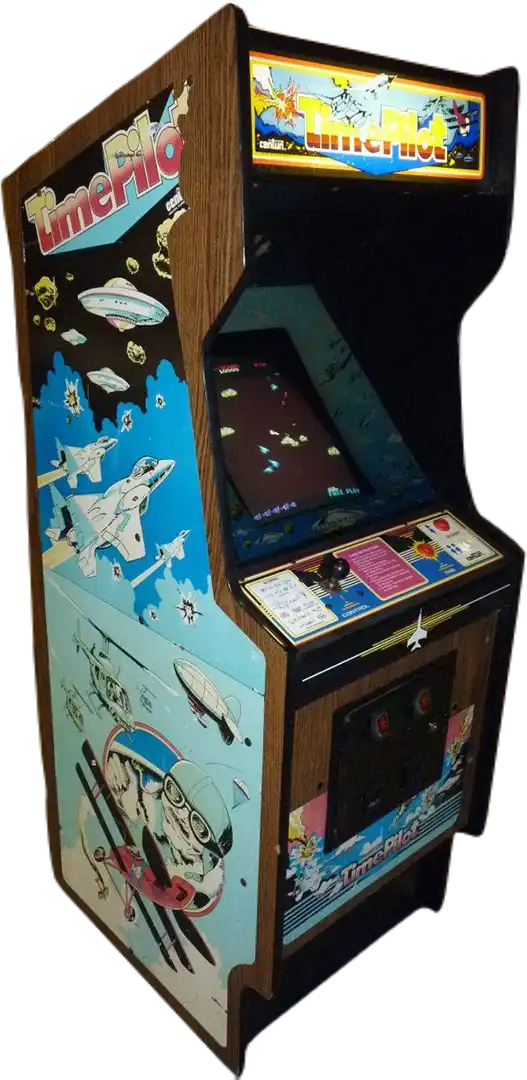
The controls in Time Pilot are deliberately straightforward. An eight-way joystick determines the direction of flight, and a button fires the onboard weapons. The key trick is that the player’s jet remains centered. So when you move the joystick to the left, you don’t just see the aircraft moving to the left: instead, the jet rotates, and clouds and enemies move across the screen relative to it. For a game from 1982, this system conveys a remarkably convincing sense of spatial freedom.
Each round takes place in a different era. The journey begins in 1910, where biplanes attack the futuristic jet. After enough shoot-downs, a larger airship appears as the final boss. In 1940, faster propeller-driven fighters and a heavy bomber await. In 1970, the aerial combat becomes more frantic with the addition of helicopters and more dangerous projectiles. The player then reaches the “present” of 1982—or 1983 in later versions—where modern jet fighters appear. The final stage is the year 2001: the blue sky disappears, the battle shifts into space, and UFOs take on the role of enemies. After that, the cycle begins anew, though under more challenging conditions.
To advance to the next era, the player must first destroy 56 ordinary enemies in the arcade version. After that, the respective larger command vehicle—or “mothership”—appears, which requires seven hits to destroy. In addition, paratroopers occasionally appear. Players who collect them while they’re in flight earn bonus points; multiple rescues in a row increase the reward. This creates an additional risk-and-reward system alongside the simple act of shooting down enemies. Players who leave their safe position to rescue a paratrooper can earn a lot of points—or lose a life immediately.
The actual goal of the game remains achieving the high score. This is precisely where the typical arcade philosophy of that era shines through. Time Pilot isn’t primarily meant to be “played through” from start to finish. Instead, the player is meant to refine their movements, recognize attack patterns, and survive as long as possible. The further the game progresses, the denser the enemies, projectiles, and missiles become. What begins as a straightforward aerial battle eventually turns into a frantic dance of turning, dodging, shooting, and collecting points.
Technology Above the Clouds
From today’s perspective, the graphics in Time Pilot seem simple, but the technical implementation supports the game’s concept extremely effectively. The arcade hardware runs on Z80 processors or Z80-based Konami technology. Two AY-3-8910 sound chips are used for audio. The game runs on a vertically oriented screen with a resolution of 224 × 256 pixels. Thus, the technology essentially corresponds to the typical framework of early 1980s arcade games, but is cleverly utilized for the unusual movement system.
Particularly clever is the optical illusion created by the player’s jet, which remains in a fixed position. Instead of having to manage a huge, contiguous game world in memory, the game uses comparatively simple graphical elements to create the impression of unlimited airspace. Passing clouds serve not only as decoration but also constantly reinforce the sense of speed and direction. Although the jet technically barely leaves its spot on the screen, it feels as though you’re covering long distances.
The graphic design also pursues a clear goal: the different eras must be immediately recognizable. That’s why the developers use distinctive silhouettes. A biplane looks distinctly different from a helicopter, a modern jet, or a UFO. Elaborate details would have been virtually impossible at such a low resolution anyway. Instead, Time Pilot focuses on clarity—a crucial advantage when numerous enemies and projectiles are flying across the screen at the same time.
The sound is similarly functional. Gunfire, explosions, and brief electronic effects provide constant auditory feedback. A complex soundtrack wouldn’t have been necessary for the gameplay at all. The sounds immediately tell the player whether a shot was fired, a hit landed, or an enemy destroyed. Graphics, controls, and sound thus work toward one primary goal: to ensure that the aerial combat remains easy to understand and controllable at all times.
Fun Facts About the Game
One of the most interesting stories about Time Pilot is its unusual origin. Designer Yoshiki Okamoto later reported that his original proposal was not initially met with enthusiasm at Konami. Instead, he was supposed to work on a racing game. Okamoto, however, stuck to his idea and had programmer Hideki Ooyama continue working on the concept. Ironically, the very project that initially failed to meet his superiors’ expectations went on to become a successful arcade game.
Also noteworthy is the game’s treatment of the “present.” In the original version, 1982 represents one of the future stations—or, rather, the contemporary era. As the game gained wider international distribution and the calendar year changed, versions emerged in which this level was labeled 1983. A small detail that seems almost unintentionally funny today: A game about massive leaps in time had to be updated shortly after its release because its “present” had already become outdated.
Time Pilot was later ported to several home platforms, including the Atari 2600, ColecoVision, and MSX. Due to the significantly different hardware, these versions had to make compromises. The core elements—free-form aerial combat, shifting eras, and the pursuit of high scores—remained recognizable, however.
In 1995, a variant called Time Pilot ’95 even appeared as a bonus game in a Japanese Ganbare Goemon title for the Super Famicom. The Game Boy Advance release, included in a Konami compilation, later added a hidden additional era: a journey back to 1,000,000 B.C., in which pterodactyls take on the role of flying enemies. This idea alone demonstrates how well the original concept can be expanded in terms of gameplay.
Arcade Reviews
The contemporary reception of Time Pilot was generally positive—and its commercial success, in particular, shows that the concept resonated with arcade-goers. The British magazine Computer and Video Games reviewed the arcade game favorably upon its release. However, the revenue charts speak even more clearly: In Japan, Time Pilot was listed as the fifth-most successful arcade video game of 1982 in Game Machine’s year-end rankings. This placed it, in an exceptionally strong year, in the immediate company of titles such as Pole Position, Dig Dug, Galaga, and Pengo.
The game also held its own in North America. In early 1983, Time Pilot reached the top of a U.S. revenue ranking published by the industry magazine Play Meter. The Amusement & Music Operators Association later also listed it among the year’s most successful arcade titles. For an arcade machine at the time, this was at least as important as a favorable press review: operators primarily installed games that encouraged players to keep inserting coins.
From the perspective of that era, the game’s strengths were obvious. The controls were easy to grasp, the 360-degree gameplay set it apart from many shooters that scrolled strictly horizontally or vertically, and the changing eras provided variety through simple mechanics. At the same time, the game possessed exactly the level of difficulty that successful arcade machines required. A beginner could jump right in, but usually lost their first lives quickly. Advanced players, on the other hand, learned to exploit enemy formations, outmaneuver missiles, and strategically use risky rescue maneuvers to achieve higher scores.
A Mark on Gaming Culture
Time Pilot never achieved the pop-cultural fame of Pac-Man, Space Invaders, or Donkey Kong. Nevertheless, it holds a firm place in the history of the shoot-’em-up genre. Its most important contribution is less a single technical revolution than the combination of several ideas: free movement, a player craft that remains centered at all times, continuous scrolling in all directions, and a level theme that visibly changes the enemies.
As early as 1984, an official sequel, Time Pilot ’84, was released. It adopted parts of the basic multidirectional concept but moved away from the charming time-travel premise, focusing more on futuristic action. For many players, the original therefore remained the more memorable title.
Numerous later re-releases also kept Time Pilot in the public consciousness. The game appeared in Konami compilations and was re-released for platforms including PlayStation, Game Boy Advance, Nintendo DS, and Xbox 360. Hamster’s Arcade Archives series eventually brought the original arcade version to modern systems such as Nintendo Switch and PlayStation 4. Even today, the official description highlights the free 360-degree movement, the rescue of skydivers, and the journey through different generations—precisely the elements that made the arcade game so distinctive in 1982.
Last but not least, Time Pilot is closely linked to Yoshiki Okamoto’s later career. After his time at Konami, he moved to Capcom, where he was involved in games and series that would go on to shape arcade history even more significantly. In retrospect, Time Pilot therefore seems like an early example of a design philosophy that also characterized his later work: A good arcade concept must be understandable within a few moments, yet offer enough scope for skill and replayability.
A Classic Endures
More than four decades after its release, Time Pilot naturally seems technically modest. The scenery consists mainly of sky, clouds, and relatively simple sprites. There’s hardly any story in the modern sense, and after the final stage, the battle starts all over again. Yet it is precisely this simplicity that accounts for much of its quality.
The game requires no lengthy introduction. A joystick, a fire button, and a few seconds are all it takes to grasp the concept. After that, skill alone determines the outcome: changing direction, chasing enemies, dodging projectiles, rescuing parachutists, and always scoring a few more points. At the same time, the journey from 1910 to 2001 ensures that this abstract arcade battle develops its own distinct identity.
Time Pilot thus exemplifies why many games from the golden age of arcades still hold up today. Their technology has aged, but their best gameplay ideas have not. Konami’s time-travel shooter transforms a simple high-score chase into a wild flight through the history of aviation—and proves that sometimes a blue sky, a few pixel clouds, and a solid gameplay concept are enough to still take off even decades later.








Kommentar verfassen