

Contents
- A Fantasy Quest with a Twist
- The Hunt for Myraglym
- Words Instead of a Joystick
- Puzzles Without a Safety Net
- Saving is a must
- Images Set the Mood
- Technology with Quirks
- The Infamous Bee Problem
- Graphics Become Game Mechanics
- Praise for Its Ambition
- Criticism of Arbitrariness
- Between Two Eras
- Memories Through Quirks
- Fascinating and Merciless
A Fantasy Quest with a Twist
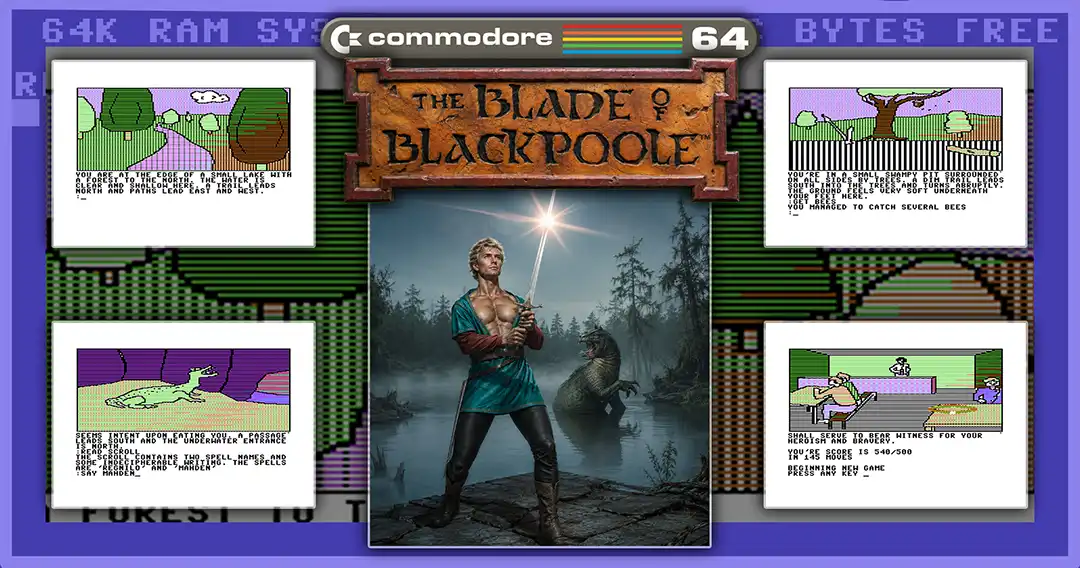
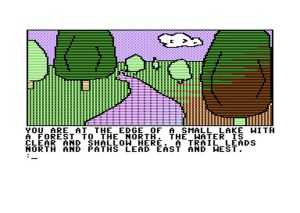
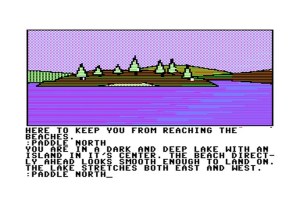
When the Commodore 64 began its triumphant rise in the early 1980s, it was still far from clear what a “major” computer game was actually supposed to look like. Action games were modeled after arcade games, role-playing games were based on pen-and-paper role-playing games, and adventure games often consisted almost entirely of text. The Blade of Blackpoole fits perfectly into this transitional period. Tim Wilson’s fantasy adventure was originally released in 1982 for the Apple II by Sirius Software and was subsequently ported to, among others, Atari 8-bit computers and the Commodore 64; the C64 version followed in 1983. Rather than relying on quick reflexes, the game emphasized exploration, dialogue, logic, and a good dose of patience. Its distinctive feature was the numerous illustrated locations, which transformed a classic text adventure into something that, at the time, felt almost like an interactive picture book.
The Hunt for Myraglym
The story draws directly from the classic fantasy adventure genre. The quest is for the magical sword Myraglym, which was once stolen from an altar and is said to be hidden somewhere in the caves near the mysterious Lake Blackpoole. Until the player actually holds the blade in their hands, the journey takes them through forests, swamps, rivers, caves, and a labyrinth. Along the way, you’ll encounter far more than just classic knights and wizards. A carnivorous plant, a hermit, a dangerous lizard-like creature, a hungry water monster, and other curious beings stand between the adventurer and their goal. The manual explicitly warns against expecting a quick solution. And this warning is justified: The Blade of Blackpoole is less an epic heroic tale than a long chain of puzzles, the logic of which was likely only completely obvious to the programmer himself at times.
Words Instead of a Joystick
The game is played almost exclusively via the keyboard. The player reads the description of the current location, looks at the corresponding graphic, and then enters commands. Directions such as NORTH or WEST are used for movement; LOOK is used to examine the surroundings; and INVENTORY displays the items the player is carrying. In addition, the parser understands relatively complex short sentences. According to the manual, the player is not limited to simple combinations of verbs and nouns; constructions such as “TURN ON THE LAMP” or actions involving an additional tool are also processed. If the program asks, for example, “WITH WHAT?”, the player can specify the missing item. For the early adventure game era, this was remarkable. Rombach’s C64 Game Guide estimated the vocabulary at 99 verbs, 92 nouns, and 16 other words—a clear indication that language actually forms an essential part of the game mechanics here.
Puzzles Without a Safety Net

The real challenge, however, isn’t finding the right words, but figuring out what the game actually expects from the player. Items can be purchased relatively early on; some of these turn out to be important later, while others serve practically only as distractions. A seemingly useless boat eventually serves a purpose; a magical liquid changes the size of an object; and, of all things, beer—which must be poured into the water—proves effective against a water creature. Other situations are even less intuitive. A rope functions in certain places in ways that are almost impossible to predict beforehand, and some obstacles require very specific phrasing. This is precisely where the game’s historical charm lies—but also its biggest problem. Anyone accustomed to modern adventure games, in which important items are highlighted and dead ends are avoided, will encounter a completely different design philosophy here. Experimenting, failing, loading a save, and experimenting again are an integral part of the process.
Saving is a must
This difficulty is compounded by the fact that wrong decisions can indeed be fatal. A dark hole, a dangerous current, or careless handling of magical items is all it takes to end the journey. That’s why frequent saving isn’t just a convenience feature—it’s practically part of the game strategy. The program allows for up to ten save slots. On the Commodore 64, you even had to prepare and format a separate floppy disk for this purpose; the manual warns against misusing the original disk as a storage medium. From today’s perspective, this effort seems cumbersome, but in 1983 it was simply a natural part of working with floppy-disk-based software. Anyone who wanted to seriously solve The Blade of Blackpoole ideally kept not only multiple save files but also their own maps and notes. Especially in a maze that was sometimes unpredictable, the pencil next to the C64 could become at least as important as the keyboard.
Images Set the Mood

Technically speaking, The Blade of Blackpoole cannot be compared to later C64 masterpieces. The computer’s graphical and audio capabilities were only gradually pushed to their limits. Here, the images primarily serve as an atmospheric complement to the text. Around 60 locations have their own illustrations; in addition, there are occasional animated elements and sound effects. The perspective is mostly that of the adventurer: landscapes, caves, buildings, and creatures appear like small windows into the game world. By today’s standards, this seems crude and static, but it was a decisive step away from the purely abstract text adventure. Contemporary observers, however, were divided on the quality of the images. While Rombach’s game guide generally praised the graphics but noted inaccuracies in the details, Ahoy! awarded the C64 graphics only a “D-,” though it rated the gameplay a “B.”
Technology with Quirks
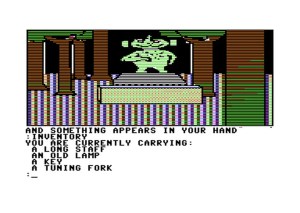
Even when playing the game today in an emulator, it becomes clear just how closely such early programs were tied to the specific hardware. There are different PAL and NTSC versions of The Blade of Blackpoole. If an NTSC version is launched with the wrong video settings, the display may appear visibly distorted. The C64 Wiki therefore explicitly recommends using the correct NTSC configuration for the corresponding disk images. It’s also interesting to note how little space such an adventure game required despite its scope: text, parsers, game logic, and dozens of illustrations all had to fit within the tight technical constraints of a 64-kilobyte home computer. That’s precisely why one shouldn’t view the simple images in isolation. Blackpoole dates from a period when developers were just beginning to learn what possibilities the new Commodore computer offered. Later titles would take the C64 into entirely new realms, both graphically and acoustically; here, you’re experiencing, in a sense, a snapshot of its early software history.
The Infamous Bee Problem
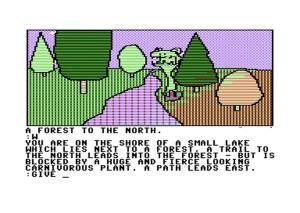
The game’s unique puzzle logic is particularly well demonstrated by the famous bee problem. At one point, the player needs bees to satisfy a carnivorous plant and pass through it. The crucial catch: The bees aren’t mentioned at all in the text description of that location. They’re only visible in the graphics. Anyone who—as is quite natural in a text adventure—relies primarily on the location description has no textual clue that an interactive object even exists here. Only entering “GET BEES” allows you to proceed. After that, you also have to come up with the idea of handing the bees over to the plant by typing “GIVE BEES.” Attempts such as throwing the bees can fail, and particularly adventurous players may even discover that swallowing a swarm of bees is an exceptionally bad idea.
Graphics Become Game Mechanics
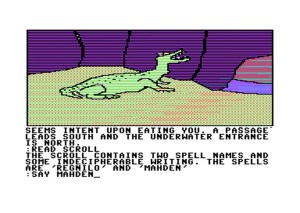
This detail is more than just a funny anecdote. The bee puzzle illustrates an important developmental step in the adventure game genre. Here, the graphics are not merely illustrations, but suddenly become carriers of game-relevant information. The player must learn to interpret text and images together. At the same time, this example illustrates why this transitional phase was problematic: there is still no established visual language to indicate which parts of an image are clickable or otherwise relevant—after all, mouse controls didn’t even exist yet. The result is a puzzle that is interesting from a historical perspective but can be unfair from a gameplay standpoint. Today, one would likely refer to this as a lack of “signposting.” In 1983, however, this kind of trial-and-error was simply part of the nature of many adventure games. The bee problem is therefore almost a microcosm of the entire game: clever, unusual, technically interesting, and at the same time capable of stalling a player for hours at a single point.
Praise for Its Ambition

At the time, The Blade of Blackpoole was taken quite seriously. Computer Gaming World reviewed the original Apple II version and highlighted, among other things, the scoring system. The game was designed for a total of 500 points, with the most efficient solution—achieved in the fewest moves—being rewarded. This created an additional incentive, beyond simply completing the game, to optimize known solutions. Other magazines also took notice of the game. Electronic Fun with Computers & Games, for example, rated the Atari version 3.5 out of 4 points in 1983. The German Rombach’s C64 Game Guide ultimately described Blackpoole as one of the best graphic adventures with a fabulous backstory, though it ranked The Hobbit and Twin Kingdom Valley even higher. For a game that is known today primarily to connoisseurs of early adventure game history, the reception at the time was quite respectable.
Criticism of Arbitrariness

At the same time, critics recognized even back then—or in contemporary adventure game guides—precisely those weaknesses that stand out particularly today. Compute!’s Guide to Adventure Games praised the parser and the high-resolution illustrations, but criticized the puzzles unusually bluntly, calling some of them arbitrary. Particular complaints were directed at red herrings, items that behaved inconsistently, and situations where the solution could hardly be deduced from previous information. The conclusion was essentially this: a good first impression, but even experienced adventure gamers need patience and a willingness to try out even unreasonable solutions. Electronic Games also took issue with the poor documentation of the C64 version, even though the basic rules were relatively easy to grasp. This makes it clear that the game’s notorious difficulty isn’t merely a judgment call by modern players. Even at the time of its release, Blackpoole could both fascinate and frustrate—often within the same hour of play.
Between Two Eras
The Blade of Blackpoole did not develop a direct cultural influence like Zork, The Hobbit, King’s Quest, or, later, Maniac Mansion. It would therefore be an exaggeration to declare the game the forgotten founder of the modern graphic adventure. Rather, it is interesting as a representative of a brief, experimental transitional phase. Pure text adventures had proven that computer games could convey stories and complex worlds. Now developers began to make these worlds visible without immediately abandoning text-based controls. Blackpoole therefore combines an old-school parser with an almost entirely illustrated environment. A few years later, graphical user interfaces, mouse controls, and visible inventories would eliminate many of these linguistic hurdles. The game documents the moment immediately before that—when developers still had to figure out how much an image should show, what still needed to be conveyed in text, and how the player would navigate between these two levels of information.
Memories Through Quirks

The fact that The Blade of Blackpoole is still discussed today is therefore less due to a major game series or famous sequels than to its quirks. Retro gamers remember absurd solutions, the bees, the beer in the water, the shrinking boat, and the need to combine practically every suspicious object with every conceivable verb. Modern databases, C64 websites, and detailed retro walkthroughs still document the game, and preserved disk images make it possible to experience the C64 version in emulators. There were even Japanese ports for systems like the FM-7, PC-88, and PC-98—an indication that Sirius’s fantasy adventure was more widely distributed at the time than its current popularity would suggest. It hasn’t become a widely known cult classic, but it is a well-preserved example of a design era in which rules hadn’t yet been standardized and, precisely for that reason, there was a surprising amount of experimentation.
Fascinating and Merciless
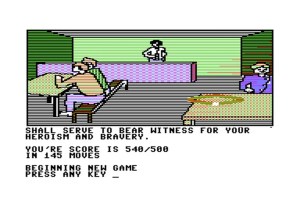
From today’s perspective, The Blade of Blackpoole is both fascinating and difficult to recommend. Anyone looking for a comfortable adventure game with straightforward puzzles is likely to quickly become frustrated by its parser, the dead ends, and the sometimes arbitrary object logic. On the other hand, anyone interested in the history of the Commodore 64 and the evolution of the adventure genre will find a remarkable historical document here. The combination of text input and images shows how developers in the early 1980s were searching for a new form of digital storytelling. The bee problem, in particular, epitomizes this ambivalence: you can’t proceed without closely examining the graphics, yet the game never explains this rule. That’s poor modern game design—and at the same time, fascinating computer history. The Blade of Blackpoole is therefore not a forgotten masterpiece, but perhaps something even more interesting: an edgy, idiosyncratic piece of early C64 history that shows how the graphic adventure first had to learn to be a graphic adventure.








Kommentar verfassen