

How the Web Has Changed the World Since August 6, 1991
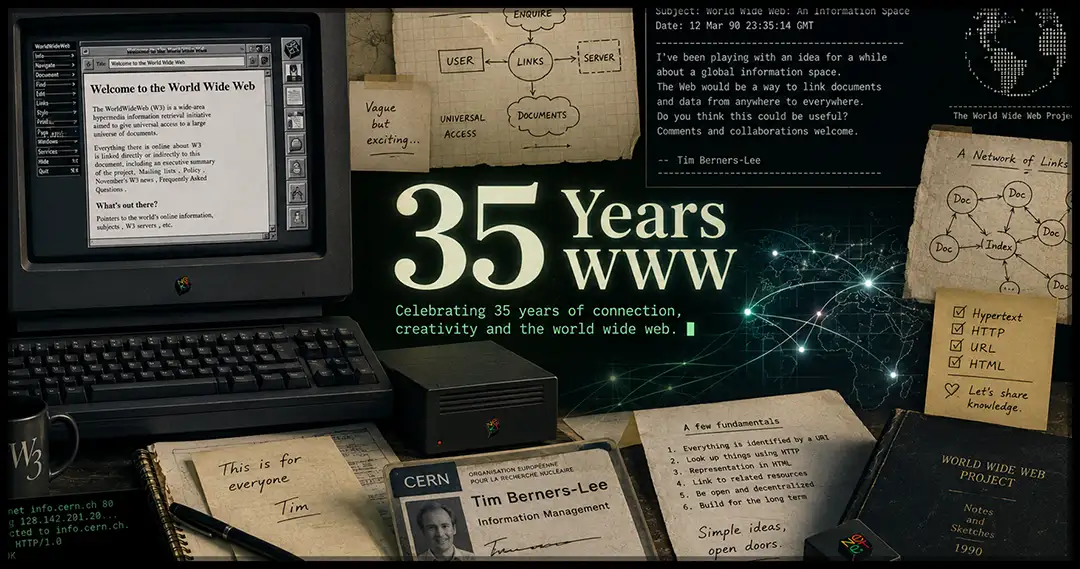
August 6, 2026, marks the 35th anniversary of an unassuming but momentous event: Tim Berners-Lee posted information about his WorldWideWeb project in the Usenet group “alt.hypertext.” It wasn’t a big press conference, but rather an invitation to try out a new information system. This technical announcement gave rise to one of the most important infrastructures of modern society. The Web has transformed the way people find knowledge, communicate, work, and learn. Its anniversary is therefore also an occasion to ask what kind of Web we want for the future.
A Network Goes Public
The Web wasn’t invented on August 6, 1991. Its history began in 1989 at the CERN research center near Geneva. There, British computer scientist Tim Berners-Lee was looking for a solution to a practical problem: Scientists from many countries were working with different computer systems and databases. Information was available, but hard to find and often isolated from one another.
Berners-Lee therefore proposed a distributed hypertext system. Documents were to be linked together via electronic references. By the end of 1990, CERN was already running the first web server, the first website, and a browser that also functioned as an editor. The announcement on August 6, 1991, brought the project beyond the narrow circle of researchers. Berners-Lee explained that the WWW was intended to enable connections to information anywhere, and invited others to contribute.
Precursors to Hyperlinks
The idea of linking information via “links,” however, was not new. Concepts similar to the hypertext principle existed long before the World Wide Web.
A particularly influential milestone was Douglas Engelbart’s famous “Mother of All Demos” in 1968. There, he presented the NLS system, which already demonstrated basic hypertext functions: documents could be linked together, navigated, and edited collaboratively. This early vision of a networked, interactive information space is now considered one of the most important sources of inspiration for later hypertext systems.
Hypertext ideas were also put into practice in the 1980s. A prominent example is Apple’s HyperCard (1987). This system made it possible to create so-called “stacks” of digital cards that were linked to one another via buttons and hyperlinks. Users could thus create non-linear information structures and navigate through local hyperlinks—though exclusively on their own computers, without a network connection.
These precursors show that the Web was not the invention of hypertext itself, but rather the first successful implementation of a globally networked hypertext system.
Three Building Blocks, Major Impact
The technical foundation of the Web was relatively simple. HTML structured content, HTTP governed the transfer between servers and browsers, and URLs gave documents a unique address. What was crucial was how they worked together: Anyone who knew an address or followed a link could retrieve information from a remote computer without having to understand its internal system.
This simplicity made the Web interoperable. New pages could link to existing content without having to ask a central authority for permission. Providers could operate their own servers, while users, in principle, needed only a browser. The Web was not a single program or a closed platform, but a growing space of open connections.
Openness as a Principle of Success
A decisive step followed on April 30, 1993: CERN placed the fundamental Web software in the public domain and later published an open license. Companies, universities, developers, and private individuals could use and further develop the technology without having to pay license fees to CERN. The Web became an open standard rather than the exclusive property of a corporation.
In 1994, Berners-Lee founded the World Wide Web Consortium, or W3C for short. Together with companies, research institutions, and other stakeholders, it develops standards for an interoperable, international, and accessible Web. Such open standards help ensure that websites remain accessible across different devices and browsers.
From Reading to Participating
The first websites consisted mainly of text, links, and simple graphics. Nevertheless, the original browser embodied an idea that only later became taken for granted: people should not only be able to read content, but also edit and publish it. The first browser was therefore also an editor.
With faster connections, graphical browsers, and user-friendly content management systems, the early information network evolved into a mass medium. Search engines made the growing number of pages accessible. Forums, blogs, and wikis turned millions of people into authors. Later, social networks, video portals, online retail, and cloud-based applications were added. The browser evolved from a window for documents into a universal work environment.
This shifted social roles. Small businesses could reach customers worldwide, educational opportunities became available regardless of location, and individuals gained new ways to attract attention. The Web lowered many barriers to access, even if it by no means eliminated them entirely.
The World in the Browser
Today, the Web is so taken for granted that its technical distinctiveness is easily overlooked. The Internet and the Web are often equated, but they are not identical. The Internet is the global network infrastructure over which many services run. The World Wide Web is one of these services: a system of linked resources that are typically accessed via browsers. Email also uses the Internet, but technically does not automatically belong to the Web.
This distinction is important because the Web was conceived as a universal space. A website should not be limited to functioning only within a specific device, operating system, or company. The W3C describes a Web that is intended to be accessible on various devices, in numerous languages, and with assistive technologies for people with disabilities.
The Dark Side of Success
Its enormous success gave rise to problems that were hardly foreseeable in 1991. Large platforms concentrate attention, data, and economic power. Personalized systems influence which news, opinions, and products become visible. Business models based on extensive data collection threaten privacy. Disinformation, hate speech, fraud, and digital surveillance show that open communication does not automatically lead to an open society.
Access also remains unequal. Not everyone has a reliable connection, a suitable device, or digital literacy. Barriers arise from complicated user interfaces, a lack of translations, or inaccessible design. The W3C itself emphasizes that web technologies are intended to create social benefits, but can also be misused.
Moreover, many people primarily use apps and platforms whose rules are set by a single company. Content can disappear, accounts can be suspended, and interfaces can be shut down. This puts pressure on the open principle of the Web: the ability to publish content yourself, link freely, and switch between services.
The Web in Flux
On its 35th anniversary, the Web is once again undergoing a phase of fundamental change. Artificial intelligence is transforming search, content creation, and interaction with digital services. Answers are increasingly generated directly, rather than simply being presented as a list of links. While this can facilitate access to knowledge, it also raises questions: Where does the information come from? Who is compensated for the content? How can we detect errors and synthetic media?
At the same time, decentralized technologies and open social networks are gaining attention. They build on the original idea that users should not be completely dependent on individual platforms. Whether this will lead to a broad alternative remains to be seen. What is certain is that technical standards alone are not enough. Political rules, economic incentives, and social values also determine how the Web functions.
An Open Future
Thirty-five years after its public debut, the World Wide Web remains an extraordinary collaborative project. It was not completed in a single moment, but through countless contributions: program code, standards, websites, texts, images, discussions, and links. Its history demonstrates the power that emerges when a technical idea is openly accessible and can be further developed by many.
This anniversary serves as a reminder of a promise: Knowledge should be connected, communication facilitated, and participation expanded. This promise does not fulfill itself. A free, secure, accessible, and diverse Web must be continually reshaped and defended. The crucial question, therefore, is not whether the Web will continue to exist. It is whether it will remain a space that serves people—and not just the most powerful platforms and business models.








Kommentar verfassen