

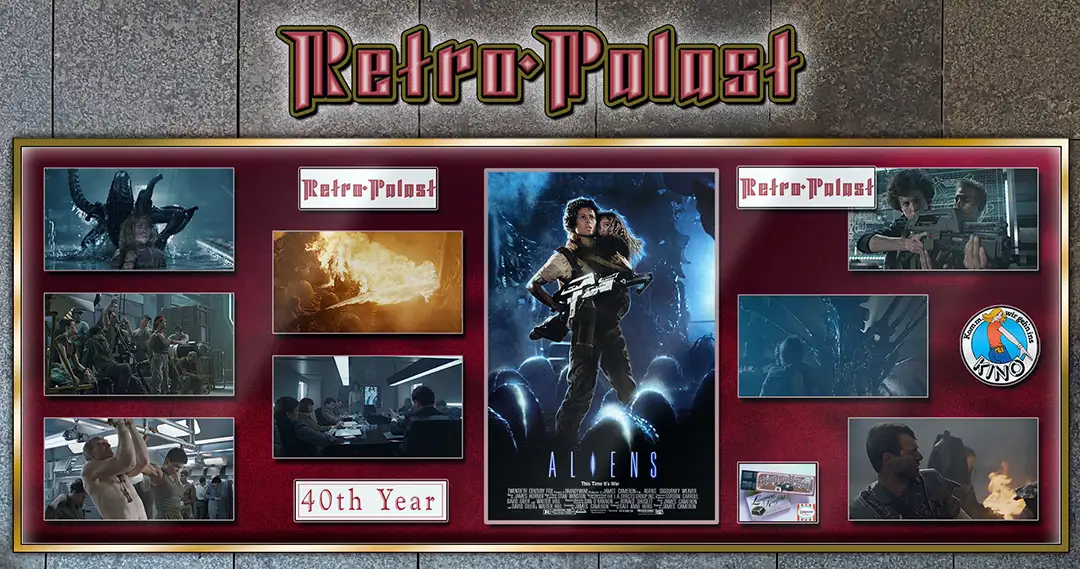
Hey Vasquez, have you ever been mistaken for a man?
They mostly come at night… mostly.
Aliens – The Perfect Nightmare
When Ridley Scott released Alien in 1979, he created a modern classic of science fiction horror that was inevitably doomed to failure. The first film thrived on loneliness, darkness, and the feeling that an unknown creature was lurking somewhere in the narrow corridors of the “Nostromo.” James Cameron therefore made the smartest possible decision: He didn’t try to remake the same movie. Aliens, released in 1986, takes the world, the main character, and the monster from the original but transforms the claustrophobic horror into a military siege film. That is where its greatness lies. Alien may be the purer horror film, but Aliens is the more complete film and the best installment in the entire series. It offers suspense, action, believable characters, dark humor, and a surprisingly emotional story about trauma, responsibility, and motherhood. Cameron doesn’t simply turn Ellen Ripley into an armed heroine. He portrays a traumatized survivor who is forced to return to the site of her worst memory and form a new bond there.
The film also features an almost perfect dramatic build-up. The first half establishes the atmosphere and characters, while the second half steadily picks up the pace until a reconnaissance mission turns into a desperate fight for survival. Despite its epic battles, Aliens remains easy to follow: you almost always know where the characters are, what their goal is, and what’s at stake.
This sets the film apart from many later action productions that confuse volume with suspense. Cameron didn’t just create a bigger and louder Alien movie; he created a sequel that respects the original precisely because it’s deliberately different.
Return to LV-426
The story begins 57 years after the events of the first film. Ripley’s escape pod is recovered, but her return is no triumph. While she was in cryosleep, her former world has vanished. Her daughter has died, her professional life lies in ruins, and her story about a deadly alien creature is met with skepticism by representatives of the Weyland-Yutani Corporation. Ripley loses her pilot’s license and discovers that a human colony has since been established on LV-426, the planet where the first encounter with the Alien took place.
When contact with this settlement is lost, company representative Carter Burke asks Ripley to accompany a unit of Colonial Marines as an advisor. Ripley initially refuses. However, her nightmares and feelings of guilt make it clear that she cannot escape her trauma. Eventually, she agrees on the condition that the creatures not be studied or brought to Earth, but rather completely destroyed.
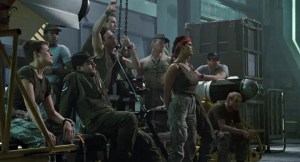
Aboard the warship “Sulaco,” she encounters a group of self-assured soldiers. Sergeant Apone leads the unit; Corporal Hicks remains calm and alert; Vasquez appears unshakable; while Hudson hides his insecurity behind cocky one-liners. The inexperienced Lieutenant Gorman may hold the rank, but he has little practical authority. Added to this is the android Bishop, whom Ripley initially distrusts due to her experiences with the treacherous Ash.
On LV-426, the Marines find the Hadley’s Hope colony abandoned and devastated. Only the young Rebecca “Newt” Jorden has survived by hiding in supply shafts. Ripley slowly gains her trust. This relationship forms the emotional core of the film: Both are survivors, both have lost their families, and both recognize in each other someone who understands their fear.

The missing colonists are eventually discovered beneath the atmospheric processor. An entire colony of Aliens has taken up residence there. The first attack destroys the Marines’ military superiority within minutes. Numerous soldiers die, Gorman loses control, and Ripley effectively takes command. When an alien causes the landing ship to crash, the survivors are stranded on the planet. At the same time, the damaged reactor of the atmospheric processor threatens to explode.
Burke secretly attempts to hand Ripley and Newt over to the facehuggers. He wants to smuggle alien specimens to Earth and prevent the other survivors from revealing his plan. His plan fails, but during the ensuing attack, Newt is snatched by an Alien.
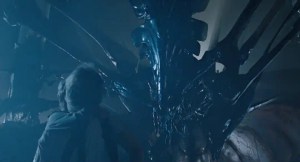
Ripley refuses to give up on the girl. While Bishop remotely controls a second landing craft, she single-handedly infiltrates the nest, rescues Newt, and encounters the Alien Queen. After a seemingly successful escape, the Queen sneaks aboard the “Sulaco” unnoticed. In the famous finale, Ripley climbs into a hydraulic loader and confronts the monster. The battle is not only human versus alien, but also mother versus mother.
Strong Characters, Strong Cast

Sigourney Weaver carries the film. Her Ripley is neither invulnerable nor unfeeling. She is afraid, suffers from nightmares, and initially reacts with understandable reluctance to the new mission. That is precisely why her later courage feels believable. She doesn’t become a heroine because she is physically stronger than everyone else, but because she thinks more clearly in decisive moments and takes responsibility.
Weaver’s performance was nominated for an Oscar for Best Actress—an extraordinary honor for a 1980s science-fiction action film. Aliens received a total of seven Oscar nominations and won in the categories of Sound Editing and Visual Effects. Newt is portrayed without the exaggerated cuteness that often characterizes child characters in Hollywood films. Newt is frightened, but intelligent, adaptable, and independent. There is no immediate, artificial bond between her and Ripley. Their trust develops through concrete actions: Ripley listens to her, keeps her promises, and takes her fear seriously.

Michael Biehn gives Hicks a pleasantly understated presence. He is competent without constantly needing to prove himself, and he accepts Ripley’s experience. This creates a quiet closeness between the two that the film never turns into a forced love story.
Lance Henriksen plays Bishop with controlled friendliness. His character refutes Ripley’s distrust of androids without the film making her caution seem ridiculous. Bishop is the antithesis of Ash from the first film: an artificial being who is actually willing to sacrifice himself for others.
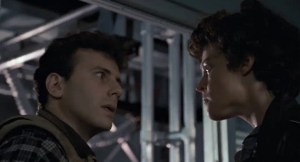
Paul Reiser is particularly effective as Burke because he initially appears harmless and reasonable. He is not a screaming supervillain, but a polite careerist who converts human lives into economic opportunities. In this way, he is, in a different sense, almost as dangerous as the Xenomorphs.
Bill Paxton, on the other hand, makes Hudson one of the most entertaining characters. His panic, his cocky one-liners, and his later resistance lend the film humor without undermining the sense of threat. Jenette Goldstein as Vasquez, Al Matthews as Apone, and William Hope as Gorman round out a cast in which even supporting characters remain instantly recognizable. Behind the Scenes

The making of Aliens was by no means a foregone conclusion. Following the success of the first film, a dispute between the studio and the producers delayed the sequel. James Cameron was commissioned to write a draft in 1983 after his screenplay for The Terminator had attracted attention. According to the AFI Catalog, Cameron had seen the first Alien on opening night—during a period in his life when he was working, among other things, as a truck driver. For the sequel, Cameron combined the horror of the original with the direct, mechanical action that would become his trademark. He himself described the planned result as a stylistic fusion of Alien and Terminator. Instead of a single creature sneaking invisibly through dark corridors, he wanted to depict an organized, almost warlike alien species. The film was shot primarily in England, including at Pinewood Studios. Parts of the abandoned colony were created at the decommissioned Acton Lane Power Station in London. The industrial setting was crucial to the film’s impact: Hadley’s Hope does not look like a gleaming vision of the future, but rather like a damp, dimly lit workplace. Pipes, grates, warning lights, and narrow corridors convey the impression of a facility that is actually in use. The special effects were created using practical methods. Stan Winston and his team further developed the Alien effects based on H. R. Giger’s original design. Particularly impressive is the Queen, a massive, manually operated set piece whose weight and physical presence remain palpable during her battle with Ripley. Cameron and Winston worked closely together to make the new creature a believable extension of Alien biology. Miniatures, puppets, rear projections, and careful editing create a sense of scale for which today’s films would often rely entirely on digital imagery. The Academy recognized this very craftsmanship with the Oscar for Visual Effects.
The technical equipment also became iconic. The pulse rifle, the motion sensors, the landing craft, and the hydraulic loader all look futuristic but serve recognizable functions. Cameron does not present technology as mere decoration. The loader is introduced early on, when Ripley uses it to demonstrate her professional competence; later, it becomes a weapon.
This setup makes the finale particularly satisfying. The solution does not appear by chance at the decisive moment, but arises from a previously established ability of the main character. Behind seemingly simple action, therefore, lies an extremely precise structure.
The Downfall of the Sequels
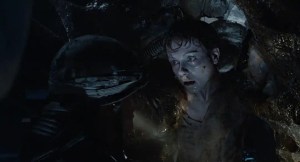
After Aliens, the series faced a fundamental problem: the film had brought Ripley’s story to an emotionally satisfying conclusion. By the end, Ripley, Newt, and Hicks had formed a damaged but hopeful surrogate family. Alien 3 destroyed this resolution almost immediately. Newt and Hicks die before the actual plot even begins, and Ripley once again finds herself alone on a hostile world.
This decision is consistently bleak, but at the same time feels like a punishment for the audience’s emotional investment in the previous film. In hindsight, the entire struggle to rescue Newt seems almost meaningless. Whereas Aliens allowed Ripley’s trauma to evolve and find a form of healing, the third film throws her back to square one.
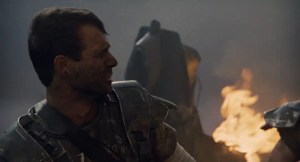
David Fincher’s Alien 3 features powerful imagery, an oppressive atmosphere, and interesting religious themes. Nevertheless, it suffers from its notoriously difficult development. Numerous writers, drafts, and directors were involved before the final version was completed. The AFI Catalog documents, among other things, a discarded draft by William Gibson as well as several changes in the director’s chair. The result feels less like a necessary sequel and more like a film that had to find its own direction even while in production. Fincher’s talent is evident, but the contradictory production decisions prevent the narrative clarity that had distinguished Aliens.

Alien: Resurrection (1997) veers even further into the realm of the grotesque. The cloned Ripley is fundamentally an interesting idea, but the mix of black comedy, body horror, and over-the-top action no longer possesses the clear tension of the first two films. Individual scenes and creature designs stick in the memory, but overall, the film often comes across as an eccentric variation on familiar themes.
Even later prequels and spin-offs rarely managed to achieve the special balance of Aliens. Some expanded the mythology; others copied recognizable situations and imagery. Yet it was precisely the increasing amount of explanation that often weakened the sense of the unknown—the very thing that had originally made the Xenomorph so terrifying.
Aliens had shown that it was possible to expand the world without completely demystifying the monster. Many sequels, on the other hand, confused more backstory with greater significance.
The Reviews from 1986

Upon its theatrical release, Aliens was received with overwhelming enthusiasm, though by no means unanimously. Variety called it a very worthy sequel to Ridley Scott’s film and saw the production as marking James Cameron’s rise to the ranks of Hollywood’s top directors. The Los Angeles Times* praised the tight, relentless pace and highlighted that Cameron had built the film around Weaver’s resolute intelligence and physical presence. At the same time, the newspaper noted that the film relied more on firepower than on the gothic futuristic horror of the original. Ebert reacted particularly strongly to the intensity of the second half. He described the film as almost painfully exhausting and admired how long Cameron was able to maintain the tension at the highest level. In Ebert’s assessment, the final hour had a barely abating, almost physically taxing effect. Ebert hits on a key point: Aliens does not seek to elegantly soothe its audience. As soon as the first major attack begins, the film allows only brief moments to catch one’s breath. New problems arise before the previous ones are fully resolved.

The Washington Post recognized a simple but effective mythical structure behind the spectacle: the struggle of a protective human mother against the Alien Queen. As a result, the finale was understood not merely as a technical spectacle, but as the culmination of the central theme. Kael was among the most vocal critics. In The New Yorker, she criticized the film’s length, the visual repetitions, and what she saw as the formulaic amplification of familiar action and horror elements. For her, the film was an oversized shock effect that inflated familiar genre tropes to epic proportions. Her objections are not entirely unfounded. The film is loud, physical, and deliberately direct. Yet it is precisely its spatial and dramatic precision that prevents it from becoming mere noise. The seven Oscar nominations, including Weaver’s Best Actress nomination, also demonstrated that Aliens was recognized even back then not only as a genre film but also as a significant achievement in craftsmanship and acting.
Impact on Pop Culture
The cultural impact of Aliens can hardly be overestimated. Ellen Ripley became a model for the modern action heroine. She combines technical expertise, determination, and physical courage with vulnerability and compassion. Her heroism stems neither from supernatural abilities nor from an innate love of combat.
Scholarly analyses of the character emphasize that her strength does not simply consist of a replica of male action heroes. Ripley is allowed to fight, doubt, protect, and lead all at once. Her handling of the hydraulic loader, for example, demonstrates both her technical training and her ability to use a tool creatively in combat. The confrontation between Ripley and the Queen is therefore one of the defining images of female agency in popular cinema. Ripley does not win because she has suddenly become a different person. She draws on her existing skills, her experience, and her protective instinct.
Equally influential was the portrayal of the Colonial Marines. Their weapons, body language, catchphrases, camaraderie, and overconfidence set a template for countless military science fiction stories. Cameron initially portrays them as nearly invincible professionals, only to have their confidence completely shatter upon first contact with the aliens.

The film’s influence is particularly evident in video games: motion sensors, narrow corridors, swarms of enemies that appear suddenly, and heavily armed task forces have become staple elements of numerous action and horror games. A look back at gaming history reveals parallels with Doom, Halo, Metroid, and Dead Space, among others. Not every one of these works is a direct copy, but Aliens provided a particularly influential visual and auditory language for the battle against alien hordes. Dialogue from the film has entered pop culture. Hudson’s desperate “Game over, man!” is still quoted and parodied to this day. Ripley’s challenge to the Queen before the final battle has also become one of the most famous moments in action cinema. Bill Paxton’s portrayal of the panicked but ultimately brave Hudson remains one of his best-known roles to this day. However, these lines do not function in isolation within the film. They are highlights of clearly developed characters and situations. Modern films often deliberately attempt to create quotable dialogue. In Aliens, by contrast, the famous lines arise organically from the characters’ personalities.
Ultimately, the film changed the perception of what a sequel can achieve. Cameron did not repeat the formula for success but instead switched genres, raised the bar, and at the same time deepened the main character. This principle was later frequently imitated: a good sequel must be bigger, but at the same time offer a new perspective. Few films have accomplished this task so convincingly.
A Nearly Perfect Finale

Aliens is a rare example of great entertainment cinema in which nearly every element interlocks. The action stems from the characters’ decisions, the special effects serve the narrative, and even the most spectacular moments serve an emotional purpose.
The film begins with a woman who is alone, traumatized, and not taken seriously by those around her. It ends with that same woman protecting a new family and having actively confronted her greatest trauma. Crucially, her fear does not simply disappear. Ripley acts despite her fear. That is where her true courage lies.

Of course, Aliens isn’t flawless. Some of the marines are deliberately portrayed as archetypes, certain lines of dialogue clearly reflect the tone of the 1980s, and the lengthy final act might feel tedious in a weaker film. Yet Cameron masters pacing, space, and anticipation so skillfully that the runtime hardly feels like a burden. Each escalation follows logically from the one before.
The later sequels contain interesting ideas but achieve neither its clarity nor its emotional impact. In particular, the hopeful bond between Ripley, Newt, and Hicks was never convincingly developed further.

The first Alien remains a masterpiece of horror. Aliens, however, is the more comprehensive experience. It expands the world without losing its sense of menace, establishes Ripley as one of cinema’s great heroines, and blends fear, action, and emotion with extraordinary technical mastery.
That’s why Aliens isn’t just an outstanding sequel. It’s the pinnacle of the Alien series and one of the best science fiction action films ever made: gritty, thrilling, human, and still astonishingly vivid even decades later.
More
Trailer
External links
- Aliens at IMDb
- Aliens at Rotten Tomatoes
- Aliens at Wikipedia (en)
- Aliens at Wikipedia (de)
Notice Regarding Image Rights and Copyrighted Material
All images, film stills, posters, logos, trailer excerpts and other copyrighted materials used in this article are used solely for editorial reporting, film criticism, review and illustrative purposes related to the respective content.
Unless otherwise stated, all copyrights, trademark rights and other intellectual property rights in the materials used remain with their respective rights holders, including film studios, distributors, production companies, photographers, artists or other licensors.
The materials are used in good faith and with regard to applicable legal limitations, licence terms and source attributions. If, despite careful review, any rights have been infringed or any attribution is incomplete, please contact me. Upon review, the relevant content will be removed or corrected promptly.







Schreibe einen Kommentar