

Ada Lovelace:
The Visionary of Computer Technology
Ada Lovelace, born Augusta Ada Byron on December 10, 1815, was one of the most influential and visionary figures in the history of science. In an age when the idea of computers was still far off, she recognized the transformative potential of machines that could do much more than simple calculations. Today, she is considered the world’s first programmer, and her work helped shape the foundations of modern computer technology. Her legacy extends from the early days of computer science to its applications in almost all areas of life today.
Early years and education:
the path to mathematics
Ada Lovelace was born into an intellectually sophisticated family. Her father, the famous romantic poet Lord Byron, left the family shortly after her birth. Her mother, Anne Isabella Milbanke, a highly educated woman with a passion for mathematics, ensured that Ada received a rigorous scientific education. This decision was remarkable because it was unusual for women in that society to receive a mathematical-scientific education. Milbanke wanted to prevent Ada from adopting her father’s character traits, which were described as “poetic madness”. Therefore, her education focused on logic, mathematics and natural sciences.
Ada’s education was exceptionally thorough. She received private instruction from renowned mathematicians such as Mary Somerville, one of the most outstanding scientists of her time, and Augustus De Morgan, a renowned logician. This early and intensive exposure to science sparked a lifelong passion for mathematics and mechanics in Ada. Her enthusiasm for complex machines and analytical thinking would later lead her to her significant work on the Analytical Engine.
Meeting Charles Babbage:
The Beginning of an Important Collaboration
In 1833, at the age of 17, Ada Lovelace met the mathematician and inventor Charles Babbage. This encounter was to change the destiny of both of them. At the time, Babbage was working on the “Difference Engine”, an early mechanical calculating machine for calculating mathematical tables. Babbage was deeply impressed by Ada’s intellectual abilities. They shared an enthusiasm for the possibilities of mathematics and mechanics, which led to a close and productive collaboration.
While Babbage was working on his more ambitious “Analytical Engine” – a machine that could theoretically perform all types of calculations – Ada was one of the few people to recognize the significance of this idea. She understood that this machine went far beyond the capabilities of a mere calculating machine. In 1843, Babbage asked Ada to translate an essay by the Italian engineer Luigi Menabrea about the Analytical Engine into English. Lovelace seized this opportunity to add her own notes – her notes, known as the “Notes”, were three times longer than the original text and contain some of the most significant contributions to the development of computer science.
The first algorithm:
the birth of programming
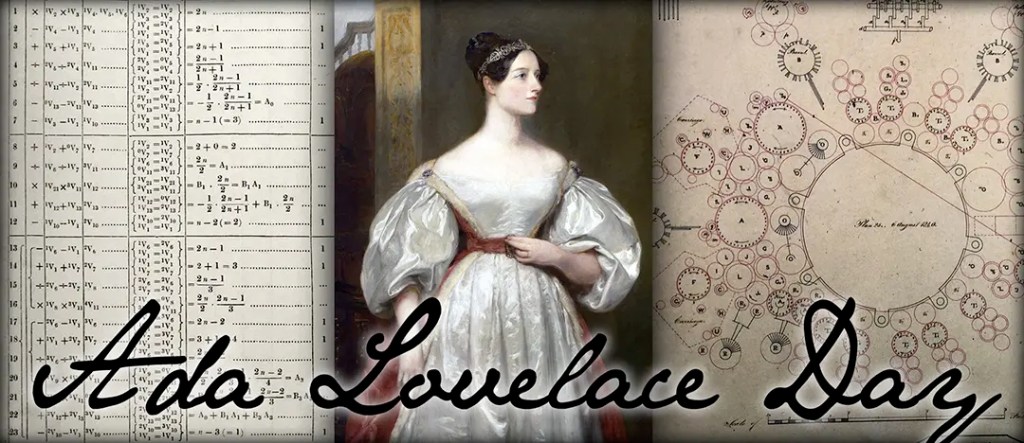
In her notes on Babbage’s “Analytical Engine”, Ada Lovelace developed the first known computer program. She described an algorithm that could be executed by the machine to calculate the Bernoulli numbers – a series frequently used in mathematics. This algorithm is considered the first program in history and makes Ada Lovelace the world’s first programmer.
But Ada’s groundbreaking work was not limited to this algorithm. She was the first to propose the idea that machines could do much more than just calculate numbers. In her notes, she wrote that machines could be able to process other data, such as musical notes or texts. This notion that machines could be flexibly programmed to perform a wide range of tasks is considered one of the most visionary insights of her time. She understood that a machine capable of processing information could be more than just a computational tool – it could become a universal tool for any kind of information processing.
A profound vision:
the machine as a creative tool
Ada’s deeper understanding of the Analytical Engine was evident in her idea that machines would be capable of more than just calculations. She recognized the potential of these machines as tools for processing and even creating art, music and creative content. This idea was revolutionary. Her notes contain the famous quote: “The Analytical Engine makes no claim to create anything. It can only do what we tell it to do. But it can help discover what we don’t know.” This shows that Ada recognized the role of computers as tools for discovering new knowledge, far beyond mathematics.
Ada’s imagination and ability to see machines as universal problem-solving tools was a milestone for science. Her insights laid the foundation for later developments in computer science, including the concepts of algorithms, programming languages, and the idea that computers can also be used in creative processes. Today, her vision is omnipresent in areas such as music composition, machine learning, and data processing.
Influence on today’s computer technology:
a legacy that shapes the future
Ada Lovelace’s influence on modern computer technology is enormous. Her idea that machines could be programmed to perform a variety of tasks forms the basis for today’s computers and the internet. She was the first to anticipate the idea of a “universal computer” – a machine so flexible that it can execute any program. This idea was taken up and further developed a century later by the mathematician Alan Turing, who formulated the concept of the “Turing machine”, which is considered the theoretical basis of modern computers.
Ada’s influence can also be seen in the development of modern programming languages. The eponymous programming language “Ada”, developed in the 1980s by the US Department of Defense, pays homage to her groundbreaking ideas. This language is still used today in safety-critical systems, such as in aviation and defense.
Furthermore, Ada’s understanding of algorithms and computing helped lay the foundation for today’s technologies. The way modern computers execute applications, control complex processes and process data in various forms is directly rooted in her insights.
Ada’s legacy:
An inspiration for women in science and technology
Today, Ada Lovelace is not only an icon of computer science, but also a symbol for women in science who made groundbreaking discoveries in a male-dominated world. Her legacy is honored by the annual celebration of “Ada Lovelace Day,” which highlights the achievements of women in science, technology, engineering, and mathematics (STEM). The day serves to raise awareness of the often overlooked contributions of women in these fields and to inspire new generations of female scientists and engineers.
Ada Lovelace was far ahead of her time. Her vision of computers as creative and universal tools has changed the world forever. Her story is not only one of scientific genius, but also of a woman who dared to push the boundaries of thought and dream the future of technology. She remains an enduring inspiration to those who are looking for new ways to shape the world through science and creativity.
Her legacy lives on in modern computer science, but perhaps her greatest achievement was to teach us that science and imagination can go hand in hand. Ada Lovelace is proof that visionary thinking can change the world – and she opened the door to the digital revolution that we all benefit from today.








 McHenry's Lair
Kommentar verfassen :