

NEW : Prefer to watch? Explore this article as a slideshow video.
Beautiful Illusions

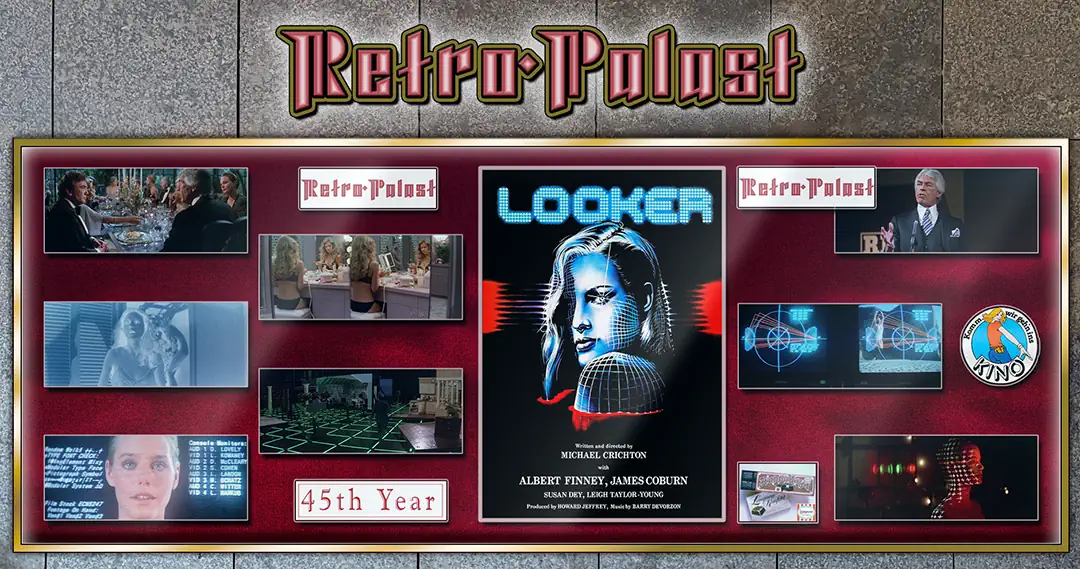
Beauty is supposed to attract attention, but in Michael Crichton’s Looker, attracting attention can be fatal. This unusual science-fiction thriller, released in 1981, brings together cosmetic surgery, advertising, corporate conspiracy and computer-generated people. The film’s world appears polished and prosperous, but beneath the immaculate surfaces lurks an unsettling question: what happens when a person’s image becomes more valuable than they are? Crichton bases his film on this idea, turning the pursuit of physical perfection into a story about manipulation and disposability.
Watching Looker today means encountering both an unmistakable product of its period and a remarkably prescient piece of speculative fiction. Its fashions and technological hardware belong to another era, but its anxieties feel much closer to home. Artificial beauty, manufactured desire and the commercial ownership of human likenesses give the film considerable contemporary resonance. This does not make it a neglected masterpiece, however, as its storytelling is uneven and its characters sometimes struggle to compete with its ideas. Nevertheless, these ideas make the film more interesting than its reputation might suggest.
Deadly Perfection

The story follows Dr Larry Roberts, a successful Beverly Hills plastic surgeon whose patients include beautiful young advertising models. Several of them request extraordinarily precise adjustments to features that hardly seem to need correcting. Their requests imply that beauty has become a mathematical specification, with even the slightest deviation being viewed as a professional disadvantage. When these patients start dying in suspicious circumstances, Roberts becomes embroiled in the investigation. His attempts to uncover the truth bring him together with Cindy Fairmont, another model who may be in danger.

Their investigation leads them to Digital Matrix, a company associated with the powerful businessman John Reston. The company’s technology promises to replace living performers with computer-generated versions whose appearances and actions can be controlled. Even more disturbing is its use of advertising to manipulate viewers through hypnotic visual techniques. The conspiracy is protected by a weapon that disorients its victims, leaving gaps in their awareness while events continue around them. These episodes create some of the film’s most intense suspense; danger appears to move faster than perception itself. As Roberts and Cindy approach the truth, the familiar murder mystery expands into a broader nightmare about the power to determine what people see, and consequently what they believe.
Creative Origins

Looker emerged from Crichton’s concerns about beauty, commercial persuasion and the increasing artificiality of everyday life. According to an Advertising Age interview from October 1981, preserved on his official website, the screenplay originated in the mid-1970s. Initially, he approached the idea of audiences being seduced by computer-animated images as absurd enough for comedy. However, conversations with animation companies changed his perspective when specialists treated the premise as a plausible extension of work already underway. The distance between his imagined future and the technology then in development was smaller than he had expected.
The production itself followed a complicated route. According to the American Film Institute, the project passed from Twentieth Century-Fox to Paramount before reaching The Ladd Company, with Howard Jeffrey as producer. The 1980 actors’ strike affected scheduling, and principal photography eventually began on 27 October 1980 and concluded in January 1981. Filming took place at studios and locations around Los Angeles, and the American release followed on 30 October 1981. This background situates the film between established Hollywood production methods and emerging digital possibilities. The film’s uncertain balance of comedy and suspense also reflects the difficulty of turning an outrageous technological proposition into a conventional commercial thriller.
Human Faces

Albert Finney lends Looker a valuable human centre as Larry Roberts. His performance conveys intelligence and professional assurance without turning the surgeon into an effortlessly capable action hero. Roberts often seems irritated or bewildered by the world he has entered, which makes his predicament more relatable. There is also an interesting contradiction in the character: he earns his living by changing people’s appearances, and then he discovers a business that takes this far beyond anything he could have imagined. Finney’s grounded performance helps to hold together a film whose speculative machinery occasionally threatens to overwhelm its characters.
Susan Dey plays Cindy Fairmont, whose involvement gives the conspiracy a personal dimension. She represents the individual behind the marketable image, although the screenplay does not always allow her enough independence to fully develop this. James Coburn brings relaxed authority to the role of John Reston, portraying corporate power as comfortable and socially respectable. Leigh Taylor-Young contributes to the company’s polished atmosphere as Jennifer Long, while Dorian Harewood plays Lieutenant Masters. Together, the actors establish a convincing contrast between vulnerable individuals and an organisation that presents its disturbing practices as ordinary business. The principal limitation lies in the writing, which provides some of these performers with more narrative functions than fully developed personalities.
Digital Milestones
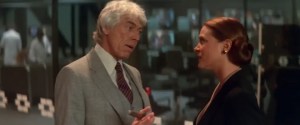
One of Looker’s strongest claims to historical attention lies in its computer graphics. The sequence presenting a digital representation of Cindy is one of the earliest cinematic experiments with computer-generated human figures. Information International Inc., commonly known as Triple-I, supplied the computer animation. This becomes clearer when it is considered alongside Tron, which was released in 1982, rather than being judged against the seamless digital characters that audiences would encounter decades later. Here, the human body is presented as information that can be measured, reconstructed and manipulated.
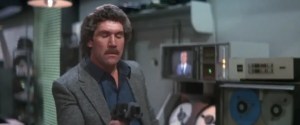
Claims about technological ‚firsts‘ require careful consideration. Looker is often credited with pioneering shaded three-dimensional human imagery, but computer graphics had already appeared in earlier films, including Futureworld. Effects pioneer Gary Demos’s account documents Triple-I’s earlier work of reconstructing Peter Fonda’s head from photographs. Therefore, it is more useful to describe Looker as an important advance in digital human representation than as the invention of cinematic CGI. The film’s special achievement is thematic too: the technique illustrates the very process that the story finds threatening. Viewers watch a human likeness become a reproducible object, and so the visual effect demonstrates more than just technical ingenuity. It makes the film’s central anxiety tangible.
Contemporary Reactions
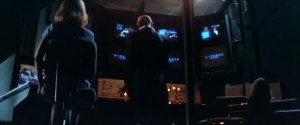
The film’s ambitious premise did not guarantee an enthusiastic reception. Vincent Canby’s contemporary review in The New York Times acknowledged its potential, but strongly criticised its narrative gaps and execution. Likewise, Variety dismissed it as an unconvincing science fiction thriller. Such responses point to a real weakness: Looker introduces enough intriguing concepts for several stories, but does not always establish convincing relationships between them. While the murders, digital replacements and manipulation of television audiences form a striking collection of threats, the underlying conspiracy raises questions that the film does not satisfactorily answer.

However, contemporary opinion was not uniformly negative. In The Criterion on 20 November 1981, James W. Arnold welcomed its combination of entertainment, visual innovation and criticism of television culture. He responded to its humour and cinematic tricks rather than demanding complete logical consistency. This remains a useful approach when viewing the film. When viewed as a tightly constructed mystery, the film can be frustrating, but when approached as an extravagant satire with suspense sequences, it becomes easier to enjoy. The disagreement also suggests that its uncertain tone was central to its reception: what one reviewer experienced as muddled storytelling, another could appreciate as playful exaggeration.
Cultural Echoes

Looker’s cultural significance is more easily established through its technological context and thematic relevance than through claims of direct influence on subsequent filmmakers. While its digital imagery belongs to the developing history of computer effects, thematic similarities alone cannot prove that subsequent films borrowed from it. Nevertheless, it offers an early and unusually explicit exploration of a disturbing commercial possibility: a company may desire someone’s appearance while considering that person’s continued involvement to be inconvenient. This gives its science-fiction premise implications that extend beyond advertising into questions of identity, work and control.
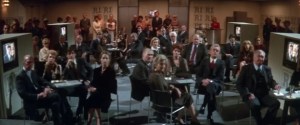
A later discussion on SlashFilm connected the film with the debate surrounding digital likenesses during the 2023 actors‘ strike. This comparison helps to explain why Looker can feel newly relevant without us having to treat it as an exact prediction. The film’s deeper insight concerns the imbalance between individuals and organisations that can reproduce their images. However, the film’s own depiction of beauty complicates its critique. The camera participates in the glamour and objectification that the story questions, and the female characters are not always depicted as having interior lives, which would strengthen the film’s argument. This tension makes Looker revealing both as a warning about manufactured images and as an example of the entertainment culture that produces them.
Imperfect Vision
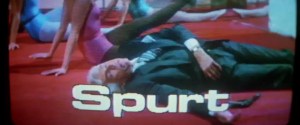
Looker is most rewarding when its achievements and shortcomings are allowed to coexist. Its mystery lacks the precision of its fictional beauty measurements, its tonal shifts are sometimes clumsy, and its characters could have been developed further. Yet Finney provides an engaging anchor, the technological imagery retains historical fascination, and the advertising world provides Crichton with a fertile setting in which to explore the relationship between desire and power. Even its more implausible inventions stem from recognisable fears about losing control of perception.
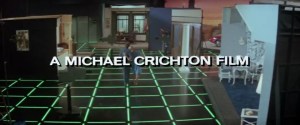
Once the thriller mechanics have faded, the disturbing possibility remains: that perfection can make a person replaceable. The models are encouraged to eliminate their differences, only to discover a system capable of eliminating their participation altogether. This is a sharper idea than the film consistently knows how to dramatise, but it gives Looker lasting interest. While its future may appear dated on the surface, the underlying questions remain uncomfortable: who controls an image, who profits from it, and what happens to the human being when the copy becomes the preferred product?
More
Trailer
External links
- Looker at IMDb
- Looker at Rotten Tomatoes
- Looker at Wikipedia (en)
- Looker at Wikipedia (de)
Notice Regarding Image Rights and Copyrighted Material
All images, film stills, posters, logos, trailer excerpts and other copyrighted materials used in this article are used solely for editorial reporting, film criticism, review and illustrative purposes related to the respective content.
Unless otherwise stated, all copyrights, trademark rights and other intellectual property rights in the materials used remain with their respective rights holders, including film studios, distributors, production companies, photographers, artists or other licensors.
The materials are used in good faith and with regard to applicable legal limitations, licence terms and source attributions. If, despite careful review, any rights have been infringed or any attribution is incomplete, please contact me. Upon review, the relevant content will be removed or corrected promptly.







Schreibe einen Kommentar