

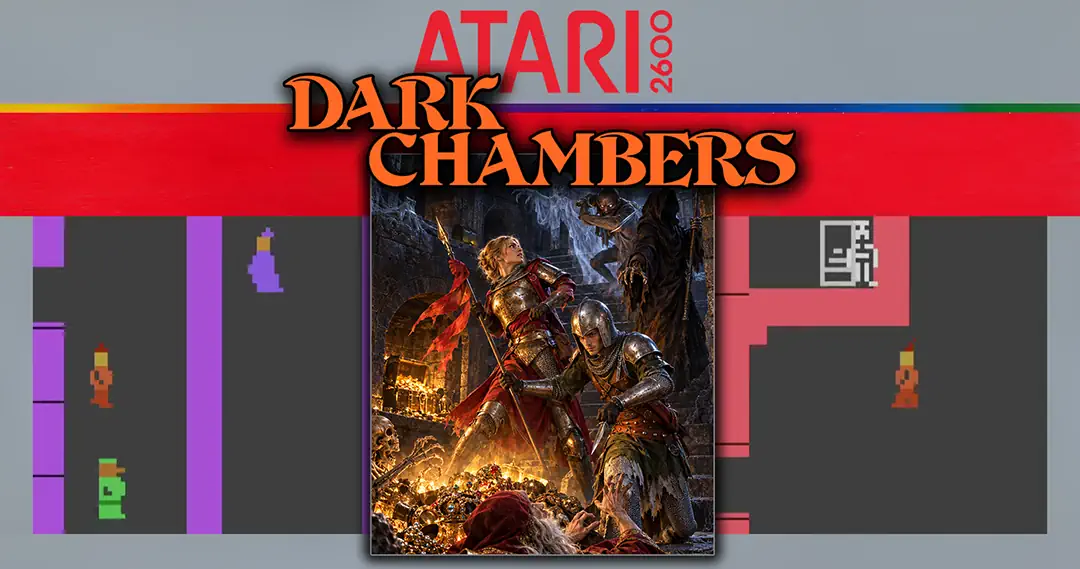
Dark Chambers on Atari 2600 – A Dungeon Crawler Lost in the Shadows
Into Darkness
By the late 1980s, the Atari 2600 belonged to another era. First released in 1977, the machine had survived the rise and fall of the first great home-console boom, the North American video game crash, and the arrival of far more capable systems such as the Nintendo Entertainment System and Sega Master System. Yet Atari continued supporting its veteran console, and among the surprisingly ambitious titles to appear near the end of its commercial life was Dark Chambers.
Released for the Atari 2600 around 1988–1989, depending on territory and dating source, Dark Chambers was a top-down action game set inside a sprawling underground labyrinth. Atari introduced the title at the 1988 Summer CES, while surviving catalogue information points to a North American retail release in 1989.
At first sight, the game looks like an attempt to squeeze Atari’s enormously successful arcade title Gauntlet onto hardware more than a decade old. Players explore mazes, destroy monster generators, collect treasure and food, unlock doors and gradually descend through dungeon levels. The resemblance is impossible to miss.
But the history is considerably more interesting than that. Dark Chambers is not simply a primitive Gauntlet imitation. Its ancestry stretches back to a game that actually helped inspire Gauntlet itself. That strange reversal makes an otherwise obscure late Atari 2600 release one of the more fascinating footnotes in the history of dungeon crawlers.
Dungeon Crawling
The objective in Dark Chambers is straightforward: survive 26 underground levels, labelled A through Z, while accumulating treasure and finding the hidden exit to each stage. One or two players can participate, and the Atari 2600 version offers several difficulty settings.
Viewed from above, the player moves through rooms and corridors using the joystick and attacks enemies by throwing projectiles. Exploration is just as important as combat. Doors block important passages, keys must be found, and exits can be concealed behind enemies or monster generators. The result is less of a pure shooter than its appearance initially suggests.
Health is represented by a strength meter. Contact with enemies drains it, turning every encounter into a calculation between fighting, fleeing and continuing the search for useful supplies. Food and potions restore strength, while poison and traps naturally have the opposite effect. Treasure mainly increases the score, encouraging players to take additional risks instead of rushing directly toward the exit.
One of the game’s most distinctive ideas is its enemy hierarchy. Zombies, wraiths, skeletons, wizards and grim reapers are not merely separate monsters. Shooting a powerful creature causes it to transform into the next weaker form. A grim reaper therefore has to be reduced through several stages before it finally disappears. Monster generators operate as a constant threat because they continue producing new opponents until destroyed.
There are also useful upgrades. Swords increase attack strength, firearms improve the rate of fire, shields provide protection and bombs can clear nearby enemies. None of these systems are particularly complicated, but together they give Dark Chambers substantially more structure than the score-attack games traditionally associated with the Atari 2600.
Two-player mode is especially interesting. Both adventurers occupy the maze simultaneously, allowing one player to fight while the other searches for keys or supplies. If one hero falls, the surviving player inherits the keys; reaching the next level can revive the defeated companion. It is a remarkably cooperative design for the hardware and one of the game’s strongest links to its unusual ancestry.
The pace, however, is deliberate. Anyone expecting the chaotic swarms of Gauntlet may be surprised. There are relatively few enemies visible at once, movement is methodical, and much of the challenge comes from learning the maze rather than surviving dozens of simultaneous attackers. That slower rhythm can feel monotonous, but it also gives the 2600 edition a personality of its own.
Technical Tricks
Technically, Dark Chambers is an impressive example of what programmers could still extract from Atari’s ageing machine.
The commercial Atari 2600 version uses a 16 KB ROM together with Atari’s additional 128-byte „SuperChip“ RAM and F6 bank switching. That may sound minuscule today, but it was significantly more elaborate than the 2 KB and 4 KB cartridges common during the console’s early years. The additional resources helped accommodate 26 maze layouts, multiple enemy types, items, a title screen, cooperative play and character animation.
The display is heavily adapted to the 2600’s limitations. Rather than attempting the dense, freely scrolling rooms of the arcade Gauntlet, Dark Chambers presents enlarged sections of its dungeon and limits the number of active creatures. Rooms are visually simple, built from stark walls and dark backgrounds, but the character sprites are surprisingly recognisable considering the restrictions of the Video Computer System.
Horizontal movement between areas uses transitions rather than trying to maintain a huge seamless arcade-style playfield. The result is slower, but it reduces the graphical burden and makes the labyrinth feel larger than the television screen. Contemporary and later commentators have also noted occasional flicker when several objects appear together, a familiar side effect of ambitious Atari 2600 programming.
Sound is similarly restrained. There is no elaborate musical accompaniment during exploration; audio mainly consists of functional effects accompanying attacks, pickups and encounters. From a presentation standpoint, therefore, Dark Chambers cannot disguise its technological age. What deserves recognition is how much game structure exists beneath those crude visuals.
Even small touches stand out. Dark Chambers includes an unusually elaborate title screen for a 2600 cartridge, and the game contains an undocumented pause function activated through the console’s TV Type switch.
Strange Ancestry
The best piece of Dark Chambers trivia is also the reason the game deserves more attention today.
Its story begins with programmer John Howard Palevich and a game called Dandy, originally distributed through the Atari Program Exchange for Atari 8-bit computers in 1983. Dandy was a cooperative fantasy maze game in which several players explored dungeons together, fought monsters, collected treasure and destroyed monster generators.
Two years later, Atari Games released the arcade phenomenon Gauntlet, designed by Ed Logg. Because Gauntlet became enormously more famous, later players naturally assumed that Dark Chambers was simply trying to imitate it.
The historical relationship runs in the opposite direction.
Logg has openly acknowledged that playing Dandy helped unlock the concept that eventually became Gauntlet. In a detailed interview, he explained that Dandy demonstrated how a Dungeons & Dragons-style experience could work as an action game. He specifically identified elements including the scrolling playfield, monster generators, ghosts, multiplayer cooperation, health and treasure as ideas shared with or inspired by Palevich’s game.
This does not mean Gauntlet was simply a copy. Logg considerably expanded the concept with distinct character classes, power-ups, secret rooms, enemies capable of ranged attacks, transporters, speech and, crucially, a four-player arcade cabinet designed around coin-operated multiplayer. Those additions transformed the basic formula into one of the defining arcade games of the decade.
There was nevertheless enough similarity for Palevich to approach Atari about the matter. Logg later said he understood that the dispute had been resolved to everyone’s satisfaction, while later accounts describe an out-of-court settlement. Stories claiming that Palevich received a Gauntlet arcade cabinet as part of the arrangement circulate widely, although that particular detail is better regarded as anecdotal rather than firmly documented fact.
When Atari later returned to Palevich’s design and produced Dark Chambers, Dandy had effectively completed a curious circle: an Atari computer game helped inspire Gauntlet, Gauntlet became an arcade blockbuster, and Atari then released a new version of Dandy that inevitably looked like a simplified Gauntlet.
Few games have a more ironic family tree.
Period Reception
Judging Dark Chambers in its original context is difficult because the Atari 2600 received far less mainstream magazine attention by 1988 and 1989 than it had earlier in the decade. The console was competing for attention against newer 8-bit and increasingly 16-bit hardware, so late releases could pass almost unnoticed.
The broader Dark Chambers family did receive contemporary coverage. ANALOG Computing, for example, included a review by Matthew J. W. Ratcliff in its August 1989 issue, although its readership primarily centred on Atari’s 8-bit computer line rather than the 2600 console specifically.
The qualities that divided later reviewers were already inherent in the design. On one side, the game offered an unusually large adventure for the VCS: 26 levels, simultaneous cooperation, numerous objects and recognisable dungeon-crawling mechanics. From a technical perspective, simply making the concept work convincingly on the 2600 was an achievement.
On the other hand, its timing worked against it. In 1989, players had already seen Gauntlet deliver fast scrolling, enormous enemy hordes, four-player action, speech and colourful fantasy characters in arcades. Against that benchmark, Dark Chambers could appear slow and visually austere.
Later retrospective criticism has often focused precisely on those shortcomings. The Video Game Critic, for example, objected strongly to the slow movement, limited enemy population and repetitive-looking rooms. Other retrospective writers have been considerably kinder, praising its exploration, two-player structure and unusual depth for the Atari 2600.
That divide remains the fairest way to understand the game. As a late-1980s action title competing with newer hardware, it looked outdated. As an Atari 2600 production considered within the capabilities of a machine designed in the mid-1970s, it was remarkably ambitious.
Lasting Footprint
Dark Chambers never became a major franchise. It received versions for Atari’s 2600, 7800 and 8-bit computers, but no long-running series followed. In cultural terms, its importance is therefore less about popularity than genealogy.
The game’s strongest legacy comes from reconnecting players with Dandy. Without the Dandy–Gauntlet story, Dark Chambers might be remembered simply as another late Atari cartridge. With that history understood, it becomes evidence of how game ideas evolved during the early 1980s: from experimental computer software to blockbuster arcade design and then back to home consoles.
Many mechanics now associated with action RPGs and dungeon crawlers are visible here in primitive form: cooperative exploration, shared survival, persistent health pressure, destructible enemy generators, treasure hunting, keys, doors and character upgrades. Dark Chambers did not invent all these concepts, but its lineage places it surprisingly close to an important branch in the evolution of cooperative action games.
Its reputation has also benefited from modern retro-gaming culture. Maps of all 26 levels have been preserved by Atari enthusiasts, prototypes are documented by collectors, and Atari itself has returned to the title with a modern limited-edition cartridge compatible with original Atari 2600 hardware and newer Atari systems.
That renewed attention highlights something easily forgotten about the Atari 2600: the system’s software did not stop evolving after its famous early classics. Games such as Dark Chambers show programmers still testing the boundaries of the machine more than a decade after its introduction.
Final Thoughts
Dark Chambers is an imperfect but fascinating Atari 2600 game. Its sparse graphics, limited sound and measured pace can make it difficult to appreciate if approached as a direct alternative to Gauntlet. The arcade game is faster, louder, richer and dramatically more chaotic.
But treating Dark Chambers merely as an inferior Gauntlet misses what makes it special.
Behind its blocky walls lies an unusually substantial 2600 adventure: 26 interconnected maze stages, cooperative play, keys, doors, treasures, upgrades, generators and an entire hierarchy of transforming monsters. It feels closer to a miniature action RPG than to the brief arcade challenges that defined much of the console’s library.
More importantly, its history overturns the obvious assumption. Dark Chambers resembles Gauntlet because both ultimately descend from John Palevich’s Dandy—and Dandy directly influenced Ed Logg when he designed Gauntlet. What looks like a late clone is therefore better understood as a descendant returning to its own roots.
For retro enthusiasts, that alone makes Dark Chambers worth exploring. It may not be one of the Atari 2600’s most famous games, but it is one of those cartridges whose story reaches far beyond what appears on the screen: a small, shadowy dungeon hiding an unexpectedly important piece of video game history.
More
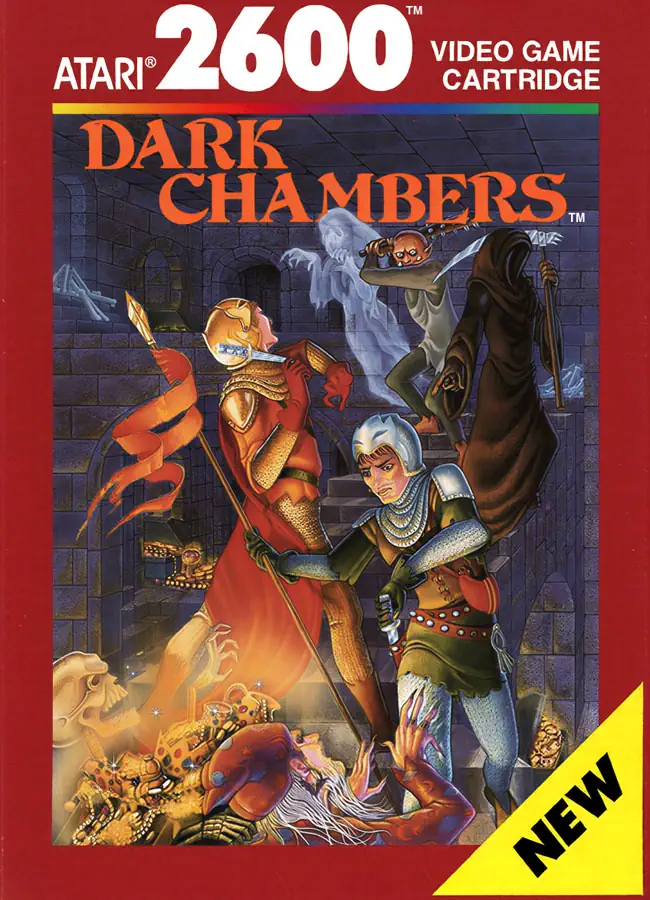
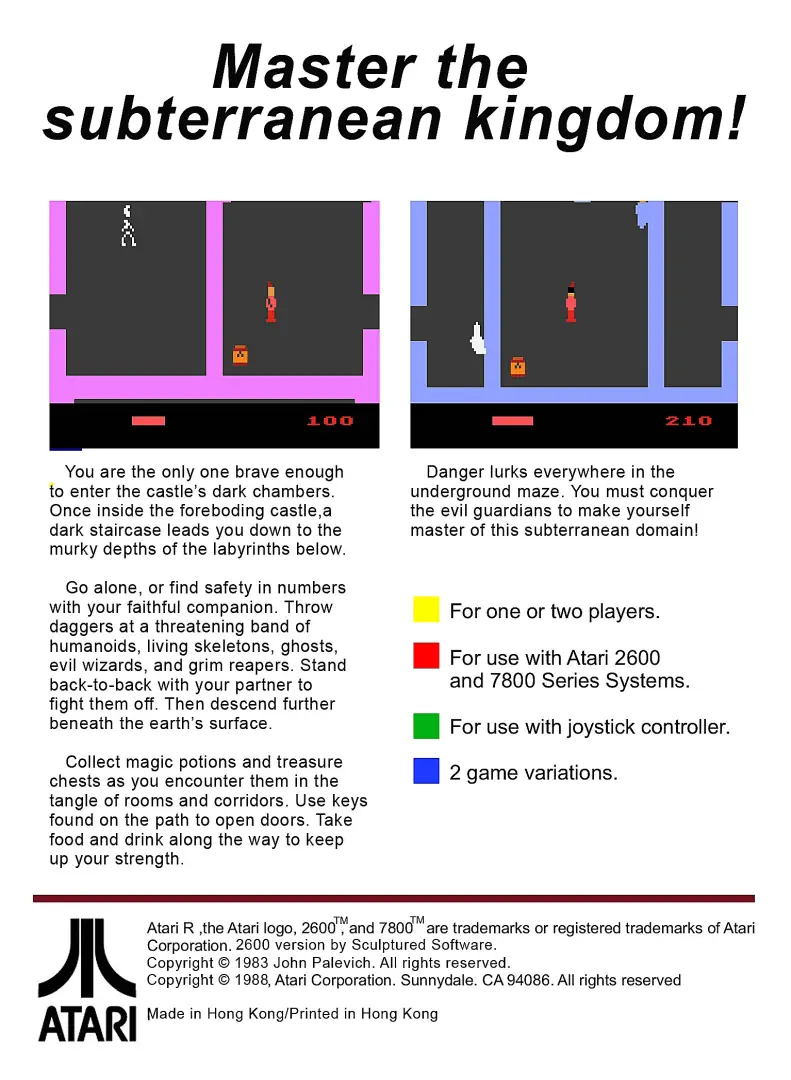
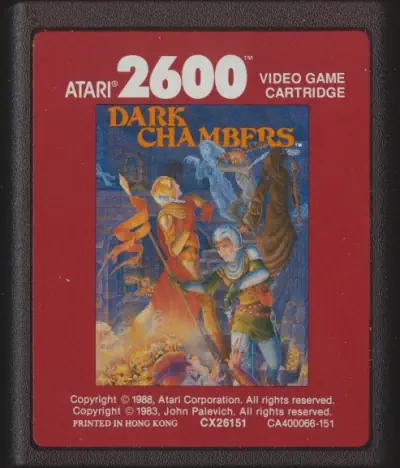
Box and Cartridge








Kommentar verfassen