

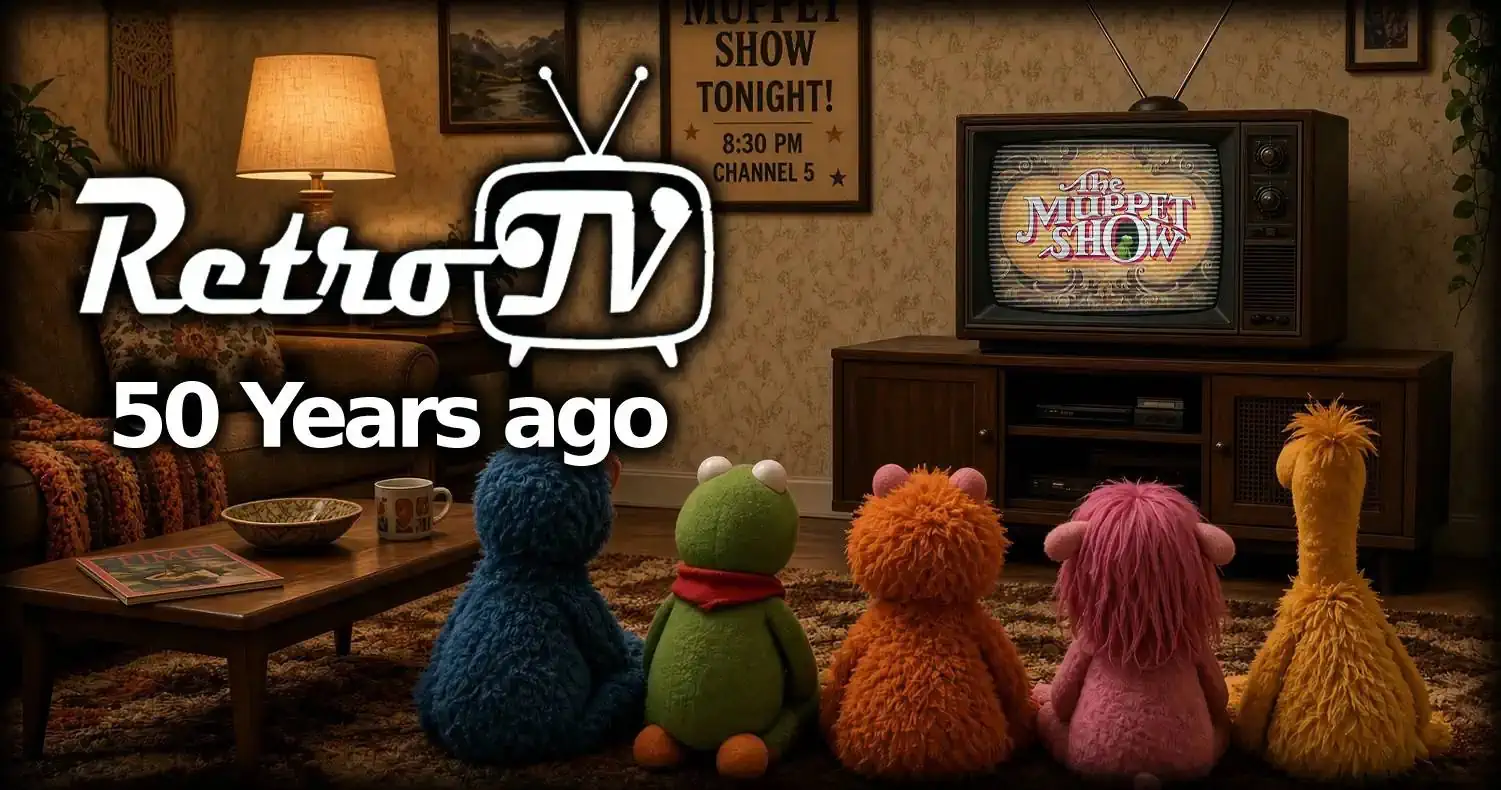
It’s time to play the music
It’s time to light the lights
It’s time to meet the Muppets on the Muppet Show tonight
It’s time to put on makeup
It’s time to dress up right
It’s time to raise the curtain on the Muppet Show tonight
To introduce our guest star
That’s what I’m here to do
So it really makes me happy
To introduce to you…
So now let’s get things started
Why don’t you get things started?
It’s time to get things started
On the most sensational inspirational, celebrational, Muppetational
This is what we call the Muppet Show!
Curtain Up
Fifty years. You know, for a frog, that’s really no age at all. At least that’s what I tell myself. Miss Piggy claims anyway that she hasn’t aged a single day since 1976, and I’ve learned not to question certain statements. It’s good for relationships. And for your health.
When I think back on “The Muppet Show” today, the first things that come to mind aren’t awards, ratings, or famous guests. I remember the noise. I remember Fozzie desperately trying to crack one more joke. I remember Gonzo setting up a cannon somewhere without telling anyone. Animal, who was probably destroying something. And, of course, Statler and Waldorf, who were already delivering scathing reviews from their box before the actual critics had even turned on their typewriters.
Between 1976 and 1981, five seasons were produced, totaling 120 episodes. The concept was incredibly simple: Every week, we wanted to put on a big variety show. The only problem was that we were the ones supposed to put it on.
So the audience wasn’t just watching a show. They were watching a show about the attempt to put on a show. Up front, there was singing, dancing, and storytelling; backstage, props went missing, performers vanished, pigs quarreled, monsters ate things, and somewhere in the middle, I was usually standing there, trying to look as if someone had a plan.
Maybe that was exactly our secret.
Today, the Smithsonian describes “The Muppet Show” as a tribute to classic vaudeville, in which human guest stars became part of a completely crazy theater troupe both on stage and behind the scenes. The series became an international success, reaching audiences in more than 100 countries.
And me? Well, I was the frog with the clipboard.
Early Frogs
Of course, it didn’t all start in 1976.
Jim Henson had already built me in 1955 for “Sam and Friends,” a short-lived TV show in Washington, D.C. Back then, I was essentially made of fabric, eyes, and optimism. The original Kermit was made, among other things, from material from an old coat belonging to Jim’s mother; the eyes were crafted from pieces of ping-pong balls. And before anyone asks: No, in the beginning it wasn’t even clear that I was a frog. That biological certainty came later. Today, the Smithsonian describes this first Kermit puppet as one of its most significant artifacts. Not bad for someone who was practically made from an old coat.
Jim understood very early on something that would prove crucial for the Muppets: Television isn’t just theater with a camera in front of it. The camera itself is part of the performance. Our eyes could look directly into the lens. Small movements suddenly became big. A glance, a pause, an irritated turn of the head could be just as funny as a punchline.
Then, in 1969, “Sesame Street” came along. This made the Muppets famous—but also very closely associated with children’s television. Jim wanted more. He wanted a show in which puppets didn’t just teach children the alphabet, but sang with adult stars, performed absurd humor, parodied old show business traditions, and occasionally blew things up.
At first, U.S. television networks weren’t very convinced.
There were pilot projects, but a regular primetime series never materialized. Eventually, Jim met the British media entrepreneur Lord Lew Grade. Grade gave him the chance to actually produce the show—albeit in the United Kingdom. Preparations began in 1975, and the first regular episodes were produced at the ATV studios in early 1976. What initially seemed like a detour turned out to be a stroke of luck: Grade’s international distribution network brought us to numerous countries within a short time.
Sometimes you just have to cross the Atlantic to end up on American television.
Or you’re a frog. Then you take what you can get.
Stars and Chaos
At first, it wasn’t easy at all to get famous people to travel to England to appear alongside a frog, a bear, and a very self-assured pig.
That’s why the first season featured a few guests from the circle of friends of Jim Henson and his manager Bernie Brillstein. But then something pivotal happened: Rudolf Nureyev, one of the world’s most famous ballet dancers, wanted to be on the show.
Just imagine that. One of the greatest dancers of his generation—and we put him, among other things, next to a giant pig in a ballet costume.
Suddenly, people got the concept.
Stars didn’t come on our show just to promote their new album or movie. They had to step into our world. Steve Martin didn’t just play Steve Martin. John Cleese became part of the madness and even appeared in an episode with a fictional “no pigs” clause in his contract. Alice Cooper brought a whole story about a deal with the devil. Gene Kelly spent parts of his episode backstage with the rats before we were finally able to persuade him to perform.
Joining them were Julie Andrews, Elton John, Diana Ross, Johnny Cash, Debbie Harry, Liza Minnelli, Peter Sellers, and many others. Today, the list reads a bit as if someone had thrown 1970s pop culture into a blender.
Which, by the way, was pretty much in line with our production philosophy.
And the key point was: the guests were allowed to make fools of themselves.
That might sound trivial, but it isn’t. Famous people are used to having a show organized around them. On our show, it could happen that their duet partner was a chicken. Or that Miss Piggy was gushing over them. Or that a monster suddenly took over the scene.
This made people see the stars differently. They became more human, precisely because they were playing with puppets.
And at some point, the situation completely flipped. At first, we were desperately searching for guests. Later, appearing on *The Muppet Show* itself became something stars wanted to do. Nureyev’s visit is considered one of the moments that accelerated this shift.
Not bad for a show where the janitor was sometimes part of the plot.
Critics in the Audience
Today, people like to talk about classics as if everyone had known from the very first night that something was about to make television history.
Of course, that’s rarely true.
In our case, it was complicated. The Muppets were well-known, but many people knew us primarily from “Sesame Street.” An evening variety show featuring puppets therefore first had to prove that it could entertain both adults and children at the same time, without having to choose one side over the other.
An article in the “Washington Post” in early 1977 already described Jim Henson as the man behind an enormously successful Muppet company. Regarding our show, it essentially said that while some of the jokes were old-fashioned, the delivery, the characters, and the expressiveness of the puppeteers made the whole thing extremely engaging. I like that. Basically, it means: “We already know the jokes, but the bear tells them so badly that they become interesting again.”
In the United Kingdom, too, the enthusiasm quickly became apparent. An article in *The Guardian* from early 1977 already mentioned around 14 million viewers and described the show as a veritable cult phenomenon.
And in 1978, *Time Magazine* went even further: it described *The Muppet Show* as the most popular television entertainment program being produced at the time. During its run, the series received Emmys and other major television and entertainment awards, among other honors.
The interesting thing, though, is that our best critics had long been sitting in the theater itself.
Statler and Waldorf.
Two elderly gentlemen who attended every performance, even though they supposedly hated every single one.
I never understood why.
Today I think: Maybe they were the modern TV critics before social media existed. They commented on everything immediately, mercilessly, and publicly—and still came back the following week.
Actually, they were frighteningly ahead of their time.
Gentle Anarchy
Why are we still talking about this show fifty years later?
I think it’s because the Muppets were always two things at once.
We were old-fashioned and modern. Our theater looked as if it had seen better decades. We did vaudeville, ballet, musical numbers, wordplay, and slapstick. At the same time, we were constantly deconstructing these traditions.
The show loved show business and made fun of show business.
Fozzie desperately wanted to be a great comedian—and failed constantly. Gonzo wanted to create great art—only no one knew exactly what his art was supposed to be. Miss Piggy wanted to be a glamorous global superstar and, just to be safe, treated the world as if she already were one.
And I just wanted everyone to get on stage on time.
Perhaps that’s why so many people could relate to these characters. A curator at the Smithsonian said of the Muppets that there was something in them for everyone and that people could discover parts of themselves in these characters. The museum describes their humor as irreverent, satirical, and at the same time unifying—a kind of comedy that mocks cultural conventions without becoming cynical.
That’s important.
We were chaotic, but rarely cruel.
The joke usually wasn’t that someone was perfect and laughed at the losers. No one was perfect. Everyone was a loser.
Together.
That makes a difference.
The Muppets thus offered a strangely optimistic vision of community: a diva, a failed comedian, a stuntman with a questionable instinct for self-preservation, a hyperactive drummer, two professional complainers, and an overwhelmed frog can create something together.
It won’t go smoothly.
But the curtain rises.
And sometimes that’s all it takes.
Lasting Legacies
After 1981, “The Muppet Show” was over. But the Muppets weren’t.
“The Muppet Movie” had already hit theaters in 1979. More movies followed. We ended up in New York, told Christmas stories, went on treasure hunts, returned to television, and disappeared again. Different generations got to know different versions of the Muppets.
That’s inevitable over the course of fifty years.
Jim Henson’s death in 1990 was also a turning point whose significance can hardly be overstated. Jim hadn’t just played many characters. He had shaped the spirit behind this world: curiosity, a love of technical experimentation, kindness, and the conviction that imagination isn’t automatically just for children.
His characters have since literally become museum pieces. Originals of Kermit, Miss Piggy, Fozzie, and others are part of the collections at the Smithsonian National Museum of American History. The original Kermit from 1955 is housed there alongside artifacts from American political, cultural, and everyday history.
And yet, we don’t live only in a museum.
For its 50th anniversary in 2026, “The Muppet Show” even returned to the stage of the Muppet Theater with a new special. Sabrina Carpenter was the special guest, Maya Rudolph also appeared, and Seth Rogen was among the executive producers. At the same time, the five seasons of the original series are still available for streaming.
This is perhaps the strangest form of immortality: Someone who was five years old in 1976 can show their grandchild that exact same episode today.
The grandchild might not understand who the guest star was back then.
But they’ll understand Animal.
Animal is timeless.
Unfortunately.
Final Curtain
So if you ask me what fifty years of “The Muppet Show” mean, I’d like to say something very clever.
Something about art. About television. About how humor brings people together.
And probably, at that very moment, something would explode right behind me.
That would be fitting.
Because perhaps the Muppets’ true legacy doesn’t lie in individual skits, songs, or characters at all. Perhaps it lies in a certain way of looking at the world.
The world isn’t neat.
People aren’t neat.
Families aren’t neat. And theater troupes certainly aren’t.
We’re constantly trying to put on a perfect show, even though behind the curtain someone is frantically searching for a prop, someone else has forgotten their lines, and Gonzo is just asking if insurance actually covers cannon accidents.
And yet the show goes on.
Jim Henson and his team transformed this chaos into a form of optimism. Not the kind of optimism that claims everything will be perfect. But the kind that says: It’s probably going to be chaotic—but maybe, together, we can still create something beautiful.
That seems almost more important to me today than it did fifty years ago.
Maybe that’s why a stuffed frog is still instantly recognizable. Why people still laugh at a bear who tells bad jokes. Why two old men in a theater box have become symbols for every grumbler who’s secretly watching with enthusiasm.
And why Miss Piggy will probably still be claiming in fifty years that she hasn’t aged a day.
As for me?
I’m just sitting here.
I’m thinking of Jim. Of Frank Oz, Jerry Nelson, Richard Hunt, Dave Goelz, and all the people whose hands, voices, and ideas brought this crazy troupe to life.
Of the stars who walked through our stage door.
The audience.
Five decades.
And if, somewhere, a curtain rises, an orchestra begins to play, and someone frantically shouts that we’re going on the air in ten seconds…
well…
then it’s probably time for the show again.





Kommentar verfassen