

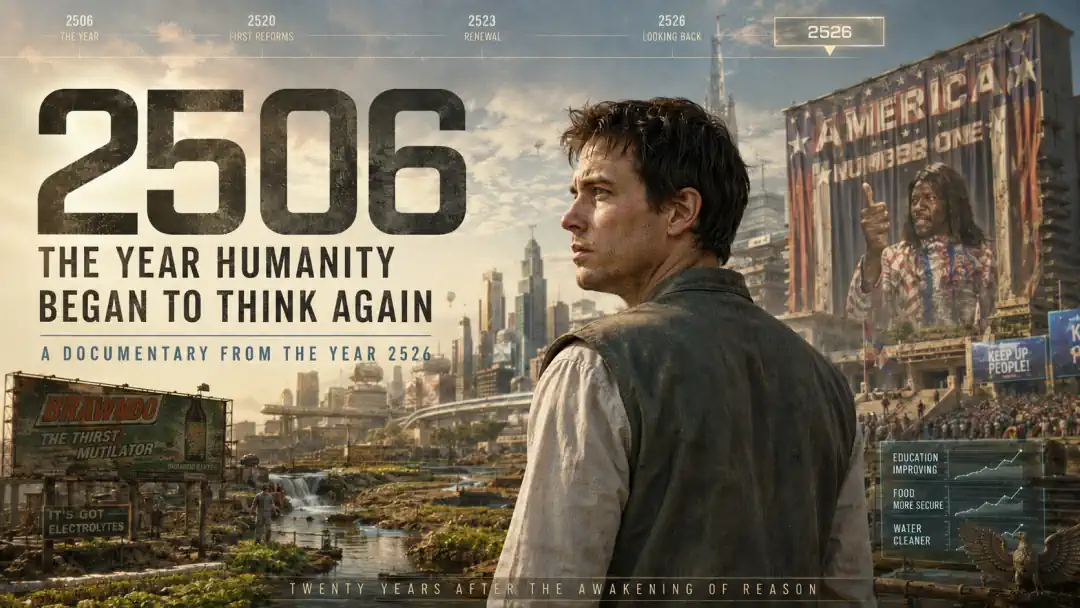
As the twenty-first century began, human evolution was at a turning point.
Natural selection, the process by which the strongest, the smartest, the fastest reproduced in greater numbers than the rest, a process which had once favored the noblest traits of man, now began to favor different traits.
Most science fiction today predicted a future that was more civilized and more intelligent.
But, as time went on, things seemed to be heading in the opposite direction.
A dumbing down.
How did this happen? Evolution does not necessarily reward intelligence.
With no natural predators to thin the herd, it began to simply reward those who reproduced the most, and left the intelligent to become an endangered species.
A historical documentary from the year 2526
There are years that transform a civilization.
Years after which nothing is ever the same again.
For the United States of America, 2506 was one such year.
Today, twenty years later, much of what happened back then seems almost unimaginable. A nation whose political decisions were influenced by entertainment shows. Hospitals where diagnoses were largely automated, even though no one understood how the machines worked anymore. A farming industry that irrigated its fields with a caffeinated sports drink. A president who was both a former wrestler and a porn actor.
And a population for whom the answer to nearly every social problem was:
“More electrolytes.”
But 2506 was not only the year of the near-total collapse of American society.
It was also the year a man named Joe Bauers awoke from a long-forgotten past—and, for the first time in generations, brought an extremely dangerous idea back into the public eye:
Perhaps we should think about what we’re actually doing.
The World Before the Awakening
Historians today refer to the decades leading up to 2506 as the “Great Simplification.”
The term is controversial. Critics point out that “simplification” suggests a deliberate process.
There is no evidence to suggest that it was deliberate.
Over several centuries, scientific institutions, educational systems, and government agencies gradually lost their significance. Technical systems continued to function—at least in part—but the knowledge of why they worked disappeared.
Machines were used, but not understood.
Software was operated, but not maintained.
Laws existed, but hardly anyone could read them.
An advertisement from the year 2498 may have summed up the political philosophy of this era better than any surviving government document:
“If it doesn’t work, buy the bigger version.”
The economy was increasingly controlled by a few large corporations. Particularly powerful was the restaurant chain Carl’s Jr., which at times not only sold food but also took on government functions
Archival footage shows branches where, after purchasing a burger, customers received automated notifications stating that they were “an unfit mother” or had violated the Constitution’s terms of use.
Whether these notifications had legal consequences remains unclear to this day.
In 2522, the Department of Justice stated that the relevant files had either been lost or used as toilet paper.
The Man from 2005
Joe Bauers was not a scientist. Not a politician. Not a philosopher.
According to surviving military documents from the early 21st century, he was considered almost entirely average.
That, precisely, would prove to be decisive.
As part of a secret military experiment, Bauers had been placed in an artificial deep sleep in 2005. The plan was for a one-year experiment.
In fact, he awoke five hundred years later. In a world where his average intelligence was suddenly extraordinary.
Together with Rita, another test subject from the early 21st century, Bauers first had to understand what had become of his society. Eyewitness accounts describe these first days as chaotic.
Within a short time, Bauers was arrested, medically examined, insulted, and finally brought to trial.
The trial lasted less than ten minutes. The judge at the time simultaneously engaged several television viewers by making direct comments to the camera. The defense consisted primarily of insults.
Legal scholars today refer to the trial as one of the last documented cases of so-called “entertainment law.”
A research project by the University of Washington found in 2524 that at least 63 percent of all court proceedings between 2470 and 2506 included commercial breaks.
In 18 percent of cases, viewers were able to vote on the punishment.
President Camacho and the Crisis
America in the year 2506 faced a problem that could no longer be solved by advertising, violence, or larger beverages.
Crops failed. The soil was nearly barren. Food became scarce.
Unemployment and social unrest were on the rise.
President Dwayne Elizondo Mountain Dew Herbert Camacho responded in an unusual way.
He sought out someone who could solve the problem.
Camacho is viewed more nuancedly today than he was immediately after his term in office. For a long time, he was seen merely as a symbol of the political culture of his era: loud, impulsive, and perpetually accompanied by explosions.
More recent historical research paints a more complex picture.
Camacho may have understood little about agriculture, economic policy, or administration.
But at least he recognized that there were things he didn’t understand.
For the year 2506, that was remarkable.
After government intelligence tests declared Joe Bauers the most intelligent person in the country, Camacho appointed him Secretary of the Interior.
His task was simply put: Save the crops. If he failed, he would die.
Political scientists today call this system “results-oriented short-term administration.”
It was officially abolished in 2511.
Brawndo: It Has Electrolytes
From today’s perspective, the cause of the agricultural disaster seems absurd.
It was real. For decades, American fields had not been irrigated with water. Instead, they used Brawndo.
A caffeinated sports drink. The reason for this was one of the most famous advertising slogans of the late Idiocracy:
Brawndo contained electrolytes. Electrolytes were “what plants crave.”
Apparently, there was no generally accepted answer to the question of why plants need electrolytes.
Over the decades, Brawndo had taken over large parts of the state’s water supply. Drinking water was used almost exclusively for toilets.
For agriculture, this spelled an ecological disaster. Salts and additives destroyed the soil, plants died off, and crop yields plummeted.Joe Bauers proposed a solution that seems obvious today. Water.The reaction was outrage.
Archival footage shows government officials repeatedly asking Bauers why plants should be given something that is normally used in toilets. This statement later became a symbol of the era. But the decision initially had dramatic economic consequences.
After Brawndo was driven out of agriculture, the company’s stock price plummeted. Since the company controlled a significant portion of the American economy, millions of people lost their jobs within a few hours.
The public blamed Bauers.
His execution was announced.
Broadcast live, of course.
Rehabilitation
The decisive turning point came with an event described in modern textbooks as “the first documented empirical verification in several generations.”
The plants began to grow again.
Not immediately. Not spectacularly. There was no explosion. No wrestling music. No commercial break.
Green shoots simply sprouted from the ground. For the people of the year 2506, it was almost a miracle.
For Bauers, it was agriculture. President Camacho halted the execution. Bauers was exonerated.
And for the first time, a broader public discussion began about whether knowledge might actually be useful.
This discussion marks the beginning of what historians today refer to as the Second Enlightenment.
Twenty Years of Reconstruction
The world of the year 2526 is still far from what earlier civilizations would have called highly developed.
But much has changed. Schools are teaching math again. The average length of a class period is now 34 minutes—a historic high since the 24th century. Universities have been reestablished. Libraries have sprung up. Several states now require that laws be read in their entirety before being voted on.
Congress is currently debating whether this rule should also apply to senators. Agriculture once again relies primarily on water.
Brawndo still exists, though exclusively as a beverage. The company has been advertising with the slogan since 2518:
“Brawndo—it has electrolytes. But please, not on corn.”
The media landscape has also changed.
The legendary TV show Ow! My Balls! was canceled in 2513 after nearly four hundred years. The network cited “changing viewer interests” as the reason for the decision. A reboot in 2521 failed after three episodes. Critics complained of a lack of character development.
The Uncomfortable Question
Yet the story of 2506 is often told too simplistically today. As the story of a foolish society saved by a wise man. That’s convenient. Perhaps too convenient. Because the people of the year 2506 hadn’t suddenly become incompetent one morning.
Their world had evolved over centuries. Not through a single mistake, but through thousands of small decisions. Education became less important. Complex problems were reduced to simple catchphrases. Entertainment supplanted information. Corporations took over tasks that had previously been fulfilled by public institutions. Technologies became increasingly powerful, while fewer and fewer people understood how they worked. Experts were not challenged. They were laughed at. Politics became a spectacle. News became entertainment. Attention became more valuable than truth.
And at some point, no one noticed anymore that a system that still somehow functioned had long since ceased to be understood.
Perhaps the most frightening thing about 2506 is therefore not its absurdity. It is its normality.
For the people who lived back then, their world was not ridiculous. It was simply the world.
What We’ve Learned From This
Today, monuments in Washington commemorate Joe Bauers, Rita, and President Camacho. A statue of Bauers has stood in front of the reconstructed Capitol since 2520. There is no heroic quote on the pedestal.
Just one sentence: “Maybe we should try water.”
Every year, thousands of students visit this site.
Afterward, they must write a short essay explaining why the statement was scientifically testable. Since 2523, they’ve been prohibited from using AI for this task. At least not entirely. We shouldn’t overlook the irony of this story.
Humanity wasn’t saved in 2506 by an extraordinary invention. Not by a new energy source. Not by a superweapon.Not even by extraordinary intelligence.
It was saved because someone made a simple observation, formulated a hypothesis, and was willing to test whether it was correct.
That was all.
And perhaps that was exactly what had been lost.
Conclusion: The Idiocracy Was No Accident
Twenty years after the events of 2506, we know that intelligence can return. Institutions can be rebuilt.
Education can be valued again.
Knowledge can emerge once more.
But we also know how quickly a society can forget why these things matter.
Civilization is not a state that you achieve once and then possess.
It is a habit.
A daily decision to ask questions.
To demand evidence.
To tolerate complexity.
To listen to people who know more than you do.
And above all:
Not to accept every simple answer just because it sounds good.
The generation of 2506 believed that plants needed Brawndo because Brawndo contained electrolytes.
Our generation laughs at that.
Perhaps rightly so.
But the most important question posed by this documentary is not how absurd our ancestors were.
The most important question is
What things do we believe today simply because they’re repeated often enough?
What systems do we use without understanding them?
What warnings do we ignore because they’re boring?
And what decisions do we leave to people, companies, or machines simply because thinking would be more exhausting?
2506 was twenty years ago.
Close enough that some government offices still have Brawndo vending machines.
Close enough that President Camacho’s campaign posters are sold at flea markets.
Close enough that older people remember how executions used to have commercial breaks.
And yet already far enough in the past that a new generation is beginning to view *Idiocracy* as a grotesque episode from the past.
That is precisely where the danger lies.
Because the people of the year 2506 didn’t consider themselves to be people from an “Idiokracy.”
They considered themselves normal.
Perhaps that is the only warning we really need to take away from their story:
A society doesn’t necessarily realize when it stops being reasonable.
Sometimes it only realizes it when someone points to a dying field and says:
“Why don’t we just try water?”







Schreibe einen Kommentar