

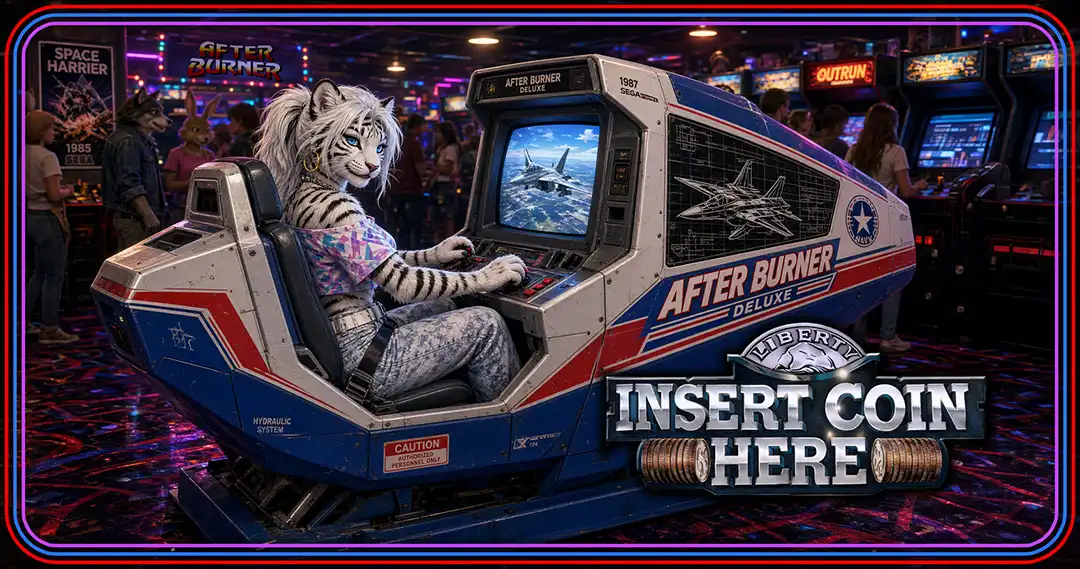
Take Off with Afterburner
When Sega brought After Burner to arcades in 1987, the company had long been redefining the concept of the “arcade game.” Under the leadership of young designer Yu Suzuki, Hang-On, Space Harrier, and Out Run had already been created—games designed to impress players beyond just the screen. Sega wanted to engage the player’s entire body. Motorcycles, movable seats, and elaborately designed cockpits transformed the arcade machine into an attraction that drew attention even from a distance.
After Burner took this concept to the extreme. Instead of a sports motorcycle, a fantasy world, or a Ferrari, this time a modern fighter jet awaited the player. From a perspective directly behind the aircraft, you raced through the sky while enemy planes, missiles, explosions, and contrails streaked across the screen at breakneck speed.
The influence of the 1986 movie Top Gun is hard to miss. Developer Hiroshi Kawaguchi later recalled that the film was extremely popular during development. Suzuki, however, had already been thinking about a fighter jet game beforehand and had initially even experimented with a more fantastical world reminiscent of Castle in the Sky. Ultimately, Sega opted for a scenario that would be universally understandable and a jet that was unmistakably modeled after a Grumman F-14 Tomcat.
It’s important to distinguish between After Burner and After Burner II. Both were released in 1987 and differ less than the numbering would suggest. The second installment is more of a quickly released, revised, and expanded version. Many of the memories associated with After Burner today—especially the throttle—actually refer to After Burner II.
Fast-Paced Gameplay
In terms of gameplay, After Burner is an uncompromising arcade shooter. Your fighter jet is prominently displayed in the foreground, while enemies race toward you from the depths of the screen. You use the joystick to move the aircraft up, down, and side-to-side. Enemy jets can be engaged either with the onboard cannon or with missiles. As soon as an enemy is locked onto, the targeting system signals a favorable opportunity to shoot it down.
Complex flight simulation was never the goal. Although the presentation mimicked military technology, Sega deliberately simplified the dogfights to actions that were immediately understandable. Players shouldn’t have to study instruments or learn flight maneuvers first. Insert a coin, grab the joystick, target enemies, and survive—the principle was clear within seconds.
It was precisely this simplicity that drove the game’s tremendous speed. Enemies appear in formations, missiles come from multiple directions, landscapes rush by beneath the aircraft, and downed planes explode spectacularly on camera. With extreme evasive maneuvers, the jet can even perform rolls. Often, the feeling is less that of a tactical dogfight and more that of an interactive action movie.
The original After Burner comprises 18 levels. After Burner II expands the game to 23 levels and, most importantly, adds a key control feature: the thrust lever. This allows the player to reduce speed or activate the eponymous afterburner. The development team had actually intended to include this feature in the first game. However, since the game was already balanced at that point, Sega decided against it initially. It later became apparent that the lack of speed control was causing problems, even from the developers’ perspective. It therefore became a central feature of After Burner II.
Technology at the Limit
Powering the spectacular visuals was Sega’s X-Board hardware. The system relied, among other things, on two Motorola 68000 processors and a Z80 for sound processing. A Yamaha YM2151 chip and Sega’s PCM technology were used for the music. The screen resolution was 320 × 224 pixels—numbers that seem unremarkable from today’s perspective but reveal little about what Sega was capable of achieving on screen.
The key was the ability to quickly scale and rotate large numbers of sprites. This allowed enemies to appear to fly toward the player from a great distance and fill the screen within seconds. At the same time, the entire display could be rotated while the jet performed a roll. Combined with the massive plumes of rocket smoke, this created an exceptionally dynamic impression for 1987.
The development team experimented extensively with these effects. Programmer Satoshi Mifune specifically cited the rotation of sprite areas and the convincing depiction of rocket smoke trails as major technical challenges. The game was also developed on NEC PC-98 computers—an unusual move for Sega at the time, as other development environments had previously been the norm.
The sound was at least as important as the graphics. Composer Hiroshi “Hiro” Kawaguchi specifically wanted a guitar-driven style this time around. Inspired by the musical atmosphere of contemporary action films, he created driving rock tracks that underscored the game’s fast pace. Kawaguchi even experimented with spatial sound reproduction within the movable cabinet. Ultimately, the concept had to be simplified; nevertheless, four speakers provided an unusually powerful acoustic backdrop.
Standard or Deluxe

After Burner was not just a video game, but also a demonstration of what Sega meant by a “Taikan” game—a game meant to be experienced physically. That’s why different cabinet versions existed.
The standard version more closely resembled a conventional arcade machine. It took up less space, was more affordable for arcades, and still offered the characteristic flight joystick as well as the audiovisual presentation. In terms of gameplay, it was essentially the same fast-paced action game. What was missing, however, was that part of the experience that set After Burner apart from ordinary arcade machines the moment you walked into an arcade.
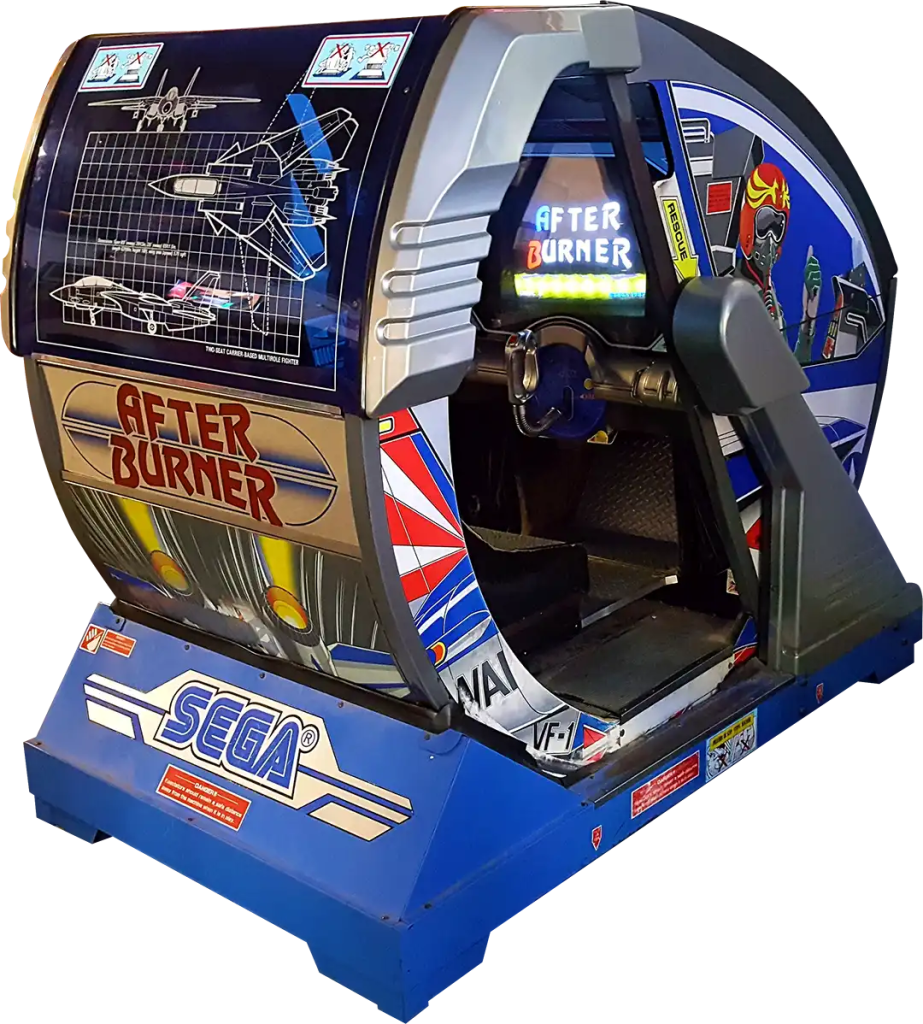
The Deluxe cabinet, on the other hand, was an attraction in its own right. The player sat in a cockpit-like structure that tilted and rotated in sync with the jet’s movements. When the aircraft veered to the left, the seat structure moved as well; violent maneuvers could be physically felt. The screen was positioned directly in front of the player, while speakers, the control stick, and the surrounding structure gave the sensation of sitting in a small, amusement-park-style version of a fighter jet.
During development, Sega even experimented with significantly more extreme movements. According to the team, an early prototype possessed impressive power, but it was deemed too dangerous and toned down for the production version. Yu Suzuki was already considering a design with even stronger, almost gyroscopic movement—an idea that would resurface a few years later in the legendary Sega R-360.
With After Burner II, the selection of cabinets became even more diverse. Contemporary reports mention, in addition to an upright version, movable sit-down variants with movement mechanisms of varying complexity. Added to this was the thrust lever, which made the physical illusion of a jet cockpit even more convincing. The Deluxe model was therefore not simply a more luxurious version of the same game. Movement, sound effects, and controls merged into an experience that was virtually impossible to replicate at home.
Trivia and Curiosities
The development of After Burner took place under unusual secrecy. Following the success of Out Run, Sega wanted to produce a true blockbuster. Internally, the project was associated with “Studio 128,” among other names, and a large portion of the previous Out Run team worked together again. Actual development began in late 1986.
Some ideas didn’t make it into the final game. For example, Suzuki wanted downed pilots to jump out of their planes with parachutes. At times, the team also considered significantly more elaborate dogfights and more realistic duels between just a few aircraft. Ultimately, however, time constraints and technical limitations led to the concentrated mass attack for which After Burner became known.
The little Sega references are also charming. For a landing sequence, Suzuki originally wanted a scene like the one in Top Gun, where a motorcycle rides alongside an airplane. Instead, it ended up featuring the bike from Hang-On, of all things; even the Ferrari from Out Run found its way into this playful self-reference.
Reviews from Back Then
Upon its release, After Burner impressed the trade press above all for its technical prowess. The speed, the large sprites, the rotation effects, and the movable cabinet were extraordinary for 1987. Computer and Video Games described the game as an outstanding experience, while Sinclair User awarded it eight out of ten points. Other contemporary reviews praised the graphics and the immediate impact, but at the same time acknowledged that the actual gameplay was comparatively simple or superficial.
This is precisely where the interesting contradiction of After Burner lies: as a set of rules, it is astonishingly simple. There are only a few weapons, little tactical depth, and hardly any long-term decisions. The challenge arises primarily from speed, reaction time, and the increasing chaos on the screen.
The price also drew criticism. In particular, the elaborate, movable cabinets in some British arcades cost significantly more per game than standard machines. Nevertheless, players lined up to play it. Contemporary reports described After Burner as one of the arcade hits of the year; in Japan, it was among the top-grossing large-scale arcade machines of its time and received an award for its graphics at the Gamest Awards, among other honors.
Interestingly, later home computer ports were often judged much more critically. Without a huge screen, special controls, movement, and the power of the arcade hardware, it became more apparent just how straightforward the game actually was. This shows how closely After Burner is tied to its original arcade machine: the cabinet wasn’t merely an accessory, but an essential part of the design.
Cultural Influence
After Burner belongs to that brief phase in arcade history when Sega treated arcade machines almost like amusement park attractions. Along with Space Harrier, Out Run, Thunder Blade, and later G-LOC or the R-360, the game established the idea that a video game did not necessarily have to take place inside a rectangular box.
Aesthetically as well, After Burner became a symbol of the late 1980s: F-14 jets, sunsets, rock guitars, military technology, and an almost unbridled enthusiasm for speed combined to capture the essence of the action-pop culture of the time. The game did not set out to simulate or comment on war. Rather, it adopted the visual language of Hollywood blockbusters and transformed it into a three-minute adrenaline rush.
Just how iconic the arcade cabinet had become is evident, among other things, from its appearance in Terminator 2. For Yu Suzuki’s team, it was precisely this kind of place in pop culture that demonstrated how widely the distinctive cabinet was recognized—even outside traditional arcades.







Schreibe einen Kommentar