

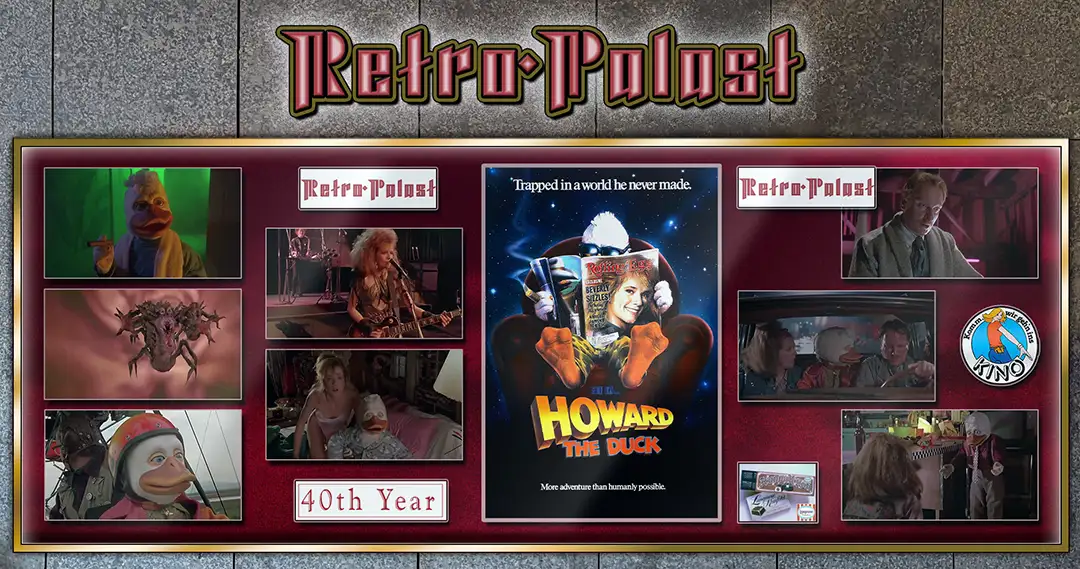
Not bad for a duck from outer space.
The Misunderstood Duck Wonder
There are movies that are successful upon their release but age surprisingly quickly afterward. And then there are movies like Howard the Duck: works that are initially left open to public criticism but, decades later, seem more vibrant, more unconventional, and bolder than much of the competition that was celebrated at the time. Willard Huyck’s science-fiction comedy hit U.S. theaters on August 1, 1986; it was produced by Lucasfilm and based on the Marvel character created by Steve Gerber and Val Mayerik. Lea Thompson, Jeffrey Jones, and Tim Robbins—who was still at the beginning of his career at the time—took on the main human roles; Howard himself was physically portrayed by several actors and puppeteers, while Chip Zien provided his voice.
To this day, the film’s reputation is almost entirely defined by its failure at the time. It is regarded as an expensive flop, a misstep by George Lucas, and a cautionary tale of a comic book adaptation whose tone no one understood. Yet that is precisely the problem: Howard the Duck is usually not viewed as a film, but rather as a court case that has already been settled. Its poor reputation replaces any personal encounter with the work itself.
Those who set aside this preconception will discover not a sleek, polished mainstream product, but a bizarre, handmade, and surprisingly romantic blend of rock musical, monster movie, screwball comedy, science-fiction adventure, and underdog story. The film is over-the-top, occasionally tasteless, tonally daring, and utterly convinced of its own madness. Yet it is precisely these qualities that make it so valuable today.
A masterpiece doesn’t have to be free of inconsistencies. Sometimes greatness emerges where different ideas collide with full force. Howard the Duck possesses this untamed energy. In an era where many blockbusters carefully meter out their eccentricity and hedge their risks with familiar formulas, its uncompromising nature seems almost revolutionary. The film aims to amaze, unsettle, seduce, frighten, and ultimately even move the audience. The fact that it attempts all of this with a cigar-chewing duck at its center is not a weakness, but rather its greatest artistic achievement.
Howard Takes a Hard Landing
The story begins on Duckworld, a parallel universe where a civilization of anthropomorphic ducks has developed. Howard T. Duck lives an urban, distinctly modern life there until a mysterious beam of energy pierces his apartment and hurls him across the cosmos to Cleveland. This opening sequence alone sets the tone: the film treats its absurd world with elaborate matter-of-factness. Duckworld is not a hastily explained punchline, but a brief, meticulously detailed glimpse into a fully conceived alternate reality. Howard is not introduced as a shining hero, but as an exasperated city dweller who is literally torn from his everyday life.
In Cleveland, he encounters rock singer Beverly Switzler, who is being harassed by two pushy men. Howard intervenes with his “Quack-Fu” and rescues her. Beverly takes the alien stranger in, even though she can barely comprehend his existence at first. An unusual bond develops between the two: Beverly sees in Howard not only a sensation, but a homeless person who, just like her, is stuck between ambition, disappointment, and the desire for a different life.
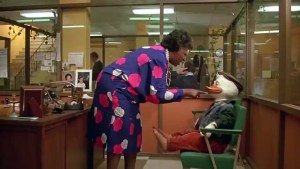
Howard, in turn, finds in her someone who doesn’t reduce him solely to his appearance. Their relationship is the emotional core of the film, precisely because it defies easy categorization. It is friendship, flirtation, solidarity, and a fairy-tale romance all at once. What has often been mocked as crossing the line of good taste is, in fact, the film’s most consistent message: affection arises when two outsiders take each other seriously.
The eccentric museum employee Phil Blumburtt initially promises scientific help but turns out to be a pompous slacker. Howard loses hope of returning home and ends up back on the streets. When he sees Beverly performing with her band Cherry Bomb, he finds a new purpose. He protects her from an exploitative manager and eventually becomes her manager and ally himself.
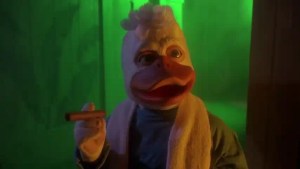
This middle phase is often criticized as aimless, yet it is precisely here that the film develops its soul. Howard must not only find a machine that will take him home. He must figure out whether home is a geographical place or a human—or duck-like—relationship. His journey takes him from a cynical loner to a protector, friend, and musician.
Then, with admirable audacity, the film transforms into cosmic horror. The scientist Dr. Walter Jenning explains that a laser spectroscope accidentally pulled Howard to Earth. However, the beam also reached the “Dark Overlords of the Universe”—alien demons who now seek to take over human bodies and conquer Earth. Jenning himself becomes possessed and gradually mutates into a radioactive, slimy creature.
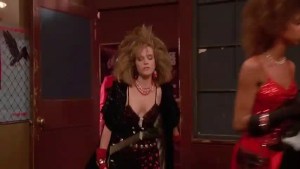
Jeffrey Jones’ physical transformation, the chaos at Joe Roma’s Cajun-sushi restaurant, and the ensuing car chase are among the film’s highlights. The comedy doesn’t tip cautiously into horror; it plunges into it with gusto. The film shifts genres as if a particularly crazy comic book issue were being handed off from one art team to another right in the middle of the story. This shift in tone is no accident, but rather an expression of a world in which literally anything can happen.
In the finale, Howard and Phil fly in an experimental glider to the lab where Beverly is to serve as a host body for more Dark Overlords. Howard uses a futuristic weapon to free Jenning from possession and then confronts a giant, tentacle-like monster.

To save humanity, he ultimately destroys the machine, even though it represents his only chance to return to Duckworld. This decision finally establishes him as a hero. It is not fate or superpowers that elevate Howard, but his voluntary renunciation of what he desires most. He saves a world that had previously mocked, persecuted, and cast him out.
In the end, Howard stays on Earth, manages Beverly’s band, and fulfills his long-held dream of being a guitarist on stage. The ending is triumphant, heartwarming, and remarkably consistent: the stranger doesn’t find a portal home, but instead creates a new home for himself.
The Courage to Be Quirky

Lea Thompson is the beating heart of the film. Her character, Beverly, could easily have been reduced to a mere human sidekick to a fantastical figure, but Thompson plays her with sincerity, energy, and an almost unshakable openness. She reacts to Howard not only with comical astonishment but with genuine affection. In doing so, she compels the audience to accept him as a fully realized character.
It’s particularly impressive that Thompson doesn’t view the rock musician ironically from the outside. She sings, performs, and throws herself wholeheartedly into the garish ’80s aesthetic. Her sincerity prevents the film from becoming a cynical revue of gimmicks. Beverly believes in her music, in Howard, and in the possibility that two failed lives can build something new together.
Chip Zien’s voice gives Howard that mix of weariness, sarcasm, and vulnerable swagger that the character needs. Howard sounds like a hard-boiled private detective who has seen too much, even though he finds himself in a world that is completely foreign to him. His dry voice creates a charming contrast to his small, feathered body.

The visual embodiment of Howard emerged from a complex interplay between several physical performers and puppeteers. The credits list Ed Gale, Tim Rose, Steve Sleap, Peter Baird, Mary Wells, and Lisa Sturz, among others, as being associated with the character. It is precisely this collective effort that deserves recognition. Howard is not a digital effect that was added to the scene later, but a physically present co-star. He shares light, space, and movement with the actors. This lends even the clunkier moments a tangible magic that modern computer effects struggle to reproduce.
Tim Robbins plays Phil Blumburtt as an unbridled bundle of insecurity, enthusiasm, and a thirst for recognition. The performance is deliberately over-the-top, nervous, and cartoonish. Those expecting naturalism will find it exhausting; those who view the film as a live-action comic will recognize its purpose. Phil is a man so desperate to make a significant scientific discovery that he himself becomes a caricature of his own ambition.
Jeffrey Jones, on the other hand, delivers the most fearless performance as the obsessed Dr. Jenning. His increasingly contorted physical movements, his distorted voice, and his transformation from an absent-minded scientist into a monstrous harbinger of the apocalypse are both comical and unsettling. Not for a single moment does the cast act as if they need to apologize for the material. It is precisely this dedication that transforms the madness into a believable cinematic world.
Madness Behind the Scenes
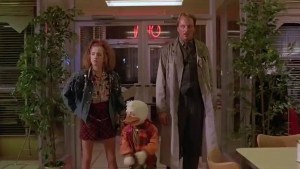
The film’s development story is almost as extraordinary as the movie itself. George Lucas had already been interested in an adaptation as early as the 1970s. Willard Huyck and Gloria Katz, who had worked with Lucas on American Graffiti and later co-wrote Indiana Jones and the Temple of Doom, eventually brought the project to Universal.
Contemporary sources estimated the final cost at approximately $35 to $37 million—an enormous sum for such a risky venture. Filming took place from November 1985 to March 1986 at 32 locations around San Francisco, which stood in for Cleveland in the film. About 50 sets were built for the production, including a seven-metric-ton laser spectroscope.
Technically, too, the film was far more ambitious than its reputation suggests. Howard was brought to life through costumes, animatronics, and puppetry, while Industrial Light & Magic handled the space and creature effects. For the scene in which Howard is pulled through several walls out of his apartment, the effects team used computer-aided techniques to remove the supporting wires. This early form of digital wire removal foreshadowed a technique that would later become standard in major action and effects productions. The supposedly outdated duck adventure was thus also a laboratory for the future of cinema.
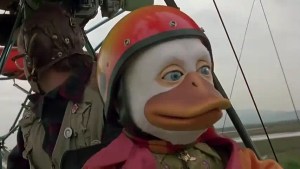
Howard’s voice wasn’t finally cast until late in the process. Chip Zien later reported that Robin Williams, among others, had previously worked on the voice-over. However, the character’s pre-determined beak movements were difficult to reconcile with Williams’ spontaneous and improvisational rhythm. Zien’s distinctive, slightly nasal voice ultimately suited Howard’s serene demeanor perfectly.
The soundtrack is also an underrated gem. John Barry composed the film score, while Thomas Dolby produced the songs. Other songwriters involved included Allee Willis and George Clinton. As a result, the film possesses not only the look but also the sound of a particularly imaginative snapshot of pop culture. The music is not merely decorative; it provides an emotional counterpoint to the science-fiction chaos and lends credibility to Howard’s development as a musician.
It’s particularly endearing how strongly Lea Thompson later defended the film. At a screening, she explained that she had enjoyed revisiting the film and that the decades of mockery were unfair. As recently as 2022, she spoke publicly about her desire to direct a new Howard story for Marvel herself. This is more than just nostalgic loyalty: It shows that, for its lead actress, the film has remained not an embarrassing fluke, but a work with unfulfilled potential.
A Slashing that Had Consequences
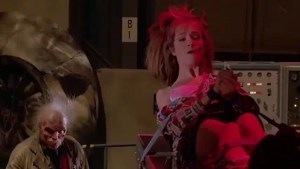
The contemporary reaction was brutal. The film grossed around $16.3 million in North America; worldwide, it brought in just under $38 million, against a reported budget of $37 million. Given additional marketing and distribution costs, this was not enough for commercial success. The American Film Institute documents the weak theatrical opening, early double features, and the immediate consequences for Universal.
At the Golden Raspberry Awards, the film shared the award for Worst Picture with Under the Cherry Moon. In addition, the screenplay and the visual effects surrounding Howard, among other elements, were honored with negative awards.
Later critical reviews also remained scathing. Rotten Tomatoes currently lists the film with only 14 percent positive reviews. The consensus there particularly criticizes the inconsistent tone and the allegedly mediocre performances.
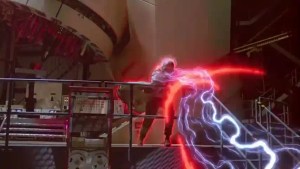
But the accusation of tonal inconsistency, in particular, falls short. Howard the Duck is not accidentally a children’s adventure, an erotic farce, a rock movie, and a monster movie all at once. Its identity lies in this collision. The comic book character thrived on satire, absurdity, and the sense that Howard is trapped in a world even crazier than he is. The film translates this idea into images—not elegantly, but with overwhelming consistency.
Many scathing reviews treat good taste as an objective measure of quality. But good taste is not the same as imagination. The film contains ideas that a more cautious studio would have cut immediately: duck versions of everyday human culture, a hinted-at romance between a woman and a duck, Quack-Fu, a Cajun sushi restaurant, a demonically mutating scientist, an ultralight aircraft, and a rock concert as redemption.

One may reject individual gags. You might find Howard’s face takes some getting used to. You might shake your head at some of the dialogue. But you can hardly deny that the film possesses a rare density of original ideas. Even where the film fails, it fails in a way that no other film could replicate.
Its failure, therefore, stems less from a lack of ideas than from a mismatch between the film and audience expectations. The audience didn’t get a cozy family comedy, even though the advertising and the cute title character might have suggested otherwise. Adult viewers, in turn, didn’t get pure satire. What remained was a film with no clear place in the market at the time.
Today, after decades of hybrid genres, talking space animals, and self-deprecating superhero movies, its tone is much easier to grasp. Howard the Duck wasn’t necessarily wrong. Perhaps it simply arrived in a cinematic culture that didn’t yet have an audience for its unique wavelength.
The Duck Endures

A truly meaningless film disappears. Howard the Duck, on the other hand, has refused to be forgotten for four decades. The character made a prominent return to pop culture, particularly through his appearance at the end of Guardians of the Galaxy and subsequent appearances in the Marvel Universe.
In 2015, Marvel launched a new comic book series by Chip Zdarsky and Joe Quinones, in which Howard appeared as a private investigator. In 2023, the publisher celebrated its 50th anniversary with a new one-shot and an extensive lineup of cover art. The duck, whose movie had supposedly destroyed any future, was once again celebrated as a natural part of the Marvel universe.
This comeback shows just how strongly the movie has shaped the public image of the character. Even people who have never read a Howard comic recognize his leather jacket, his deadpan expression, and his connection to a garish cosmic world. The movie created a visual icon that is allowed to be both ridiculous and cool at the same time.

It is precisely this tension that is now a fundamental principle of many successful comic book adaptations: the absurd is no longer hidden but celebrated with the utmost production value. A talking raccoon, an alien tree, or a multiverse adventure no longer seem fundamentally problematic to modern audiences. Howard the Duck dared to embrace a comparable level of absurdity as early as 1986—and did so without the backing of decades of superhero films.
The film also deserves recognition as a cinematic pioneer. Long before the established Marvel Cinematic Universe, it proved that even a deeply peculiar supporting character could carry a major studio film. The film flopped, but its boldness at least made later experiments conceivable. Its practical effects work, early digital wire removal, and radical genre mishmash also make it a fascinating document of that transitional period when Hollywood’s hand-crafted special effects cinema began to experiment with digital tools.
A true cult masterpiece
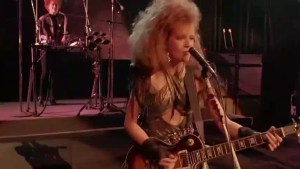
Howard the Duck is not a perfect film. It is something better: a one-of-a-kind film. Its flaws are visible, yet they stem from exuberance, not indifference. Every set, every creature, every costume, and every musical excess bears witness to people who truly wanted to bring an impossible idea to the screen. The result is vibrant, handmade, and imbued with a freedom that major studio productions are rarely allowed.

The film works as an underrated masterpiece precisely because it defies simple standards. It tells a story of being an outsider, friendship, and a self-chosen home, without sacrificing its anarchic surface. Howard doesn’t save the world because he’s the strongest or most powerful, but because he takes on responsibility despite ridicule, loneliness, and homesickness. And when he picks up the guitar at the end, the punchline finally becomes a hero.
There’s no need to rehabilitate Howard the Duck as a flawless classic. We just need to finally see it for what it is: a daring, technically innovative, emotionally honest, and spectacularly strange piece of cinema. The film was plucked in 1986. Forty years later, it’s high time to let its feathers shine again.
More
Trailer
External links
Notice Regarding Image Rights and Copyrighted Material
All images, film stills, posters, logos, trailer excerpts and other copyrighted materials used in this article are used solely for editorial reporting, film criticism, review and illustrative purposes related to the respective content.
Unless otherwise stated, all copyrights, trademark rights and other intellectual property rights in the materials used remain with their respective rights holders, including film studios, distributors, production companies, photographers, artists or other licensors.
The materials are used in good faith and with regard to applicable legal limitations, licence terms and source attributions. If, despite careful review, any rights have been infringed or any attribution is incomplete, please contact me. Upon review, the relevant content will be removed or corrected promptly.






Kommentar verfassen