


A Classic Takes Off
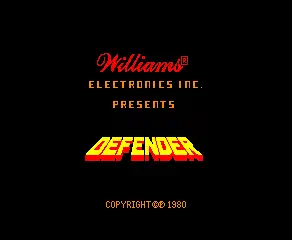
When Defender hit the arcades in 1981, the video game industry was in a phase of rapid experimentation. Space Invaders had sparked the modern arcade boom just a few years earlier, Asteroids demonstrated the fascination of a freely maneuverable spaceship, and Pac-Man proved that on-screen characters could already become pop icons. It was into this environment that Williams Electronics introduced a game that initially seemed almost too complicated to reach a mass audience. Defender required not only quick reflexes but also spatial awareness, strategic planning, and mastery of an unusually complex control panel.
The game was developed primarily by Eugene Jarvis and Larry DeMar, with support from Sam Dicker and Paul Dussault. For Williams, known until then primarily as a pinball machine manufacturer, Defender was its first truly independent video game project. Jarvis had previously worked on pinball machines and approached the new medium without a set of fixed rules. The team combined influences from Space Invaders and Asteroids, but deliberately sought to move away from simple shooting games with static screens. The result was a vast, horizontally scrolling world in which the player didn’t just destroy enemies but had to defend a vulnerable population.
It was precisely this combination of speed and responsibility that made Defender extraordinary. At first glance, it was a frantic space shooter. Beneath its flashy surface, however, lay a system of interconnected dangers: Those who simply fired away lost the people on the ground; those who focused solely on rescue missions were overwhelmed by the waves of alien attacks. The player had to keep an eye on the entire planet and constantly decide where their attention was needed most urgently.
Rescue Under Constant Fire

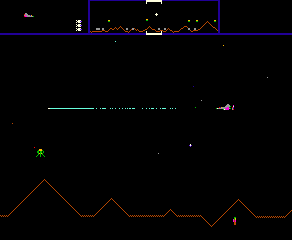
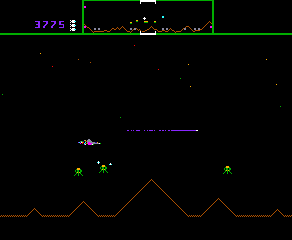
The player controls a small spaceship over the surface of an unnamed planet. The landscape is depicted as a thin, jagged line and moves across the screen to the left or right depending on the direction of flight. Above the actual playing field is an elongated radar screen. It displays the positions of the player’s ship, the enemies, and the humanoids across the entire world. This allows the player to see both the immediate battle and an abstract overview of the action at the same time. The Strong National Museum of Play specifically highlights this combination of a scrolling world and a radar-like mini-map as an important innovation.
The main objective is to survive waves of attacks by alien ships and prevent ten humanoids on the planet’s surface from being abducted. The so-called landers float down toward the humans, pick them up, and attempt to carry them to the top of the screen. If they succeed, the abductor and victim merge into an aggressive mutant. The player can rescue a captured human by shooting down the Lander, then catching the falling humanoid and setting them safely on the ground. However, a single inaccurate shot or a rescue attempt that comes too late is enough to kill the very person who was supposed to be protected.
Additional enemies ramp up the pressure. Bombers drop mines in the play area. When shot down, pods burst into groups of small, fast swarmers. Baiters appear if the player takes too long to defeat a wave, thereby preventing cautious, endless point-scoring. If all humanoids are killed or transformed, the planet explodes. The game isn’t over yet, but the surviving landers become mutants, and the subsequent waves of attack are considerably more dangerous. After several rounds of attacks, the world is restored and repopulated with ten humanoids.
The controls play a crucial role in the game’s intensity. A joystick limited to up and down movements controls altitude. Five separate buttons are available for firing, thrust, changing direction, the smart bomb, and hyperspace. Thus, the ship does not automatically move in the direction the joystick is pushed. To turn, you must use a separate button; to accelerate, hold down the thrust button. The Smart Bomb destroys visible enemies and can save you from a hopeless situation. Hyperspace teleports the ship to a random location, but carries the risk of being destroyed immediately after the jump.
These controls are confusing at first, but after prolonged practice, they create a remarkably precise feel for the game. Advanced players race just above the landscape, turn at the right moment, catch falling people, and monitor the radar all at the same time. Defender does not reward a rigid attack routine. Every second demands a new priority: Should a lander be stopped, a minefield avoided, a pod deliberately destroyed, or a smart bomb saved for later? This convergence of tasks gives rise to the game’s famous rhythm—a mix of panic, concentration, and growing control.
Technology Pushed to the Absolute Limit

Defender was not only challenging to play but also technically ambitious. The arcade cabinet was powered by a Motorola 6809 processor, while a dedicated processor board handled sound generation. The graphics were displayed on a color raster monitor and utilized a video memory that could be written to directly by the processor. It could display 16 colors simultaneously. The game code was written in assembly language because the developers had to make the most direct use possible of the hardware’s limited resources.
What was particularly remarkable was that the movement of the many objects was largely controlled by software. Numerous early arcade machines used specialized circuits that strictly defined specific graphical tasks. Defender relied more heavily on a freely programmable video memory. This gave the team creative freedom but placed a heavy load on the main processor. Every landscape line, every projectile, every enemy, and every explosion had to be calculated and drawn within tight time constraints.
The scrolling world was larger than the visible portion of the screen. For players in the early 1980s, this was by no means a given. The radar made this spatial expanse understandable: it was not merely decoration, but a second channel of information. The rough overview and the detailed main screen complemented each other. In this way, Defender anticipated a form of user interface that would later become standard in strategy, action, and open-world games: the player acts locally but simultaneously observes a map of the larger space.
The audiovisual experience also contributed significantly to the gameplay. The graphics were abstract but unusually vivid. Enemies changed colors, shots trailed glowing lines, and destroyed objects disintegrated into particles scattering energetically in all directions. Sam Dicker developed effects that made explosions seem less like rigid, repetitive animations. The sound consisted of aggressive pulses, warning signals, and a constantly swelling electronic noise. The result was not a realistic depiction of space, but a compelling sensory experience: the machine conveyed a sense of danger through movement, color, and sound long before elaborate cutscenes or orchestral music were possible.
From today’s perspective, the hardware seems extremely limited. That is precisely why its performance is so impressive. The main processor ran at about one megahertz, and a large portion of the available memory was required for graphics rendering. Nevertheless, the game was able to handle numerous enemies, projectiles, people, mines, and particles simultaneously. The assembly source code released in 2021 shows just how closely the program structure and the specific arcade hardware were intertwined.
Curious Stories and Details

The development of Defender was by no means straightforward. Jarvis initially experimented with variations of Space Invaders and Asteroids, but felt the early designs were too heavily dependent on their models. It wasn’t until the idea of a world extending beyond a single screen emerged that the project gained its own identity. The ability to fly in both directions wasn’t planned from the start either. Pinball designer Steve Ritchie convinced Jarvis not to limit the screen scrolling to a single direction.
The title arose from Jarvis’s desire to give the shooting a clear purpose. He recalled the TV series The Defenders and found the idea of protection more emotionally compelling than the senseless slaughter of enemies. The humanoids were therefore more than just an afterthought for bonus points: they gave the game its name and transformed mere survival into a defensive mission.
Shortly before the presentation at the 1980 AMOA trade show, key components such as the demo mode and the high-score table were still missing. The team worked late into the night, burning new EPROMs and even initially installing a set of chips upside down, which caused a short circuit. Despite this frantic rush to completion, the game did not initially seem like a surefire success at the trade show. The many buttons and the fast-paced action deterred some operators and visitors.
Defender was also not originally designed for the extremely long games that top players would later achieve. The developers considered a score of around 60,000 points to be exceptional. However, once the game was released, arcade experts developed techniques that allowed them to score in the millions and play for hours on end. In 1982, Defender became the centerpiece of an early, cross-city video game competition. Players in 32 cities competed against each other over the same weekend. Such events helped transform high scores from a local record on the arcade machine into a publicly comparable achievement.
Another sign of its success was the enormous number of ports. Defender appeared on numerous consoles and home computers, including the Atari 2600, Apple II, Commodore 64, Intellivision, and ZX Spectrum. The Atari 2600 version alone sold more than three million copies. No port could fully reproduce the original’s wide control panel and fast pace, but the home versions made the game’s name known far beyond the arcades.
Contemporary Voices and Reactions
Initial reactions were mixed: Defender was considered both fascinating and intimidating. At its trade show debut, the expected immediate enthusiasm was initially lacking. Jarvis later attributed this to the complex controls and the overwhelming visuals. A machine with five buttons required more explanation than many competitors, which got by with a joystick and a fire button.
In actual arcade settings, the picture changed quickly. Spectators gathered around the machines, watched experienced players, and learned the mechanics by imitation. Jarvis later recalled playtests where large groups brought chairs over to watch the games for extended periods. Stan Jarocki, then marketing director at rival Midway, is said to have simply described the game as “amazing” at the time of its release.
Revenue figures also confirmed the enthusiasm. Defender held top spots in American operator charts for months in 1981 and was among the highest-grossing arcade titles by the end of the year. Williams sold more than 55,000 machines—an extraordinary success for a game whose gameplay had initially seemed like a commercial risk. It thus became the company’s best-selling arcade game.
The game was particularly praised for its fast scrolling, colorful graphics, intense explosions, distinctive sound, and unusual strategic depth. Its difficulty level, however, was the main source of criticism—and even fear. Even short games could end after just a few seconds, and beginners had to learn several control inputs before they could even turn and shoot accurately. The game was thus less accessible than titles like Pac-Man or Galaga.
But it was precisely this difficulty that became part of its reputation. Defender rarely presented defeats as entirely random punishments. Most of the time, the player knew they had reacted too late, ignored the radar, or botched a rescue maneuver. This made trying again feel worthwhile: it wasn’t the game that needed to change, but the player’s own performance.
This mindset aligned with the arcade business model, where every mistake could cost another coin, but it also fostered an early form of the “hardcore” audience. Anyone who mastered Defender visibly demonstrated skill, memory, and nerves of steel. Looking back, the Strong National Museum of Play describes the game’s difficulty as a characteristic that clearly distinguished dedicated players from casual arcade visitors.
Traces in Gaming Culture
Defender popularized the side-scrolling shooter and demonstrated that an action game could take place in a cohesive world larger than the screen. Later titles such as Scramble, Super Cobra, Choplifter, Gradius, and R-Type took side-scrolling in very different directions. Games like Archer Maclean’s Dropzone particularly clearly adopted the free movement, the rescue of people, and the high speed.
Its influence, however, extends beyond the genre. The radar combined immediate action with a strategic overview. The rescue mission assigned interdependent roles to enemies and civilians. Furthermore, the game generated narratives not through text, but through systems: a person is kidnapped; the player shoots down the landing craft, rescues the victim, and brings them back. From just a few rules emerges a dramatic miniature narrative featuring danger, rescue, and the possibility of failure. This principle is central to modern game design.
Defender also shaped the concept of the arcade game as a public test of skill. Its steep learning curve made good matches spectacular. Spectators could immediately tell whether someone was just frantically hammering the control panel or actually controlling the chaos. Tournaments, record attempts, and local high-score rivalries reinforced the competitive culture that is among the historical precursors of organized esports and modern high-score gaming.
For Eugene Jarvis, Defender marked the beginning of an extraordinary career. With Robotron: 2084, NARC, Smash TV, and later arcade titles, he continued to explore the concept of intense, physically direct action. Defender itself received a more complex sequel, Stargate, as early as 1981 and remained available for decades through collections, re-releases, and emulations. In 2021, the assembly language source code for one version was even made publicly available, facilitating technical analysis and digital preservation.
This long-term recognition is also evident at the institutional level. On May 8, 2025, Defender was inducted into the World Video Game Hall of Fame at the Strong National Museum of Play, alongside Tamagotchi, GoldenEye 007, and Quake. The selection honored not only its popularity but also its lasting influence on game mechanics, competition, and pop culture. Thus, a game that initially seemed too complicated to many trade show visitors was officially granted the status of a culturally and historically significant work.
Why Defender Lives On

Defender is neither user-friendly nor easy to play by today’s standards. Its controls aren’t intuitive, the first few minutes are often frustrating, and the fast pace leaves little room for thought. Nevertheless, the game doesn’t come across as merely a historical curiosity. Its rules are so intricately intertwined that every match generates a chain of significant decisions. Shooting, flying, rescuing, observing, and conserving special weapons are not separate tasks, but parts of a single system.
Technically, Defender impresses with its determined approach to working within the constraints of limited hardware. Artistically, it stands out with a clear audiovisual identity. Historically, it represents the moment when arcade games began to design worlds rather than individual screens and to demand more from players than mere reaction. Its difficulty may be daunting, but it is not arbitrary: it forces you to truly understand the game.
Above all, however, Defender possesses a quality that allows many classics to stand the test of time. It’s instantly recognizable, but takes time to master. The first attempt ends in chaos; later, you begin to recognize patterns, rescue humanoids strategically, and navigate the onslaught with growing confidence. Overwhelm turns into skill. It is precisely this journey that makes Defender one of the most impressive games of the golden age of arcades, even more than four decades after its release.








Kommentar verfassen