

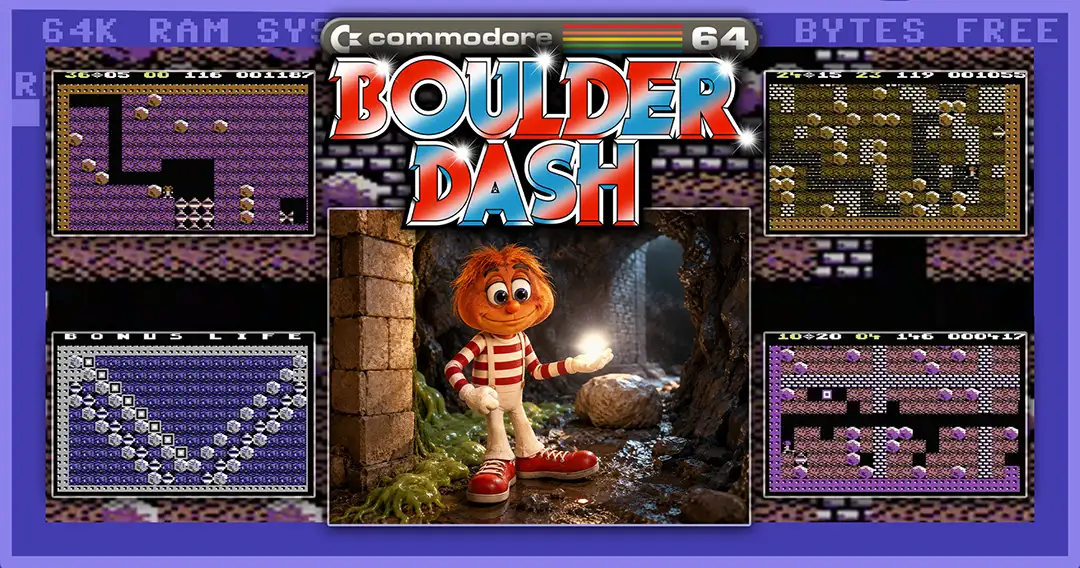
A Classic Under Pressure
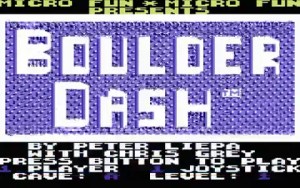
Few games from the early days of home computing can be conjured up with a single sound. With Boulder Dash, the dry thud of a falling boulder is all it takes—and immediately, a cave of brown earth, blue walls, sparkling diamonds, and a small, restlessly blinking hero appears in your mind’s eye. Released in 1984, the game is one of those works whose graphical simplicity doesn’t detract from it, but rather allows its central idea to stand out all the more clearly. Boulder Dash is easy to understand, hard to master, and surprisingly rich in situations that don’t seem visibly pre-programmed, but rather arise from a few interconnected rules.
At the center of it all is Rockford, a cave explorer with a barely fleshed-out backstory but high name recognition. His task is to collect a specified number of diamonds underground and then reach the exit. What initially sounds like a straightforward treasure hunt quickly transforms into a game about gravity, space, time, and the consequences of one’s own decisions. Every block of earth removed can set a stone rolling, block a path, release an enemy, or trigger a life-saving chain reaction.
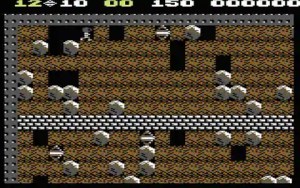
The original Boulder Dash was developed by Canadians Peter Liepa and Chris Gray and published in 1984 by First Star Software. The first version was created for Atari’s 8-bit computer, but ports for other systems, including the Commodore 64, were released that same year. The C64 version was developed by Jeff Schneider and went on to become one of the game’s most famous iterations.
Boulder Dash struck a chord at a time when computer games were seeking their own forms of expression. It was neither a mere reaction game nor a pure puzzle game. Instead, it combined the immediacy of an arcade title with the strategic planning of a puzzle. It was precisely this blend that made it an ideal C64 game: immediately accessible, playable in short sessions, and yet deep enough to keep players engaged for weeks or months.
While many games of that era relied on quick reflexes, high scores, or imitating well-known arcade machines, Boulder Dash demanded a different kind of attention. The player had to not only react but also read the environment. The cave was not a static backdrop but a cohesive system. Digging without thinking would permanently alter this system. As a result, every movement carried a weight that went far beyond a single button press or joystick movement.
Dig, Think, Survive
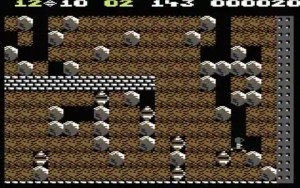
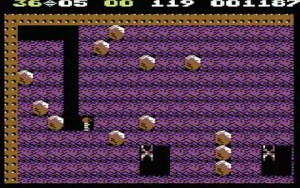
Rockford is controlled with the joystick as he navigates a scrolling cave labyrinth. He can remove dirt simply by running through it, collects diamonds upon contact, and can move boulders sideways, provided there is an empty space behind them. Rockford cannot push them up or down. These few actions form the basic vocabulary of the entire game. Its true complexity arises from the fact that almost every object reacts to its immediate surroundings.
Boulders and diamonds fall downward as soon as the ground beneath them disappears. If a boulder is resting on a rounded object and there is space to the side, it can roll to the side. For Rockford, this is life-threatening: a single misstep is enough for a falling boulder to bury him. At the same time, the boulders are important tools. They can be used to crush enemies, secure paths, or set certain sequences in motion. Boulder Dash thus turns the same game mechanic into both a threat and a solution.
Enemies include Fireflies and Butterflies, which move through open passages according to fixed patterns. They aren’t intelligent hunters in the modern sense, but their predictable behavior doesn’t make them harmless by any means. The player can observe their behavior, anticipate their movements, and exploit them strategically. Particularly appealing is the ability to hit Butterflies with falling rocks: When destroyed, they transform into a group of diamonds. In this way, a dangerous opponent becomes a valuable resource.
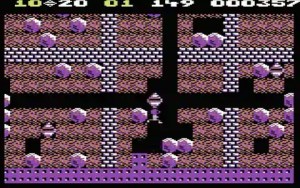
Other elements, such as amoebas and enchanted walls, further alter the familiar rules. An amoeba grows through open areas of the cave and, depending on its development, can transform into stones or diamonds. The magical wall, in turn, transforms objects that fall through it: Boulders can become diamonds, while diamonds are transformed in the opposite direction. The player must frequently activate and control such mechanisms under time pressure.
The original game features 16 regular caves, labeled A through P. After every four caves, there’s a short interlude—a compact bonus, logic, or skill challenge. In addition, there are five difficulty levels available, which alter time limits, diamond values, and other requirements. As a result, Boulder Dash offers significantly more depth than its simple presentation initially suggests.
The time pressure is crucial. Each cave requires a certain minimum number of diamonds before the exit opens. If you take too long to plan, you lose; if you act too hastily, you might trigger a deadly rock avalanche. The game thus forces you to constantly switch between analysis and execution. You assess the situation, devise a sequence of steps in your head, and then must carry them out precisely. Because the cave continues to “change” in the meantime, even a good plan remains vulnerable to timing errors.
A common mistake is removing a seemingly insignificant block of earth too early. This might cause a rock to fall into a passage that will be needed later. Another time, an enemy is released before a safe escape route has been prepared. Still other caves require you to deliberately trigger an avalanche or move a specific boulder across multiple obstacles. The solution rarely lies in a single action, but rather in the correct sequence of many small decisions.
It’s also remarkable how understandable many defeats feel. While Boulder Dash can be extremely unforgiving, the decisive mistake is usually easy to identify: a dirt block removed too early, an overlooked escape route, or an enemy misjudged. The game teaches through consequences. It explains its systems with hardly any text, instead letting the player observe, fail, and deduce the rules from those experiences. This form of learning is a central part of its appeal.
Pixel Physics and Programming Artistry
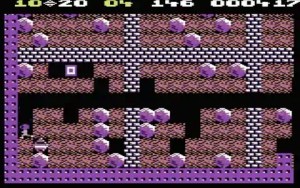
#Technically, Boulder Dash appears modest at first glance. The playing area consists of clearly distinguishable tiles, the animations are brief, and the sound focuses on a few distinctive effects. Yet it is precisely this minimalism that serves a functional purpose. Dirt, walls, rocks, diamonds, enemies, and Rockford are instantly recognizable. In a game where a single block can determine success or failure, visual clarity is more important than decorative detail.
The C64 version scrolls in all four directions and always shows only a section of the larger cave. This creates a sense of spatial expanse without allowing the player to see the entire layout at any given time. You have to memorize paths and anticipate risks outside the visible screen area. The scrolling is therefore not merely a technical presentation style, but directly influences the gameplay experience.
The sound design aids orientation. Falling rocks, collected diamonds, opened exits, and explosions each have distinct, easily distinguishable sounds. Compared to later C64 productions, the music and sound effects remain simple, yet it is precisely the rumbling, clanging, and exploding sounds that are inextricably linked to the game’s identity. The sounds provide important feedback about events that may be taking place right at the edge of the visible screen.

The conceptual foundation of the game is particularly interesting. Peter Liepa later described Boulder Dash, in essence, as mathematics hidden behind a graphical interface. During development, he was fascinated by the principle of cellular automata. A game board consists of individual cells whose state changes based on local neighborhood rules. In Boulder Dash, this approach is evident in the fact that every object reacts to its immediately adjacent cells according to simple rules. These local decisions give rise to global events such as avalanches, blocked passages, or long chains of explosions.
This “pixel physics” is not a realistic simulation. Rocks fall strictly along the grid, enemies follow schematic movements, and some transformations are downright fantastical. Nevertheless, the system feels believable because it is consistent. Players can form hypotheses and test them. Once you understand when a rock will fall or roll to the side, you can apply that knowledge to increasingly complex situations. That is precisely where the technical elegance lies: It’s not computing power or graphical complexity that creates the depth, but rules that are carefully coordinated with one another.
The title is also a little linguistic pun. “Boulder Dash” alludes to the English word “balderdash,” which roughly means nonsense or gibberish. At the same time, the title literally describes the frantic movement between boulders.
Rockford himself gains character through his simple animations. If the player waits a few seconds, Rockford blinks and taps his foot impatiently. Such small details give an otherwise abstract character personality without interrupting the game’s pace. They demonstrate how developers were able to create a recognizable character using very few frames.
Another technical and cultural milestone followed in 1986 with the Boulder Dash Construction Kit. It included new caves and an editor that allowed players to design their own levels. This turned the game’s rule system itself into creative material. The editor not only extended the series’ lifespan but also fostered a community where caves were shared, modified, and compiled into unofficial collections.
Enthusiasm in the Trade Press
The trade press at the time reacted with overwhelming enthusiasm. It is striking that critics emphasized originality, playability, and addictiveness rather than audiovisual opulence. Personal Computer Games named Boulder Dash “Game of the Month” in December 1984. Your Commodore awarded it the top score of five points in early 1985, and Home Computing Weekly also rated the game five out of five points. Other magazines also gave it high scores.
This recognition was by no means a given. In 1984, numerous games were released that appeared more technically spectacular or imitated successful arcade machines. Boulder Dash, on the other hand, relied on an unusual combination of puzzle-solving and real-time action. Contemporary reviews described it as extraordinarily captivating and emphasized that the simple basic concept constantly gave rise to new challenges.
The U.S. magazine Computer Games characterized it as a particularly captivating maze game and compared its basic concept to Dig Dug, though it found Boulder Dash to be faster-paced and more exciting. II Computing praised the colorful animation and the entertaining presentation. The Commodore magazine Ahoy! later even called the C64 version an entertainment classic and highlighted the graphics, sound, and the many clever little ideas.
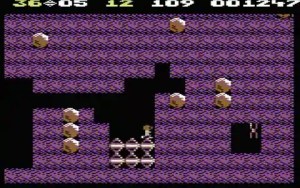
Of course, there were also points of criticism. Even by the standards of the time, the graphics were more functional than spectacular. The scrolling could make it difficult to keep track of the action, and the high difficulty level led to frustration, especially when it took many attempts to figure out a cave. Those expecting only fast-paced action might have found the careful planning required to move a boulder to be slow. On the other hand, those expecting a calm logic game were put under pressure by the time limit and the moving enemies.
Yet it was precisely this tension that was part of its strength. Boulder Dash couldn’t be neatly pigeonholed into a single category. The press had to combine terms like “arcade,” “strategy,” “maze,” and “puzzle” to describe the experience. The high ratings show that this unusual blend was seen not as indecisiveness, but as innovation.
The game also garnered attention at award ceremonies. At the 1984 Golden Joystick Awards, Boulder Dash was nominated in the “Best Arcade-Style Game” category. There, it competed against titles such as Daley Thompson’s Decathlon, Wanted: Monty Mole, and Star Strike.
Retrospective reviews confirmed the impression from that time. Later C64 magazines, online databases, and retrospectives regularly placed Boulder Dash on best-of lists or once again awarded it very high scores. This is not solely due to nostalgic leniency: even decades later, critics highlight that the rules are clear, the feedback is immediate, and the caves are carefully designed. The presentation has visibly aged, but the game design has hardly changed at all.
The Legacy of the Caves
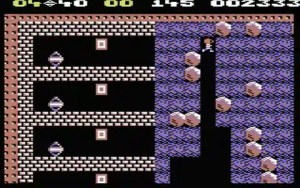
The cultural influence of Boulder Dash is first evident in the large number of similar games. The concept of diggable tiles, falling objects, collectible gems, and rule-based enemies was adopted so frequently that the term “Rocks-and-Diamonds” genre became established. Titles such as Emerald Mine, Supaplex, and Rocks’n’Diamonds further developed the basic concept on other computers; Repton is also frequently mentioned in the same gameplay context. Boulder Dash thus delivered not only a successful standalone game but also a recognizable design pattern.
Its influence, however, runs deeper than mere visible imitations. The game demonstrated early on how surprising situations can arise from just a few systemic rules. Today, this is often referred to as emergent gameplay: developers do not define every dramatic scene individually, but rather build systems whose interactions produce unexpected events.
In Boulder Dash, a small movement can trigger an avalanche, destroy an enemy, generate new diamonds, and simultaneously block the way back. The player experiences a unique chain of cause and effect, even though all components follow strict rules. This gives rise to small stories that aren’t told in cutscenes but are caused by the player’s own actions.
The combination of thinking and skill also became a model. Many later puzzle-action games use the same narrative arc: First, a solution must be identified; then, it must be executed under time pressure or with precise controls. Boulder Dash demonstrates that finding a solution does not automatically mean executing it. A good plan can still fail due to a change of direction that’s too slow or a rock movement triggered imprecisely. This distinguishes the game from classic sliding-block or board game puzzles and gives it its unique sense of tension.
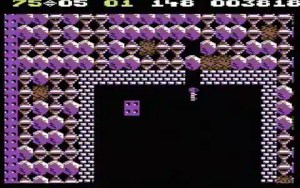
The construction kit concept amplified its cultural impact. Custom caves could be shared within circles of friends and later via floppy disk collections, mailboxes, and the Internet. This gave rise to a form of collaborative level culture long before today’s platforms for user-generated content. Official accounts of the series’ history emphasize that the editor and the sharing of user-created caves bolstered the popularity of Boulder Dash for many years.
Added to this was its enormous reach across various systems. Boulder Dash made the leap from home computers to consoles and even to arcades. This shift was remarkable because, in the early 1980s, the opposite path was usually taken: successful arcade games were ported to home computers. With Boulder Dash, however, an idea originally developed for home computers became an arcade game.
Sequels, compilations, re-releases, and modern interpretations followed. The rights to the brand were acquired by BBG Entertainment in 2017. More recent editions combine classic caves with new worlds, editors, and levels designed by longtime fans. Even after several decades, the original mechanics continue to form the core of the series.
Boulder Dash holds a special place in C64 culture. It epitomizes an era in which a game could become a classic not through cinematic presentation, but through a strong mechanical concept. Its visuals and sounds are part of the collective memory of many home computer owners. At the same time, the game works even without this nostalgic backdrop. Anyone entering a cave for the first time today will understand the objective within seconds—and yet can still spend hours truly grasping the implications of the rules.
Why Boulder Dash Endures

Boulder Dash is a prime example of timeless game design. Its interface is simple, its rules are straightforward, yet their combination creates remarkable depth. Every step changes the cave. Every rock is both a danger and a tool. Every enemy follows a predictable pattern, but can create complicated situations when interacting with the environment. The game treats the space not as a mere backdrop, but as a dynamic machine.
On the Commodore 64, this idea took on a particularly striking form. The vivid colors, the four-directional scrolling, the sparse SID sounds, and Rockford’s small animations come together to create a presentation that serves the gameplay entirely. Technical limitations were not hidden but transformed into a clear and focused aesthetic. The caves feel alive not in spite of their grid structure, but precisely because of it.
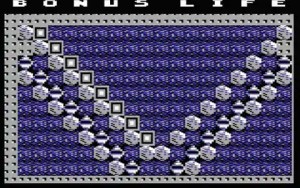
Its success with critics at the time is therefore easy to explain: Boulder Dash offered something unique and combined immediate accessibility with a long-term challenge. Its cultural legacy—sequels, ports, imitators, editors, fan-made levels, and modern remakes—shows just how enduring the core concept was. Few games can claim to have defined their own genre while simultaneously spawning a creative community.
Above all, however, Boulder Dash still evokes that special blend of curiosity and tension. You spot a diamond hidden behind several rocks, identify a possible path, and start digging. Then a boulder slides to the side, an enemy is unleashed, and within seconds, a simple plan turns into a mini-drama.
It is precisely in these moments that the game’s greatness lies. Boulder Dash doesn’t tell an elaborate story and doesn’t need spectacular cutscenes. It builds a world of rules in which players create their own stories through their own decisions. That is why Rockford’s journey through the caves of the C64 has lost none of its fascination, even after more than four decades.








Kommentar verfassen