

More Than Just a Licensed Product
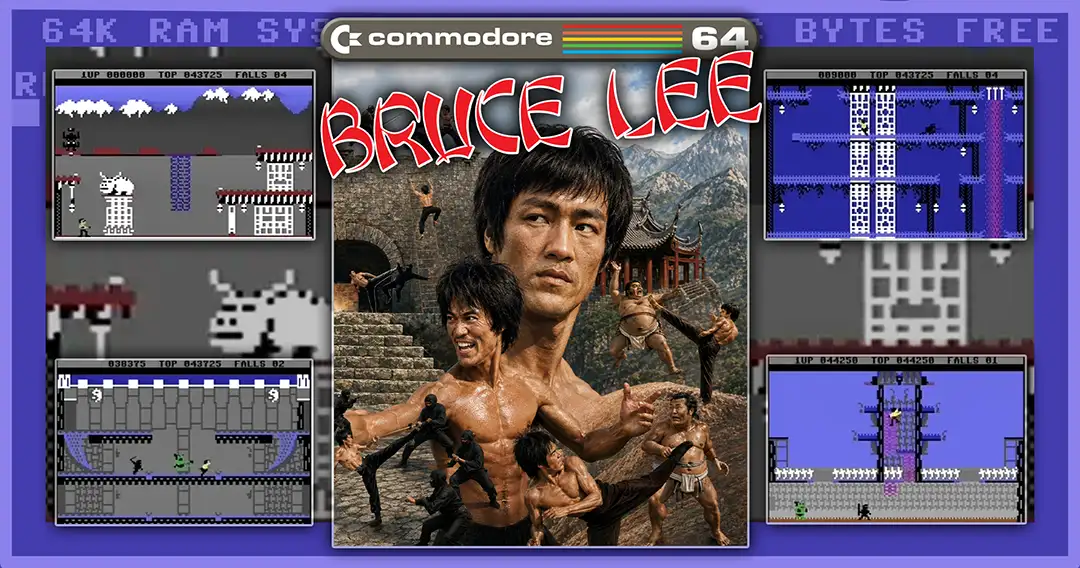
When people talk about the great early C64 classics today, names like Impossible Mission, Summer Games, The Last Ninja, or Boulder Dash often come up. But even before those, there was a game that demonstrated—almost brazenly—just how much character, pace, and gameplay a home computer title could deliver using relatively simple means: Bruce Lee. Released in 1984 by Datasoft, this game wasn’t just another licensed title with a big name on the box for the Commodore 64. It was an astonishingly well-crafted action game that so skillfully combined platforming elements, combat mechanics, and a sense of rhythm that it resulted in a masterpiece that still holds a firm place in the collective memory of many C64 fans to this day.
What’s remarkable about Bruce Lee begins with its very first impression. The name promised martial arts, cinematic coolness, and the aura of an icon whose influence extended far beyond cinema and pop culture. On screen, however, you didn’t get a simple beat ’em up, a tournament duel, or a clumsy retelling of the movie. Instead, the game led into a mysterious fortress where Bruce Lee had to work his way through 20 chambers, delving ever deeper into a world of lanterns, traps, climbing sections, enemies, and deadly timing. This mix felt original back then and still feels surprisingly fresh today.
Especially on the C64, Bruce Lee was so effective because it possessed a key quality shared by many enduring classics: It was easy to grasp right away, but not easy to master. You could start running, jumping, and kicking within seconds, but even after the first few rooms, it became clear that this game demanded far more than mere reaction. You had to read the rooms, anticipate enemies, plan your path, and tackle risky moments with perfect timing. It was a game that seemed easily accessible yet revealed its full sophistication only as you played.
There was another factor at play: Bruce Lee captured the imagination of his era. By the early 1980s, Bruce Lee had long been a legend, and his name stood for speed, precision, and controlled energy. The game conveyed this very feeling surprisingly well. The character seemed fast, agile, and determined. The animations were minimal but effective. And although the graphics were, of course, highly abstracted, you never felt like you were controlling some generic pixel hero. You weren’t just playing a character—you were, within the limits of the technology, actually playing an embodiment of Bruce Lee.
The fact that it became far more than just a licensed product also explains the game’s reputation today. Many film-based or high-profile brand adaptations from the early days of home computers are interesting primarily as curiosities. Bruce Lee, on the other hand, has remained relevant because the famous name didn’t replace the game mechanics here, but rather formed a genuine unity with them. That’s precisely why the C64 title is still considered one of those early strokes of genius in which concept, controls, pace, and atmosphere come together almost perfectly.
Jumping, Fighting, Timing
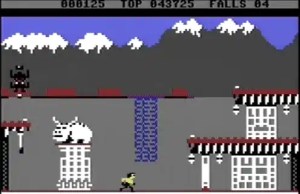
At its core, Bruce Lee is a multi-screen action game with a platformer structure. The objective sounds simple at first: in each chamber, you must collect lanterns so that the exit opens and the path to the next area is cleared. The real brilliance, however, lies in how the game transforms this simple task into a surprisingly rich narrative.
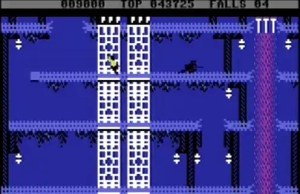
Each room is a small puzzle of movement. Platforms, ladders or climbing routes, swinging elements, narrow ledges, and danger zones ensure that you can’t simply run blindly from left to right. You have to read the paths, time your jumps correctly, and constantly weigh when an attack makes sense and when retreat would be wiser. That’s precisely what makes Bruce Lee so strong: It’s not a game of mindlessly charging forward, but one of small decisions made in a fraction of a second.
Add to that the two iconic adversaries. The black ninja is fast, aggressive, and a nuisance, but still manageable. Far more dangerous is Yamo, the green colossus who chases Bruce through the rooms and builds enormous pressure with his kicks and strikes. Both opponents function less as complex AI marvels and more as mobile disruptors that keep every room in constant motion. Even once you’ve grasped the layout of a screen, their positions are constantly shifting the situation.
This is precisely where the gameplay’s brilliance shines through. Bruce Lee doesn’t force the player into a single solution. You can seek out confrontations, take out opponents one by one, outmaneuver them, or pit them against each other. Those who are bold can leap just over the heads and dangers. Those who play more cautiously can lure the enemies to one side of the screen and buy themselves a moment’s respite. This freedom gives the game a dynamism that goes far beyond its apparent simplicity.
The controls also play a crucial role. Bruce runs fast, jumps straight up, can strike while standing still, kick while running, duck, and swing along vines or climbing elements. All of this sounds like a given today, but in 1984, this level of cohesion was anything but commonplace. Above all, the combination of running, jumping, and kicking conveys an immediate, almost athletic feeling. That’s precisely why many players still remember those moments to this day—when a perfectly timed jump kick takes out an opponent or a risky leap to the last lamp is just barely successful.
Added to this is a brilliant social twist: The game offered multiplayer modes in which a second player could not only take turns playing but, in certain modes, even control Yamo. This gave Bruce Lee a special “living room” quality. Suddenly, it was no longer just the classic spectator experience of single-player mode, but a half-cooperative, half-sabotaging game of cat and mouse. Whoever played as Yamo could deliberately make life difficult for a friend—and that’s exactly what sparked schadenfreude, rivalry, and that typical home computer magic that turned a good game into a shared experience.
Ultimately, this results in a gameplay structure that feels remarkably modern. Bruce Lee combines spatial control, pressure from opponents, and a sense of movement so skillfully that almost every screen tells a little story. You improvise, fail, learn, survive a tricky moment with your last ounce of strength, and are then immediately ready for the next room. The game understands the value of pace—but it also understands the value of pausing. It is precisely this alternation that creates its addictive appeal.
Cleverly designed, unconventional
Technically, Bruce Lee is a wonderful example of how much impact can be achieved with clear priorities. The game doesn’t try to impress in every area. It doesn’t aim to be either the most graphically opulent or the most sonically lavish title of its time. Instead, it focuses on precisely those elements that are crucial to its impact: clear-cut levels, distinctive characters, quick reactions, and compelling animation.
The game was programmed by Ron J. Fortier, with graphics by Kelly Day and music by John A. Fitzpatrick. This division of labor is interesting because it shows how professionally Datasoft operated even at a time when many studios were still heavily reliant on the “jack-of-all-trades” approach. The game didn’t feel like an improvised licensed product, but rather like a deliberately crafted interplay of code, graphics, and presentation.
The animation, in particular, was crucial to the game’s impact. As a character, Bruce Lee must look convincingly fast; otherwise, the entire concept falls apart. And that’s exactly what they achieved. His movements have momentum, his kicks are crisp, and his posture conveys tension. Not everything is anatomically perfect, and not every pose is artistically refined—but everything is functional and immediately understandable. Combined with his high running speed, this creates a character that players intuitively enjoy controlling.
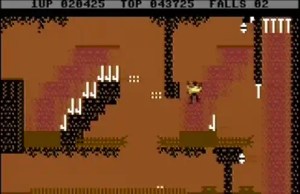
The level design also deserves praise. The fortress doesn’t look realistic, but it has character. The Far Eastern-inspired architecture, the platform layout, the traps, and the color scheme create a setting that is both abstract and memorable. You don’t really believe it’s a real pagoda, but you fully accept this game logic. That, in particular, is a strength of many early C64 classics: they don’t create a world in the modern sense, but rather a stage with its own rules. Bruce Lee turns this into a virtue.
The sound is one of its charming quirks. The title screen features a distinctive, instantly recognizable piece of music that still triggers nostalgic feelings in many fans today. In the actual game, however, it remains comparatively quiet. Instead of continuous music, there are mainly sound effects: hits, movements, and small signals. From today’s perspective, this seems spartan, but it also fits the directness of the gameplay. Nothing is meant to distract from the timing, and nothing is meant to mask the clear rhythm of the actions.
A nice touch is the multiplayer concept centered around Yamo. Technically, this may seem simple, but in terms of gameplay, it’s a home run. The second player isn’t merely relegated to the role of a spectator but actively intervenes in the flow of the game. This gives Bruce Lee a sense of asymmetry that feels remarkably fresh for a home computer game from the early 1980s.
There’s also quite a bit to say about the trivial details. The C64 version was developed during an early porting phase, when technical differences between the systems had to be creatively resolved. Fortier later mentioned that, for the C64 port, he had essentially worked with a sort of emulator approach to transfer the basic logic of the original system to the Commodore. That sounds almost modern today and shows just how pragmatically and inventively people worked back then.
It’s also interesting that the game didn’t turn out to be brutally difficult, even though it easily could have been. Fortier later hinted that the difficulty level was scaled back somewhat during development. In hindsight, that was probably a stroke of luck. After all, it’s precisely this balance between challenge and playability that makes Bruce Lee so enduringly appealing. The game is challenging, but it doesn’t deter players. It punishes, but it doesn’t humiliate. That’s a much rarer quality than one might sometimes think when it comes to retro games.
Praise and Minor Flaws

Contemporary reviews were, on the whole, very positive. The raw scores alone show that Bruce Lee was by no means perceived merely as a licensed gimmick in the 1980s. British magazines such as Personal Computer Games, TV Gamer, Commodore User, and Home Computing Weekly awarded high scores, and the early reception clearly indicates that this was seen as a particularly playable action game. Later, the title was reviewed again in budget re-releases and maintained its good reputation remarkably well.
What the critics particularly appreciated back then is still easy to understand from today’s perspective. The animations, the responsive controls, and the fast-paced gameplay were repeatedly praised. Bruce Lee conveyed movement not only visually but also through gameplay. Many action games of that era felt either sluggish or unfairly frantic. Bruce Lee struck a balance where the pace was fast, yet the character remained precisely controllable. That’s exactly what set the game apart from the crowd.
The mix of elements was equally well-received. The game wasn’t merely a karate title, nor was it merely a platformer. It combined combat, movement, and exploration into a rhythm that never grew tiresome, even after several screens. Contemporary reviews described the game as gripping, action-packed, and surprisingly versatile. The fact that even the enemy mechanics contributed so much to the entertainment value was a key part of this success.
However, Bruce Lee wasn’t entirely without criticism. A common point of criticism—then as now—concerns the audiovisual restraint. While the graphics were mostly praised, they weren’t universally regarded as top-notch. Some found them more functional than spectacular. This was even more evident in the sound: The title music stuck in your head, but during gameplay, the audio was noticeably more sparse than in some competing titles. Anyone expecting a martial arts game to be a constant fireworks display of sound and effects was met with functional economy rather than bombastic spectacle.
A second point of criticism concerned the game’s length or difficulty level. From today’s perspective, that’s almost a compliment, since many old games suffered from merciless difficulty. Bruce Lee, on the other hand, could definitely be mastered with a little practice. Some reviewers and later retrospectives therefore noted that experienced players eventually figure out the 20 rooms quite quickly. However, this only slightly diminishes the game’s appeal, because the journey to get there is so entertaining.
It’s interesting how well this criticism fits into the bigger picture. No one accused the game of conceptual emptiness or technical shortcomings. The reservations were more about the fine-tuning, the difficulty curve, and the density of presentation. In other words: even where Bruce Lee didn’t seem quite perfect, the overall tone remained clearly appreciative. For a licensed game, that was by no means a given.
Looking back, it’s clear that the reviews at the time were astonishingly accurate. The qualities that were praised—playability, animation, and flow—are precisely the aspects for which the game is still appreciated today. And the minor objections—a somewhat limited soundscape, a playtime that’s a bit short for skilled players—resurface almost identically in modern retrospectives. This suggests that Bruce Lee was already recognized back then quite clearly for what it was: a superbly executed action game with few, but noticeable, limitations.
A Classic with Lasting Impact

The cultural influence of Bruce Lee on the C64 cannot be measured solely in sales figures or ratings. More important is its enduring presence in the collective memory of the home computer era. The game enjoys the rare status of a title known even to people who don’t otherwise have every corner of the C64 catalog memorized. It belongs to that category of classics whose name immediately conjures up images, snippets of music, and gameplay scenarios in the mind.
This is primarily due to its clear identity. Bruce Lee is not an abstract concept, but a game with a distinctive character, memorable opponents, and a strong core concept. Yamo and the Ninja have become not just obstacles, but almost mascots of the game. Anyone who has ever encountered the green giant won’t forget him anytime soon. Such characters often leave a stronger impression on our memories than any technical achievement.
At the same time, Bruce Lee exemplifies a specific moment in home computer history: the phase when games still consisted of just a few elements, but these elements interlocked so strongly that they produced timeless quality. Many later titles became bigger, more beautiful, and more complex. But few possess this immediate clarity. That’s why Bruce Lee has kept cropping up in best-of lists, retro retrospectives, and fan discussions for decades.
The game’s enduring legacy in the C64 scene is also evident in its lasting impact. There have been fan projects, unofficial sequels, and modern tributes that sought to preserve the original’s core spirit. The homebrew and retro communities, in particular, never treated Bruce Lee as a museum relic, but rather as a living point of reference. Anyone looking to build a classic multi-screen action game with smooth gameplay quickly finds themselves returning to this model in their thoughts.
Of course, the prominent name also played a role. As a cultural figure, Bruce Lee was far greater than the game itself, and that gave the title additional appeal. It’s worth noting, however, that the game’s history doesn’t rely solely on the person’s fame. Many C64 players love Bruce Lee without necessarily being big fans of the movie star. The game has, to some extent, broken free from its license. Today, it’s not just “the Bruce Lee game,” but “the C64 classic Bruce Lee.”
Furthermore, the game had a more subtle impact: it demonstrated how elegantly genres could be blended. Platforming, fighting, and multi-screen architecture weren’t simply juxtaposed here, but organically intertwined. Later games took different approaches, but the idea that action doesn’t have to be one-dimensional finds an early, particularly clear expression in Bruce Lee.
Its cultural legacy therefore exists on two levels. On the one hand, there’s nostalgia: memories of living-room duels, of joysticks, of the moment when a friend took over as Yamo and suddenly all sense of fairness went out the window. On the other hand, there’s genuine respect for a design that is still understood and admired even decades later. This dual foundation is what makes the title so enduring.
A Classic Endures

Bruce Lee on the C64 is not a perfect game. It is not the most technically spectacular work of its time, nor the biggest, the hardest, nor the most visually and aurally opulent. But that is precisely where its strength lies. It wastes no energy on trivialities but focuses on what matters most: movement, rhythm, situational awareness, intensity, and the joy of playing.
What remains is a game that not only bears its famous name but also justifies it through gameplay. It conveys speed, precision, and control—precisely the qualities associated with Bruce Lee. At the same time, it builds an astonishingly rich gaming experience out of simple environments, two types of opponents, and a clear objective. That’s the kind of elegance that characterizes many retro classics, but that only a few demonstrate so clearly.
For the C64, Bruce Lee is therefore more than just a good title in the early game catalog. It’s a lesson in just how powerful good game design can be when everything superfluous is stripped away. Those who play it today may no longer find it a technical marvel. But you’ll quickly discover why generations of players have given this game a special place in their hearts.
In the end, Bruce Lee is exactly what a true classic should be: easy to remember, hard to forget, and still instantly playable even after many years. Not every legend ages well. This one certainly does.








Kommentar verfassen