

Early Thrills in the Living Room
When Haunted House was released in early 1982 for Atari’s Video Computer System—later commonly known as the Atari 2600—the vocabulary of the horror game had not yet been invented. The term “survival horror” would not become an established genre designation until many years later. Nevertheless, James Andreasen’s game seems today like a surprisingly complete blueprint of what this genre would eventually come to embody: a self-contained, hostile environment, limited perception, dangerous creatures, limited options for action, and the constant balancing act between protection, orientation, and progress. Atari itself classifies Haunted House as a single-player adventure from 1982. The objective is to find three pieces of a magical urn in a four-story mansion and return them to the entrance.
The premise is remarkably simple, yet effective. In the fictional small town of Spirit Bay stands the dilapidated estate of the late Zachary Graves. A family urn, which shattered during an earthquake in 1890, is said to still be hidden within the building. The ghost of the unpopular master of the house roams the rooms, while neighbors report flickering lights, slamming doors, heavy footsteps, and mysterious shadows. The manual plays an important role here: it provides the imagery that the crude on-screen graphics alone cannot convey. When you start the game, you don’t see a detailed haunted castle, but you already have that image in your mind.
This is precisely where the game’s historical significance lies. Haunted House is not the first video game with horror elements, and it possesses neither the cinematic presentation of Alone in the Dark nor the complex resource and combat systems of Resident Evil. The retrospective designation as an early survival horror title is therefore more of an interpretive classification than a contemporary genre affiliation. It is nonetheless plausible because the game does not merely use monsters as decoration. Its entire set of rules creates a sense of vulnerability. The player is not meant to destroy as many enemies as possible, but rather to survive, search, evade, and escape in a confusing environment. The horror arises from uncertainty rather than spectacle.
Hunt Through Graves Mansion
The mansion consists of 24 rooms, spread across four floors, each with six rooms. Corridors, doors, and staircases connect the individual areas. In higher difficulty levels, some doors are locked, so the player must first find a master key or take a detour via other staircases. The three parts of the urn are distributed among varying locations at the start of a game. As soon as all parts have been collected, they automatically reassemble into a complete vessel. However, the game is not won until the player reaches the main entrance with it.
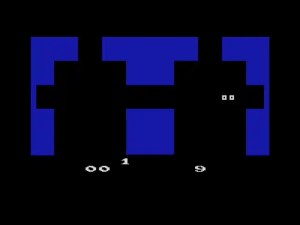
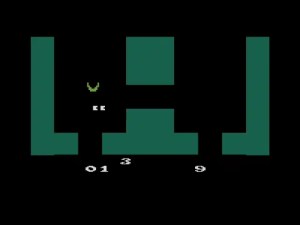
The player character is visible on the screen only as a pair of wandering eyes. This reduction is both a technical workaround and an ingenious design decision. The body vanishes into the darkness; only the gaze remains. The joystick is used to move the eyes through rooms and hallways, and the fire button is used to light a match. For a brief moment, a circular section of the surroundings becomes visible. Walls, doors, and objects emerge from the blackness before the wind or an approaching creature extinguishes the light again. Although matches are unlimited, every lit match is counted. A successful run therefore requires not only survival but also careful use of light.
The central system is the single-item inventory. The player can carry only one object at a time. In addition to the urn fragments, there is a key and a magical scepter. The key opens locked doors; in most versions, the scepter protects against the creatures. However, whoever is carrying the scepter cannot carry either the key or the urn. This constantly gives rise to small strategic decisions. Should you choose the safe route and explore while protected? Should you memorize the location of an urn fragment and return later? Or should you risk carrying it unprotected to reach the exit faster? The game forces the player to use spatial memory as an additional resource.
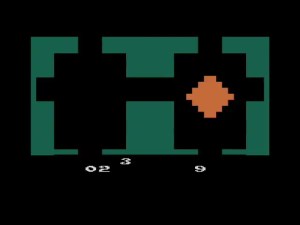
Enemies include slow tarantulas, fast vampire bats, and the particularly aggressive ghost of Zachary Graves. If a creature touches the player’s eyes, the player loses one of nine lives. The ghost is the most dangerous because it can pass through walls and locked doors. In later variations, the rules become more challenging: enemies move faster, chase the player across multiple rooms, the bat can move carried items to a different location, and eventually, even the scepter no longer provides reliable protection. The ninth version also changes the floor plan and allows all five creatures to chase the player even through locked doors.
It is remarkable how deeply sound is integrated into the gameplay. Footsteps, slamming doors, wind, collisions with walls, and a short sequence of sounds when climbing stairs are not merely atmospheric elements but also serve as orientation cues. When ascending, the sound sequence moves from low to high notes; when descending, it moves in the opposite direction. Players who opt to play without the occasional flashes of lightning must feel their way along walls in the dark and deduce what is happening based on sounds. Haunted House thus transforms the limitations of its visuals into a core gameplay mechanic: what cannot be seen must be heard, remembered, or inferred.
Technology, Tricks, and Trivia
The Atari 2600 presented developers with extreme limitations. The console ran on a MOS-6507 processor clocked at approximately 1.19 megahertz, had only 128 bytes of RAM, and lacked traditional video memory. The image was generated line by line via the Television Interface Adaptor, or TIA for short. Programmers therefore could not simply store a complete screen frame in memory. They had to closely align graphics, movement, and timing with the structure of each television frame. Under these conditions, building a house with multiple floors, moving enemies, randomly placed objects, inventory logic, and audio cues was a remarkable achievement.
Haunted House was programmed by James Andreasen. During development, working titles such as Mystery Mansion and Graves Manor were under consideration. The rooms themselves are fixed in design, while important items are redistributed from game to game. To position the urn pieces, the program used memory-efficient number sequences, allowing the game to create the impression of varying search patterns with minimal effort. Furthermore, Haunted House was among the early console games that did not treat larger areas merely as individual static screens, but instead combined movement and the field of view in such a way as to create the impression of a scrolling space.
Perhaps the most elegant technical idea is the circle of light. Instead of rendering a detailed mansion, the game shows almost nothing. This emptiness not only saves processing and memory resources but also heightens the suspense. The black screen becomes invisible architecture. The game doesn’t need to render every room in full because the player perceives it only in brief glimpses. The two eyes function similarly: a minimalist figure becomes a powerful point of identification. The result is an early example of how technical limitations can be transformed into an aesthetic rule rather than being hidden.
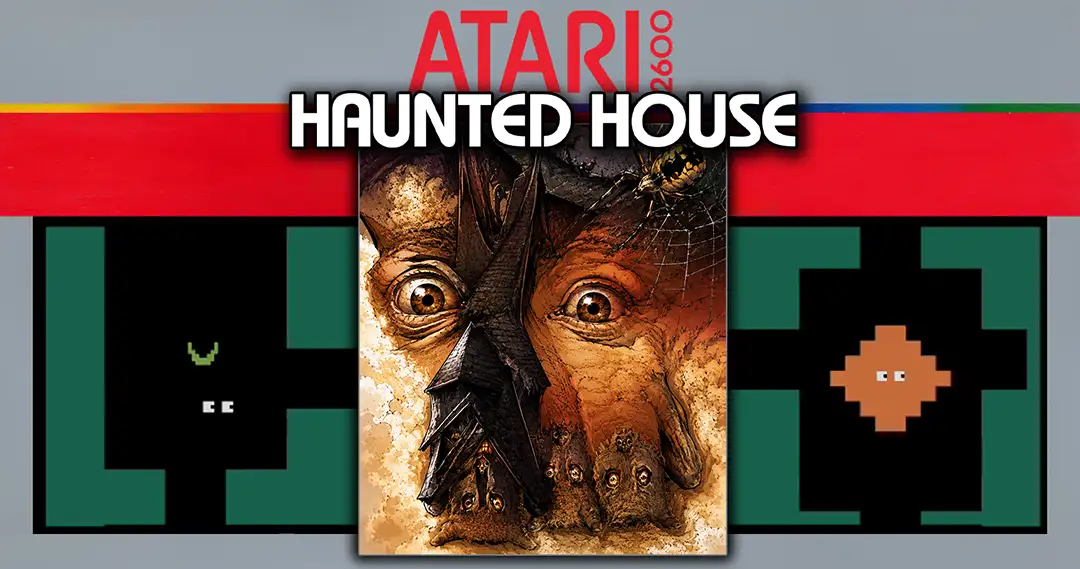
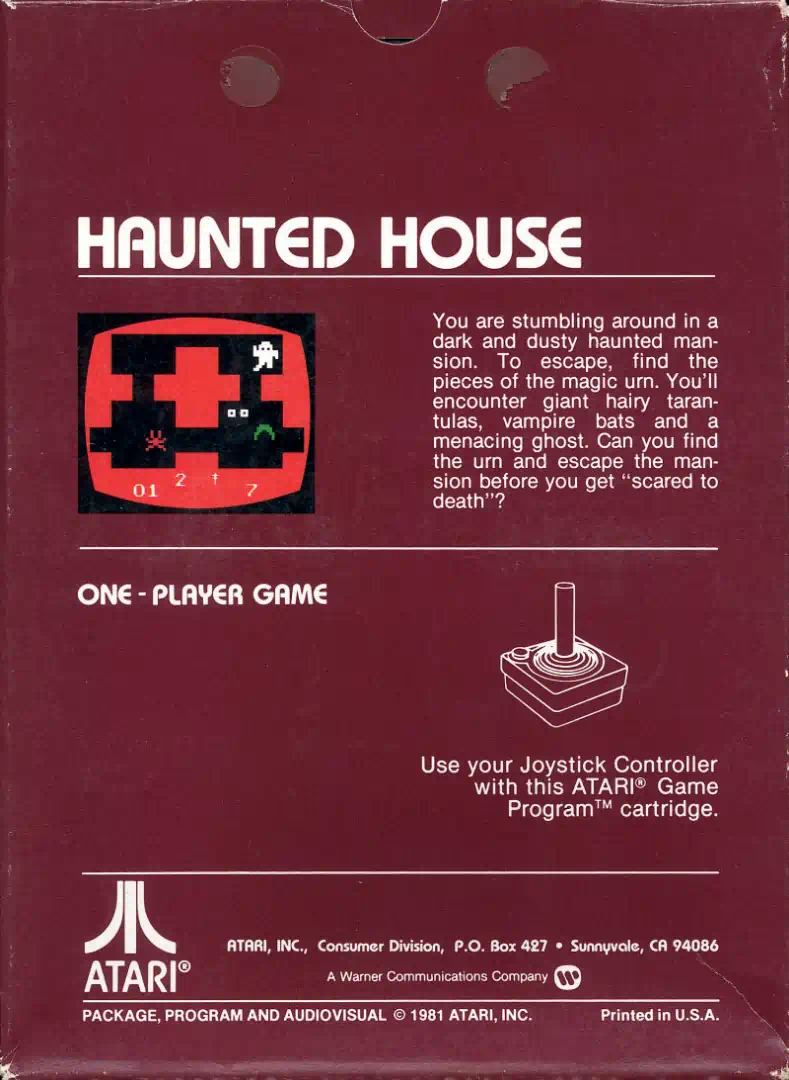
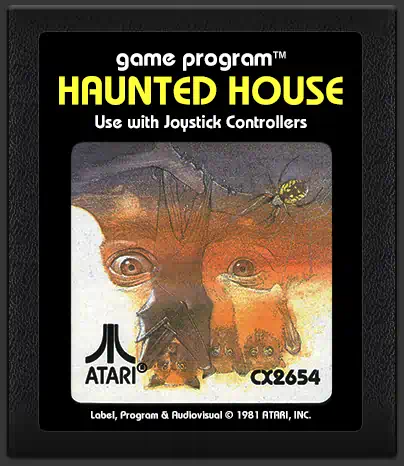
The packaging also played an important role. Atari games of that era often featured elaborate illustrations that turned a few screen blocks into imaginary worlds. The cover and manual for Haunted House were created by Steve Hendricks. Although Atari artists were given guidelines, some of them also sought dialogue with the developers to understand a game’s atmosphere and plot. An early design for Haunted House is said to have been rejected because the placement of glowing eyes on the depicted figure was considered problematic for marketing purposes. The printed artwork thus added elements of gothic horror, decay, and dramatic movement to the cartridge—elements that the television could only hint at.
A minor detail regarding the release date continues to lead to differing year specifications to this day. The manual, program, and audiovisual content bear a copyright notice from 1981; February 1982 is usually cited as the release date. The cartridge was released under product number CX2654. This discrepancy is typical for games whose development, production, copyright registration, and actual release spanned the turn of the year.
Reactions from 1982
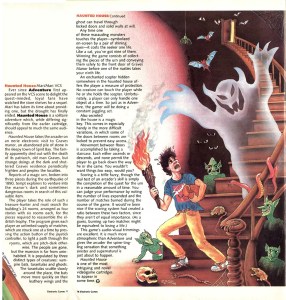
The contemporary reaction was largely positive, but by no means unanimous. Electronic Games compared Haunted House to Atari’s Adventure, but emphasized its significantly stronger atmosphere. The magazine praised the audiovisual design and described the cartridge as unusual and fascinating, but criticized the fact that the scoring system—based on used matches and remaining lives—was not immediately easy to understand. In a later software review, the game received seven out of ten points; particular emphasis was placed on the constant feeling that something eerie was about to happen.
Richard A. Edwards was even more enthusiastic in his review in The Space Gamer. For him, the graphics and sound were among the best Atari had shown on the system up to that point; he could hardly point to any immediate weaknesses. From today’s perspective, this assessment seems to require some explanation, as the visuals consist of simple shapes, symbols, and darkness. In the early 1980s, however, technical quality was not measured solely by the level of detail. What also mattered was whether a game, working with limited resources, could create a recognizable world, fluid movement, varied situations, and distinctive sounds. This was precisely where Haunted House excelled.
Other reviewers were more reserved. The Capital Times described the graphics as blocky and unimpressive, but acknowledged the game’s playability. The magazine Video Games gave it a moderate “interest” rating but a high “difficulty” rating, noting that players almost needed to take notes to keep track of their bearings and items. How to Win at Home Video Games also found the game difficult to grasp at first but recommended it to players willing to patiently learn its rules. What some praised as atmospheric disorientation, others thus perceived as a lack of clarity.
These contrasting reactions strike at the heart of the design. Haunted House does not reward immediate sensory overload. It requires players to learn the floor plan, interpret sounds, set items aside, memorize paths, and accept failure. For an audience that primarily expected fast-paced shooters or clearly legible arcade gameplay, this could seem cumbersome. For players who enjoyed adventure games, however, it offered an unusually dense, replayable search-and-find challenge.
The fact that the cartridge was ranked among the best-selling video games in July 1982 shows, at the very least, that its unusual approach found a significant audience. Success here did not mean that all players appreciated the darkness and the challenging orientation system. It does, however, show that in the early console market, even a slower-paced, atmospheric search-and-find game could hold its own alongside shooters, sports games, and arcade ports.
Traces in the Horror Genre
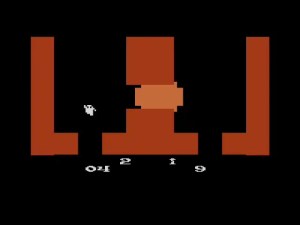
The cultural influence of Haunted House lies less in a verifiable direct lineage than in its early combination of motifs that would later become familiar. The mansion as a closed labyrinth, a player who can be pursued, limited inventory slots, keys and locked doors, randomly distributed objects, defensive tools, and escape as the ultimate goal: all these elements reappear in later horror games in a refined form. It is particularly important that the player is not superior to the enemies. The scepter offers temporary protection, but no lasting control. Progress requires giving up safety.
At the same time, one shouldn’t retroactively declare the game to be a full-fledged, pocket-sized Resident Evil. Genre terms arise from conventions, marketing, and audience perception. When Haunted House was released, “survival horror” did not yet exist as an established category. Some historians therefore tend to date the actual beginning to Alone in the Dark (1992) or Resident Evil (1996), because those games combined cinematic presentation, exploration, puzzles, resource scarcity, and horror aesthetics into a recognizable model. Haunted House is most convincing as a precursor: not a fully formed genre, but a game that brought together several of its later core ideas unusually early on.
Its enduring legacy is also evident in re-releases and reinterpretations. The original was included in various Atari collections and is part of modern retro bundles such as Atari 50. New games have been released under the same name, including a 3D remake from 2010, Haunted House: Cryptic Graves from 2014, and another reinterpretation from 2023. These titles differ greatly from the 2600 original but revisit the mansion, the urn, and the combination of exploration and haunting. The fact that Atari continues to use the name decades later attests to the early cartridge’s recognition value.
In retrospectives, Haunted House has repeatedly been reevaluated. The online magazine GameSpy inducted it into its Hall of Fame in 2002; Game Informer noted as early as 2005 that it contained numerous building blocks for later series such as Silent Hill and Resident Evil. Such assessments say as much about the evolution of game criticism as they do about the work itself. It was only after survival horror had established itself as a genre that these earlier experiments were reevaluated. As a result, Haunted House earned a place in a prehistory that, at the time of its release, no one would have named as such.
Its enduring fascination can also be explained by the universal motif of the haunted house. A house is supposed to promise safety, order, and familiarity. As soon as its rooms become confusing and invisible dangers lurk behind doors, this safe haven turns into a trap. Haunted House translates this age-old idea into gameplay rules in a particularly direct way. The player can move but can barely see; they can wear protective gear, but must give it up to obtain the crucial item. The architecture itself thus becomes the enemy.
Darkness as a Major Strength
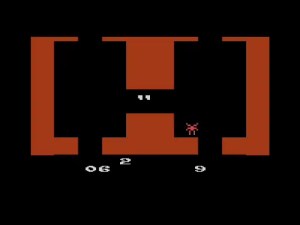
Haunted House is not a frightening game by modern audiovisual standards. Its bats, spiders, and ghosts consist of just a few rough symbols; the player has nine lives, and a successful round can be relatively short. Yet anyone who engages with its rules will recognize an astonishingly clear design concept. The game does not treat darkness as a backdrop, but as the central adversary. It forces the player to construct mental maps of rooms, take sounds seriously, and weigh protection against progress.
It is precisely the limitations of the Atari 2600 that give the game its character. The missing details leave room for the imagination; the pair of eyes makes the player both visible and incorporeal; and the limited inventory space forces decisions that go far beyond simple mechanics. Haunted House shows that horror doesn’t depend on realistic monsters. It can arise from a burnt-out match, a sound behind a black wall, and the uncertainty of whether the next path leads to the exit or straight into the ghost’s clutches.
As a historical work, Haunted House stands at the intersection of adventure games, mazes, and early horror design. It did not single-handedly invent survival horror, but as early as 1982, it articulated central questions of the genre: How much should the player be allowed to see? How vulnerable must they be? What information should they retain, and what sense of security should they give up?
More than four decades later, the game’s greatest achievement therefore lies not in its technology alone, but in how consistently it turned limited hardware into atmosphere, darkness into gameplay mechanics, and a pair of pixel eyes into an entire horror experience.
More
Box and Cartridge








Schreibe einen Kommentar