
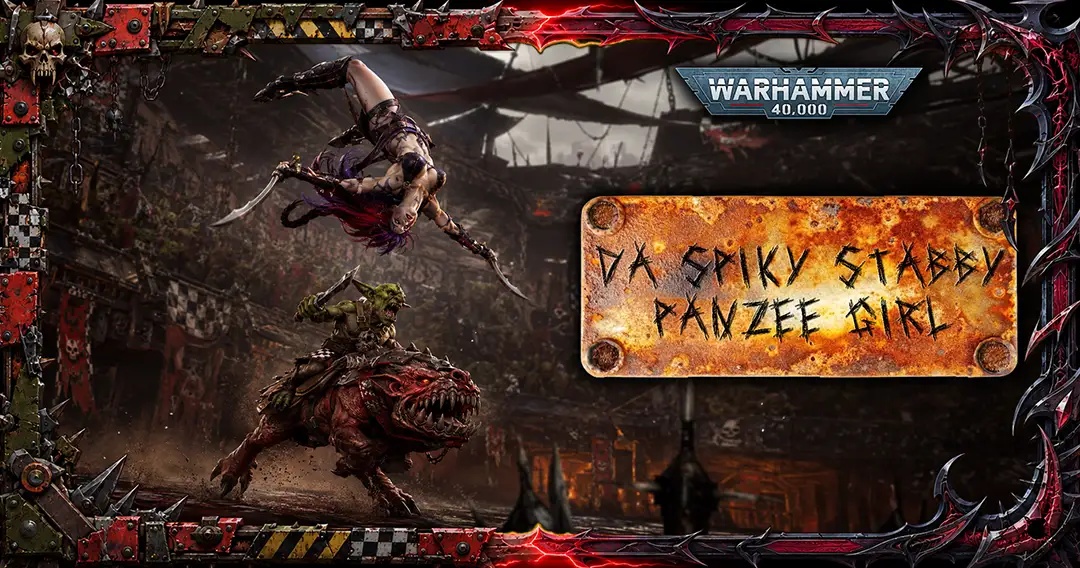

We grabbed us a stabby, nasty Panzee girl.
Thought she’d break quick. She didn’t.
’Stead, she fought in our arena, hacked everyfing apart, and kept slicin’ ’erself outta every pile o’ trouble we threw at ’er. Gretchin, squigs, humies, an’ stuff even proper Boyz would rather watch from a safe distance.
Da little git’s fast. Mean. Fights dirty an’ makes a right good racket. And somehow, she just keeps goin’
Dis ’ere’s a tale of blood, steel, and roarin’.
And of a Panzee what just don’t know when she’s supposed to be dead.

I
Xelyth dug her bare feet into the dark sand. In each hand she held a long Wych dagger, slim and deadly as venom-fangs.
Forty metres ahead of her, atop a snarling squig, crouched a Gretchin. The little creature bared its yellow tusks and waved two rusty blades, as if it fancied itself a Nob. Beneath it, the squig tensed — a knot of muscle with legs and far too many teeth. Threads of saliva dripped from its half-open mouth.
The Gretchin screeched something in its rasping tongue and kicked the squig in the flank.
The beast shot forward.
Xelyth merely smiled.
Then she ran to meet it.
At the last instant, she sprang. Her wiry body snapped upward, higher than the lumbering green-skinned brute-breed had ever expected. She turned in a graceful somersault above rider and mount alike. At the peak of the motion, she let one blade kiss across the Gretchin’s ear as she passed.
Not deep enough to kill.
Deep enough to torment.
The pain was exquisite.
It flowed through her like an icy current, filling the hollow places in her soul and driving back, for one precious heartbeat, the distant hunger of the Great Enemy.
She landed lightly in the sand, half-turned, and threw her second dagger without looking. The blade punched deep into the squig’s back. The beast yowled, stumbled, and tumbled end over end. The Gretchin was hurled from the saddle and smashed against a metal wall with a loud clang. At once, howling cheers surged from all around. The rotting arena of scrap, blood and rusted iron shook beneath the stamping of the loathsome Ork crowd.
The Orks roared with delight.
Xelyth was already at the squig before it had finished twitching in the dust. She pulled the dagger free with a deliberate twist.
More pain. More fear. More sustenance.
The dazed Gretchin fumbled for the blade lying beside it.
Xelyth stamped on its wrist and, in one clean motion, cut off the hand.
The scream that followed was music.
Behind her, the squig hauled itself upright once more. Tougher than it looked. Always hungry. Always angry.
Without turning, Xelyth seized the Gretchin by the scruff of its leather rags and hurled it toward the charging squig. The beast snapped reflexively. Its jaws clamped around the little greenling’s arm.
The Gretchin shrieked as bone broke. Then the squig shook its head like a predator. Flesh tore. Tendons burst. The severed arm vanished into the animal’s ravenous mouth.
The arena went wild.
Xelyth retrieved her dagger and turned to face the squig. The monster came for her again, blood-smeared and blind with rage and pain.
She stood her ground.
Only in the final instant did she drive both blades, with the precision of an arena queen, into its eye sockets. Steel punched deep into the brain. The squig collapsed with a wet sound and, as it fell, dragged one of its tearing fangs across the skin of her flat belly.
Only a scratch.
She did not even glance at the wound.
Instead, she went back to the mangled Gretchin. It was still crawling, leaving a red trail in the sand and whining for mercy in its disgusting tongue.
Xelyth knelt beside it, as though about to whisper some secret.
Then she drove both daggers deep into its belly.
Slowly.
With a luxuriant twist of the blades.
The Gretchin arched, gasped, choked, and trembled. Xelyth savoured every heartbeat. She had to be careful not to draw the performance out too long. Orks loved blood, but they hated boredom.
So she ended it sooner than she would have liked, and split the Gretchin’s skull with one dagger.
For a moment, only the pounding of primitive drums could be heard.
Then the stands erupted in howls.
Xelyth rose, blood-spattered, breathing as though after a dance. Another day survived among Orks. Another day of quenching the thirst of her kind with the suffering of others. Another day of keeping the clawed attention of She Who Thirsts away from her soul.
Yet deep within, she knew the truth.
Tomorrow, the hunger would return.
II
It was meant to be a swift, clean raid.
Xelyth Vhaine had been sent out with other Hekatarii and a squad of Kabalite Warriors to prey upon a remote Mon-keigh colony. An ordinary raid: little resistance, many captives, rich spoils for the arenas and laboratories of Commorragh.
But nothing about it remained ordinary.
At almost the same moment, an Ork raiding mob descended upon the same world. Evidently the greenskins had hoped for a harder fight against the humans.
Instead, they found Drukhari.
And Orks never passed up a good fight.
They almost entirely ignored the colonists and threw themselves, howling, at Xelyth’s force. In the space of moments, a precise ambush became a wild slaughter of splintering blades, raw muscle, and Orkish frenzy.
Xelyth slew several Orks in rapid succession. Her daggers opened throats, tendons, and bellies, and for one glorious, fleeting span the battle became nothing but rhythm. But even she soon recognised that the sheer mass of the greenskins threatened to drown her raiding party.
Something exploded behind her with brutal force. Whether it was a stikkbomb, a misfired weapon, or the death of some improvised Ork gun-platform, she never saw.
A fragment of metal struck the back of her head.
Everything went black.
—
When awareness returned, the first thing she felt was a tugging at her arm, and then the foul breath of a greenling.
She opened her eyes.
Crouched directly over her was a revolting Gretchin, trying to wrench the dagger from her still-clenched hand.
On instinct, Xelyth snapped her head upward and smashed her brow into the creature’s nose. Cartilage broke with an ugly sound.
Even as the Gretchin reeled back, she swung her arm up.
The dagger severed its head from its neck.
Xelyth pushed herself upright, still dazed. Around her lay dead Drukhari and Orks alike. A few Gretchin and greenskins were already looting the fallen, making little distinction between friend and foe.
How long had she been unconscious? Where were the Raider skimmers? Where were the ships, the survivors, the retreat?
A few Orks noticed her and began to close in with that curious murderous delight their kind possessed.
Xelyth took up a fighting stance, as best her condition allowed. Her skull throbbed. Her ribs burned. Warm blood ran down the back of her neck. But the dagger was still in her hand, and that was enough.
The first Ork came at her with a rusted machete.
Too fast.
Too unfocused.
Too easy.
Xelyth ducked under the blow. The first cut opened the Ork’s belly. The second severed the muscles of his right thigh. The third ruined the left leg.
He collapsed, wheezing.
His pain flowed into her like a weak fire. Nowhere near as exquisite as the suffering of a Mon-keigh soul, and far cruder than the anguish of a Tau or Eldar. Orks were duller, tougher, more blunted in pain.
But pain was still pain.
And she took what she could get.
More Orks stepped closer and formed a circle around her. Xelyth raised the dagger, turning slightly, forcing them to keep their distance.
The greenskins grinned. One of them — broader than the rest, and carrying a long metal pipe — stepped forward.
He swung at her.
Xelyth caught the blow on her blade.
The impact travelled straight into her shoulders. She was driven down to one knee, and crude, roaring cheers burst out all around.
She let the pipe slide along her dagger, stepped in, and punched the Ork in the face with her free hand.
It felt like striking a wall. Pain shot through her fingers.
The Ork answered with a punch to her stomach.
Xelyth was thrown several metres through the air. The surrounding greenskins stepped back laughing, giving her room to fly. She hit the ground hard and lay on her back for a moment, breathless.
The Ork came closer, tossed aside the pipe, and grabbed her head in both hands. Slowly, he began to squeeze.
Xelyth felt the pressure mounting in her skull until bone threatened to crack.
With the last of her strength, she drove her dagger sideways into his neck.
At once, the pressure eased.
She tried to wrench the blade free, but it had lodged deep somewhere among vertebrae, tendons, and muscle.
Before she could do anything more, several large, rough hands seized her shoulders and arms and dragged her upright.
Grips like vices.
Half-dragged, half-carried, she was brought before an Ork even bigger than the others. Scars, metal plates, and brute authority made it clear he was the one in command.
He studied her like an animal one did not kill at once, but meant to use first.
Then he spoke in broken Eldari, slowly, laboriously, and with visible pride in every correctly formed word.
“‘Ard little spiky stabby Panzee girl. You wanna kill. You gonna kill. Fer our entertainment.”
He made a curt gesture with one hand.
The Orks dragged Xelyth away.
III
They hauled Xelyth into their camp, a vile sprawl of welded scrap, crooked metal plates, and impaled remains that could only, by Orkish logic, be called a fort.
For the first time in her long life, she saw Orks at such close quarters without killing them in the same breath. The thought alone was repellent.
The whole place stank of old grease, machine oil, blood, smoke, excrement, and that damp, animal rot which seemed to cling to the greenskins themselves. They were noisy everywhere—brawling, roaring, arguing, punching one another over nothing, or dragging loot through the mud as if they were masters of some empire rather than a spreading infestation. Gretchin darted between their legs like rats. Squigs strained at chains, snapped at anything within reach, and were rewarded with kicks, laughter, or blows.
The looks Xelyth drew were almost as disgusting as the smell. Yellow eyes followed her with raw curiosity, stupid malice, and the simple anticipation with which predators regard a wounded beast. Some Orks bared their teeth in grins. Others elbowed one another and pointed with thick fingers, as though they had bagged some particularly interesting quarry.
To them, she was not a person, not even truly an enemy.
Only something exotic.
Xelyth returned their stares with open contempt. Had her arms been free, she would have shown them how swiftly curiosity could become screaming.
At last they threw her into a barred pen already packed with several humans. As Xelyth landed among them in the half-dark, panic broke out at once. A few recoiled with strangled sounds. Others pressed themselves so tightly against the walls it seemed they hoped to vanish into the rotten metal.
Of course.
To these Mon-keigh, she was scarcely less terrifying than the Orks outside.
After a time, one of them hesitantly stepped away from the rest. A narrow, starved man with hollow cheeks and the dull gaze of one already broken. Cautiously, he pushed a bowl toward her containing a slab of barely identifiable meat, along with a cup of water. Plainly he hoped to place himself on her good side before she decided what to do with them.
Xelyth regarded the offering with cold indifference.
Physically, she would not starve here any time soon. Drukhari required very little ordinary sustenance, far less than these frail creatures.
But the other hunger was far worse.
The hunger of her soul.
The hunger that gnawed more fiercely with every passing hour, and could truly be sated only by pain, fear, and suffering.
Only thus could She Who Thirsts be held at a distance.
Slowly, Xelyth raised her gaze and looked toward the humans.
The Orks would hardly object if she passed a little time by amusing herself with some of them.
The thought was distasteful.
But hunger made all things tempting.
IV
The next day, the pen door was torn open. An Ork ducked through the frame, pointed a thick finger at Xelyth, and motioned curtly for her to come out.
As soon as she was close enough, he seized her brutally by the upper arm. A second grip closed around her other arm. In front of her stood a third Ork holding a heavy, welded-together firearm whose barrel seemed to have been assembled from at least three different guns. Xelyth had no wish whatsoever to discover what sort of ammunition the monstrosity fired. Its muzzle was aimed directly at her face.
So they had grown more cautious.
Good.
That meant they had learned.
The three of them led her to what the Orks apparently considered an arena. In truth, it was little more than a crudely fenced fighting pit of scrap rails, iron stakes, and beaten metal sheets. The ground was hard-packed dirt, dark with old blood.
The two Orks lifted Xelyth over the fence and threw her into the ring. The third remained outside, pointing his weapon at her.
So.
Best not attempt to leave the enclosure just yet.
A moment later, two rusted Ork machetes landed at her feet.
Xelyth picked them up. Heavy. Crude. Sharp enough to open flesh, but unpleasantly unbalanced. No elegance. No precision. Only raw mass, built for violence rather than art. She drove one blade experimentally point-first into the ground. The other she rolled through her fingers, testing its weight, inertia, and false centre of balance.
Around her, Orkish roaring swelled.
Then, on the far side, a human climbed over the fence.
He landed hard, caught himself at once, and rose to his full height. In his hands he carried two rough Ork knives. Across his body he wore tied-on metal plates and strips of leather as a primitive armour. For a Mon-keigh, he was muscular, trained, and marked by old scars.
No ordinary prisoner.
Something the Orks had deliberately kept alive.
Their champion, Xelyth thought.
The man raised his arms, and the crowd went mad.
Then he turned toward her.
When he realised who stood before him, the colour drained from his face.
An Ork struck a metal plate with the skull of a Gretchin.
The fight began.
The human came first.
Not clumsily, not in panic, but with the taut caution of a man who had survived many fights by exploiting weakness the instant he saw it. His first blade forced Xelyth to block. The second drove low. She twisted away by a breath and felt the air stir across her ribs.
Fast.
Surprisingly fast for a human.
And these disgusting Ork blades moved wrongly in her hands. Too heavy at the tip, too sluggish in transition, too crude in their balance. Every motion demanded more strength and a different rhythm than her art had ever known.
The man recognised her hesitation at once.
He pressed the attack, denied her room, hammered blow after blow against her guard. One blade grazed her shoulder. The other cut a shallow line across her thigh.
Nothing serious.
But to the eyes of the Orks, it looked good.
The roaring grew louder.
Xelyth smiled coldly.
She yielded another step, then another, letting the human believe he had found the measure of the fight. He grew bolder. Broader in his movements. Greedier for the next strike.
A mistake.
Finally, Xelyth could sense the purpose of the Orkish machete. Rather than a blade, it was like an iron hook of fury. So she stopped trying to wield it like an elegant Drukhari weapon.
When the human struck again, she did not meet his right hand head-on. Instead, she slipped along the line of his blade, let the attack run past to one side, and ripped upward from below with her own weapon in a brutal hook. Steel crashed against steel. His knife hand was flung high.
Before he could react, she stepped in and smashed her brow into his face, feeling something in his nose break.
He staggered back.
The Orks howled.
Now the rhythm belonged to her.
She drove forward, both machetes working in short, hard motions. No dance now.
Butchery.
One slash carved across his forearm. The next ripped open his shoulder. The third split the leather bindings of his chest armour, and metal pieces clattered into the dirt.
The human fought on desperately. He was good. Tough. Brave in that blunt, almost admirable Mon-keigh fashion. Twice more he forced her to evade. Once his blade grazed her side.
Then no more.
Xelyth knocked the first knife from his hand.
A heartbeat later, the second.
He tried to throw himself at her, probably hoping to drag her down with sheer weight. She kicked sideways into his knee, and he crashed into the dust.
Before he could rise again, she was on him.
One knee on his chest. One machete across his throat. The point of the other pressed into his stomach, just deep enough to bring pain, but not release.
The human gasped. His gaze was full of hatred, fear, and the bitter knowledge that he lay beneath a creature capable of killing him far more slowly than any Ork ever would.
Xelyth bent down over him.
Then she drove the blade into his body.
Slowly.
Not deep enough to destroy vital organs at once. Only enough to open nerves, flesh, and naked terror. She pulled the edge free and this time drew it across his skin instead, tearing a long bloody furrow over his torso.
His screams rose high and ragged into the air.
And Xelyth drank them in like water to the dying of thirst.
It was not the delicate, exquisite agony of an Eldar. Not the rich bouquet of true fear that a cultivated mind could yield. But it was pain. Living, immediate, human.
Sustenance.
For one instant, the gnawing in her soul fell silent.
Then something struck her on the head.
A rotten piece of fruit.
Then scraps of meat.
Then more unidentifiable refuse.
Amidst boos and bellowing laughter, the Orks started throwing things at her.
Still kneeling on the human, Xelyth paused for a moment.
She did not understand what had happened.
Only moments before, the crowd had been cheering. Now waste flew at her, and the jubilation had turned into angry roaring. Rotting fruit burst against her temple. Meat slapped across her shoulder. Something hard struck her cheek.
For a heartbeat she simply stayed atop the man and stared into the raging stands, unable to comprehend the sudden reversal.
Then the same three Orks as before stormed into the ring. They seized Xelyth roughly by the arms and shoulders and tore her away from the half-dead human. One of them knocked the machete from her hand. Amid the howling and cursing of the crowd, they dragged her back to the pen and threw her inside.
The man from the previous evening approached her slowly. Carefully. With the wary look of a creature that had learned to survive between monsters. Without a word, he picked the fruit scraps and bits of meat from her skin and hair.
Extra rations.
Then he looked at her and said slowly, with deliberate clarity in the human tongue:
“Orks don’t want slow. Don’t want screams. Don’t want suffering.”
He made a chopping motion with his hand, as if hacking someone into pieces.
“Orks want action. Lots of blood. Fast fight. Big hits. Fun.”
Xelyth stared at him motionless for a moment.
Only then did she understand.
It was not victory the greenskins had disliked.
Not even pain.
It was the way she had offered it.
Too slow. Too fine. Too concerned with pleasure and suffering.
Orks wanted no artful death.
They wanted violence so crude and obvious that even a drunk brute in the cheapest seats could bellow with delight.
V
Slowly, Xelyth approached the side gate of the arena. Behind her, Gretchin dragged their companion with the split skull and the bloody remains of the squig from the ring.
Waiting by the exit already stood a Gretchin with a cloth surprisingly clean by Orkish standards.
Xelyth knew the ritual by now. She laid her blades upon it, and the greenling darted away with them through a little side door. Only then was the true gate opened.
Beyond it stood her Ork.
Massive, broad as a bulkhead, with small suspicious eyes and arms like hydraulic pistons. Not her Ork in the sense of possession, but the Ork assigned to her.
Her guard.
Her shadow.
Her cage walking on two legs.
Since Xelyth had begun giving the greenskins proper fights and fast, bloody spectacles, she had risen in their crude favour. She was still a prisoner—there was no doubt of that. But a useful prisoner enjoyed freedoms others did not. With her minder beside her, she could move comparatively unhindered through parts of the camp.
Naturally, always unarmed.
He brought her to her pen, a small metal box of riveted plates, hardly larger than a cell.
Yet even among Orks, a champion had certain privileges.
Inside the box waited Luke, the old human who had brought her food on her first day. Xelyth had told the Orks she wanted him as her personal slave. The greenskins had grinned and raised no objection. In truth, Luke was worth far more than a servant: he aided her with his knowledge of Orks, and this primitive species proved considerably more complex than Xelyth had first assumed.
At her request, he had watched, counted, listened, and remembered which routes the Mekboyz took, which bosses had access to vehicles, and where the Orks kept their aircraft.
When the door clanged shut behind them, Xelyth first went to one of the small cages in the corner. Inside huddled several native rodents that Luke had somehow acquired from somewhere in the camp. Xelyth had convinced the Orks these creatures were a delicacy of her kind. Thus Luke could move about the camp with a measure of freedom, supposedly in search of more.
In truth, he used every opportunity to scout the camp.
She took one of the animals, closed her fingers around it, and crushed it slowly.
A tiny pain. A miserable whisper of life, fear, and ending.
Little more than a morsel for her tormented soul.
But better than nothing.
Even after the fight in the arena, the gnawing within her had not ceased.
Only when they were both sure the Ork outside the door had sunk into the heavy, rattling snore of its kind did they begin to speak in hushed voices.
Luke stepped closer and lowered his voice still further.
“I found out where they keep the flyers,” he murmured. “Mostly Ork junk. But there’s a Valkyrie there too. By Ork standards it looks almost untouched from the outside. At least, as far as I could see. But tell me honestly—is it really a good idea to try escaping in Ork scrap?”
Xelyth looked at him.
Then she simply nodded.
VI
A few days later, Xelyth was led back to the arena. This time, three Orks were escorting her instead of two.
They also took Luke along with them.
Even on the way there, Xelyth noticed something was different.
The camp was empty.
Not nearly empty. Not merely unusually quiet.
Empty.
The entire greenskin mob had apparently gathered at the arena. Since the last fight, the Orks had even welded additional stands onto the rusting structure. New braces, new platforms, new plates of scrap, all hastily piled atop one another without the slightest understanding of statics.
Yet Ork engineering never obeyed the laws of sensible peoples.
If enough of them believed it would hold, then it held.
The closer they came, the more clearly Xelyth saw that the arena itself had also been altered. The walls had been raised. New plates of metal thrust upward like jagged teeth.
Luke was led off toward one of the stands.
Xelyth stepped through the open gate.
The first thing she noticed were the heavy guns mounted on the newly elevated walls. At least eight of them. In addition, dozens of armed Orks sat in the front rows with loaded shootas, every muzzle pointed toward the ring.
Whatever was to happen today, the greenskins intended to make very certain it stayed inside.
Her familiar daggers already lay waiting upon the cloth.
But this time there were other weapons beside them as well: crude Ork machetes, spears with sharpened points, long pole-weapons bearing jagged blades and rusted hooks at the end, and other Orkish implements of stabbing and butchery.
Xelyth’s grip tightened involuntarily.
What sort of fight demanded an entire arsenal?
A slow unease crawled upward inside her as she realised that literally the entire camp was staring at her.
Then the gate on the opposite side opened.
Several Orks and Gretchin pushed a heavy metal crate into the arena. Unusually cautiously for their kind. The thing was about three metres long and almost as tall as a man, reinforced in several places with extra plating and wrapped around with hurriedly welded braces, as though they had feared the contents might otherwise break free.
Xelyth heard a dull thudding from within.
Then scratching.
The crate trembled once.
The greenskins pushed it just far enough inside for the gate behind it to be shut again. Then they all withdrew.
All except a single Gretchin.
The little greenling tied a rope to a handle at the base of the front panel and then climbed atop the metal casing, gripping the rope in both hands.
An expectant murmur ran through the arena.
Xelyth picked up her daggers and widened her stance slightly. Not too low.
Ready to spring.
Ready to evade.
Ready for something that even the Orks did not wish to drive openly into the ring.
Then came the start signal: the hollow, sickening sound of a Gretchin skull struck against a metal plate.
The Gretchin atop the crate yanked the rope.
The front panel flew upward with such violence that the little idiot failed to leap clear in time. The heavy slab of metal caught him full-on and pulped him between crate and door into a red smear.
The Orks roared with delight.
A heartbeat later, something crawled from the darkness inside.
Not an animal.
Not an ordinary monster of this world.
Something alien.
Something that moved with the hungry, jerking precision of a living blade.
A Hormagaunt.
Its chitin-hard body was scarred with gouges, burn marks, and badly healed cracks, as though the beast had already survived several captivities and many fights. Sickle-claws scraped across the metal. Saliva dripped in long threads from its narrow, twitching maw.
Xelyth did not freeze. She never took her eyes from the creature while her mind already searched for weaknesses, distances, and patterns of motion.
But she understood at once why the entire camp had come today.
The Orks did not want to see an ordinary arena fight.
They wanted to see whether their little Drukhari knife-artist could stand against a nightmare from the stars.
VII
The Hormagaunt did not crawl from the crate.
It exploded from it.
With a speed that surprised even Xelyth for the span of a heartbeat, the creature launched itself forward, sickle-claws extended, its whole body one single impulse of hunger and violence. Xelyth flung herself aside. One claw sliced through the air where her head had been a moment before and struck a metal plate at the edge of the arena hard enough to throw sparks.
The Orks went mad.
Xelyth moved at once. Against something that swift, stillness was death. The Hormagaunt pursued her, leaping, scraping, cutting. She ducked beneath one blow, caught the next on crossed daggers, and felt the force of it numb both arms. The claws were not weapons in the usual sense. They were living blades wielded by an organism born only to tear.
She retreated, let the gaunt rush past, and drew one dagger across one of its forward limbs. Metal would scarcely have noticed the cut. The chitin answered with only a thin screech.
Too hard.
Too smooth.
Too resilient for a swift, clean kill.
The Hormagaunt whirled and attacked again.
Now Xelyth grasped the true horror of the beast. No hesitation. No pain response such as Orks or humans showed. No instinct one could savour. Only endless, focused aggression. As though she fought not a living being, but the will of some distant swarm condensed into muscle, armour, and scything bone.
One leap forced her backward. A claw ripped the skin along her side. The second nearly shattered the dagger from her right hand. She rolled through the dirt, came up again, and heard above her the ecstatic roaring of the Orks.
They wanted blood.
Well then.
They would have blood.
Xelyth let the Hormagaunt come and this time deliberately led it toward the left side of the arena, where new metal plates had been hastily welded onto old struts. Even by Ork standards, that section looked unsteady.
The gaunt sprang.
At the last instant, Xelyth slipped aside. The beast missed her by inches and crashed with the full weight of its body into the wall. Metal shrieked. Rivets burst. A brace bent outward.
The stand above it swayed.
The Orks only cheered louder.
Xelyth smiled coldly.
They were about to learn an expensive lesson.
The Hormagaunt came on again. This time Xelyth did not run away, but straight toward one of the spears that had been laid out. She let one dagger fall, snatched up the shaft as she passed, and spun just as the gaunt hurled itself at her again.
She thrust the spear forward.
Not to kill.
Only to guide.
The point slid between the chitin plates at the creature’s shoulder. Not deep enough to stop it, but enough to break the line of its leap and twist the body aside. The Hormagaunt did not smash into Xelyth, but sideways into another arena support.
This time, metal broke.
Part of the raised wall sagged. Two Orks and a heavy gun tipped forward with shrieking protests. The weapon tore loose from its mounting, struck below, and discharged at once in an uncontrolled burst. Bullets ripped through the front rows, shredding wood, scrap, and greenskins alike.
For one heartbeat, silence reigned.
Then panic broke loose.
Not in all of them. Orks knew little true fear. But they loved chaos, and chaos now spread faster than fire in promethium fumes. Some bellowed with joy. Others grabbed for their shootas. Still others started beating one another because somebody had shoved somebody else. Gretchin shrieked and leapt from the stands. Another support beam in the viewing platforms buckled beneath the weight of too many stamping greenskins.
Xelyth used the moment.
The Hormagaunt was already upon her again.
This time she dropped the spear, seized one of the Orkish hook-poles, and ducked beneath the first sickle-swipe. Then she jammed the hook with all her strength beneath a plate of armour at the base of the creature’s neck and hauled the shaft sideways.
Not to hold the gaunt.
That would have been foolish.
Only to turn its charge once more.
The creature rushed onward, half-leaping, half-dragging, and nearly tore Xelyth’s arms from their sockets. But its course had shifted. Instead of tearing through the middle of the arena, the Hormagaunt now hurtled at an angle toward the main support pillar of the right-hand stand.
Xelyth threw herself flat and let go.
The impact landed like an artillery strike.
Scrap plates burst apart. Braces snapped. The whole front section of the stand sank with an infernal shriek. Orks, Gretchin, weapons, chains, and metal debris plunged in a roaring avalanche of noise and iron into the arena. One shoota fired even as it fell and blew half the skull off a Nob behind it. Somewhere, ammunition exploded.
The arena was no longer a ring.
It was a battlefield.
For a moment, the Hormagaunt vanished amid wreckage and thrashing greenskins. When it reappeared, it was bloodier than before.
Not its own blood.
Ork blood.
In its blind momentum, it had ripped apart everything that stood between it and movement.
Xelyth could not have defeated it.
At least, not quickly.
So she did something cleverer.
She gave the Orks a new target.
With a sharp whistle and a flash of motion, she sprang onto a half-collapsed section of wall, slashed her dagger across the gaunt’s face as it shot past, and landed beyond a mound of rubble. The beast screeched and immediately followed.
Yes, Xelyth thought.
Come.
She led the Hormagaunt in a zigzag course through the collapsing section of the arena, past panicking Gretchin and trigger-happy Orks. Every missed attack from the gaunt smashed more of the rotten walls. Every Ork volley meant for it struck metal, stands, or other Orks instead.
At last Xelyth reached the outer wall of the arena, where the hastily raised boundary met a serviceway of scrap planks and ammunition drums.
She leapt onto the narrow edge, turned as she ran, and hurled her last dagger into a chain from which a bundle of munition crates hung loosely.
The blade severed the link.
The crates crashed down.
At that same moment, the Hormagaunt slammed into the wall beneath them.
Scrap burst open.
Fuel canisters ruptured.
One of the stray shoota rounds whining through the air finally found something that wanted to explode.
The detonation tore a yawning hole in the side of the arena. Fire burst outward, scrap rained across the yard beyond, and the pressure wave flung Xelyth sideways into the dirt.
When she pushed herself up again, she saw what she had wanted to see.
An open way out.
Beyond the shattered outer wall lay, past a slope of scrap and burning wreckage, the outer edge of the camp. Beyond that rose masts, maintenance gantries, and the ragged silhouettes of Ork aircraft against the reddish sky.
The airfield.
Xelyth did not hesitate.
Behind her, Orks roared as the Hormagaunt carved through their ranks again. Somewhere, someone was shouting for more dakka.
Perfect.
In the midst of the total confusion, hardly anyone noticed that the little Drukhari arena-fighter no longer wished to be part of the show.
Xelyth sprang through the smoking breach, landed amid twisted metal plates, caught herself, and ran.
Not back.
Not toward hiding.
But straight for the airfield.
VIII
Xelyth ran across the airfield.
Orkish scrap stood everywhere: patchwork jets, half-disassembled gun platforms, rusting fuel drums, ammunition crates, and flying machines whose mere appearance raised the question of how they ever remained airborne.
And then she saw the Valkyrie.
Even at a distance it looked alien amid all that junk. Sleeker. Cleaner. Purposeful. A fragment of Imperial order in the midst of Orkish squalor. The greenskins must have captured it only recently. The Mekboyz had evidently not yet found enough time to desecrate it completely.
Xelyth broke into a sprint.
Then an explosion tore up the ground beside her.
Earth, scrap and stone fragments lashed against her. The pressure wave knocked her off her feet and sent her flying through the air. She hit the ground hard, slid along it, and lay there gasping for breath.
When she rolled over, she saw him.
The Warboss.
The biggest Ork for a long way around, covered in scars, metal plates, and raw authority. The same one who had captured her and later thrown her into the arenas. He stood broad-legged amidst smoke and scrap, larger than she remembered, as though even the violence around him were forced to grow. In one fist he held a still-smoking weapon, something between a shotgun, a hand-cannon, and portable artillery.
He was already reloading.
Then he grinned and spoke again in his broken Eldari.
“Ungrateful spiky stabby Panzee girl. We gives you a job. Killin’. Entertainin’. An’ you leg it.”
Xelyth tried to rise.
But after the fight, the run, and now the blast as well, her body refused her for a moment. Her muscles shook. Her ribs burned. Every breath came too shallow.
The Warboss raised the gun and aimed at her head.
His finger was already tightening on the trigger.
Then the muzzle jerked suddenly aside.
The shot missed and slammed into one of the parked aircraft. Metal burst apart. Sparks flew.
Someone had jumped onto the Warboss’s back.
Luke.
In his hand he held something small and metallic. He pressed it against the Ork’s temple.
For an instant, Xelyth did not understand what she was seeing.
Then the Warboss began to claw at Luke with his free hand.
But it was already too late.
With a dull, brutal crack, the grenade detonated.
The Warboss’s skull burst apart in a cloud of bone, blood, and scorched flesh. Fragments of metal, brain matter, and pieces of the Ork flew in every direction. Some of them struck Xelyth’s skin hot and wet.
Luke was taken with him.
When the smoke cleared, there was barely enough of him left to call him more than bloody scraps among what remained of the Warboss.
Xelyth forced herself to her feet.
For a single bitter instant, she hoped Luke’s soul had not fallen to She Who Thirsts, but to the dead god to whom his kind still cast their prayers.
Then she ran on.
She vaulted into the Valkyrie and slammed the hatch shut behind her. Inside, much was still kept to Imperial standard. No Ork glyphs daubed over the instruments. No roughly welded extra levers. No total rebuilding of the controls.
Thanks to Luke, her grasp of Low Gothic had improved in the months past.
Not enough to be elegant.
But enough to start the machine.
She slid into the pilot’s seat and let her gaze race across gauges, switches, and control runes with breathtaking speed.
Fuel: nearly full.
Munitions: some of the weapons still loaded.
Machine status: operational.
Good.
Xelyth activated the engines. The Valkyrie woke with a deep growl. Vibrations ran through the hull. Dust and loose scrap whipped up before the aircraft.
She lifted off.
Hard. Not pretty. But controlled enough.
Then she pushed the thrust forward and sent the Valkyrie hurtling over the camp.
No one fired on her as she passed overhead.
Not because she went unnoticed.
But because most of the Orks were still occupied with the Hormagaunt, the collapsing sections of the arena, and the glorious chaos birthed from both.
Xelyth accelerated still further.
The camp fell away behind her.
Now she only had to leave this accursed world.
And then find her way back to Commorragh.
Da Scrap’s Over. Da End.
Warhammer 40,000 Story
Main Character: Xelyth Vhaine, a Hekatrix of a Wych Cult from Commorragh. Slender, wiry, swift as a splinter buried in flesh. Captured by brutal tormentors and condemned to fight bare-handed for survival in their arenas. What her jailers do not understand is this: every scream, every flicker of fear, every torn strip of flesh eases the gnawing hunger in her soul and keeps She Who Thirsts at bay, if only for a little while.





Kommentar verfassen