

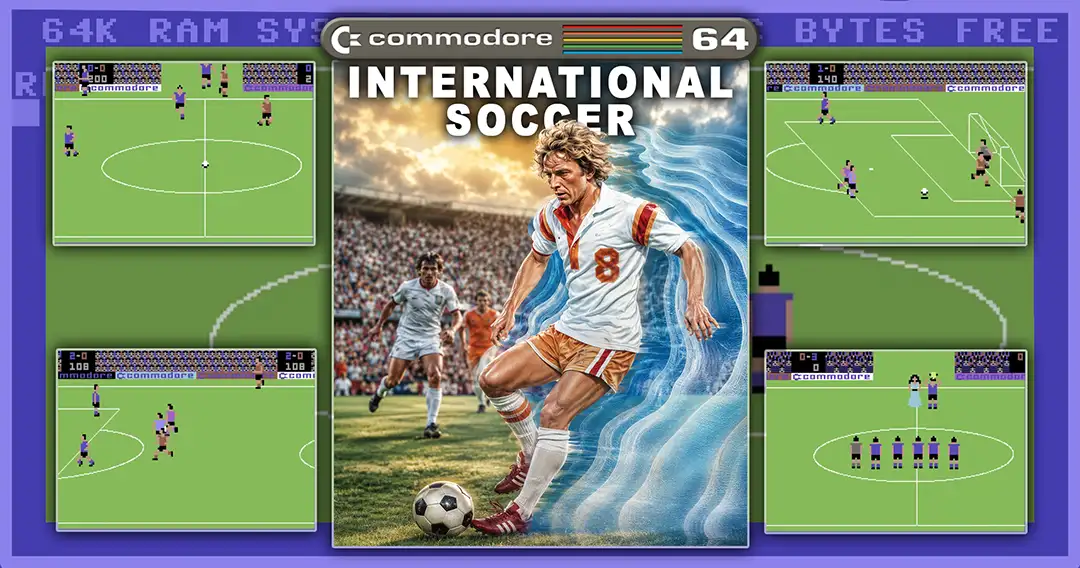
As the 2026 World Cup kicks off,
it’s worth taking a look back at the early digital beginnings of soccer.
Long before today’s games dazzled with licenses, tactics, and TV production,
soccer had to be created from a few pixels and a lot of improvisation.
International Soccer for the Commodore 64 hails from precisely this pioneering era.
The early soccer game
When people talk about seminal soccer games today, names like Kick Off, Sensible Soccer, FIFA, or Pro Evolution Soccer usually come up. But long before these series defined the genre, there was already a title on the Commodore 64 that became the first real digital soccer experience for many players: International Soccer by Commodore from 1983. From today’s perspective, the game seemed simple, almost naive, and yet it contained an astonishing amount of what would later define soccer games: immediacy, drama, familiarity, rivalry on the couch, and the feeling that a few pixels could suddenly become an entire stadium.
International Soccer was created at a time when sports games on home computers were by no means a given. Many early titles approached sports themes through abstract symbols, fixed perspectives, or almost board-game-like mechanics. Soccer was particularly tricky from a technical standpoint: too many characters, too much movement, too much dynamism, too many changes of direction. Especially on machines with limited memory and strict hardware constraints, it was a challenge to create any kind of convincing on-field action at all. That is precisely why International Soccer is so historically interesting. It does not attempt to fully simulate soccer, but distills it down to those moments that can be expressed most powerfully both technically and in terms of gameplay: running, passing, shooting, defending, and celebrating.
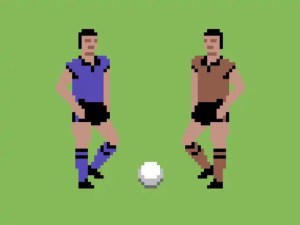
The game was written by Andrew Spencer and published by Commodore itself. This combination alone makes the title remarkable. Many early Commodore games were considered rather functional or stood in the shadow of creative third-party developers. International Soccer, on the other hand, was quickly recognized as an exception: a work that not only functioned but visibly had ambition. It wasn’t simply a software product for the catalog, but a game with its own identity. Its side-scrolling playing field, the relatively smooth animations, the distinctive goal-celebration moments, and its immediate accessibility ensured that the title found a permanent place in many households.
Added to this was the special status of the C64 itself. The Commodore 64 was not a niche computer, but a mass phenomenon. Anyone who grew up with home computers in Europe in the 1980s was highly likely to have come into contact with the “breadbox.” In this environment, a game like International Soccer was able to achieve an enormous reach. For some, it was just an early sports game. For others, it was their first encounter with a virtual soccer atmosphere at all. And for still others, it became a ritual: Quickly insert the cartridge, grab the joysticks, choose jersey colors, kickoff.
The fact that the game is still remembered today isn’t because it offered realistic soccer. Quite the opposite. In many ways, it’s a product of its time: rules are simplified, game situations are often absurd, and ball physics and physical contact follow a charming logic of their own rather than the rulebook. But that is precisely where part of its magic lies. International Soccer is not an attempt to accurately depict soccer. It is an attempt to present soccer as an exciting, instantly understandable, visually vibrant computer game. And in this role, it was astonishingly successful in 1983.
In retrospect, the title is therefore more than just a historical curiosity. It stands at a pivotal point in gaming history: between technical improvisation and a breakthrough in gameplay, between the early days of home computing and the formation of a genre. Anyone who plays it today isn’t just experiencing an old soccer game, but a piece of design history. It demonstrates how a compelling gameplay experience could be created with limited resources—and how powerful a clear idea can be when it’s precisely tailored to the capabilities of the hardware.
Gameplay
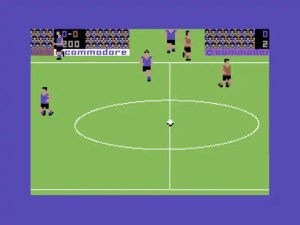
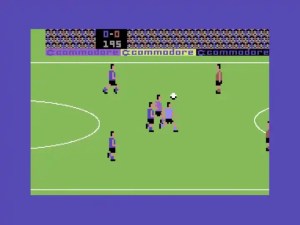
The basic principle of International Soccer is quickly explained. Two teams compete against each other, either player versus player or player versus computer. The game is not played eleven versus eleven, but with a reduced team size: six field players and one goalkeeper per team. This reduction alone is typical of the era and makes sense at the same time. It makes the game easier to follow, reduces the technical burden, and speeds up the pace. As a result, everything on the screen feels more immediate. Instead of long build-up phases, the game is dominated by short exchanges of passes, quick runs, and spontaneous shots.
The controls are pleasantly direct by C64 standards. You move the active player in eight directions, and the fire button is used to shoot or pass. This simple control scheme ensures that no lengthy learning curve is required. After just a few seconds, you understand how the game feels. This is precisely a key reason for its popularity: International Soccer isn’t a title you have to study, but one you can play right away.
At the same time, the simplicity creates a unique form of depth. Because the rule set is minimal, timing takes center stage. When do I press? At what angle do I approach the ball? How long do I hold the direction? How close can I get to the goalkeeper? Many game situations develop from these micro-moments. The result isn’t realistic soccer, but a very readable one. The game doesn’t rely on complex menus, tactics boards, or formation systems, but on direct physicality within the screen space.
The screen view shows only a portion of the field. The camera scrolls horizontally along with the ball’s movement. This, too, is a crucial design choice. Today, an incomplete view of the field might seem like a drawback, but in 1983, this approach had several advantages. First, it made the display appear larger and more dynamic. Second, the game didn’t have to constantly render the entire field, including all the players. Third, it created a sense of forward momentum: attacks gained direction, space, and pace because the screen literally followed them.
Ball possession in International Soccer often feels sticky. Whoever controls the ball doesn’t just carry it—at times, they seem to almost merge with it. From a simulation perspective, this is questionable, but from a gameplay perspective, it’s very effective. You can make runs, cut around opponents, and, with enough momentum, get into promising scoring positions. Especially in a two-player match, this leads to classic couch moments: the wild sprint down the wing, the chaotic cross in front of the goal, the goalkeeper’s last-ditch save, the mutual taunting after a completely undeserved goal.
It’s striking that the game significantly simplifies or omits several soccer rules entirely. There’s no real focus on fouls, no yellow or red cards, and no complicated rule management. This makes International Soccer a distinctly arcade-style entry in the genre. The core is action, not rules. Corners and throw-ins contribute to the game’s recognizability as soccer, but they aren’t developed into special tactical events. The game doesn’t aim to simulate the referee, but rather the back-and-forth of a hard-fought match.
Another strength lies in the multiplayer mode. Many early sports games only really came to life in direct head-to-head matches, and International Soccer is no exception here. You can choose different difficulty levels when playing against the computer, but the true heart of the game is the match against a second player. That’s when the game’s true character emerges: it gets rough, frantic, unfair, funny, and surprisingly thrilling. This is also because the mechanics are open enough to allow for small exploits and improvised tricks. Some goals seem well-earned, others more like they were stolen. But that’s exactly what creates memorable moments.
The relationship between intention and chance is also interesting. The game is controllable, but never fully masterable. Precisely because of the collision detection of the time, the simple AI, and the limited precision of the characters, situations arise time and again where planning and chaos merge. A pass can look brilliant or be accidentally perfect. A shot can fail miserably or seem unstoppable, even though from today’s perspective it was executed rather crookedly and haphazardly. This lack of precision is part of the appeal. International Soccer is simply not sterile.
Added to this is the short match structure. Games don’t last forever, the halves are compact, and as a result, the game invites you to jump right into a rematch. “Just one more game” isn’t just a cliché here—it’s part of the design. The game is perfect for spontaneous sessions, for tournaments in the kids’ room, for rivalries between siblings or friends. In an era when loading times and accessibility were often hurdles, that was a major advantage—especially in the cartridge version.
What the game lacks from a modern perspective is just as obvious. There are no deep tactical systems, no career or tournament mode, no team licenses, no long-term progression. The basic patterns of on-field action repeat themselves relatively quickly. Anyone expecting analytical or realistic soccer today will hardly stay motivated for long. But that would also be the wrong yardstick. International Soccer works best when viewed as a compact action soccer game, not as a full-fledged sports simulation.
And it has aged remarkably well in precisely this role. Even decades later, it’s still clear why the title worked so well back then. The rules are simple, the gameplay is easy to follow, the controls are direct, and the matches are short and intense. These are not accidents, but good design decisions. They show that a game can endure even when its interface looks technically outdated—as long as the core gameplay is clear.
Technology/Graphics
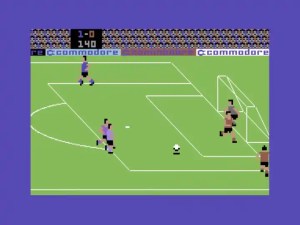
Technically, International Soccer is particularly interesting because it doesn’t hide its limitations but uses them productively. On the Commodore 64, memory, processing time, and graphical resources were scarce. The VIC-II graphics chip was powerful for its time, but by no means magical. Anyone who wanted to display multiple animated characters, a ball, a scrolling playing field, and additional visual elements all at once had to be frugal with every sprite and every screen refresh. This is precisely where the quality of International Soccer shines through.
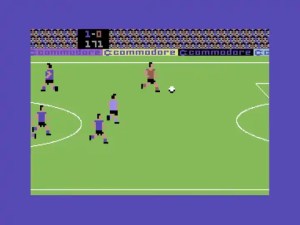
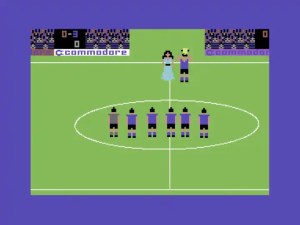
The characters are small, clearly defined, and functionally drawn. No one would mistake them for realistic soccer players, but they are immediately recognizable as players. That alone was no given. Most importantly, the animations are clear. Running movements, changes of direction, and goalkeeper dives convey a credible pattern of movement, even though the number of frames is limited. The players don’t look like rigid markers, but like participants in a real match. For a game from 1983, that’s remarkable.
The decision to use a side view with horizontal scrolling is particularly successful. Many early sports games suffered from the fact that while they wanted to show the entire field or large parts of it, they barely developed any sense of dynamism. International Soccer takes the opposite approach. It shows less, but stages what is visible more intensely. The scrolling view conveys speed, space, and direction. Attacks gain momentum, and counterattacks feel like movement through a larger environment. The playing field seems to extend beyond the screen, and this is precisely what makes the game feel larger than it actually is in technical terms.
The color scheme also contributes to the effect. The C64 was known for its bold, distinctive colors, and International Soccer makes good use of this. The jersey colors clearly distinguish the teams, the green of the field is striking, and key game situations remain easily recognizable. Particularly noteworthy is the inclusion of a grayscale mode for black-and-white televisions. This shows just how much real-world living room conditions were still taken into account in the early 1980s. Not every family had a color TV yet, so software had to function even under limited conditions.
The sound is rather simple compared to the famous SID music of other C64 classics, but it serves its purpose. It’s less about complex compositions and more about acoustic cues: goals, reactions, moments of excitement. Above all, the cheering after goals has remained in many people’s memories. Such effects were important because they added emotional depth to the abstract pixel action. A goal was not just a change in the score, but an event.
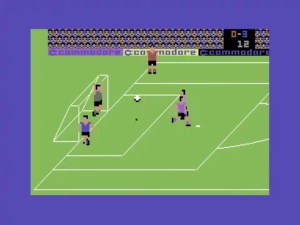
It is remarkable how well International Soccer uses animation to create spectacle. The goalkeeper’s dives are a good example of this. They appear dramatic, even though they are simple by today’s standards. Equally important is the presentation after goals or at the end of a match, when additional small animations round out the experience. Such details require development resources, but they contribute significantly to making a game not just playable, but memorable.
The game’s technical simplification was not a stopgap measure, but a deliberate choice. The smaller number of players on the field, the limited frame of view, the streamlined set of rules, and the clear legibility of the characters are all interconnected. International Soccer can therefore be seen as a prime example of how hardware limitations give rise to a design aesthetic. The game does not try to be more than the computer can handle. It seeks precisely the form in which what is possible looks convincing.
The fact that Andrew Spencer clearly had a good sense for sprite handling and movement is also evident in the legacy of his work. International Soccer was not perceived as a singular fluke, but as proof that vibrant sports graphics could be realized on the C64. Spencer’s later works and his technical reputation support this assessment. So the game was not only successful because soccer was a popular topic, but because its implementation appeared visibly superior compared to much of what was contemporary.
Of course, from today’s perspective, many limitations remain obvious. The ball physics are quirky, the collision detection is sometimes odd, and the overall look lacks the elegance of later 8-bit milestones. The player figures are interchangeable, the stadium is more implied than constructed, and tactical formations can only be roughly captured graphically. But one should look closely at what the technical achievement actually consisted of: not in maximum detail, but in a coherent representation of movement. And movement is everything in soccer games.
That is precisely why International Soccer stands at an interesting point in the history of the genre’s evolution. It is still a long way from later iterations of the genre, but it lays down central visual and technical building blocks. The game demonstrates that soccer on home computers can function not merely as static symbolism, but as an animated, spatially immersive spectacle. It does not create the illusion of a television broadcast, but it does create the illusion of a live match. That was already an enormous step forward in 1983.
Trivia
Over the years, a small aura of curiosities and anecdotes has formed around International Soccer, which fits well with its status as an early C64 classic. Even the format of its release is part of this. Originally, the title was released as a cartridge, which gave it a significant convenience advantage over many cassette and floppy disk games of the time. This was worth its weight in gold, especially for spontaneous multiplayer matches: plug it in, turn it on, and get started. Later, the game was re-released, including in other distribution formats and under alternative titles.
These alternative names are a beautiful piece of home computer culture in their own right. Depending on the market and publisher, the title appeared as International Football or Cup Final, for example. Such renaming was not uncommon in the 1980s, but today it gives the game an almost mythical branching: many remember the same game, but under a slightly different name, with different packaging, or under a different distribution label.
The presentation after a won game also left a lasting impression. The fact that the winning team is honored with a trophy elevates the otherwise very compact match to a small final-game moment. Such elements may seem trivial, but they are enormously important for the memory. Many retro games aren’t remembered for their mechanics, but for individual images. In International Soccer, these are precisely the moments that stand out: the goal celebration, the applause, the feeling that the screen briefly wants to be more than just a game interface.
Another charming detail is the aforementioned grayscale mode. Today, when we think of retro aesthetics, we often automatically think of bold pixel colors. But in the early 1980s, the reality in many living rooms was more varied. The fact that a game explicitly takes this into account is not only technically practical but also culturally and historically interesting. It serves as a reminder of how closely software design was once tied to specific household conditions.
In retro circles, memories of peculiar playstyles, exploits, and house rules also keep surfacing. As with many early sports games, informal tricks developed: specific running routes, angles that were hard to defend against, or situations where you could almost carry the ball into the goal. From today’s perspective, these would be balance issues. Back then, they often became part of the local gaming culture. Every group knew its “sure goals” or forbidden maneuvers.
The fact that Commodore itself was behind the game also gives it a special profile in retrospect. Many legendary C64 games are associated with studios or individual developers outside the manufacturer. International Soccer therefore seems like a rare case in which a title published by the system environment itself truly left a cultural mark. This makes it both a game and a brand building block: a sort of sporting flagship for the machine.
After all, part of the trivia surrounding International Soccer is its afterlife in memory and reinterpretation. In discussions about early soccer games, the title is often described either as a primitive precursor or as a true pioneer. Both are true to a certain extent. That is precisely why it is so fascinating. It is simple enough to be ridiculed, yet significant enough to be respected.
Reviews at the Time
The contemporary reception of International Soccer was remarkably positive. This is particularly interesting because early home computer sports games were by no means automatically treated with favor. Too often, the gap between ambition and technical reality was too wide. With International Soccer, however, many critics seemed to notice that something unexpectedly well-rounded had been achieved here.
The animations and the immediate playability were particularly praised. Contemporary reviewers emphasized that the game felt lively and brought more dynamism to the screen than many competing titles. Especially when compared to average third-party software, International Soccer was, in some cases, celebrated with genuine surprise. The fact that Commodore itself released a game of this quality did not seem to be a given. The general consensus was, in essence: not perfect, but surprisingly good and, above all, amazingly playable.
The press also appreciated that the game did not get bogged down in dry simulation. It was clearly recognizable as action soccer and was convincing precisely in that regard. Its strengths lay less in tactical depth than in momentum, rhythm, and presentation. This profile made it easy to recommend the title. It ran quickly, looked visually appealing, and was excellent for head-to-head matches.
At the same time, limitations were certainly evident. Those expecting a full set of soccer rules or deep strategic options were left wanting. The simplified rules, the sometimes odd ball handling, and the lack of more complex modes made the game feel more like a sporty action take than a serious simulation. But back then, this was often seen not as a failure, but as a clear choice of focus. International Soccer aimed to entertain, not recreate the Saturday broadcast.
Another indicator of its success at the time was its chart presence in the UK. The game achieved high rankings early on and later returned to the top. This is not merely a detail for collectors, but an indication of genuine visibility in the market. A game that appeared in the charts was not an insider tip, but part of the ongoing conversation among C64 owners.
From today’s perspective, it is interesting that many reviews at the time praised precisely those aspects that later became fundamental to the genre: fluid animation, direct control, quick accessibility, and excitement in two-player matches. In doing so, they unwittingly laid out a blueprint for future soccer games. At the same time, the limitations that were criticized or tacitly accepted show just how different expectations were back then. People didn’t demand completeness, but rather persuasiveness within the limits of the technology.
This is perhaps the best way to summarize the criticism of the time: International Soccer wasn’t celebrated because it was realistic, but because it was lively. For a sports game from 1983, that was probably the greater compliment.
Cultural Influence
The cultural influence of International Soccer is greater than its now-simple interface would suggest. The game marks an early moment when virtual soccer on home computers no longer appeared merely as a technical exercise but as a serious form of gameplay. It demonstrated that the sport did not necessarily have to look abstract or sedate in digital form. This realization was important—not only for players but also for developers.
The title is particularly often cited as a source of inspiration for later soccer games. It stands at the beginning of a lineage that extends through other 8-bit and 16-bit titles all the way to the great classics of the genre. This is less about direct copies of individual mechanics and more about the basic idea of designing soccer as a fast-paced, accessible, visually intuitive action game. In this sense, International Soccer was a trailblazer.
Added to this is its influence on the culture of remembrance surrounding the C64. The game is one of those titles that repeatedly appear in nostalgic retrospectives because they represent a specific type of home computer experience: two joysticks, a TV, a quick setup, and immediate multiplayer fun. Not every historically significant game remains emotionally present. International Soccer is an exception here because it is remembered less as a solo gaming adventure and more as a social occasion.
Its standing within the sports game genre is also significant. Before soccer games moved toward greater authenticity, licensing, and tactical complexity, it first had to be proven that the basic form was fun on screen. International Soccer provided exactly that proof. It didn’t define the end of development, but an early, decisive beginning.
The fact that the title still appeared in best-of lists and retrospectives years later shows that it wasn’t just a short-lived market success. It remained a benchmark: as a classic C64 sports title, as a pioneer, as a nostalgic touchstone. Anyone who wants to understand why soccer games later became so popular on home computers should start with this game—not because everything is already here, but because it reveals which elements truly caught on first.
Conclusion
International Soccer is not a realistic soccer game, not a complex sports simulation, and not a flawless milestone. But it is an extraordinarily important, cleverly designed, and historically insightful game. In 1983, it managed to create something on limited hardware that felt like a real competition: with pace, tension, friction, cheering, and the urge to play again.
Its strength lies in its distillation. Few rules, clear controls, short matches, easily readable animations, and a compelling multiplayer core are enough to make soccer an experience as a digital event. Precisely because the game doesn’t try to do too much, it achieves an astonishing amount. It is improvised soccer in the best sense: raw, direct, sometimes absurd, often magnificent.
Viewed in a historical context, International Soccer was an early promise to the genre. It said: Soccer can work on the home computer. Not someday, but now. Everything that would later become more polished, realistic, and grand needed such precursors. That is why the title deserves more than mere retro nostalgia. It deserves recognition as a game that turned technical limitations into a lasting form of gaming joy.
Anyone who plays it today won’t see the future of soccer, but rather its astonishingly vibrant origins.








Kommentar verfassen