

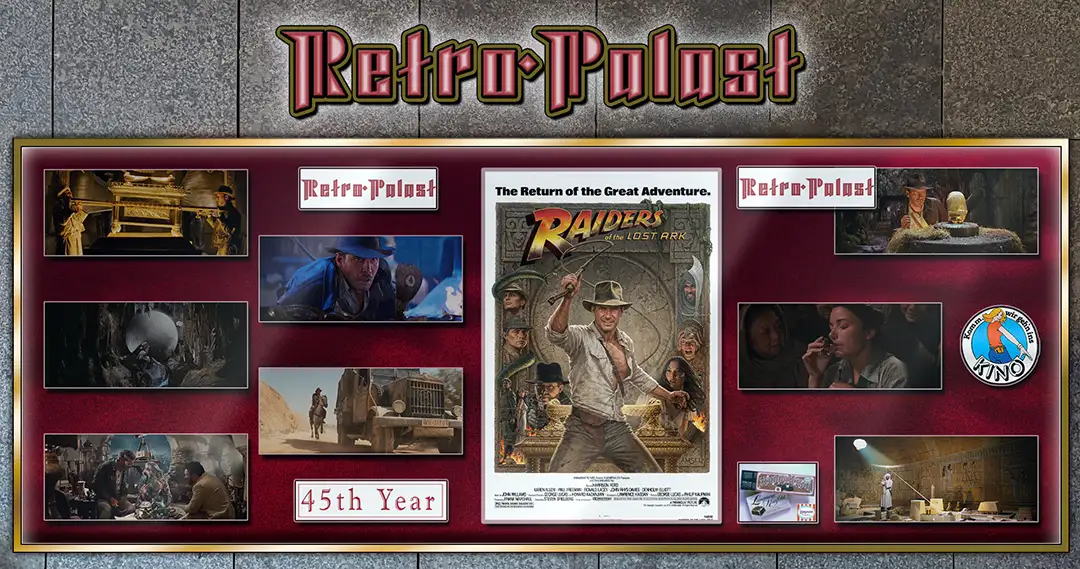
Marion, don’t look at it. Shut your eyes, Marion. Don’t look at it, no matter what happens!
Why Indiana Jones Still Shapes Adventure Cinema Today
When Raiders of the Lost Ark hit theaters in 1981, the film seemed both old-fashioned and revolutionary. Old-fashioned because it was clearly inspired by the adventure serials of the 1930s and 1940s: daring expeditions, exotic locations, sinister villains, ancient mysteries, and heroes who rush from one danger into the next. Revolutionary because Steven Spielberg and George Lucas didn’t simply copy these influences, but rather reassembled them with the technical skill, narrative pace, and blockbuster instinct of modern Hollywood. The result was a film that feels like pure cinema in concentrated form: movement, suspense, humor, myth, and spectacle, without ever losing its rhythm.

At the center is Dr. Henry “Indiana” Jones Jr., archaeologist, adventurer, scholar, and daredevil all at once. He is not a flawless superhero, but a hero with scrapes, sweat, a talent for improvisation, and occasional moments of being overwhelmed. That is exactly what makes him so human. Indiana Jones stumbles, makes mistakes, reacts too late, gets beaten up, ambushed, chased, and rescued—and that’s exactly why he comes across as believable. The audience doesn’t see an invincible action machine, but a man who, with intelligence, courage, and a good dose of luck, always manages to find a way out of chaos.
The film is titled Raiders of the Lost Ark in German and is the first released installment of the subsequent Indiana Jones series. It established not only a character but an entire visual language: the fedora, the leather jacket, the whip, the rolling stone, the dusty temple, the map with the travel route, and John Williams’ triumphant march. Hardly any adventure film after 1981 could escape its influence. This is not only due to the iconic scenes, but also because Raiders of the Lost Ark achieves a rare balancing act. The film is nostalgic without becoming museum-like, serious enough to be dramatic, and at the same time playful enough to never feel heavy.
To this day, the film remains one of those works where you can feel how precisely all the gears mesh together. Direction, editing, music, cinematography, production design, casting, and choreography all pursue the same goal: to make adventure tangible as an immediate experience. The viewer is not meant merely to observe, but to be swept along. That is why it is worth viewing Raiders of the Lost Ark not just as a popcorn classic, but as a seminal work of modern entertainment cinema—a film that demonstrates how technical perfection and childlike imagination can fuel one another.
Plot

The story begins with one of the most famous openings in film history. Indiana Jones and a few companions break into a South American temple to recover a golden idol. Even in these first few minutes, the film makes it clear how its world works: every achievement comes at a price, every cave hides a trap, every ally could turn into a traitor. Indy first masters the temple’s deadly mechanisms, replaces the idol with a sandbag, and still triggers a chain reaction. The ensuing escape from the gigantic boulder has long since become an iconic image in film history. At the end of the sequence, however, his rival Belloq and a group of locals take the loot from him. This is how the hero is introduced: brilliant, courageous, but by no means all-powerful.

Back in the United States, we encounter Indiana Jones in a different role. He is a university professor, giving lectures and admired by his students. This dual role is crucial to the character. Indy is not just a treasure hunter, but also a scholar. Shortly thereafter, he is approached by government officials who have intercepted intelligence indicating that the Nazis are searching for the Ark of the Covenant in Egypt. This biblical artifact, said to contain the Tablets of the Law, is an object of immeasurable religious and symbolic power in the Judeo-Christian tradition. In the film, it becomes at once a myth, a political objective, and an existential threat. The fear is that if Hitler were to actually gain access to the Ark, it could serve as a weapon or at least as a propaganda tool of immeasurable impact.
To find the Ark, one needs the so-called pommel of the Staff of Ra, a medallion that provides clues to its exact location. This object is in the possession of Marion Ravenwood, Indy’s former lover, who now runs a bar in Nepal. This reunion alone is one of the film’s most emotionally powerful moments. Between Indy and Marion lies not only past affection, but also wounded pride, betrayal, and unresolved history. Marion is therefore, from the very beginning, far more than the “hero’s companion.” She is quick-witted, suspicious, tough, and ready to defend herself.
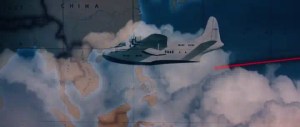
In Nepal, a brawl and a fire break out quickly when Nazi agents also try to get their hands on the medallion. Marion joins Indy after her bar is destroyed and it becomes clear that she, too, is now in mortal danger. From there, the journey leads to Cairo, where the film finally finds its adventurous stride. Alleyways, markets, secret passages, snakes, tombs, and convoys create the feeling that the next challenge awaits around every corner. Indy receives support from his friend Sallah, a resourceful and loyal ally.

In Cairo, it also becomes clear how much Raiders of the Lost Ark thrives on confrontations that are charged not only physically but also ideologically. Belloq is the perfect antagonist. He is essentially a mirror image of Indiana Jones: also an archaeologist, also charismatic, also intelligent—but morally corrupt. While Indy, despite all the gray areas, still believes in a scientific and ethical core, Belloq willingly collaborates with the Nazis to gain power and glory. This is precisely what makes him dangerous: not as a monster, but as a civilized opportunist.

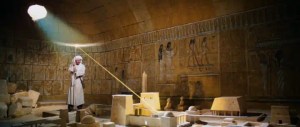
The search for the Ark hinges on a detail of the medallion, and precisely because the Nazis possess only an incomplete copy of its inscription, they are digging in the wrong place. Indy and Sallah finally discover the right location: the “Well of Souls.” There, the Ark of the Covenant is indeed found. The scene combines the thrill of discovery with a horror atmosphere, especially because Indy, who detests snakes, must descend into a chamber full of snakes. Here, too, the film employs a simple yet effective method: the hero is not immune to fear. His phobia makes the scene palpable and heightens the tension.

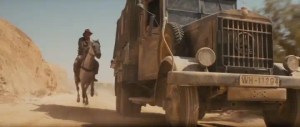
But of course, the find doesn’t stay in Indy’s hands for long. The Nazis and Belloq snatch the Ark from him, Marion is captured, and the film shifts into a series of spectacular chases. The truck chase, in particular, is legendary: Indy fights his way onto and under a moving truck, is believed to have been run over, returns, and recaptures the vehicle in a masterfully staged action sequence. This scene encapsulates everything that defines the film: clarity of spatial relationships, physical intensity, mounting tension, and the ability to keep every action narratively coherent.

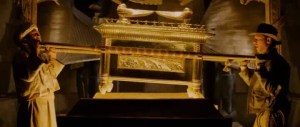
Ultimately, however, the Ark falls back into the hands of the enemy. On an island, Belloq and the Nazis intend to open the Ark of the Covenant in a ritual. Indy and Marion are bound and forced to watch. What follows is one of the most surprising and eerie climaxes of 1980s mainstream cinema. The opening of the Ark does not unleash a controllable power, but rather an act of divine destruction. The Nazis present and Belloq are cruelly wiped out. Indy survives only because he orders Marion to keep her eyes closed. This ending lends the film an almost Old Testament-like force: some things cannot be possessed, exploited, or used for military purposes. Human hubris fails in the face of a power that defies all calculation.
In the end, however, the Ark is not revered as a religious object but stowed away by the U.S. government in an anonymous warehouse. This, too, is typical of the film: after all the myth, the story ends with bureaucratic sobriety. The mystery does not disappear; it is archived. This leaves a residue of irony—and the sense that the world of this film is full of further hidden wonders.
Actors

The success of Raiders of the Lost Ark hinges crucially on the casting. Harrison Ford turns Indiana Jones into one of those film characters who become larger than their own story. What makes his portrayal special is the combination of contradictory traits. Ford doesn’t play Indy as a dapper, detached action hero, but as a man with rough edges, weariness, a need to improvise, and latent sarcasm. He comes across as competent but not untouchable; charismatic but never polished; intelligent but not overly contrived. It is precisely his responsiveness—this constant switching between thinking, cursing, running, fighting, and improvising—that gives the character his energy.
It’s also important that Ford lends the hero a physical realism. When Indy jumps, strikes, stumbles, or hangs from a vehicle, you feel the weight and the risk. That’s one of the reasons why the action still works today. It doesn’t feel sterile, but physical. Ford doesn’t turn Indiana Jones into a distant myth, but into a hero you can relate to.

Karen Allen as Marion Ravenwood is just as essential. In many adventure films of that era, female characters would have been primarily functional: love interests, sources of danger, or motivational tools. Marion is more than that. She is spirited, a heavy drinker, angry, vulnerable, brave, and often smarter than Indy gives her credit for. Karen Allen plays her with a blend of natural presence and explosive energy that prevents Marion from ever becoming a mere appendage. Even in situations where she is trapped or threatened, she remains a character with poise and edge.

Paul Freeman as René Belloq provides the ideal antagonist. He plays the villain not as a raging fanatic, but as a sophisticated manipulator. That is precisely what makes Belloq so effective. He speaks calmly, thinks strategically, and perhaps understands Indiana Jones better than many other characters. The film benefits enormously from the fact that his adversary is not a pure villain, but a corrupted doppelgänger of the hero.

John Rhys-Davies, as Sallah, brings warmth, humor, and a sense of grounding. His character is the classic loyal friend, but never merely window dressing. Sallah brings humanity to the story and gives the expedition a social dimension: Indy is not a lone wolf, but someone who relies on networks, trust, and friendship.

Ronald Lacey as Major Toht, who appears in round glasses and a black coat, embodies the sadistic streak of the Nazi side in a disturbingly striking way. His appearance is deliberately exaggerated, but never harmless. Wolf Kahler as Colonel Dietrich completes the military Nazi presence with cold authority. Taken together, the result is an ensemble that is clearly typified without becoming one-dimensional.
Trivia
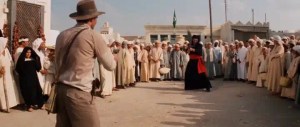
Numerous anecdotes surround Raiders of the Lost Ark, many of which have since become part of film legend themselves. One of the best-known concerns the scene at the bazaar in Cairo, in which a swordsman challenges Indiana Jones to a duel. Originally, a longer fight sequence was planned. However, Harrison Ford suffered from health issues during filming, as did parts of the crew. The pragmatic solution was for Indy to simply shoot the opponent. A stopgap measure became one of the film’s most famous gags—precisely because the scene abruptly breaks the built-up tension with dry efficiency.
Equally legendary is the opening sequence with the giant boulder. It condenses the promise of the entire film into a few moments: ancient traps, narrow escapes, physical danger, and visual clarity. Such images are not only spectacular but also easily memorable. This is a special quality of the film: almost every major scene can be summed up in a single iconic image.

John Williams’ music is a must-have in any trivia collection. The Indiana Jones March is one of the most famous film melodies of all time. It functions as an acoustic distillation of the character: energetic, heroic, driving forward, yet at the same time with a touch of romantic nostalgia. Without this music, the Indiana Jones myth would hardly be the same.

It’s also interesting how carefully the film balances its mix of seriousness and lightheartedness. Despite its humor and pulp-style sense of adventure, Raiders of the Lost Ark features dark, almost horror-like moments—such as in the Well of Souls or during the Ark of the Covenant finale. It is precisely this blend of tones that contributes to its longevity. The film dares to be scary without losing its promise of entertainment.
Added to this is the close creative partnership between George Lucas and Steven Spielberg. Lucas contributed the basic idea of a modern serial adventure, while Spielberg brought the precision of direction. The result is a film that feels seamless, even though it was reassembled from many old set pieces. It is no coincidence that this became the starting point for one of the most famous adventure series in film history.
The “Indy Is Useless” Theory

It is often claimed that Indiana Jones is actually superfluous to the story because the Nazis open the Ark of the Covenant in the end anyway and perish as a result. However, this is only partially true for the film’s plot. Indy is the one who ensures that the correct excavation site is found in the first place; he gets to the Ark first and repeatedly puts the Nazis in trouble. Without him, their search would have gone faster and more smoothly.
Nevertheless, there is some truth to the theory: Indy does not prevent the Ark from being opened. The film’s conclusion is determined not by his strength, but by the power of the Ark itself. For the story, this means: Indiana Jones is not useless, but he is also not the one who actively solves the final problem. He drives the plot forward without fully controlling the outcome.
Reviews at the Time

Upon its release, Raiders of the Lost Ark was met with overwhelmingly enthusiastic reception. Many critics particularly praised Steven Spielberg’s breathtaking direction, the precision of the action sequences, and the film’s ability to blend classic adventure cinema with modern energy. The film was celebrated as the triumphant return of a cinema that sought to amaze without seeming naive. Particular praise was given to the timing, the humor, and the masterful craftsmanship with which scene followed scene without creating any lulls.
Harrison Ford also received much acclaim. Although he was already known from Star Wars, Raiders of the Lost Ark definitively confirmed that he could not only function as a laconic space hero but also embodied a screen character all his own. Many reviews emphasized how perfectly Ford suited a role that combines intelligence, tenacity, and irony.

John Williams’ music was equally frequently praised for lending the film an additional emotional and mythical layer. At a time when the New Hollywood cynicism of the 1970s was still lingering, Raiders of the Lost Ark struck many reviewers as a counterpoint: less skeptical, less psychologically scarred, but more immediate, kinetic, and audience-oriented.
However, there were also critical voices. Some observers accused the film of being rather superficial in content and of subordinating character psychology to spectacle. Others saw its serial aesthetic as a calculated retro strategy that offered more pace than depth. From today’s perspective, many of these objections seem understandable, yet also limited. For Raiders of the Lost Ark never intended to be psychological auteur cinema. Its art lies precisely in executing a seemingly simple form with maximum skill.

In retrospect, it is striking that contemporary critics recognized the film’s central merit early on: it was not merely a successful entertainment film, but a kind of benchmark for what popular genre cinema can look like when constructed with the utmost precision. Its recognition at awards ceremonies and in year-end best-of lists demonstrated that adventure cinema did not automatically have to be dismissed as light fare.
Cultural Influence

The cultural influence of Raiders of the Lost Ark can hardly be overstated. First, the film created a character in Indiana Jones who immediately entered the canon of popular film heroes. The fedora, the whip, and the silhouette are still enough today to make the character recognizable worldwide. Few film characters have such a clear visual identity.

Furthermore, the film shaped the entire adventure genre. Numerous subsequent works in film, television, and video games adopted its basic structure: a mix of treasure hunts, historical mysteries, geographical movement, trap-filled architecture, a charismatic hero, and a sense of irony that subverts the seriousness of the situation. Without Indiana Jones, series like The Mummy in their modern form, games like Tomb Raider or Uncharted, and many other adventure narratives would be almost inconceivable.

The film also left its mark in formal terms. The fast narrative pace, the clear visual orientation in action scenes, and the idea of designing set pieces to convey plot, character, and spectacle all at once became style-defining. Many blockbusters of later decades became bigger, louder, and more digital, but not necessarily better at creating suspense through space, timing, and physical presence. Precisely for this reason, Raiders of the Lost Ark is often regarded as a prime example of “classic” blockbuster directing.

Culturally, the film also served to revive a romanticism of adventure that seemed almost lost in the modern era. It made archaeology—at least in its pop-cultural fantasy version—exciting, mysterious, and heroic. The fact that this is linked to a highly romanticized and not always unproblematic portrayal of foreign locations is discussed more intensely today than it was in 1981. Recent debates in particular ask how colonial perspectives, exoticization, and the appropriation of foreign cultural assets play a role in such adventure films. This criticism is important because it shows that classics do not exist outside of history. Their influence is great, but not beyond contradiction.

Nevertheless, the fascination remains undiminished. The film has left behind not only images and motifs, but also a certain promise of cinema: that on-screen adventures can trigger a sense of discovery, as if the world were larger, more mysterious, and more dangerous than everyday life suggests. In this sense, Raiders of the Lost Ark has permanently shaped the cultural imagination of the adventure film.
Conclusion

Raiders of the Lost Ark is far more than the launch of a successful franchise. The film is a near-perfect distillation of what great entertainment cinema can achieve. It possesses pace without haste, humor without silliness, pathos without heaviness, and spectacle without arbitrariness. Its characters are clearly defined, its images unforgettable, its music iconic, its direction nearly flawless.
Particularly remarkable is how effortlessly the film blends opposites. It is nostalgic and modern, playful and menacing, pulp-like and precise. Indiana Jones himself embodies this tension perfectly: a professor with dirt on his face, a hero afraid of snakes, an adventurer who doesn’t have everything under control. That is precisely what keeps him so alive.

The discussions the film continues to spark to this day—such as the “Indy is useless” theory or its treatment of history, myth, and exoticization—ultimately demonstrate its cultural presence. Only works that linger in the memory are reinterpreted, defended, criticized, and reimagined over the decades.
The fact that Raiders of the Lost Ark still feels so fresh today is due to its technical confidence. The film does not rely on sheer scale, but on precision. Every scene knows what it wants. Every gag hits the mark. Every chase has direction. Every threat carries weight. At a time when many blockbusters suffer from excess, Spielberg’s film reminds us that adventure is at its strongest when it is told clearly, concretely, and physically.
That is why Raiders of the Lost Ark is not just a classic of the 1980s, but an enduring benchmark. Anyone who wants to understand why cinema can fill people with wonder will find one of the most convincing answers here.
More
Trailer
Notice Regarding Image Rights and Copyrighted Material
All images, film stills, posters, logos, trailer excerpts and other copyrighted materials used in this article are used solely for editorial reporting, film criticism, review and illustrative purposes related to the respective content.
Unless otherwise stated, all copyrights, trademark rights and other intellectual property rights in the materials used remain with their respective rights holders, including film studios, distributors, production companies, photographers, artists or other licensors.
The materials are used in good faith and with regard to applicable legal limitations, licence terms and source attributions. If, despite careful review, any rights have been infringed or any attribution is incomplete, please contact me. Upon review, the relevant content will be removed or corrected promptly.








Kommentar verfassen