

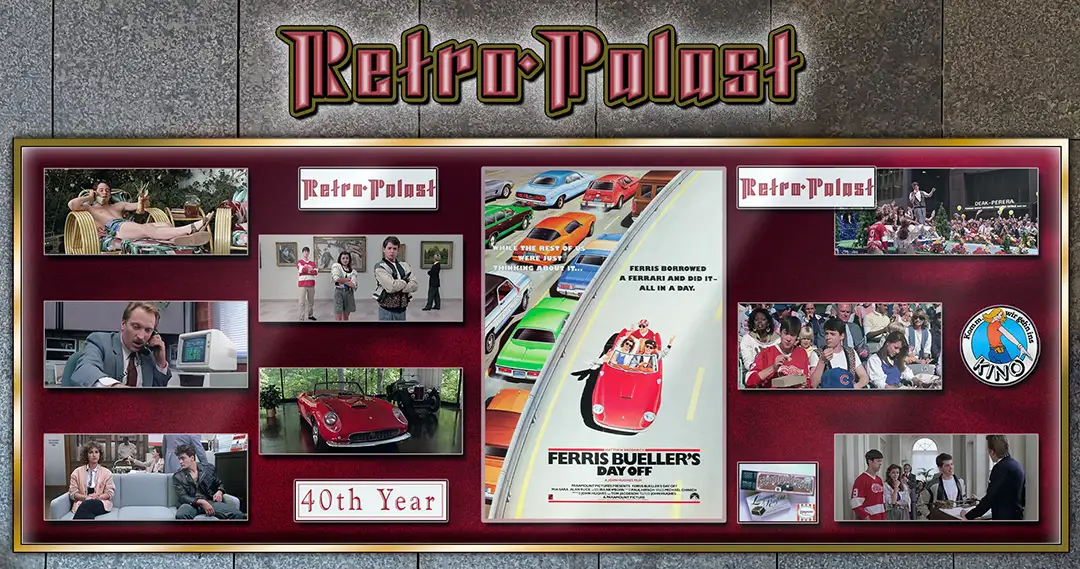
Life moves pretty fast.
If you don’t stop and look around once in a while, you could miss it.
Freedom, Youth, and the Perfect Day
When “Ferris Bueller’s Day Off” hit theaters in 1986, the film seemed at first glance like a lighthearted teen comedy: a charming student skips school, roams Chicago with his friends, and outwits parents, teachers, and the entire school system in the process. Yet it was precisely this seemingly simple premise that made the film so effective. Director and screenwriter John Hughes, who became the most important chronicler of American youth culture in the 1980s, transformed a harmless break from class into a story about self-determination, friendship, the fear of growing up, and the question of how one actually wants to live life.
To this day, “Ferris Bueller’s Day Off” remains one of the most famous films of 1980s American mainstream cinema. It is not only entertaining but also remarkably perceptive. Behind the jokes, the rapid-fire dialogue, and the iconic scenes lies a film that captures the spirit of a particular generation—and is at the same time timeless enough to still be understood and loved decades later.
Ferris Bueller is no ordinary movie hero. He is neither an outsider nor a rebel in the classic sense. He is popular, smart, articulate, manipulative, charming, and always one step ahead. Unlike many teenage characters in coming-of-age films who struggle with insecurity or social isolation, Ferris moves through his world with natural ease. That is precisely what makes him so fascinating: he is not a realistic role model, but rather a fantasy—the student who sees through the system and escapes it with style.
At the same time, the film is more than a celebration of breaking the rules. It shows that Ferris’s seemingly effortless day also serves a purpose: he wants to pull his best friend Cameron out of his paralyzing passivity and give him a glimpse of a different life. Thus, the comedy about skipping school becomes a story about courage, emotional liberation, and the value of a single, intensely lived day.
The film is as remarkable in its form as it is in its content. Ferris speaks directly to the audience, breaks the fourth wall, and makes viewers privy to his plans. This device gives the film a playful, almost conspiratorial tone. You don’t just watch Ferris—you’re drawn into his way of thinking. This creates a sense of intimacy that plays a major role in why the film still feels so accessible and alive today.
“Ferris Bueller’s Day Off” is therefore not merely a comedy about a day off from school. It is a film about the art of seizing the moment, about the fear of being stuck in a rut, and about that brief, fleeting feeling that anything is possible. That is precisely why it is far more than a nostalgic product of its time: it is a modern fairy tale about freedom.
Plot

The story begins with a simple but ingenious plan: Ferris Bueller decides not to go to school on a sunny day. He feigns illness, puts on a convincing show for his worried parents, and stays home—officially sick, but in reality ready for a day full of adventure. Within the first few minutes, the film establishes Ferris as a master of the performance. He knows exactly what adults expect and knows how to use it against them.
But Ferris doesn’t want to spend the day alone. His real goal is to lure his best friend Cameron Frye out of his depressive, anxious world, one shaped by his domineering father. Cameron is the exact opposite of Ferris: insecure, nervous, passive, and marked by constant worry. He is actually sick in bed—or at least in a state somewhere between hypochondria, exhaustion, and existential paralysis. Ferris practically forces him to get up and come along. It becomes clear right here that the day will have much greater significance for Cameron than for Ferris himself.
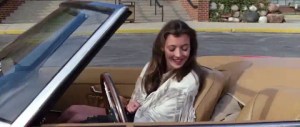
The third member of the trio is Sloane Peterson, Ferris’s girlfriend. To get her out of school, Ferris devises another clever trick: the school administration is deceived with a fabricated story about a death in the family. Sloane joins the two boys, and together they leave the confines of school, class schedules, and supervision to turn Chicago into their playground.
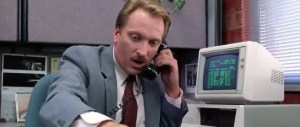
Meanwhile, the film’s antagonist begins to take action: Dean of Students Ed Rooney, who believes he has long since seen through Ferris. Rooney is convinced that Ferris is not sick, but is once again fooling the school system. Obsessed with the desire to catch Ferris red-handed, he becomes a caricature of authoritarian power. What begins as an attempt at discipline increasingly turns into an absurd chase in which Rooney sinks deeper and deeper into ridicule, frustration, and a loss of control.

Ferris, Cameron, and Sloane drive through the city in a red Ferrari—or rather, in the Ferrari that Cameron has stolen from his father. This car is not only a luxurious status symbol but one of the film’s most important symbols. It represents the pressure under which Cameron lives, his father’s emotional distance, and a world of material success in which affection and understanding have no place.
The day in Chicago unfolds in episodes that are by turns funny, poetic, and satirical. The friends visit a posh restaurant and, with great self-assurance, manage to snag a table there. They stroll through the city, view art in a museum, take part in a parade, and experience moments of complete carefreeness. The museum sequence is particularly noteworthy because here, for a moment, the film tones down its over-the-top comedy. Cameron stops in front of a painting and gazes at it so intently that his inner crisis reveals itself almost wordlessly. Amid the hustle and bustle of the day, it suddenly becomes clear just how vulnerable and torn he is inside.

One of the film’s most famous scenes is Ferris’s impromptu performance at a parade, where he first performs “Danke Schoen” and later “Twist and Shout”. Here, the film finally transforms from a school-skipping comedy into a celebration of the moment. Ferris gets an entire city dancing and, for a moment, becomes a kind of folk hero spreading joie de vivre. This scene is pure cinematic bliss: over-the-top, unrealistic, and precisely for that reason so effective.
At the same time, the film follows several subplots. Ferris’s sister Jeanie Bueller is annoyed by the fact that Ferris always gets away with everything, while others have to bear the consequences. Her anger is not just sibling rivalry, but an expression of a sense of justice: Why is Ferris admired by everyone, even though he constantly breaks the rules? This perspective is important because it prevents the film from merely glorifying Ferris uncritically. Jeanie represents those who perceive Ferris’s charm not as freedom, but as privilege.

Rooney, too, pushes his pursuit further and further, eventually even breaking into the Buellers’ house to find evidence. In doing so, he gets caught up in a series of slapstick disasters that ultimately turn him into a laughingstock. His defeats are not only funny but also symbolic: stubborn, humorless authority stands no chance in Ferris’s world.
The emotional climax of the film, however, comes toward the end, when Cameron must confront his father’s Ferrari. After Ferris and Cameron attempt to roll back the car’s odometer, disaster strikes: the Ferrari plummets through the glass front of the garage. This moment is initially a shock for Cameron, but then a liberation. For the first time, he decides not to run away, not to lie, and not to leave the responsibility to Ferris. He wants to stand up to his father. It is precisely this development that makes it clear that the film’s true inner arc belongs not to Ferris, but to Cameron.
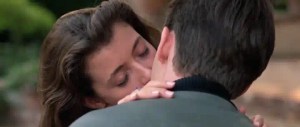
In the end, a race against time begins. Ferris must return home before his parents realize that he has by no means spent the day sick in bed. A frantic, comical return ensues through front yards, streets, and back alleys. Ferris makes it back to bed at the last moment and pretends to be sick again, just as his parents arrive.
Formally, this marks the end of the external plot. But internally, something has changed. Cameron has become more determined, Jeanie has at least partially reconsidered her attitude toward Ferris, and Rooney has been completely demystified as an authoritarian figure. Ferris himself remains what he always was: a master of evasion, a player, a charmer. Yet the film makes it clear that his day was not merely escapism. It was about taking life seriously for a moment by living it playfully.
Cast
A key reason for the enduring success of “Ferris Bueller’s Day Off” lies in its cast. The film works not only because of its screenplay or direction, but because the actors fill their roles with just the right mix of comedy, charisma, and emotional precision.
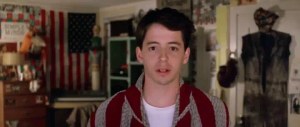
Matthew Broderick carries the film almost effortlessly. His portrayal of Ferris Bueller is the essence of what makes the character so unforgettable: He is charming, funny, intelligent, slightly arrogant, but never truly unsympathetic. Broderick plays Ferris not as a malicious manipulator, but as someone who perceives life with greater alertness and elegance than anyone else. He is, in a sense, a trickster—a character who breaks rules but in doing so reveals a higher truth.
Crucially, Broderick never lets Ferris come across as too over-the-top or artificial. Although the character often appears unrealistically competent, he remains accessible thanks to Broderick’s tone, timing, and directness. His glances at the camera don’t feel like technical gimmicks, but like genuine connections with the audience. This creates the impression that Ferris is taking the viewers along on his day, rather than merely performing for them.

If Ferris is the radiant center of the film, then Alan Ruck as Cameron Frye is its melancholic soul. To this day, many critics and viewers see Cameron as the film’s most emotionally complex character. Ruck plays him with great nervousness and, at the same time, with quiet sadness. Cameron isn’t simply anxious; he is a young person under emotional pressure who has barely learned to stand up for himself.
It is precisely this contrast that gives the film its depth. On his own, Ferris might be nothing more than a clever fantasy character. Cameron anchors the story in genuine vulnerability. His moments in the museum, his panic over the Ferrari, and finally his decision to take responsibility are among the film’s most powerful scenes. Alan Ruck doesn’t turn this into a melodramatic crisis, but rather a credible inner transformation.

Mia Sara embodies Sloane Peterson with a quiet elegance that creates an important balance amid the film’s chaotic energy. Sloane is not just “the hero’s girlfriend,” but a character who understands and shares in Ferris’s charm without coming across as naive. She is calm, attentive, and confident. Although her role is given less screen time than those of Ferris and Cameron, she is crucial to the film’s tone: she lends it warmth and lightness.
Sloane also serves as a link between Ferris’s playful world and Cameron’s insecurity. Her presence prevents the film from becoming purely a male self-indulgence. She observes a lot, judges little, and is at the same time a symbol of the idealized freedom the film evokes.
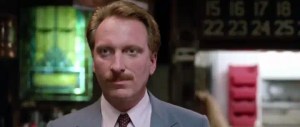
Jeffrey Jones as the school principal or Dean of Students Ed Rooney delivers one of the film’s greatest comedic performances. On paper, Rooney is a fairly simple character: an authoritarian adult who has it in for Ferris. But Jones makes more of it. He plays Rooney with wounded pride, childish obsession, and a growing loss of control. Instead of coming across as threatening, Rooney becomes increasingly embarrassing—and that is precisely where his comic power lies.
He is the perfect foil for Ferris because he doesn’t understand Ferris’s sense of fun at all. While Ferris embodies improvisation and charm, Rooney stands for rigidity, a power-driven mindset, and the desire to keep everything under control. His failure is therefore not just slapstick, but the defeat of an entire model of authority.

Jennifer Grey brings an important counterpoint to the film as Jeanie Bueller. Jeanie is annoyed, angry, and sarcastic—and she has good reasons for it. While everyone admires Ferris, she sees him as an egocentric brother who is constantly favored. Grey infuses the role with energy and sharpness without reducing it to mere jealousy. This is precisely what gives the film an additional perspective: not everyone sees Ferris as a hero.
At first glance, Jeanie’s storyline seems like a side plot, but it serves an important function. It shows that Ferris’s freedom also stems from a social environment that forgives him a great deal. Jeanie makes it clear that charm can be a form of power.
The chemistry between the lead actors is particularly remarkable. Broderick and Ruck work excellently as a pair of contrasting friends. Ferris pushes outward, Cameron withdraws inward—and it is precisely this tension that gives rise to the film’s best moments. Mia Sara brings calm to this duo, while Jeffrey Jones and Jennifer Grey, on the other side, embody the forces that limit—or at least question—Ferris’s freedom.
The result is an ensemble that not only delivers strong individual performances but collectively creates a world where comedy, satire, and emotion can coexist.
Trivia and Special Features

Hardly any other teen movie of the 1980s has produced as many iconic details as “Ferris Bueller’s Day Off.” Many of them have become deeply ingrained in pop culture and contribute to the film’s instant recognizability to this day.
One particularly interesting detail concerns the creation of the screenplay. John Hughes was known for writing very quickly, and this film, too, was written in an astonishingly short time. This partly explains the lightness and rhythmic flow of the story. The film doesn’t feel over-engineered, but rather as if it sprang from a creative impulse—perfectly in keeping with its theme.
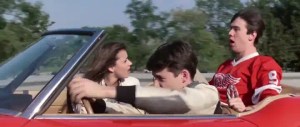
Also famous is the red Ferrari, which plays a decisive role in the film. In fact, it was not a real Ferrari 250 GT California, but a replica. Even back then, an original was extremely rare and expensive. The fact that the car still seems so mythical shows how much cinema thrives on symbols. In the film, this car is less a vehicle than a projection screen: luxury, fear, status, and destruction converge in it.
The filming locations in Chicago are also a central part of the film’s identity. Unlike many Hollywood productions that use cities merely as interchangeable backdrops, “Ferris Bueller’s Day Off” celebrates Chicago with visible affection. The architecture, the streets, the museum, the parade—all of this gives the film a distinct geographical and cultural profile. Chicago is not simply visited, but celebrated.
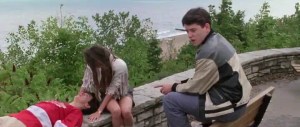
The famous parade sequence is one of the film’s greatest highlights. Ferris’s performance of “Twist and Shout” became one of the most famous musical numbers in film history. The scene embodies the spirit of the entire film: spontaneity, self-confidence, public display, and pure joy. While it is unrealistic for an entire crowd to suddenly start dancing along, it is emotionally completely convincing.
One of the film’s original quirks is Ferris’s direct gaze into the camera. Breaking the fourth wall was by no means unknown at the time, but rarely was it used so charmingly and consistently in a mainstream comedy. Ferris explains his tricks to the audience, comments on the behavior of other characters, and makes the viewers his accomplices. This narrative style reinforces his exceptional status: he seems to control not only the film world, but even the film itself.

Another frequently mentioned point is the post-credit scene, in which Ferris reappears after the official ending and essentially asks the audience why they’re still there. This brief scene was often referenced later and can seem today almost like a precursor to modern post-credits gags.
Furthermore, it is remarkable how much individual quotes from the film have entered everyday language. Above all, Ferris’s famous philosophy of life—that life moves pretty fast and you sometimes have to stop and look around so you don’t miss it—became a guiding principle for generations of viewers. It is precisely this line that elevates the seemingly lighthearted comedy to an almost existential statement.
Reviews at the Time
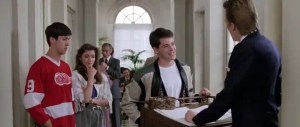
Upon its release in 1986, “Ferris Bueller’s Day Off” was received overwhelmingly positively. Many critics quickly recognized that John Hughes had once again demonstrated a keen sense of the teenage experience. Praise was directed above all at the script’s wit, the fast pace, the lighthearted direction, and Matthew Broderick’s charismatic lead performance.
It was particularly noted that, despite its over-the-top premise, the film never felt heavy-handed or cynical. It was cheeky but not malicious; satirical but not bitter. At a time when teen movies often came across as either morally didactic or purely slapstick, “Ferris Bueller’s Day Off” felt refreshingly unique. The film trusted its audience to understand irony while also perceiving emotional nuances.
Many reviewers saw Ferris as a new kind of youth figure. He was not a suffering outsider, not a sports star cliché, and not a classic problem child. Instead, he was an ironic hero who evaded the routines of everyday life with intelligence and style. That is precisely what made him attractive—but also controversial. For not all critics liked how easily Ferris got away with his deceptions.

Some contemporary critics accused the film of romanticizing rule-breaking. Ferris lies, manipulates adults, skips school, and never seems to face serious consequences. For some, this was entertaining escapism; for others, a questionable message. More conservative voices, in particular, saw the character as an expression of that pop-cultural attitude that prioritized individuality over responsibility.
Interestingly, some of the criticism was directed less at the film itself than at the enthusiasm it sparked. Ferris was celebrated as a role model, even though he comes from a privileged background, is attractive, and has an extraordinary amount of social leeway. Some critics questioned whether the film was truly universal or whether it primarily told a fantasy of effortless escape for a character who was already privileged.

Nevertheless, even back then, the praise outweighed the criticism. Alan Ruck’s portrayal of Cameron was particularly highlighted because it gave the film emotional substance. Many critics recognized that at its core, “Ferris Bueller’s Day Off” is not just about the fun of skipping school, but about Cameron’s inner liberation. This gave the film a depth that elevated it beyond a mere comedy.
Formal aspects were also viewed positively. Ferris’s direct address to the audience, the episodic structure, and the blend of realism and fantasy were considered fresh and lively. John Hughes proved once again that he could take teenage characters seriously without robbing them of their humor.
In retrospect, it can be said that the critics at the time already classified the film with astonishing accuracy: as an intelligent, stylish, and unusually life-affirming comedy whose surface humor does not overshadow deeper themes but rather makes them accessible.
Cultural Influence

The cultural influence of “Ferris Bueller’s Day Off” is enormous. The film has not only etched individual scenes, quotes, and images into the collective memory, but has also shaped a certain ideal of youthful freedom. Ferris Bueller became a symbolic figure for breaking free from routines—not in a destructive way, but in a joyful, creative one.
One reason for this lies in the universality of its core idea. Almost everyone knows the feeling of wanting to escape obligations for a day. School, work, appointments, expectations—all of this appears in the film as a system that may be necessary, but should not define one’s entire life. Ferris embodies the counter-idea: that it is legitimate to step away once in a while, as long as you are truly living in the moment.
The film influenced numerous later comedies and coming-of-age works. Many productions about clever, self-assured teenagers who outwit adults and in doing so articulate a deeper truth about freedom or authenticity follow in its tradition, at least indirectly. The motif of the “perfect day,” in which characters find themselves outside their routine, has also been reimagined in many ways.

Its influence on pop culture was particularly strong. Scenes such as Ferris’s parade appearance, the Ferrari, Cameron in front of the painting in the museum, or the final sprint home have been repeatedly referenced, parodied, and reenacted. Advertisements, TV series, and films have referenced “Ferris Bueller’s Day Off” because the film is instantly recognizable and immediately evokes certain feelings: nostalgia, lightheartedness, wit, and rebellion.
Ferris’s direct address to the audience also helped shape the style. Later characters who turn to the audience with irony and self-confidence follow a tradition to which Ferris made a decisive contribution. He turns the audience not into distant observers, but into allies.
At the same time, the film became an integral part of the discussion about youth in 1980s cinema. John Hughes portrayed teenagers not merely as problem cases or consumers, but as complex human beings with longings, fears, and a sense of humor. Within this filmography, “Ferris Bueller’s Day Off” occupies a special place because the playful is emphasized more strongly here than the melancholic—although both are present.
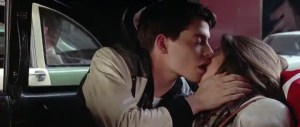
It is also remarkable how differently the film can be interpreted today. For many, it remains a feel-good movie about an unforgettable day. Others view it more critically and ask whether Ferris is truly a hero or rather a trickster. Still others interpret the film almost entirely as Cameron’s story and view Ferris as a catalyst for his development. It is precisely this openness that contributes to the film’s longevity. It is accessible enough to be immediately enjoyable, yet rich enough to be reinterpreted time and again.
Even in the digital age, the film has lost none of its impact. Perhaps it is even particularly relevant today. In a present marked by acceleration, self-optimization, and constant availability, Ferris’s message seems almost radical: You don’t have to be efficient every day. You are also allowed to simply live, observe, marvel, dance, laugh, and not just manage time, but experience it.
Conclusion
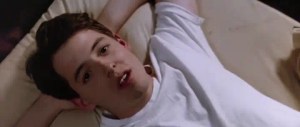
“Ferris Bueller’s Day Off” is far more than a charming 1980s teen comedy. The film combines wit, lightheartedness, and iconic imagery with themes that are surprisingly enduring: freedom, friendship, fear of authority, family pressure, and the longing to truly engage with life—if only for a moment.
John Hughes pulls off a rare balancing act here. The film is playful but not trivial; nostalgic but not backward-looking; funny but never superficial. Above all, the contrast between Ferris and Cameron is what makes it so powerful. Ferris embodies the dream of effortless escape, while Cameron represents the real difficulty of finding inner freedom. Between the two, a film unfolds that is as entertaining as it is moving.
Matthew Broderick turns Ferris into an icon, Alan Ruck gives the film its emotional depth, and the supporting characters ensure that the story never becomes one-dimensional. Added to this are precise direction, a keen sense of rhythm, and a setting that gives the film its identity. Chicago here is not merely a backdrop, but part of the film’s spirit.
The fact that the film remains so relevant today is not just due to its famous scenes or quotable lines. It is because it distills an experience that almost everyone knows: the desire to break free from it all for once, without destroying the world—simply to reconnect with oneself and life.
That is precisely why “Ferris Bueller’s Day Off” has earned its place in film history. It is light-footed and clever, ironic and warm-hearted, both of its time and timeless. And perhaps that is its greatest secret: it reminds us that a single day, lived right, sometimes means more than a whole series of properly fulfilled duties.
More
Trailer
Notice Regarding Image Rights and Copyrighted Material
All images, film stills, posters, logos, trailer excerpts and other copyrighted materials used in this article are used solely for editorial reporting, film criticism, review and illustrative purposes related to the respective content.
Unless otherwise stated, all copyrights, trademark rights and other intellectual property rights in the materials used remain with their respective rights holders, including film studios, distributors, production companies, photographers, artists or other licensors.
The materials are used in good faith and with regard to applicable legal limitations, licence terms and source attributions. If, despite careful review, any rights have been infringed or any attribution is incomplete, please contact me. Upon review, the relevant content will be removed or corrected promptly.







Schreibe einen Kommentar