


The Glass Bottom Boat you will agree, will show you the magic of the deep blue sea.
Mata Hari stops at nothing. Nothing comes between Mata Hari and what she wants.
Doris Day Between Espionage and the Space Age

When The Glass Bottom Boat hit theaters in 1966, Hollywood was in a strange transitional phase. The classic studio system still existed, but its certainties were beginning to crumble. The Production Code was losing its authority, audiences were getting younger, and the film industry was responding to television, pop culture, James Bond mania, and the ubiquitous fascination with the Space Age. At precisely this moment, Frank Tashlin’s film appeared like a dazzling hybrid: half old-school romantic comedy, half spy parody, half Space Age slapstick. This mixture alone makes it clear that the film is not simply another Doris Day comedy, but a work that very precisely reveals what American entertainment cinema of the mid-1960s dreamed of—and what it feared at the same time.
At the center is Doris Day as Jennifer Nelson, a friendly, worldly-wise woman who appears outwardly flawless and finds herself professionally immersed in a world of technology, security hysteria, and military-style secrecy. There she meets Rod Taylor as Bruce Templeton, a brilliant inventor working on a top-secret project who simultaneously falls head over heels in love with Jennifer. What initially sounds like the stuff of a conventional romantic comedy, Tashlin transforms into a delirious jumble of espionage suspicions, absurd mix-ups, mechanical household appliances, security guards in disguise, secret agents, and a humor that often stems more from exaggeration and physical comedy than from sharp dialogue.
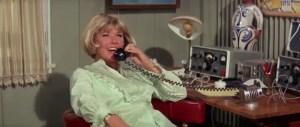
Frank Tashlin was practically predestined for this kind of tone. Before working as a live-action director, he had been a cartoonist and animator; his later signature style in films with Jerry Lewis or Jayne Mansfield always carried something of the visual exuberance of the animated film world. In The Glass Bottom Boat, this background is evident in almost every scene. Spaces, objects, and gags are not treated realistically, but rather as exaggerated comic contraptions. A kitchen is not simply a kitchen, but a futuristic maze of buttons, robots, and malfunctions. A suspicion of espionage is not merely a dramatic obstacle, but the catalyst for ever-new chain reactions of mistrust. And the love story is not the emotional center in the serious sense, but rather the charming axis around which the film lets its entire spectacle revolve.
The fact that the film is mentioned less often today than Doris Day’s greatest hits does not make it any less interesting—quite the contrary. It is not a “perfect classic,” but a film in which the ruptures, fashions, and tensions of its time are particularly evident. It shows how Hollywood attempted to combine the wholesome image and star power of an established actress like Doris Day with new trends: with the spy craze, with the pop-inspired visual language of the 1960s, with space fever, and with a slightly more irreverent, physical style of comedy. That is why it is worth viewing The Glass Bottom Boat not only as harmless entertainment, but also as a time capsule—as a work that preserves the nervous energy and playfulness of its era in a remarkably strident way.
Plot
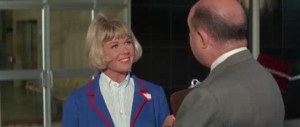
Jennifer Nelson lives on Catalina Island and leads a double life that has comedic potential in and of itself. On the one hand, she works in public relations for a space and research company involved in top-secret projects. On the other hand, she helps her father with his tourist business, appearing in a mermaid costume in connection with a glass-bottom boat. This opening immediately sets the tone for the film: it does not aim to be realistic, but rather playful, over-the-top, and almost fairy-tale-like. The fact that Jennifer encounters the male hero in this very costume is typical of Tashlin’s penchant for visual gags.
Bruce Templeton, an attractive, highly gifted scientist and engineer, first encounters Jennifer under grotesque circumstances. During a fishing trip, her mermaid tail gets caught on his fishing line, leading to a scene that oscillates between a romantic encounter, a slapstick routine, and sexual innuendo. This is not just a gag, but already a statement: Here, the classic screwball comedy is blended with the zeitgeist of the “space age” and the flirtatious tone of the 1960s. When Jennifer later discovers that Bruce is her supervisor in the lab, their acquaintance shifts from chance to professional life—and thus into a realm where misunderstandings can quickly become dangerous.
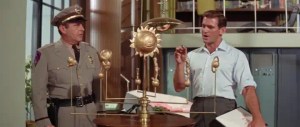
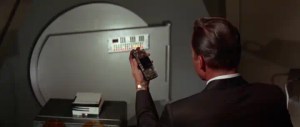
Bruce is working on a secret project that the film emphatically portrays as revolutionary and highly sensitive. This invention, which deals with the challenges of weightlessness and space travel, is exactly the kind of material that automatically becomes the object of military and intelligence desire during the Cold War. The lab is therefore not just a workplace, but a paranoid space: security personnel everywhere, suspicion everywhere, the constant fear that enemy agents are trying to steal the crucial formula. Jennifer gets caught up in this system of mistrust without fully realizing it at first.
The trigger for the actual plot is a classic case of mistaken identity, one that could not be better constructed in a farce. Jennifer behaves suspiciously in the eyes of the security guards, even though her harmless actions are completely innocent. What is particularly funny is that certain clues—such as her phone calls with someone named “Vladimir”—immediately appear to be incriminating evidence in the climate of the Cold War. What would be merely bizarre in a normal setting is interpreted here as possible evidence of Soviet contacts. The film thrives on the fact that it doesn’t take the logic of espionage seriously, but instead escalates it to the point of absurdity: the focus isn’t on the agent’s sophisticated deception, but on the stupidity of a system that transforms harmless everyday details into major threat scenarios.

This places Bruce himself in a dual position. On the one hand, he is drawn to Jennifer and wants to protect her; on the other, he is entangled in a world where every suspicion has consequences and where even intimacy can be immediately interpreted as political. Their relationship therefore does not develop in a straightforward manner. Rather, it must navigate a thicket of secrecy, mistrust, and absurd trials. It is precisely this that keeps the film in motion: instead of a quiet romantic courtship, we get a love story that is constantly sabotaged by agencies, spies, and hyperactive supporting characters.
A particular charm of the film lies in the fact that the threat never becomes entirely “serious,” yet never completely disappears either. After all, there are real spies and real criminal interests surrounding the secret project. But in Tashlin’s staging, they are repeatedly overshadowed by a higher comic principle. No one really comes across as a cold, unstoppable master agent. Rather, the world appears as a stage on which bureaucrats, security fanatics, wannabe professionals, and accidental insiders collide. In the process, Jennifer increasingly finds herself at the center of a web of surveillance and misinterpretation that she herself can barely untangle at some point.
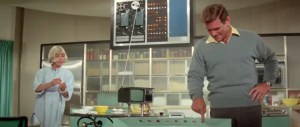
Among the most memorable episodes is the famous sequence in Bruce’s futuristic kitchen. This kitchen is less a real living space than a manifesto of 1960s technological fantasy. Everything is automated; everything is supposed to be more comfortable, faster, and more modern—and, of course, that is precisely what leads to disaster. Jennifer is literally overwhelmed by the appliances; the household takes on a life of its own. This is perhaps where the film’s humor is most clearly concentrated. Tashlin does not mock technology itself, but rather the belief that technology can eliminate all human disorder. Precisely because everything is supposed to be so perfectly organized, a minor detail is enough to cause the system to collapse. The machine as a source of chaos: this is a very modern, surprisingly enduring comic motif.
Later on, the plot escalates into ever more audacious absurdities. Jennifer is followed, eavesdropped on, suspected, and placed in situations that almost turn her into a caricature of herself. Disguises, false conclusions, and frantic attempts at rescue drive the story forward. The film relies less on logical plausibility than on rhythmic escalation. Every revelation brings new confusion; every exoneration gives rise to a different suspicion. Thus, the espionage plot becomes a mechanism of perpetual overheating.
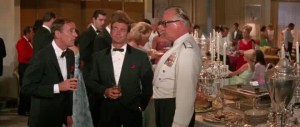
Toward the end, the plot then approaches the inevitable point where the deceptions are exposed and the actual sides become visible. The real spies and schemers emerge more clearly, Jennifer is able to free herself, at least partially, from the suspicions directed against her, and Bruce must clarify his stance between professional loyalty and personal trust. Yet even in the finale, the film remains true to its tone: It does not resolve in the strict manner of a thriller, but rather in a form of comic catharsis where action, farce, and romance merge. The plot of The Glass Bottom Boat is therefore remarkable less for its suspense in the classical sense than for its structure as a mechanical comedy: people, institutions, and devices become so entangled with one another that only a grand, absurd release can help.
Actors

The film’s greatest asset is undoubtedly Doris Day. She carries the plot not only as a star but also as the one setting the tone. Jennifer Nelson is a character who, on paper, might seem slightly one-dimensional: pretty, decent, slightly misunderstood, somehow caught between her career and romance. Day, however, makes more of it. Her performance combines friendliness with self-assertion, elegance with physical comedy. Importantly, Jennifer never remains merely a passive victim of the mix-ups. Even when she finds herself in absurd situations, Day has the ability to give her character dignity and rhythm. She can appear indignant, playful, confused, and quick-witted all at once. Her precision is particularly evident in the slapstick scenes: she never plays “below” the gag, but always right in the middle of it.
The fact that Tashlin turns her into a more physically active comedienne is a major appeal of the film. In many of her best-known roles, Day was charming and funny, but often more tied to dialogue, romance, and star presence.
Here she must run, fall, react, improvise, wrestle with contraptions, and play the plot’s grotesque demands with complete seriousness. It is precisely this that makes her funny. Her on-screen persona—healthy, smart, warm-hearted, controlled—clashes with an environment that has spiraled completely out of control. This tension makes Jennifer Nelson a surprisingly dynamic character.

Rod Taylor as Bruce Templeton is more than just a handsome counterpart. His Bruce is not the classic, confident lover, but a man who is at once a genius, a romantic, and occasionally a somewhat self-satisfied technocrat. Taylor brings a fitting blend of masculine presence and ironic lightness to the role. He convincingly conveys that Bruce is at home in a top-secret research world, yet never comes across as so grave that he grounds the film. Rather, he adapts to Tashlin’s over-the-top style without becoming a full-blown caricature. His scenes with Day work particularly well because the two form not just a glamorous couple, but a comical pair: she is more emotionally intelligent and socially adept, while he is tech-obsessed and often just a tad too convinced of his own ideas.
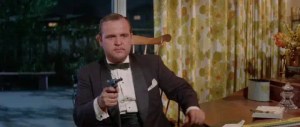
The supporting cast features an impressive array of distinctive comedic faces. Paul Lynde is a particular delight. His portrayal of the overambitious security guard Homer Cripps is one of the film’s strongest comic elements. Lynde possessed that unmistakable blend of nervousness, sophistry, and eccentric exaggeration. He seems as if he’s constantly on the verge of a melodramatic self-detonation—and that’s exactly what makes him ideal for a character who gets lost in a machinery of paranoia. When the film threatens to get tangled up in its own plot, Lynde often provides the burst of energy that gets everything moving again.
Dom DeLuise, in an early screen role, brings a different tone to the mix. Where Lynde works with sharp wit and neuroticism, DeLuise relies more on laid-back, physical comedy. His presence is immediately felt because he has that special gift of making incompetence seem almost endearing. In a film that thrives on false suspicions and overwhelmed security apparatuses, this is a huge asset. DeLuise embodies the comedy of the man who, in the midst of a high-stakes situation, comes across not as a professional but as a chance visitor.

A charming highlight is Arthur Godfrey as Jennifer’s father, Axel Nordstrom. Godfrey was best known as a radio and television personality, and his casting lends the film a peculiar warmth. He comes across less as an “actor playing a character” and more as a popular entertainer whose public persona extends into the plot. This works surprisingly well because Axel, as a father figure, doesn’t need to be psychologically complex; his main purpose is to serve as the friendly, slightly eccentric counterpoint to the high-tech and paranoid world of the lab.
There are also charming minor appearances. Alice Pearce and George Tobias, with their neighborhood dynamic, deliberately evoke their roles from the TV series Bewitched, which lends the film an additional layer of pop-cultural self-irony. Robert Vaughn makes a brief cameo appearance as Napoleon Solo—a direct nod to the then-enormously popular spy series The Man from U.N.C.L.E.. Such appearances are more than mere gags; they demonstrate how closely film and television were already intertwined in the 1960s.
Overall, The Glass Bottom Boat thrives not on deep character studies, but on precisely deployed slapstick comedy. The ensemble functions like a finely tuned clockwork mechanism, with each actor contributing a specific comedic frequency. Doris Day holds everything together, Rod Taylor anchors the romance, Paul Lynde and Dom DeLuise drive the farce, and the remaining supporting characters provide the bureaucratic, social, and media backdrop against which the spectacle can unfold.
Trivia

There are a whole host of details surrounding The Glass Bottom Boat that make the film even more interesting in retrospect. Some of them are mere curiosities, while others clearly illustrate the cultural context in which it was made.
First, of course, there is the film’s proximity to NASA. The production visibly benefited from the fascination with space travel that was nearly ubiquitous in the U.S. in the mid-1960s. The fact that the film doesn’t merely play loosely with the theme but incorporates real space-age aesthetics and a military-technological research setting gives it a unique character within the Doris Day filmography. There was even a short promotional or accompanying piece that highlighted the connection to NASA facilities. Such details show that Hollywood knew how to capitalize on the space fever of those years not only atmospherically but also as a marketing strategy.
Part of the film was shot on Catalina Island, which lends the maritime scenes a specific visual appeal. This is more than mere decoration: In the film, Catalina stands for leisure, sun, tourism, and Californian ease, while the laboratory stands for secrecy, technology, and national security. The settings alone thus reflect the film’s dual structure—vacation fantasy on one hand, the Cold War on the other.

A particularly charming anecdote concerns Doris Day’s mermaid costume. Precisely because the film’s opening scene is so iconic, this costume has become a small memento of film history. It is one of those objects that demonstrates how strongly the image of the film remains in the memory through individual props and outfits. With many classic comedies, one first recalls a line of dialogue; here, one often remembers the mermaid, the glass-bottom boat tours, the pop colors, and the technical gimmicks.
For Dom DeLuise, the film was an important early step into cinema. In retrospect, it seems almost logical to see him here, because his comedic style fits so well into Tashlin’s world. Equally notable is the appearance of Arthur Godfrey, who was better known from radio and television. The film thus also serves as an intersection of various entertainment worlds: Hollywood stars, TV personalities, comedians, and familiar faces from TV series come together in a single studio film.
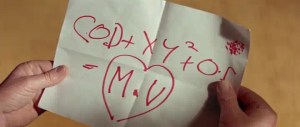
In addition, Alice Pearce, familiar to many viewers from Bewitched, made her final film appearance here. In retrospect, this lends a melancholic edge to some seemingly harmless scenes. Such historical tidbits make it clear that classic studio films often function as crossroads for various careers: for some, they mark a new beginning; for others, a farewell.
A very typical pop culture moment is the cameo by Robert Vaughn as Napoleon Solo. This brief appearance is not a narrative necessity, but an inside joke for an audience that immediately recognized which series and which spy archetype were being referenced here. This is precisely what makes the film a historical document of the spy craze. It’s clear: in 1966, the spy genre was not only successful but already so ubiquitous that it could be immediately parodied and playfully referenced.
The alternative title The Spy in Lace Panties, under which the film was released in some markets, also says a lot about the marketing strategies of the time. It attempts to sell the combination of sex appeal, silliness, and spy material in a particularly aggressive way. This is interesting for Doris Day’s image because it shows how much the marketing of her films in the 1960s played with a carefully modernized eroticism: bolder than before, but never radical; suggestive, without completely abandoning the clean and accessible.
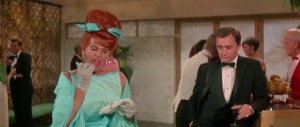
Another nice detail is the casting of Paul Lynde in drag in one of the comical surveillance scenes. Such moments remind us how heavily Tashlin’s humor relies on visibility and masquerade. Disguise here is never merely a plot device, but a spectacle. It fits into a cinematic world where identities are constantly misunderstood, played out, and put on display.
Finally, it’s worth taking a look at the technical and design aspects. The futuristic kitchen, the secret anti-gravity project, the apparatus and control rooms—all of this now feels like retro-futurism in its purest form. Back then, it was meant to appear modern, shiny, and visionary; today, it is both nostalgic and comical. It is precisely this aging that has made the film even more appealing to many later viewers. What was once a promise of the future is now a charming design relic of the past.
Contemporary Reviews
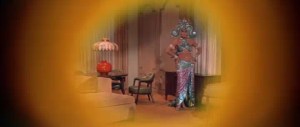
The contemporary reception of The Glass Bottom Boat was mixed, and therein lies part of its historical significance. The film was released at a time when expectations for comedy were shifting. The old Hollywood model of star-driven comedy still worked, but it was already under pressure: younger audiences demanded fresh approaches, television was aggressively competing for attention, and film critics were becoming increasingly sensitive to issues of pace, modernity, and originality. In this context, Tashlin’s over-the-top blend of screwball romance, spy spoof, and slapstick struck some reviewers as refreshing, while others found it unpalatably frantic.
There were critics who specifically highlighted Doris Day’s performance. Frank Tashlin, so the positive sentiment went, had opened up new comedic possibilities for her. Day was used more physically; she didn’t have to rely solely on charm and dialogue, but could unfold her humor through reaction, timing, and movement. Such voices saw the film as a kind of modernization of her star image: she remained recognizably Doris Day, but came across not just as prim and controlled, but as more resilient, lively, and physical.
The supporting cast was also frequently praised. Paul Lynde, Dom DeLuise, John McGiver, and Edward Andrews in particular were considered by many reviews to be a particular strength of the film. This is plausible, as they provide exactly the energy that Tashlin’s style requires: not subtle psychological comedy, but distinctive, often exaggerated characters who do not slow down the chaos but rather fuel it.
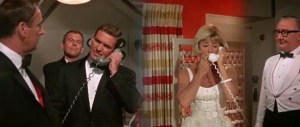
Even reviewers who found the film as a whole too loud or too mechanical often appreciated individual comedic contributions from these actors.
On the other hand, there was significant criticism of the over-the-top nature of the whole thing. Some found the film too forced, too nervous, and too eager to squeeze an extra gag out of every scene. Critics with a more literary or classical bent, in particular, reacted skeptically to Tashlin’s cartoon logic. Where his admirers saw deliberately staged exaggeration, his opponents saw nothing but hysteria. To them, the plot seemed cobbled together rather than elegant, the mix-ups loud rather than clever, the pace tiring rather than liberating.
This highlighted a classic conflict, particularly in the press of the time: Is comedy primarily about structure and style, or must it remain psychologically and narratively “believable”? Tashlin cared little for plausibility in the conventional sense. He was interested in how far one could inflate situations until they took on the character of a live-action cartoon. Those who liked this approach could see The Glass Bottom Boat as a lively, quirky delight. Those who rejected it found the film slightly annoying.
It is interesting to note that the audience response was quite decent. The film was not a commercial disaster, but found its audience. This points to a well-known divide between critics and audiences in 1960s entertainment cinema. Part of the audience didn’t go to the movies to admire subtle nuances or narrative perfection, but for stars, colors, gags, fashion, music, glamour, and simply a good time. In this regard, a film like The Glass Bottom Boat could be more successful than some reviews suggested.
In retrospect, the reviews from that time seem almost like two competing interpretations of the film. In one, it is a somewhat desperate, garish comedy that seeks to capitalize on the success of Bond parodies and Doris Day romances. In the other, it is a surprisingly skillful synthesis of both—a film that is interesting precisely because it delightfully mixes up the rules of different genres. Both perspectives have merit. And perhaps it is precisely this disagreement that explains why the film is often not perceived today as a “canonical classic,” but rather as a lovable, debatable oddity.
Cultural Influence
When asking about the cultural influence of The Glass Bottom Boat, one must first be honest: The film is not among the works that have permanently reshaped cinema or sparked an entire wave. Its influence is more indirect, symptomatic, and atmospheric than monumental. It is less a source than a magnifying glass. That is precisely why it is so appealing from a cultural-historical perspective.
First, it condenses several major trends of the mid-1960s into a single mainstream product. There is the Bond and spy craze, which, following the enormous success of the early James Bond films, spawned imitations and parodies everywhere. There is the space race enthusiasm, which allowed technical research and space fantasies to seep into even light-hearted entertainment comedies.
There is the television influence on pop culture, visible in guest appearances, recognition effects, and the use of actors the audience knew from TV series. And finally, there is a form of retro-futurism that uses household appliances, control rooms, fashion design, and technical surfaces not merely as a backdrop, but as vehicles for humor and a sense of the times.
The film also shows how Doris Day’s star image was to hold its own in a changing culture. For a long time, Day stood for a kind of high-gloss decency, for sexual tension without actually crossing any lines, for a woman who was modern enough to be career-oriented and quick-witted, yet remained anchored in a morally secure world. The Glass Bottom Boat attempts to carry this image into the mid-1960s by giving it a new look: more physical comedy, more fashionable sass, more pop colors, more spy spoof. In this respect, the film is an important document of how star systems react to cultural change. It shows not a radical break, but a clever adaptation.
Frank Tashlin’s signature style is crucial to this. His style combines classic Hollywood comedy with elements that were later often described as camp, pop-like, or comic-strip-esque. At a time when American cinema was slowly moving away from the polished studio ideal, Tashlin created works that already seemed very deliberately artificial. The Glass Bottom Boat is therefore also an example of how the mainstream began to play up its own artificiality. Colors, gags, props, and performances are not hidden but demonstratively on display. This has attracted later audiences who love not only the story but also the stylistic surfaces of films.
Its cultural value also lies in the fact that it portrays the Cold War in the mode of farce. Instead of heroic agents or serious geopolitical conflicts, we see mistrust, bureaucracy, and nervousness as the source of comical confusion. This is revealing, because pop culture often processes political tensions not through direct analysis, but through comic release. In this sense, the film is a document of how the American entertainment industry dealt with fear: by transforming it into a colorful, controllable, and slightly sexually charged comedy.
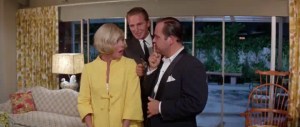
The film is also interesting in terms of the relationship between film and television. Cameos, character constellations reminiscent of TV series, and the presence of media personalities show that Hollywood had long since ceased to operate in an isolated cinematic world. Pop culture was already interconnected; recognition had become a commodity. A brief appearance could have the same appeal as a plot detail. This kind of intermedia interplay seems natural today, but at the time it was an important sign of how forms of entertainment were merging.
Not least, the film has developed a kind of afterlife as a cult object—not in the sense of a massive fanbase, but as a rediscovered piece of 1960s aesthetics. Today, many aspects of it are particularly appealing: the costumes, the production design, the blend of innocence and suggestiveness, the vision of a future that has itself become historical.
Its futuristic gadgets are no longer the future, but design nostalgia; its spy paranoia is no longer immediately political, but part of a stylized era. As a result, the film has perhaps gained more cultural significance in retrospect than it possessed at the time of its release.
In short: The Glass Bottom Boat influenced culture less by being copied by other films than by serving today as an exemplary illustration of what 1960s mainstream cinema looked, sounded, and thought like. It is a pivotal film—between the studio era and upheaval, between romantic comedy and spy spoof, between polished star image and pop-infused overstimulation.
Conclusion

The Glass Bottom Boat is neither a quiet masterpiece nor a film that derives its impact from elegant perfection. It is too loud, too colorful, too playful, and too enamored with its own devices to embody anything resembling classical restraint. But that is precisely where its charm lies. Frank Tashlin takes an already absurd premise—a part-time mermaid is mistaken for a Soviet spy in a space laboratory—and turns it not into a halfway plausible entertainment film, but into a radically artificial comedy in which technology, the Cold War, gender play, and slapstick merge into a single pop machine.
In it, Doris Day demonstrates once again why she ranks among the great stars of classic Hollywood, while also showing just how versatile her image could be. She remains the familiar Doris Day, yet here she is deployed in a more physical, wild, and comically resilient way than in many of her later comedies. Rod Taylor complements her solidly and charmingly, while the supporting cast repeatedly infuses the film with that over-the-top energy that saves it from being mere formula.

Anyone watching the film today will discover in it not just a light comedy, but a rich cultural product of the 1960s: full of space-age optimism, spy fears, television references, design fantasies, and the clever marketing of glamour and innocence. Some gags have aged, some punchlines are very much tied to their time, and not every scene carries the same comic weight. Yet precisely as a time capsule, a transitional film, and a showcase for Tashlin’s cartoonish direction, The Glass Bottom Boat possesses a unique, enduring charm.
Perhaps that is the best way to appreciate it today: not as the greatest Doris Day film, nor as the most perfect spy parody, but as a quirky, brilliant, wonderfully strange comedy that reveals a great deal about the moment in which it was created. Anyone interested in American entertainment cinema of the 1960s, in the intersection of studio aesthetics and pop modernism, or simply in over-the-top slapstick with a space-age flair will find far more than just nostalgia in The Glass Bottom Boat. The film is a slice of Hollywood in a state of transformation—and for that very reason, it’s worth seeing.
More
Trailer
External links
Notice Regarding Image Rights and Copyrighted Material
All images, film stills, posters, logos, trailer excerpts and other copyrighted materials used in this article are used solely for editorial reporting, film criticism, review and illustrative purposes related to the respective content.
Unless otherwise stated, all copyrights, trademark rights and other intellectual property rights in the materials used remain with their respective rights holders, including film studios, distributors, production companies, photographers, artists or other licensors.
The materials are used in good faith and with regard to applicable legal limitations, licence terms and source attributions. If, despite careful review, any rights have been infringed or any attribution is incomplete, please contact me. Upon review, the relevant content will be removed or corrected promptly.








Kommentar verfassen