

Pacifica Training School – Lyran Commonwealth Armed Forces
Congratulations!
Your achievements in the classroom have earned you a berth at the Pacifica Training School,
one of the Lyran Commonwealth’s premiere BattleMech training facilities.
Here, you will undertake the final stage of your preparation for MechWarrior certification.
Cadet Years in the Inner Sphere
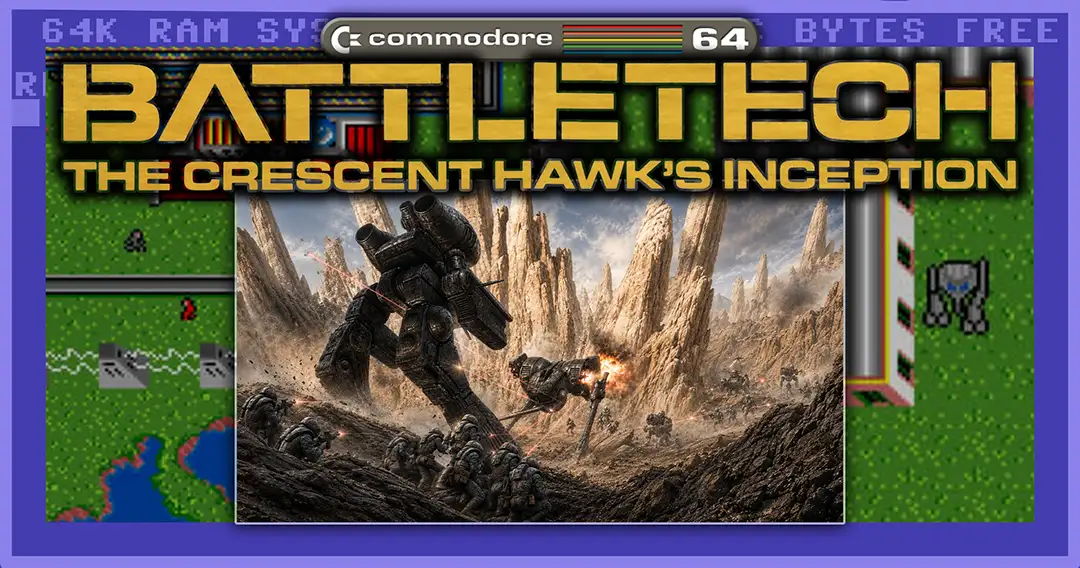
When BattleTech: The Crescent Hawk’s Inception was released on home computers in the late 1980s, the world of BattleTech had long since become more than just a tabletop game featuring giant combat robots. With the Inner Sphere, the Succession Wars, the Great Houses, and the iconic BattleMechs, FASA had created a universe that practically begged for a digital adaptation. The game was released on the Commodore 64 in 1989, bringing Westwood Associates’ role-playing approach to a computer known not only for its strong game library but also for its technical limitations. At a time when many licensed games merely used well-known names, The Crescent Hawk’s Inception actually attempted to capture the atmosphere and backstory of the BattleTech universe. This set it apart from numerous science fiction games of its era. At the same time, the game demonstrated that complex backstories could be told on home computers without relying exclusively on action or spectacular effects. For many players, this was one of their first encounters with the extensive lore of the BattleTech universe.
The story centers on Jason Youngblood, a young MechWarrior cadet on Pacifica, also known as Chara III. He is the son of the famous Jeremiah Youngblood and trains within the sphere of influence of the Lyran Commonwealth. What begins as training turns into a story of escape and resistance following an attack by the Draconis Combine. It is precisely this blend of personal drama, military science fiction, and tabletop flair that makes The Crescent Hawk’s Inception compelling to this day. Instead of immediately casting the player as an experienced hero, the game tells a classic coming-of-age story set against the backdrop of a galactic conflict. This creates a stronger connection to the main character and their development than in many comparable games of that era. The plot also conveys a sense of how political conflicts and military confrontations can affect the lives of individual people. It is precisely this personal perspective that lends the story additional credibility and emotional impact.
Gameplay
In terms of gameplay, The Crescent Hawk’s Inception is an unusual blend of role-playing, adventure, and tactical combat. At the start, you guide Jason through the Citadel, visit training facilities, improve skills, and earn C-Bills. It’s not just about piloting a BattleMech, but also about classic character stats: melee, firearms, medicine, engineering, and piloting skills all play a role. These stats noticeably influence gameplay and allow for different playstyles to develop. Players who invest early in certain skills may gain different advantages than those who focus on combat or engineering. This creates a surprisingly high degree of customization, which was by no means standard for a game of that era. Character development encourages players to experiment with various strategies and carefully weigh their decisions.
The appeal lies in the fact that the game doesn’t immediately launch into full-throttle mech action. It starts by having the player serve as a cadet. You get to know the world through training, equipment, small successes, and conversations. Only when the Citadel is attacked does the game open up more fully: Jason must survive, find allies, gather the scattered Crescent Hawks, and hold his own against Kurita forces. This slow build-up ensures that the subsequent escalation feels significantly more impactful. The events don’t feel like just another mission, but like a personal catastrophe that alters the main character’s entire life path. At the same time, this introduction conveys a sense of everyday life and normality before the plot dramatically picks up speed. As a result, the later challenges feel more significant and emotionally relatable.
Combat is turn-based. Movement, weapon selection, and targeting are controlled via menus. This applies to both ground battles and mech duels. A particularly appealing aspect is that damaged or captured mechs aren’t just props but part of your progression. If you want better equipment, you have to fight, repair, sell, save, and plan. At the same time, the game has a rough pace: random battles, loading times, and some search tasks can feel tedious today. Nevertheless, this creates a sense of resource management that fits well with the BattleTech source material. Every battle costs time, ammunition, and often money as well, giving decisions more weight than in many action games. The tactical elements ensure that even smaller skirmishes have significance and don’t merely serve as obstacles on the way to the next story sequence. Those who act rashly can quickly lose valuable resources.
In the final section, the game shifts more toward a puzzle- and exploration-based adventure. The finale in an old Star League facility is atmospheric, but also notorious: the door and color codes are among the parts of the game that many players remember more as a test of patience than as elegant design. At the same time, this section conveys a sense of mystery and discovery that fits perfectly with the backstory of the Star League’s lost technologies. Fans of BattleTech lore in particular often appreciate this part more than casual players. The mysterious atmosphere is reminiscent of classic science fiction adventures in which ancient facilities and forgotten technologies play a central role. This gives the finale a character all its own, one that differs significantly from the previous sections of the game.
Technology
On the C64, BattleTech is functional rather than spectacular. The perspective is mostly a bird’s-eye view, which fits well with its tabletop origins. Characters, buildings, and mechs are clearly recognizable but not particularly finely drawn. In combat scenes, simple animations and small cutscenes add a touch of drama. However, given the limitations of the Commodore 64, the game achieves something remarkable by managing to combine a comparatively large game world, numerous characters, and diverse combat situations. What’s particularly impressive is how many systems and game mechanics are managed simultaneously. Despite the limited hardware, the game succeeds in presenting a credible and cohesive world.
The sound is typically ambivalent: the title screen features music, while sound effects dominate the gameplay itself. While this fits the game’s sober tactical atmosphere, it makes the long exploration phases feel rather sparse acoustically. The loading times are particularly noticeable. Players who ran the game from a floppy disk had to be patient, especially when entering buildings or switching between game areas. By the standards of the time, however, this was not uncommon but was part of everyday life for many more complex C64 games. Nevertheless, the frequent loading pauses could noticeably disrupt the flow of the game. At the same time, the sound effects helped lend a certain dynamism to battles and actions. Even if the audiovisual presentation seems simple today, it served its purpose and sufficiently supported the gameplay.
It is interesting to note that the C64 version is not simply a weaker version of the 16-bit and PC versions. There are differences in map details, in certain mech encounters, and in the progression of individual situations. Some fans even view the C64 version as particularly charming because, despite technical limitations, it offers a surprisingly complete BattleTech experience. It is precisely the fact that large parts of the plot and game mechanics were preserved that makes this adaptation remarkable. Many other licensed games had to make significantly greater compromises on 8-bit systems. As a result, the C64 version still holds its own special place within the fan community to this day. It impressively demonstrates how ambitiously developers were able to work with limited technical resources back then.
Trivia
Even the title is a bit of a curiosity. Strictly speaking, it should be called “Crescent Hawks’ Inception” because it’s about the Crescent Hawks unit. The officially used spelling with “Hawk’s,” however, stuck and became part of the game’s history. Over the years, this small grammatical error has become an integral part of the brand and is often mentioned by fans with a smile. This detail regularly comes up in community discussions and has almost become part of the game’s cult status. Such quirks often help a title remain memorable in the long term.
Another nice detail is the promotional material. The packaging and inserts attempted to create the feel of a genuine BattleTech product, not just a licensed computer game. The promotion surrounding a limited-edition Phoenix Hawk LAM miniature by Ral Partha, which players could receive under certain conditions, became particularly famous. For collectors, this connection between the computer game and the tabletop miniature is now a particularly appealing part of BattleTech history. Such promotions were relatively rare at the time and demonstrate how closely the computer game and the tabletop brand were intended to be intertwined. They also illustrate how important fan engagement and brand management were as early as the 1980s. For many collectors, these freebies hold considerable nostalgic and material value today.
There’s also a lot of tabletop DNA within the game itself. Mech types like Locust, Wasp, Stinger, or Chameleon aren’t just names; they represent a system of weapons, armor, movement, and damage mechanics. Even though the computer game simplifies many things, it never feels like just another generic robot franchise. It aims to be BattleTech. Anyone familiar with the source material will recognize numerous references and details that make it clear the developers have thoroughly immersed themselves in the background lore. This attention to detail contributes significantly to the game’s authenticity. Even minor elements convey the feeling of being part of a larger, carefully crafted universe.
Canon
The canon question is more intriguing in The Crescent Hawk’s Inception than in many other licensed games. The game itself is not fully considered hard BattleTech canon. Computer and video games were long treated as apocryphal: officially licensed, but not automatically binding to the main continuity. This approach was quite common in the franchise’s early years, as different media were often viewed separately from one another. This allowed writers and developers to work more creatively without having to strictly adhere to every existing piece of background information. At the same time, however, this repeatedly led to discussions within the fan community.
Nevertheless, The Crescent Hawk’s Inception is important to the lore. Jason Youngblood, Jeremiah Youngblood, the Crescent Hawks, and their connection to the Kell Hounds were later picked up in BattleTech publications. The events of the game are thus not binding in every mechanical detail, but their general storyline and characters have left their mark on the official universe. This gives the game a special status: it stands, so to speak, between a standalone adventure and official lore. Many later publications picked up on individual elements and integrated them into the larger context of the BattleTech chronology. As a result, the game’s influence endured beyond its actual release.
This is precisely why the game is more than just a nostalgic side product for BattleTech fans. It is an early attempt to portray the Inner Sphere not merely as a battlefield, but as a walk-in role-playing world. You’re not just a nameless MechPilot in an arena, but a young person caught up in a political and military conflict. This perspective lends the universe additional depth and shows how the lives of ordinary Inner Sphere residents are affected by the great power struggles. At the same time, it makes it clear that BattleTech encompasses far more than spectacular Mech battles. It is precisely the human stories in the background that give the franchise its special appeal.
Reviews at the Time
The reception at the time was mixed. Some magazines viewed the idea positively but criticized the pacing, technology, and execution. The C64 version, in particular, was described by parts of the press as drawn-out, technically mediocre, and interesting primarily for die-hard genre or BattleTech fans. Scores hovering around the 50–60 percent mark show that the game was by no means a unanimously celebrated classic at the time. Many reviewers also compared it to other role-playing games of the era and concluded that the presentation didn’t always keep pace with the ambitious ideas. The slow gameplay pace, in particular, was frequently criticized. Nevertheless, many editors acknowledged that an unusually ambitious concept lay behind the game.
Other voices were more favorable. Magazines and players with a stronger interest in role-playing and tabletop games, in particular, praised the atmosphere, the background world, and the blend of character development and Mech combat. The Crescent Hawk’s Inception was not a fast-paced action title. Those expecting immediate explosions and fluid arcade action were disappointed. But those who wanted to delve into stats, equipment, lore, and slow progression found an unusually ambitious game. The combination of role-playing and the BattleTech setting was frequently highlighted as a particular strength. Many fans also appreciated the opportunity to experience the world of BattleTech from a more personal perspective. As a result, the game evolved over the years into an insider’s tip within the community.
From today’s perspective, this divide seems understandable. The game is sluggish, sometimes clunky, and technically not elegant. At the same time, it possesses an identity that many smoother licensed games lack. It’s not just BattleTech as a brand, but BattleTech as everyday life: training, money worries, repairs, equipment, loyalty, betrayal, and the constant risk that the next battle will be too expensive. It is precisely these aspects that ensure the game is often viewed more favorably in retrospect than it was at the time of its release. Modern players and historians today frequently recognize the significance of its ideas more strongly than the trade press did back then. As a result, its reputation has improved significantly over the years.
Cultural Influence
The cultural influence of The Crescent Hawk’s Inception lies less in sales records or mass appeal than in its role as an early digital gateway to the BattleTech world. For many players, it was one of the first opportunities to experience the Inner Sphere not just through rulebooks or novels, but to actually walk through a city, pilot Mechs, and build a small unit. In doing so, the game helped make the brand known beyond the confines of the tabletop hobby. It demonstrated that BattleTech could also function as an interactive adventure and did not have to take place exclusively on the gaming table. This step was of great significance for the brand’s long-term development.
Furthermore, the game marks the beginning of a long series of BattleTech and MechWarrior computer games. Later titles often focused more heavily on simulation, real-time tactics, or action. The Crescent Hawk’s Inception, on the other hand, pointed in a direction that was rarely pursued later on: a BattleTech role-playing game with a personal perspective, party building, and a narrative campaign. Many fans still wish for a modern reinterpretation of this concept, as the blend of story and strategy continues to hold great potential. Especially at a time when role-playing games are once again very popular, such an approach could be successful once more. The game therefore feels surprisingly modern in some respects.
The game is also interesting for Westwood. The studio would later go on to make strategy history with Dune II and Command & Conquer. In The Crescent Hawk’s Inception, you don’t yet see a real-time strategy masterpiece, but you do see a knack for licensed worlds, clear game systems, and the combination of story and strategy. In retrospect, the game feels like an early building block in the development of a studio that would later become one of the most important names in strategy game history. Some design ideas and approaches already hint at why Westwood would later become so successful. This gives the game a certain historical value even outside the BattleTech context.
Conclusion
BattleTech: The Crescent Hawk’s Inception is not a perfect game on the C64. It is slow, clunky, technically rough in places, and clearly too drawn-out in some sections. Yet it possesses something that many more polished productions lack: character. Its strengths lie less in its presentation than in its ability to convey a credible science fiction world and let the player become part of that world. It is precisely this atmosphere that ensures the game still has a loyal fan base decades later. Its weaknesses are obvious, but its qualities remain just as unmistakable.
As a C64 game, it is an ambitious attempt to translate a complex tabletop universe onto an 8-bit computer. As a BattleTech game, it offers an early glimpse of the Inner Sphere as a role-playing setting. And as a piece of gaming history, it is a fascinating precursor to the Mech games that would shape the image of BattleTech on the computer in the 1990s and beyond. That is precisely why it holds a special place in the franchise’s history today. It impressively demonstrates how ambitious developers were able to create remarkable gaming experiences even under technical constraints. Its influence may have been indirect, but it is still felt today.
Anyone jumping in today will need patience and a certain love for old-school RPGs. But those who bring these qualities to the table will find a game that, despite its rough edges, still conveys why BattleTech is more than just giant robots with rocket launchers: it is a universe of politics, loyalty, technology, loss, and the dream of somehow surviving another day in a rickety Mech. It is precisely this blend of personal story and grand galactic conflict that makes The Crescent Hawk’s Inception a remarkable title even decades after its release. For fans of classic computer role-playing games and BattleTech enthusiasts, it therefore remains a fascinating historical document that represents an important chapter in the franchise’s history.







Kommentar verfassen