

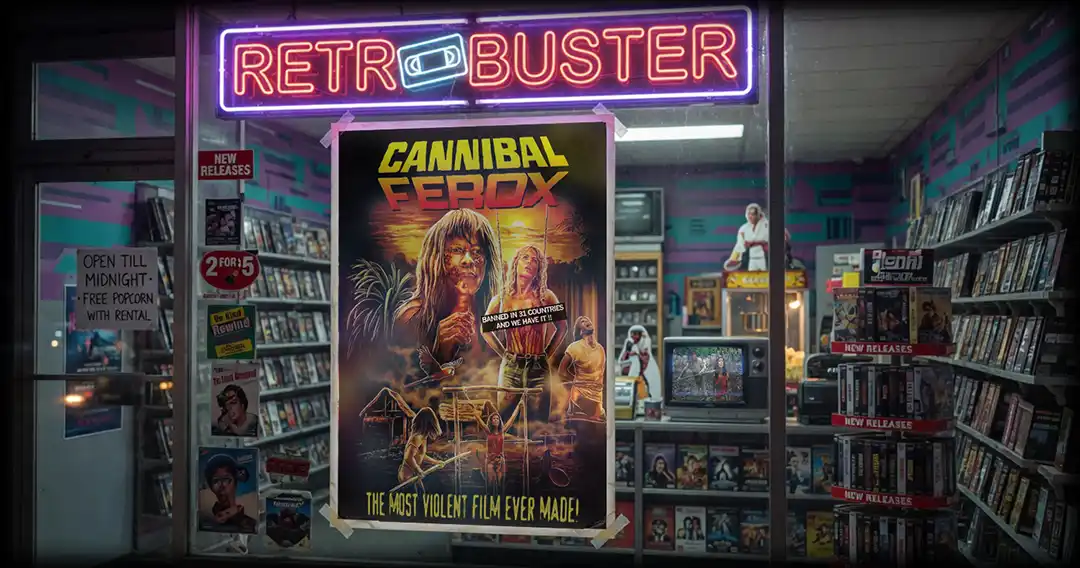
For obvious reasons, this article does not include any screenshots
A Milestone in Italian Cannibal Horror
In the history of exploitation cinema, Cannibal Ferox (original title: Cannibal Ferox, German distribution title: Die Rache der Kannibalen) occupies a unique place—one that is both notorious and still hotly debated today. Directed by Umberto Lenzi in 1981, this Italian horror film is part of the so-called “Cannibal Boom” of the 1970s and early 1980s, a wave of jungle, adventure, and horror films that shocked audiences with extreme depictions of violence, pseudo-ethnographic curiosity, colonial fantasies, and—not infrequently—actual footage of animal cruelty. Lenzi, who had already made an early and style-defining contribution to the genre with Il paese del sesso selvaggio (1972, often marketed internationally as Man from Deep River), brought this development to a particularly aggressive, sordid, and nihilistic conclusion with Cannibal Ferox. To this day, quite a few fans and critics interpret the film as a direct response to or rival of Ruggero Deodato’s Cannibal Holocaust from 1980.
The film premiered in Italy on April 24, 1981, and was distributed internationally under various titles. In the U.S., it was primarily released as Make Them Die Slowly, a title that already revealed the sadistic marketing strategy. Other international titles such as Woman from Deep River or alternatively used exploitation labels were intended to link the work as sensationalistically as possible to earlier genre successes. The American distributor Aquarius Releasing promoted the film by claiming it was “the most violent film ever made” and also spread the rumor that it had been banned in 31 countries. While this statement, in its absoluteness, was primarily a marketing ploy, it proved to be extraordinarily effective. In the exploitation genre in particular, the ban itself became a seal of approval: the more a film was allegedly suppressed, confiscated, or banned, the more sought-after it became on the home video market, among collectors, and among fans of transgressive cinema.
In fact, Cannibal Ferox very quickly got caught up in the moral panic that became known, particularly in the UK, under the label “Video Nasties.” The film ended up on the infamous list of titles deemed socially harmful and was censored, confiscated, or only permitted in mutilated versions in several countries. Its reputation, however, was not fueled solely by rumors or PR strategies. Produced on a budget of well under a million dollars, the film combines a primitive, raw aesthetic with drastic splatter effects and a conspicuous delight in breaking taboos. For gore fans, this made it a cult object; for opponents of the genre, however, it became a prime example of tasteless, inhuman, and animal-abusing sensationalist cinema.
The Cannibal film cycle itself did not emerge in a vacuum. It drew inspiration from the Mondo documentaries of the 1960s, such as Mondo Cane, which presented exoticized images of “foreign” cultures under the guise of ethnographic authenticity, thereby capitalizing on curiosity, voyeurism, and shock value.
Italian genre cinema adopted these strategies, combining them with adventure film, horror, softcore, jungle action, and splatter, thereby creating a mix suitable for international export. At the center was usually a colonial-tinged perspective: the Western intruder travels to a supposedly untouched world and triggers chaos, violence, and ultimately barbaric retaliation there. Cannibal Ferox initially follows this formula quite closely, but pushes it into the realm of the cynical in several respects. The film is less interested in character development or psychological credibility than in escalation, confrontation, and the constant subversion of civilizational self-images.
Lenzi himself later emphasized on several occasions that he viewed the cannibal film as a reaction to market trends and as a technical commission. At the same time, he liked to cast himself as the true pioneer of the subgenre and portrayed Deodato’s success as a continuation of his own ideas. This discourse of competition is important for the film’s reception because Cannibal Ferox was often perceived less as a standalone work than as an afterthought or counterpart to Cannibal Holocaust. While Deodato’s film relies more heavily on media satire, documentary structure, and a meta-level, Lenzi’s contribution is rawer, more direct, and more firmly committed to the traditional exploitation formula. For some, this is precisely where its “honesty” lies: the film makes little pretense of being a socially significant work of art, but openly demonstrates that it aims to shock, provoke, and test boundaries.
Yet it is not quite that simple. Behind all the starkly staged brutality, Cannibal Ferox explores several themes that the genre repeatedly circles around: Western greed, drug trafficking, the exploitation of indigenous groups, sexual violence, the collapse of civilizational facades, and the question of who, in such a constellation, can even be described as “barbaric.” The film asserts that it is not the so-called savages, but rather the modern, Western actors who create the cycle of cruelty in the first place. However, it does so in a way that is itself marked by racist and sexist patterns. It is precisely from this tension that the work derives its provocative power, which endures to this day.
With a runtime of around 93 minutes in the uncut version and significantly shorter runtimes in censored versions, Cannibal Ferox remains a film that does not pander to its audience. It is at once a historical document, a sleazy production, a politically ambiguous revenge tale, a vehicle for special effects, and a touchstone for questions of ethics in cinema. For some, it is a seminal work of extreme horror and an uncompromising expression of Italian genre cinema. For others, it is above all a cynical piece of trash that masks real cruelty with flimsy social criticism. Precisely for this reason, it merits closer examination. The following covers the content, characters, actors, aesthetic elements, production context, controversies, censorship history, contemporary and modern criticism, as well as the enduring legacy of this film, which is as notorious as it is influential.
Plot
The plot of Cannibal Ferox is typical of the genre in its basic structure, yet it develops an almost nightmarish consistency from this simplicity. A group of Western characters ventures into the Colombian rainforest, convinced that they can explain, map, or scientifically interpret reality. There, however, they encounter not only a foreign environment, but above all the consequences of Western violence. The crucial point is this: the catastrophe that later appears as “cannibal horror” is not presented in the film as the jungle’s original state, but as a reaction to brutal external interventions.
At the center of the plot is Gloria Davis, played by Lorraine De Selle, a young anthropology student from New York. Gloria has developed a provocative academic thesis: Cannibalism, she argues, is less an anthropological reality than a colonial myth used to justify the exploitation of indigenous societies. Together with her brother Rudy and her friend Pat, she travels to the Amazon region to find evidence for this position. This premise alone is intriguing because the film introduces its protagonist as an enlightened, academically educated representative of a liberal worldview. Gloria wants to dispel prejudices; she believes in research, reason, and moral discernment. Yet the film undermines this approach from the outset and raises the question of whether her stance stems from genuine humanism or from naive, Western self-assurance.
The opening scenes establish a contrast between urban modernity and an archaically stylized jungle setting. In New York, elements of drug trafficking, crime, and violence, which later recur in the Amazon. In doing so, the film suggests early on that the city is by no means the moral antithesis of the “wilderness.” Rather, the characters travel from an already corrupt world into a zone where this corruption becomes more visibly uninhibited. This premise is central to the film: Cannibal Ferox does not really aim to show a juxtaposition of civilization and barbarism, but rather a reflection. What is hidden in the West behind facades, uniforms, institutions, and books bursts forth openly in the jungle.
Along the way, Gloria, Rudy, and Pat encounter Mike Logan and Joe Costolani, two criminals hiding out in the rainforest. Mike is the dominant, sadistic, and highly unpredictable half of the duo. Joe initially appears weaker, sicker, and almost pitiable, but he is also deeply involved in the violent excesses. Both men have terrorized the local population to profit from smuggling, drugs, and precious stones. They have abused, humiliated, and killed people, pitted tribespeople against one another, and instilled fear through a mix of weapons, drugs, and sadistic arbitrariness. In doing so, the film establishes its central cause-and-effect logic: the cannibals’ subsequent acts of revenge do not come out of the blue, but follow Western brutalization.
The group arrives in an almost deserted village where a menacing silence reigns. Joe is seriously injured, feverish, and near death, while Mike continues to try to control the situation through aggression, bluffing, and violence. Piece by piece, the film reveals through conversations, flashbacks, and observations what has happened previously.
Mike and Joe have not merely lost their way or stumbled into an adventure, but have actively built a system of terror. Mike, in particular, crosses every moral boundary. Under the influence of drugs, he tortures locals, murders out of sadism, abuses women, and regards the jungle as a lawless zone where he can give free rein to his violent fantasies. Joe is less dominant in this regard, but by no means innocent; he is a follower, a profiteer, and an accomplice.
The deeper Gloria and her companions are drawn into this situation, the more their original research mission falls by the wayside. What begins as an anthropological search for truth tips over into a struggle for survival. The film uses this shift to destabilize its protagonist’s academic perspective. Gloria can no longer analytically control the situation. Her thesis that cannibalism is merely a colonial myth is not simply logically refuted, but shattered under conditions of extreme violence. It is noteworthy, however, that the film does not completely ridicule her conviction. Instead, it suggests that cannibalism is only just being triggered here by Western cruelty. The natives do not initially appear as naturally bloodthirsty monsters, but as a community reacting to the sadistic attacks of the intruders.
The escalation unfolds in several stages. First there is uncertainty, then claustrophobic tension, and finally open terror. Mike rapes and abuses Pat, humiliates other characters, and murders a native woman in one of the film’s most notorious excesses. This scene is central not only because of its brutality, but also because of its function within the narrative: it definitively marks the point at which every boundary has been crossed. From this point on, the cannibals’ retribution is inevitable. The film thus constructs a model of vengeance in which cruelty provokes counter-cruelty without creating a moral equilibrium. All those involved are drawn into a cycle that destroys any hope of salvation, insight, or reconciliation.
What follows are the scenes that define the film’s reputation to this day. Mike is captured and tortured in a cage. In one of the most notorious sequences, he is castrated; later, he loses additional body parts and ends up in a particularly macabre state of physical destruction. The impact of these scenes rests not only on special effects, but on the demonstrative slowness with which the film exposes the suffering. Here, violence is not merely action, but spectacle. The audience is not meant to be able to look away, but is forced to physically empathize with the consequences of the sadism established earlier. This is precisely what complicates the question of whether the film criticizes violence or relishes in exploiting it. On the one hand, it punishes Mike as an example; on the other, it uses his torture as the climax of the spectacle.
Rudy experiences a different, no less cruel fate. His escape fails; he falls into a trap, is overwhelmed by both the hostile environment and the cannibals, and ultimately dies in a convergence of animal attack and human pursuit. In these moments, the jungle does not appear as idyllic nature, but as a space where every wrong decision can immediately become fatal. At the same time, the film emphasizes that nature is not murderous in and of itself, but becomes a death zone in conjunction with human violence.
Pat, in turn, is the subject of one of the film’s most shocking images: she is hung by her breasts on hooks and slowly tortured to death. This scene has sparked particularly heated discussions because it simultaneously sexualizes violence against a female body and stylizes it as an iconic horror tableau.
Gloria remains as the last central survivor. A local man helps her escape but sacrifices himself in the course of her rescue. This, too, is typical of the film’s ambivalence: the indigenous man appears here as human and supportive, yet narratively remains ultimately a function for Gloria’s survival. After she leaves the jungle and returns to the Western world, the possibility of truth, testimony, and moral reckoning initially seems to exist. Instead, one of the film’s most bitter twists follows. Gloria publishes a book titled Cannibalism: End of a Myth and, in it, denies the actual course of events. She sticks to her original thesis or, at the very least, rephrases it so that it remains compatible with her self-image.
This ending is crucial to the overall interpretation. Cannibal Ferox does not end with a classic rescue, but with a lie. Gloria, who began as an enlightened scientist, becomes a co-producer of a false narrative. This can be read as a bitter commentary on academic vanity, on Western self-justification, or on the impossibility of honestly conveying such a trauma at all. At the same time, the conclusion confirms the film’s deep cynicism: There is no catharsis. Experience does not yield insight, but rather repression, distortion, and new hypocrisy. The true barbarism, therefore, lies not solely in the jungle, but in the civilized world’s ability to translate its own violence into neat concepts, books, and theories.
Narratively, Lenzi works in a less experimental manner than Deodato. Whereas Cannibal Holocaust plays with found footage, media reflection, and documentary framing, Cannibal Ferox largely sticks to a classic, linear narrative style supplemented by flashbacks. This simplicity is not a flaw in a technical sense, but part of the concept. The film does not aim to be an intellectual puzzle, but a direct blow. The figures are archetypes rather than complex characters: the idealistic academic, the naive brother, the vulnerable girlfriend, the sadistic psychopath, the corrupt accomplice. Yet it is precisely this typification that allows the film to use them as vehicles for specific attitudes and social patterns.
It is also striking how the film works with real animal victims. The dissection of a turtle, the killing or display of animals, and other documentary-style interludes are only loosely connected to the plot, but serve as an additional transgression. They are intended to create authenticity, grime, and immediacy while simultaneously heightening the level of disgust. Today, these scenes are particularly disturbing because they break down any distance between fiction and actual violence. In the context of the plot, they underscore the thesis that no one in this world is innocent and that exploitation extends all the way down to the level of the film footage itself.
Overall, the plot of Cannibal Ferox is thin but functional. It offers no subtly developed dramaturgy, but rather a framework upon which provocation, gore, and a primitive form of social criticism are hung. This is precisely where its effectiveness lies.
The plot serves as a sequence of expedition, revelation, punishment, and deception. From today’s perspective, this can be read as an exploitative moral fable: the West brings violence to the jungle, the jungle responds with violence, and in the end, the deception returns to the city. As simple as this structure is, it has left a lasting imprint on the memory of genre cinema.
Actors and Characters
The cast of Cannibal Ferox consists of faces typical of Italian exploitation cinema of that era: no international A-list stars, but experienced actors and actresses who worked in horror, crime, erotic, and adventure productions and often appeared under anglicized pseudonyms. This practice served not only to improve marketing abroad but also to reinforce the appearance of an international production. For many of these actors, working in such films was a balancing act between earning a living, genre routine, and the danger of being permanently identified with notorious material.
Giovanni Lombardo Radice, alias John Morghen, leaves the strongest mark on the film. As Mike Logan, he delivers a performance that oscillates between unrestrained overacting, charismatic menace, and genuine physical intensity. Mike is not a psychologically nuanced character, but rather a sadistic catalyst for escalation. Radice, however, succeeds in transforming this cliché into a memorable screen presence. His facial expressions, his fluctuating tone of voice between cold dominance and drug-induced loss of control, as well as the complete lack of inhibition in his physical performance, make Mike one of those characters who is remembered not for his depth, but for his unsettling energy. Precisely because Mike is so over-the-top, he becomes an icon of Italian horror cinema.
Radice himself later spoke out critically on several occasions about the conditions under which the film was made. He lamented not only the actual animal cruelty but also the brutality of the production atmosphere. His refusal to participate in certain scenes, particularly the killing of a pig, has become a frequently cited part of the film’s reception history. In retrospect, this distancing lends his performance an additional layer: the man who embodies the sadistic perpetrator of violence on screen was, behind the scenes, one of those who raised moral objections. This makes his later cult status particularly ambivalent. He became famous precisely through a role toward which he himself developed a critical stance.
Lorraine De Selle as Gloria Davis embodies the antithesis of Mike. She does not play a classic scream queen, but rather an intellectual, controlled, and initially self-assured woman who defends her convictions with reasoned arguments. De Selle’s portrayal is more sober and less exaggerated than that of many of her colleagues, which lends the character a certain credibility. Gloria is not naive in the simple sense, but rather blind to the harshness of the world outside her theoretical framework. De Selle conveys this mixture of education, detachment, and later despair quite precisely. Precisely because Gloria initially comes across as cool and argumentative, her later breakdown and her final lie carry particular weight. She is not a triumphant heroine, but a survivor whose mental integrity is left damaged.
Danilo Mattei, appearing under the name Bryan Redford, plays Rudy, Gloria’s brother. In the film, Rudy is less a fully developed character in his own right than a mediator for the audience. He is curious, more physically active than Gloria, and at the same time significantly less prepared for the cruelty that awaits him. Mattei imbues the role with a certain youthful spirit of adventure, without differentiating it particularly strongly. This, in particular, fits the film’s logic: Rudy is less an individual than a representative of the “normal” Western intruder who believes he can survive in a foreign land and pays the ultimate price for it.
Zora Kerova, often credited as Zora Kerowa in the film, plays Pat Johnson. Her character has the thankless role within the plot of the highly sexualized victim. Pat is made an object of male violence early on; her vulnerability is constantly visible, and the film repeatedly uses her physical presence for voyeuristic moments before letting her die in one of the most shocking torture scenes. Kerova herself brings more expression and vulnerability to the role than the script actually allows. This is precisely what makes the brutality of her treatment even more unsettling. Pat is not merely a symbol; she repeatedly comes across as the only character who intuitively recognizes how hopeless the situation has become. The film, however, does not reward this sensitivity but demonstratively sacrifices it to the shock effect.
Walter Lucchini, alias Walter Lloyd, as Joe Costolani embodies a pivotal character for the film. Joe is not as demonic as Mike, but precisely for that reason he is more interesting. He represents the gray area between perpetrator and victim, between guilt and decay. Wounded, enfeebled, and partly remorseful, he nevertheless remains part of the system of violence. His dialogues and revelations serve to make the extent of Mike’s crimes visible, without exonerating Joe himself. Lucchini convincingly portrays this broken, feverish quality, lending the film an almost tragic tone for a brief moment. In a film full of sheer excess, Joe is a figure of exhaustion.
A notable supporting appearance comes from Robert Kerman, also known as R. Bolla, who makes a cameo as Lt. Rizzo. Kerman is an interesting link within Italian cannibal cinema, as he also appeared in Cannibal Holocaust as well as other relevant productions. For genre connoisseurs, his appearance creates a sort of unofficial connection between several works of the same wave. Moreover, he embodies like no other the transnational, often improvised casting practices of Italian exploitation cinema, in which actors from pornography, B-movies, theater, and television were cast side by side.
Even minor roles and the presence of indigenous extras contribute significantly to the film’s impact. Unfortunately, it is precisely here that the problematic side of the production becomes clearly visible. The indigenous characters remain largely undeveloped as individuals and are frequently staged as a collective mass: observing, silent, and later seeking revenge. Only sporadically are they granted moments of dignity, compassion, or agency. This is less due to the actors themselves than to the film’s perspective, which only partially removes them from the gaze of the Western protagonists. When a single indigenous person helps Gloria, a humane counterbalance is established, but even this act remains narratively focused on the rescue of the white protagonist.
Overall, the cast exemplifies the production conditions of Italian genre cinema.
Many actors worked quickly, internationally, and often under precarious conditions. It wasn’t big names that were in demand, but rather dedication, physical resilience, and the ability to convincingly portray extreme situations. The result is an ensemble that doesn’t shine through subtle naturalism, but rather through a raw presence that fits perfectly with the film’s aesthetic. The acting comes across as wooden at times, and surprisingly intense at others; yet it is precisely this inconsistency that contributes to the work’s fascination. Cannibal Ferox thrives on the fact that its characters are never played entirely “cleanly.” Everything seems a bit off-kilter, over-the-top, cheap, and dangerous—and that is exactly what makes the film credible within its own logic.
Direction, Style, and Atmosphere
Umberto Lenzi directs Cannibal Ferox not with the cold sophistication of a formal stylist, but with the direct, often aggressive functionality of a craftsman who knows exactly what thrills his audience expects. His direction is geared toward constantly generating tension, menace, or revulsion. Even in comparatively quiet moments, a sleazy unease hangs over the film. The jungle does not appear as a majestic landscape, but as a damp, stifling, confusing space where every movement spells danger. The camera seeks exposition rather than beauty: bodies, mud, wounds, weapons, animals, sweat, and fear are shown in such a way that the viewer can hardly escape the materiality of the events.
Stylistically, the film moves between adventure cinema, splatter film, and the Mondo genre. The cinematography is functional, sometimes frantic, sometimes almost documentary in its observation. Especially in the violent scenes, Lenzi relies on a mix of long shots, medium shots, and abrupt close-ups that aim not for elegant choreography but for immediate impact. The characters’ bodies become showcases for pain. In doing so, the film repeatedly works with delay: it hints at violence, builds anticipation, and then delivers the graphic climax. This interplay of tension and release constitutes a significant part of its impact.
The editing is classic overall, but designed to allow no real respite. Travel, exploration, and dialogue scenes are repeatedly interrupted by interludes that foreshadow threat or brutality. This creates the feeling that violence is already waiting beneath the surface of every encounter. This is particularly evident in the flashbacks to Mike and Joe’s earlier deeds. The film uses these flashbacks not only to convey information, but also to imbue the subsequent act of revenge with moral weight. By witnessing the men’s crimes, the audience is paradoxically prepared to accept their mutilation as narratively “deserved.” Yet this is precisely where the ambivalence lies: the torture remains horrific, even when justified within the film’s narrative framework.
Music plays an important role. The score shifts between atmospherically shimmering, almost dreamlike passages and menacing, driving accompaniment. This combination is typical of Italian genre productions, in which music often does not simply illustrate but creates a contrast to the image. This is precisely what makes some scenes even more unsettling. When almost ethereal or hypnotic music plays over images of the jungle, violence, and humiliation, a jarring dissonance arises. The film then seems not only to show, but to draw the viewer into a state between fascination and revulsion.
Giannetto De Rossi’s special effects also contribute significantly to the impact.
Many of the infamous injuries, mutilations, and blood effects are handmade, visibly mechanical, and—from today’s perspective—partly transparent—and precisely for that reason, effective. The appeal lies not in perfect illusion, but in physical vividness. Skin, flesh, bones, and blood are staged in such a way that the audience “reads” the effect physically, even if they recognize the trick. This artisanal splatter cinema is one of the reasons why the film is respected within the horror genre despite all objections. The effects are not incidental but a central component of the cinematic language.
Atmospherically, Cannibal Ferox relies heavily on moral contamination. There are hardly any characters, places, or situations that appear pure, safe, or innocent. Even before the cannibals appear as an immediate threat, drugs, sexual aggression, exploitation, and smoldering malice dominate. The jungle is thus portrayed not as the source of horror, but as a sounding board for pre-existing depravity. This is one of the film’s more interesting choices, as it sets it apart from simpler wilderness horror films. It is not nature itself that is the real scandal, but what humans bring into it.
Production Background and Genre Context
To properly contextualize Cannibal Ferox, one must view it within the framework of Italian genre cinema of the 1970s and early 1980s. This film industry was characterized by flexibility, opportunism, and an enormous production pace. Successful trends were immediately picked up, adapted, and marketed internationally. Whether giallo, poliziottesco, zombie horror, post-apocalyptic action film, or cannibal film—Italian producers reacted quickly to market signals and often delivered works catering to current trends within a very short time. The focus was less on originality than on intensity, marketability, and transgressive appeal.
The cannibal film is a particularly extreme example of this logic. Earlier adventure and jungle films were enriched with Mondo elements, nudity, gore, and colonial horror fantasies. Man from Deep River is often considered the starting point of the actual cycle. In the years that followed, the films became harsher, more explicit, and often more cynical. Cannibal Holocaust took the subgenre to a new level of scandal, not least because of its pseudo-documentary form and the enormous controversy it sparked. Against this backdrop, Cannibal Ferox seemed almost inevitably like an escalation: less formally ambitious, but even more directly focused on shock and physicality.
The film was shot under conditions that, from today’s perspective, seem not only crude but often irresponsible. Low budgets, difficult locations, physically grueling shoots, inadequate safety standards, and a willingness to accept the sacrifice of real animals in the name of authenticity were, unfortunately, part of the daily reality of production for some exploitation films of that era. The legendary conflicts on set, such as those surrounding participation in animal killings, show that even within this industry, not all those involved accepted the same boundaries. This is precisely why it is misleading to dismiss the film merely as a “product of its time.” It was controversial even back then, borderline even back then, and problematic for some of the cast and crew even back then.
At the same time, it must be noted that Cannibal Ferox is, in terms of craftsmanship, typically Italian yet internationally oriented. English pseudonyms, interchangeable titles, exotic locations, and a thematically accessible shock-driven narrative made the film attractive for export. The film is tailored less to a national audience than to the global market of train station theaters, drive-ins, video stores, and midnight screenings. In this respect, it is almost a prime example of transnational B-movie cinema: cheaply produced, yet capable of circulating worldwide.
Controversy
The controversy surrounding Cannibal Ferox is not a side issue, but the core of its cultural existence. Hardly anyone discusses the film without addressing real animal cruelty, explicit scenes of torture, sexual violence, and problematic portrayals of indigenous people. The scandal began with the film’s marketing but was permanently reinforced by its actual content. Unlike some works whose reputation exceeds their actual intensity, this is a film that has thoroughly “earned” its notorious status—albeit not in a positive sense.
The most serious issues are the scenes of real animal sacrifice. These include, among other things, the dissection of a turtle and other moments in which animals are injured or killed on camera. Such scenes were unfortunately not uncommon in the mondo and cannibal films of those years, but today they are almost unanimously regarded as ethically untenable. The crucial difference from staged violence lies in the fact that here there is no longer any fiction, no trickery, and no distance. The suffering is real. This gives the film a quality that transcends aesthetic debates. One can argue about the impact of splatter; in the case of actual animal cruelty, the question arises much more directly as to whether a work is morally discredited by its production process.
Added to this is the violence against humans, especially against female characters. Cannibal Ferox depicts sexual assault, humiliation, and mutilation with a graphicness that is extreme even by horror standards. Pat, in particular, becomes a projection screen for sadistic fantasies. Here, the line between criticism of violence and the exploitation of that violence for the audience’s voyeuristic pleasure becomes blurred. Admittedly, one could argue that the film does not glorify the perpetrators and that Mike himself is horribly punished in the end. Yet the nature of the staging suggests that the visual spectacle itself is a central selling point. This is precisely where the unease of many critics lies: the film claims to convey moral messages, yet organizes its appeal through the very images it ostensibly condemns.
Another point of criticism concerns the portrayal of the indigenous population. At first glance, the film appears to strike an anti-colonial tone because it depicts the Western invaders as exploiters, drug smugglers, rapists, and murderers. The cannibals are initially established as victims of Western violence. Yet this interpretation is undermined by the fact that the film ultimately portrays the Indigenous people primarily as a threatening, difficult-to-understand, and physically brutal mass. Their perspective remains limited, their individuality minimal. Thus, the work reproduces precisely those exoticizing and racist stereotypes it purports to criticize. The message is then not: “The West is wrong and the Indigenous people are human beings with complex lives,” but rather: “The West is hypocritical, but the wilderness remains terrifying nonetheless.” This ambiguity makes the film’s political stance problematic.
The film’s sexism is also hard to overlook. Women are not only victims of violence but are particularly displayed as erotic objects. Their vulnerability is aestheticized, their suffering rhythmicized and visually composed. This is no coincidence but part of the exploitation strategy. Female bodies function as commodities within the film and within its marketing. Even if one acknowledges that the film also punishes men drastically, the specific staging of violence against women remains clearly sexualized.
The later, often-cited dispute between Radice and Lenzi over the killing of a pig crystallizes this controversy in an almost symbolic behind-the-scenes scene. The fact that an actor refused to participate in real animal cruelty while the director insisted on professional toughness shows just how skewed the standards on set must have been. Such stories have contributed significantly to Cannibal Ferox being remembered not only as a film, but as a morally questionable production event.
Censorship, Bans, and Status Today
Cannibal Ferox was released uncut on video in the UK in 1982 but immediately found itself caught up in the emerging “Video Nasties” debate. The film was not only perceived as particularly problematic but quickly became one of the titles that epitomized the moral panic surrounding violent videos. British authorities and censorship bodies reacted accordingly: The film landed on the infamous list and was banned under the Obscene Publications Act. It was precisely this early confrontation with state repression that contributed significantly to Cannibal Ferox cementing its reputation as a scandalous film. It wasn’t until 2018 that an edited version, from which about two minutes of animal cruelty had been removed, received a BBFC rating. This clearly demonstrates that, in the long run, it was not so much the simulated gore effects as the real-life animal sacrifices that remained the greatest obstacle to an uncontested release.
In Germany, too, the film’s release history was fraught with conflict and typical of how hard-hitting exploitation films of the 1980s were handled. The film was initially released in theaters here in a cut version as Die Rache der Kannibalen (The Revenge of the Cannibals), was banned in 1983, and confiscated in 1987 under Section 131 of the German Criminal Code (StGB). As a result, it did not disappear entirely from cultural circulation but rather moved into the semi-legal sphere that surrounded many notorious horror films of that era. Uncut video versions circulated among collectors, at trade shows, and via imports, which tended to reinforce rather than weaken the film’s mythos. Precisely because the film was difficult to access, it gained appeal within the horror fandom. The confiscation turned it into an object of desire for all those who deliberately sought out extreme or banned films.
In Australia and other countries, similar patterns emerged involving bans, heavy cuts, or extremely restrictive rating practices. The oft-repeated claim that the film was banned in 31 countries is clearly exaggerated and should primarily be understood as an aggressive marketing slogan. Nevertheless, it points to a real fact: Cannibal Ferox was indeed one of those films that repeatedly ran into trouble with censorship authorities internationally. The Guinness World Record attributed to it as one of the most banned films is therefore less interesting as a precise statistical fact than as part of its marketing legend. To this day, the film thrives on this aura of a globally persecuted taboo-breaker.
Today, the situation is significantly more relaxed, but not entirely free of issues. In the U.S., Grindhouse Releasing released a lavish 3-disc Blu-ray in 2015 featuring the uncut version and extensive documentary material, which finally elevated the film from a sleazy object to a historically curated cult classic. In Germany, the first HD release in uncut form appeared in 2019, later supplemented by limited-edition collector’s boxes featuring VHS retro covers and other nostalgic design elements. While the film remains burdened by its history and is strongly associated with bans, it is by no means limited to the underground market anymore. It is indexed, yet legally available, provided the legal requirements for the respective release are met.
What is interesting here is how much the framework of its reception has changed. Whereas the film was once viewed primarily as a danger, a trashy product, or an excess harmful to youth, it is now often presented as a historical document of Italian genre cinema. Restored editions, booklets, interviews, and bonus material embed it within film history, the history of censorship, and debates about exploitation. This does not alter its problematic content, but it shifts the way it is discussed. Streaming services often offer only abridged or carefully curated versions, while uncensored versions circulate primarily via physical media, collector’s editions, or problematic illegal sources. Animal cruelty remains the main reason for ongoing criticism and for continued intervention by modern classification authorities. Especially in a present when many earlier scandalous films are being rehabilitated or at least historicized, Cannibal Ferox thus stands as a special case: its aesthetic radicalism can be archived, but its ethical burden cannot be fully neutralized.
Reviews at the Time
Contemporary reviews from 1981 and 1982 were overwhelmingly scathing and generally treated Cannibal Ferox not as a work of art to be taken seriously, but as a calculated shock film. Many reviewers accused the film of merely seeking to profit from the success of Cannibal Holocaust and exploiting its scandal potential in an even cruder form. The accusation of being a cheap rehash therefore came up very frequently. Critics outside the horror fandom, in particular, saw the film as little more than a collection of sadistic attractions, held together by a flimsy plot, crude characters, and sensationalist marketing. The verdict was thus not only morally harsh but also aesthetically dismissive.
Later summaries of this stance are reflected in reviews such as that from AllMovie, where the film was described as “revolting, but nauseatingly effective.” This phrasing sums up the divide in many judgments quite well: On the one hand, disgust, rejection, and clear distancing; on the other, a reluctant admission that Giannetto De Rossi’s effects and the raw staging do have a certain impact. It is precisely this mixture of contempt and involuntary respect that runs through many reviews. Rotten Tomatoes currently lists only a small number of reviews, which also shows that the film was long treated as a marginal phenomenon of sleaze cinema. The few aggregated reviews reflect a divided reception, but no broad critical rehabilitation.
In Italy and Germany at the time, Cannibal Ferox was mostly regarded as a pure exploitation film whose provocative nature overshadowed any serious discussion. Serious magazines often ignored the film—which was not unusual for the genre—or mentioned it only in connection with scandal, bad taste, and animal cruelty. In the UK, the “Video Nasties” debate further intensified the tone. There, the film was perceived not only as bad taste but as a socially troubling object that allegedly symbolized brutalization and moral decay. British tabloid and campaign rhetoric often portrayed such works as symptoms of cultural decadence; Cannibal Ferox fit perfectly into this bogeyman narrative.
Only within smaller fan communities did things look different. Hardcore horror fans, splatter enthusiasts, and collectors of hard-to-find imports praised above all the gore effects, the gritty jungle atmosphere, and the film’s uncompromising nature. For this audience, precisely what others found repulsive or unpleasant was a sign of particular consistency. Nevertheless, even among them there was often an awareness that this was not a “good” film in the classical sense, but rather an extreme, raw, and in its own way fascinating piece of genre excess.
Finally, it is noteworthy that Lenzi himself later distanced himself from such films to some extent and dismissed them as rather unimportant works. In retrospect, this only reinforced the impression that while Cannibal Ferox was culturally significant, it was not necessarily a work that even its director viewed with unwavering artistic conviction.
Cultural Influence
For many observers, Cannibal Ferox marked the late, particularly aggressive tail end of the classic cannibal boom and had an impact far beyond its immediate production period. Even though the film did not achieve the same canonical status as Cannibal Holocaust, it remained a central point of reference for discussions about extreme depictions, cinematic boundary-pushing, and the marketing of the forbidden. As a “sister film” to Deodato’s work, it is frequently mentioned in the same breath as the central titles of the subgenre. It helped anchor the cannibal film in the cultural memory as a distinct, clearly defined trend within Italian exploitation cinema.
Its influence is evident less in direct imitations of its content than in its function as a symbolic film. Whenever the Video Nasties era, state censorship, moral panic, or the fascination with forbidden images are discussed, Cannibal Ferox almost inevitably comes up. This makes it one of those films that gain significance beyond their actual artistic value because they encapsulate cultural conflicts. It stands for an era in which home video, youth media protection, splatter, tabloid campaigns, and political moral concepts collided head-on. In this sense, its influence is not only aesthetic but also historical in terms of media.
Furthermore, the film is regularly featured and analyzed in documentaries such as Eaten Alive! The Rise and Fall of the Italian Cannibal Film or in retrospectives on European genre cinema. Such contexts have helped to lift it out of the realm of mere trash and make it legible as part of a historical development. At the same time, a loyal fan base has formed around it, one less interested in moral justification than in its status as an uncompromising piece of exploitation cinema. These fans collect various cut versions, media books, soundtrack editions, and international poster versions, allowing the film to live on as an object of collector culture.
Quotes, visual motifs, and individual scenes of violence also appear in homages, parodies, and allusions within the horror fandom, albeit mostly cited indirectly rather than explicitly. Its true resonance lies in its function as a boundary marker: a film around which questions of cinematic violence, animal ethics, critiques of colonialism, spectatorial pleasure, and exploitation can be discussed with particular intensity. Even those who reject it often use it as an example. Precisely for this reason, Cannibal Ferox remains culturally potent. It is not simply a classic in the affirmative sense, but a perpetually controversial point of reference that demonstrates how closely fascination, repulsion, and historical curiosity can be intertwined in horror cinema.
Conclusion
Cannibal Ferox leaves behind a deeply ambivalent legacy. On the one hand, it is a technically effective gore film whose special effects, jungle atmosphere, and uncompromising escalation have secured it a firm place in the history of European exploitation cinema.
On the other hand, it is a work that derives its impact from ethically highly problematic means, and whose weak plot, crude characterization, and cynical worldview stand in the way of unqualified admiration. It is precisely this tension between cinematic historical significance and moral questionableness that keeps it relevant to this day.
The film still shocks decades after its release, though not merely because of its depiction of cannibalism or its gore effects. What truly weighs against it is the real animal cruelty, which overshadows any attempt at aesthetic appreciation. Added to this are sexualized violence, racially charged images of the “other,” and an exploitative treatment of suffering that is difficult to justify. In this respect, Cannibal Ferox is not a work that can simply be dismissed as a “hardcore cult film.” Anyone who watches it is almost inevitably forced to confront the limits of their own voyeurism.
Especially in an era where streaming platforms, algorithmic visibility, and slickly produced remakes shape many viewing habits, Cannibal Ferox evokes an earlier form of genre film: raw, sensationalist, physical, and often deliberately tasteless. This rawness can be fascinating, but it also provokes opposition. The film can therefore neither be unproblematically celebrated as a masterpiece nor simply dismissed as a worthless piece of trash. Rather, it remains an extreme point in horror and exploitation cinema, where the question crystallizes: how far can film go to achieve impact?
Whether viewed as a notorious cult classic, a historical borderline case, or a cautionary tale—Cannibal Ferox remains unforgettable. Not because it is morally defensible, but because it so ruthlessly exposes the contradictory forces of exploitation cinema: a thirst for shock, commercialism, the breaking of taboos, technical virtuosity, and an ethical abyss. This is precisely where its enduring power to unsettle lies—and its lasting place in film history.








Kommentar verfassen