

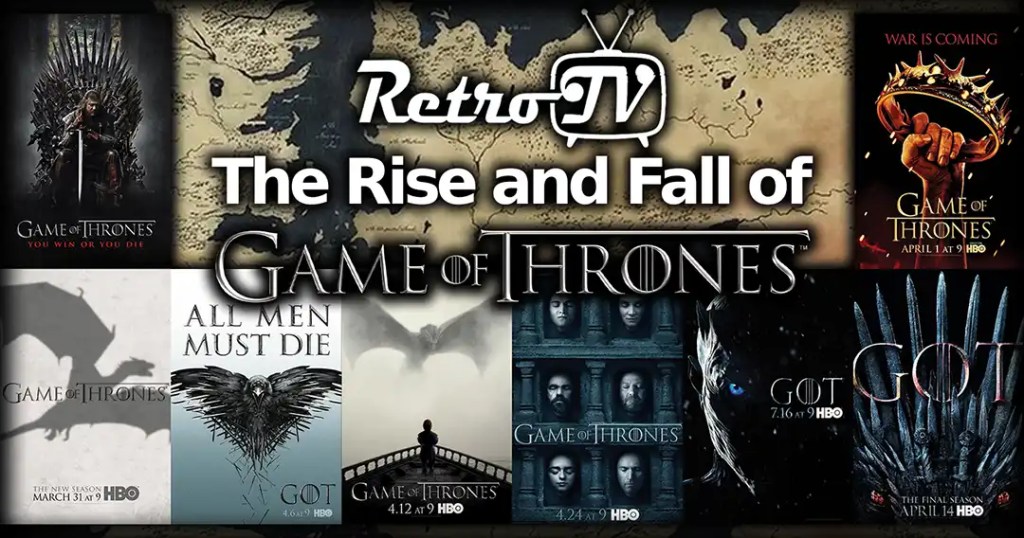
„Winter is coming“
„When you play the game of thrones, you win or you die!“
„That’s what I do: I drink and I know things.“
15 Years Later
Fifteen years after the premiere of Game of Thrones, it’s worth looking back at a series that has permanently changed television. Few productions have been the subject of as much conversation over the years as HBO’s fantasy epic. Week after week, people discussed new episodes, argued about characters, speculated on upcoming plot twists, and theorized about possible endings. Political intrigue, complex characters, surprising twists, and a world that seemed larger than anything previous series had attempted made Game of Thrones a global phenomenon. The series was not only successful but, at times, a cultural sensation that reached far beyond the boundaries of traditional fantasy fans. Yet just as remarkable as its meteoric rise was its equally dramatic fall. For a series that was initially hailed as a masterpiece has, in recent years, become an example of how an outstanding work can fail at its own end. That is precisely why looking back today is so fascinating: Game of Thrones stands both for the greatest possibilities of modern television series and for the bitter realization of how much a weak finale can alter one’s view of an entire body of work.
S01: A very strong start
The first season of Game of Thrones was an event. It became clear early on that this was no ordinary fantasy series. Instead of relying on simple good-versus-evil tropes, the series presented a world in which power, lineage, honor, and betrayal were tightly interwoven. The plot took its time introducing its characters, explaining their motivations, and carefully building the political tensions within Westeros. Robert’s visit to Winterfell alone made it clear how many old tensions lie beneath the surface: the friendship between Robert and Ned, Catelyn’s distrust of the Lannisters, and the political significance of Ned’s appointment as Hand of the King. Bran Stark’s fall at the end of the first episode was also early proof that personal secrets in this world can immediately have political and familial consequences.
Particularly striking was how uncompromising the series seemed. With Ned Stark, it appeared they had found the classic hero, only to brutally shatter that very expectation. His attempt to act with honor, openness, and moral clarity in King’s Landing failed in a world where characters like Cersei, Littlefinger, and Varys understood far better how power actually works. Daenerys’s development in Season 1 also demonstrated how powerfully the series worked with transformation: from a seemingly helpless girl, she gradually became a figure with her own authority, symbolically culminating in the finale with the death of Khal Drogo and the birth of the dragons. By the time of Ned’s execution, it was clear: no one is safe in this world. Season 1 combined strong dialogue, a dense atmosphere, and clever world-building into a foundation that immediately captivated viewers. Scenes like Robert and Cersei’s bitter conversation about their marriage, Tyrion’s quick characterization through wit and sharpness, or Arya’s early refusal to conform to the role intended for her also made it clear how precisely the series portrayed its characters right from the start.
S02 to S04: Still very good
Seasons 2 through 4 showcased Game of Thrones at a consistently high level. The series grew in scope but didn’t lose its core at first. The conflicts became more complex, new characters were introduced, and at the same time, there remained enough room for what made the series strong: conversations, intrigue, strategy, and moral gray areas. In Season 2, this was particularly evident during Tyrion’s time as Hand of the King. His verbal sparring with Cersei, his tactical maneuvering in the Small Council, and his attempt to make the politically toxic King’s Landing somewhat manageable were among the series’ strongest elements. At the same time, the season further expanded the power struggle for the Iron Throne with Stannis, Renly, and Robb, without losing sight of the bigger picture.
For many, this phase in particular is considered the series’ true peak. Events like the Battle of the Blackwater, the Red Wedding, or Tyrion’s trial remain among the most powerful moments in television history to this day. The Battle of the Blackwater was more than just a grand spectacle: it demonstrated how well the series could combine military might with character-driven storytelling, for example through Tyrion’s leadership, Joffrey’s cowardice, and Cersei’s cynical resignation in the face of a possible defeat. The Red Wedding, in turn, was so shocking because it had been set up over a long period of time. Robb’s political missteps, his broken marriage vow to the Freys, and the brutal logic of Walder Frey and Tywin Lannister made the massacre not only gruesome but tragically understandable within this world. Season 4 was similarly powerful with Tyrion’s trial, in which years of contempt, family tensions, and political calculation came to a head. His outburst in court remains one of the most memorable scenes in the series to this day.
During this period, the series managed to be spectacular without sacrificing its internal logic. Every development felt earned. Characters acted in a way that made sense, even when their decisions had catastrophic consequences. This was also evident in Jaime Lannister’s gradual transformation, which gained new depth through his captivity and his journey with Brienne. Likewise, Arya’s storyline gained power because her experiences credibly shaped her from a rebellious girl into an increasingly hardened survivor. Jon Snow’s time with the Night’s Watch and his encounter with the Wildlings also expanded the world beyond the mere struggle for the throne, making it clear that an even greater threat awaits beyond the political intrigues.
Above all, it was evident that a very strong literary source material was still guiding the direction here. The world felt alive, the conflicts were well-thought-out, and the plot was patiently told. Even minor characters like Oberyn Martell left a lasting impression in a short time because they were clearly written, superbly introduced, and immediately integrated into the existing power struggles. Game of Thrones was more than just entertainment during those years: it was prestige television at the highest level.
S05: It’s Dragging
With Season 5, the first major signs of fatigue began to appear. The series was still well-produced, still significantly better than many other productions, but the narrative pace began to shift in a strange way. Some storylines felt unnecessarily drawn out, while others lost their edge. This was particularly evident in the Dorne storyline, which seemed surprisingly flat compared to the intrigues in King’s Landing or the conflicts in the North. What could have been a new political setting with great potential often remained surprisingly lifeless in its execution. Sansa’s development in Winterfell was also perceived by many as problematic, because her story felt less like a smart next step for her character and more like an unnecessarily cruel loop designed to make her suffer once again.
It was particularly noticeable that not every setting seemed equally interesting anymore. While individual characters continued to have strong moments, stagnation and repetition became apparent in other parts of the plot. At the same time, however, Season 5 also showed that the series had not yet completely lost its impact. The episode “Hardhome,” for example, served as a reminder of just how powerful Game of Thrones could be when tension, threat, and direction truly came together. Cersei’s walk of shame through King’s Landing was also an intense, uncomfortable, and effective moment, because here personal humiliation, political reckoning, and religious fanaticism collided directly. It was precisely this contrast that made Season 5 so uneven: on the one hand, there were still powerful individual scenes and striking imagery; on the other, the series had grown so large that not everything maintained the same quality. It wasn’t a collapse yet, but for the first time, one could sense that Game of Thrones was no longer being told with the same confidence as in its early years.
S06: The End of the Books – and You Can Tell
By Season 6 at the latest, it was clear that the series had left the scope of the published books behind. Many viewers initially still found this season powerful because it offered great moments, spectacular imagery, and long-awaited resolutions. There were plenty of examples: Jon’s return from the dead, Hodor’s tragic backstory, the revelation of Jon Snow’s origins, Cersei’s destruction of the Sept of Baelor, and the Battle of the Bastards delivered exactly the kind of epic scenes that everyone was immediately talking about. Yet at the same time, the tone of the series shifted noticeably.
Whereas characters used to get into conflicts because of their decisions and weaknesses, much of the writing now seemed more focused on creating dramatic impact. The plot became more straightforward; some developments seemed to stem less from character logic than from a desire for big scenes. The Battle of the Bastards is a particularly good example of this: impressive in its staging, emotionally impactful, and visually overwhelming, but not always as neatly developed from strategy and character logic as we were accustomed to in the early seasons. The situation was similar with Cersei’s seizure of power following the destruction of the Sept of Baelor. The scene itself was superbly staged and ranks among the strongest moments of the entire season, yet the political consequences seemed to be dealt with relatively quickly. Game of Thrones remained thoroughly entertaining in Season 6 and even impressive in parts, but the narrative precision of the early years was no longer the same.
One increasingly got the feeling that while the series still knew roughly where it was headed, it could no longer always convincingly explain how it would get there. This was evident in Arya’s storyline in Braavos or Daenerys’s development in Essos: there were strong individual moments and clear objectives, but the path often seemed more direct and less finely crafted than before.
S07: Rushing to the End
Season 7 made little secret of the fact that everything was now building toward the finale. The path there was significantly accelerated. Characters suddenly traveled halfway across the world in no time, political developments were rushed through rather than played out, and much of it felt like a transitional phase between the series’ actual core and the finale. This was particularly evident in the mission beyond the Wall, where Jon and a small group were tasked with capturing an undead creature. The idea already seemed risky and contrived within the plot, but above all, the episode made it clear just how drastically space and time had suddenly shrunk in the series: Gendry runs back to the Wall, a raven reaches Daenerys, and she appears with her dragons seemingly almost immediately. Such sequences would have carried significantly more weight, time, and consequence in earlier seasons.
The problem was not just the faster pace, but that this pace undermined the former strength of Game of Thrones. The series once thrived on the fact that consequences were taken seriously and every decision needed time to unfold its effects. In Season 7, however, central developments were often treated merely as functional plot devices: the main thing was that all the characters were in the right places at the right time for the finale. The gathering in the Dragonpit is a good example of this. Essentially, nearly all the series’ major power figures converge there in one place—a moment that would have been built up over many episodes in the past. Instead, the scene feels primarily like a device to quickly usher in the next stage of the finale. It was similar with Littlefinger’s end in Winterfell: While his downfall had a certain satisfaction to it, it came about much more directly and less subtly than one would have expected for a character built up over such a long time.
So while the spectacle remained, there was less and less of the care that had once distinguished the series. Even Daenerys’ arrival at Dragonstone, her return to a place steeped in history, and her alliance with Jon Snow featured powerful imagery and symbolic weight, yet many political and personal tensions were resolved more hastily than the series’ earlier standards would have suggested.
S08: The disappointing Ending
With Season 8, this trend reached its peak—and thus also its low point. Technically, the series remained impressive. Production design, music, effects, and direction were top-notch. But in terms of content, the ending felt rushed, unsatisfying, and at times barely prepared. Even the battle against the White Walkers became a symbol of this problem for many: The Night King threat had been built up over years as a nearly apocalyptic central conflict, only to be resolved in a single, massive episode. Added to this were decisions made during the battle that often seemed more about spectacle than logic, such as the tactically questionable formation outside Winterfell or the numerous characters who were repeatedly portrayed as surely dead only to simply carry on.
Characters made decisions that no longer fit with their long-established character arcs. Central conflicts were resolved surprisingly quickly. Story arcs that had been built up over years ended, in some cases, abruptly or disappointingly. Daenerys’s development was particularly frequently criticized: The fact that she ultimately veers into becoming a destructive ruler was fundamentally laid out as a possibility, yet the transformation felt too hasty and insufficiently prepared to many viewers. Jaime Lannister’s return to Cersei was also often perceived as a step backward, as it undermined large parts of his previous development. Added to this were moments that unintentionally seemed almost casual, even though they were meant to be hugely significant—such as Euron’s sudden fight with Jaime or Bran Stark’s coronation, which was supposed to be a surprise but felt emotionally and narratively unprepared for many. Instead of an organic finale, the impression was that the series was primarily meant to be wrapped up as quickly as possible.
That is precisely why the disappointment was so great: not because Game of Thrones had started off poorly, but because the series had shown just how much better it could be. Even scenes like the deaths of Cersei and Jaime or Jon Snow’s end beyond the Wall left many viewers not with a sense of bitter but fitting tragedy, but rather the impression of a rushed conclusion. The ending was not merely controversial, but for many viewers a palpable break from what had originally defined the series.
The End for the Books
Even after the series ended, the book series remains unfinished. The discussion surrounding this continues to accompany Game of Thrones to this day and has almost become an integral part of the franchise’s entire legacy. Many fans had long hoped that George R. R. Martin would bring the story to a close in novel form and perhaps also shape certain developments differently, in greater detail, and above all, more plausibly. Especially after the controversial series finale, the hope was rekindled that the books might one day deliver a more nuanced version of the ending—with more time for political consequences, more credible character decisions, and the narrative patience that had made the early seasons and, above all, the source material so strong.
In the meantime, however, this hope seems significantly weaker than it did during the series’ heyday. The enormous hype surrounding Game of Thrones has noticeably subsided since the series finale, and with it the expectation that the books could still exert the same cultural influence as before. Whereas in the past every little news item about Martin, every blog post, and every hint about the progress of the next volumes immediately garnered significant attention, today there is a much greater sense of disillusionment. Whether Martin will ever finish the series remains to be seen. The only certainty is that the TV series has, in a sense, outpaced its source material—and that this was precisely one of the decisive turning points.
For the moment the TV series foreshadowed the end of the major storylines, the role of the books also changed. They would no longer be simply the culmination of a massive literary project, but always also a belated alternative to a series finale that left many viewers disappointed. While this might still make the books interesting, it robs them of some of the historical uniqueness they would have had in the past. That is precisely why a sense of uncertainty still hangs over the literary conclusion of Game of Thrones: not only whether it will ever be published at all, but also whether it could ever again have the same cultural impact as it did before the series ended.
Strong Start, Disappointing End
Game of Thrones remains a special case in television history. Few series have started so strongly, maintained such a high standard over the years, and reached such a large audience. The early seasons remain a prime example of how cleverly, densely, and boldly a series can be told. They proved that fantasy on television need not be merely niche entertainment, but can develop political impact, psychological depth, and cultural relevance. Especially in its early years, Game of Thrones often seemed like the rare case of a series that was both accessible to the masses and artistically ambitious.
At the same time, Game of Thrones is now also synonymous with a disappointing ending. The closer the series came to its conclusion, the more it lost the qualities that once made it so extraordinary: patience, consistency, precision, and character depth. Developments were rushed, conflicts simplified, and by the end, characters seemed more often to follow the demands of the plot than their own internal logic. Precisely because of this, the finale not only felt weaker than the early seasons but also like a break from what had once distinguished the series.
What remains, therefore, is a contradictory legacy. Game of Thrones was once the greatest series in the world—and in the end became a reminder of how crucial a good finale is to a work’s lasting reputation. One can therefore neither simply celebrate the series as a masterpiece nor reduce it solely to its failed ending. Both are part of its legacy. It helped shape modern television, captivated millions of viewers for years, and produced some of the most memorable moments in TV history. At the same time, it demonstrated how quickly even a cultural phenomenon of the century can lose its luster if the ending fails to live up to the trust it had built up.







 McHenry's Lair
Kommentar verfassen :