

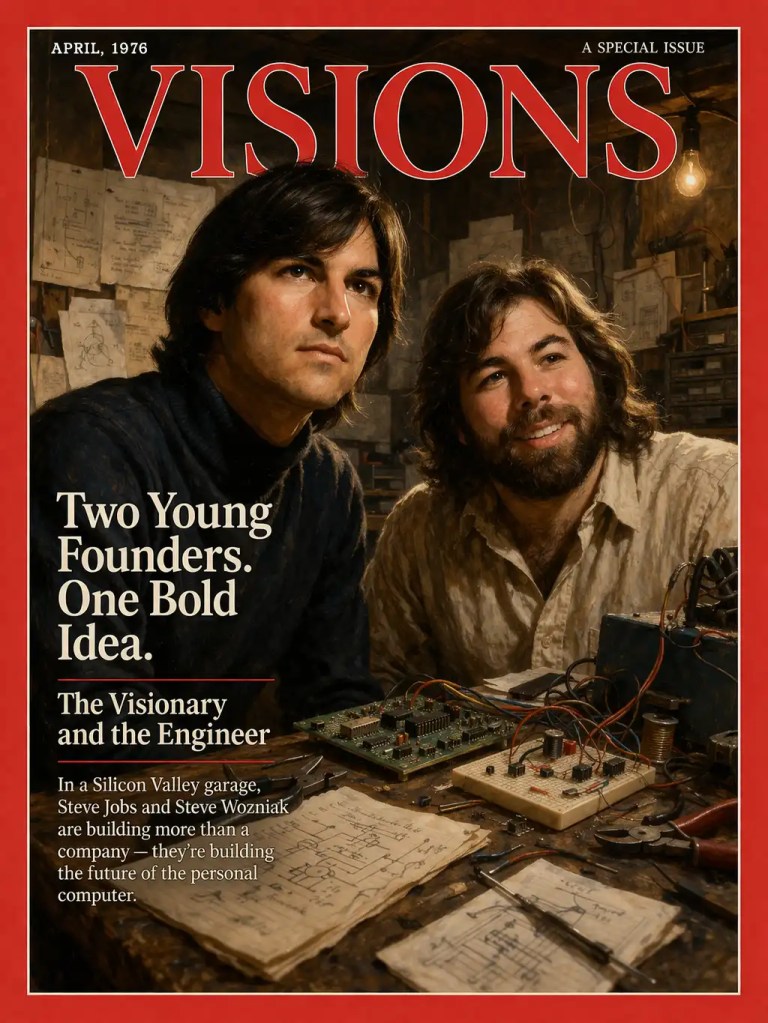
April, 1976
Two young men, a garage,
and the bold idea of freeing
the computer from the data center
At a time when computers still sound like massive machines from another world—devices for corporations, universities, and government agencies, guarded by specialists in white shirts behind locked doors—something astonishing is emerging in California. It is small, fast, almost defiant. And it goes by a name that evokes an orchard rather than an electronic revolution:
Apple Computer Company.
The company, founded by two unusual young men, embodies all the hallmarks of that new Californian energy so often talked about these days: improvisation, boldness, technical brilliance, and an almost audacious belief that the future need not remain in the hands of large institutions. If Apple is right, then computers will soon no longer be confined to windowless data centers, but will sit on desks. Perhaps even in living rooms. Perhaps, say the optimists, one day in schools, studios, newsrooms—and who knows, possibly in the form of devices so small and sleek that they could be carried in a pocket.
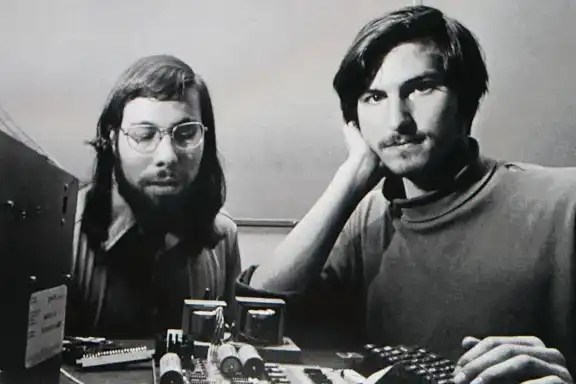
At the center of this story are two founders who could hardly be more different and yet, precisely for that reason, seem made for each other. There is Steven Jobs, the visionary: slender, intense, a fast talker, with that look that doesn’t simply enter a room but immediately redefines it. Jobs is not a man who talks about mere circuits. When he speaks of computers, it sounds as if he is speaking of culture, of freedom, of a new way of living and working. He gives the impression that the machine is only the beginning and that the real product could be something greater: a relationship between people and technology that does not intimidate, but inspires.
The other is Stephen Wozniak, the technician—friendly, witty, modest, a designer with the soul of a tinker and the instincts of a mathematical artist. Where Jobs sees the future, Wozniak is already building it. In the young world of microcomputers, he enjoys a reputation as a man who doesn’t simply assemble devices, but translates elegance into electronics. His designs are not merely functional; they bear that rare signature that connoisseurs recognize immediately: fewer components, more ingenuity, maximum impact.
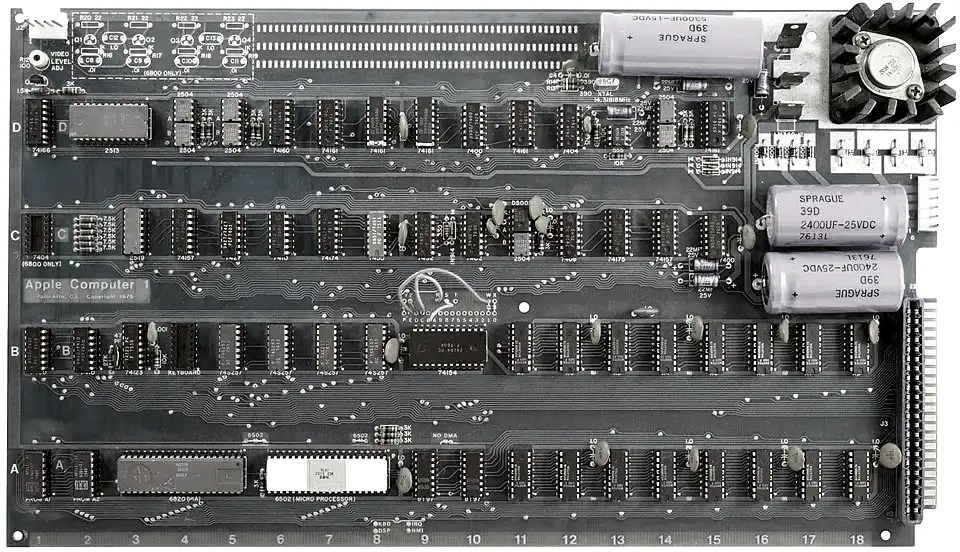
Apple is thus more than a company. It is almost a classic American founding story: two young men, a garage, a few boards, a soldering iron, plenty of determination, and little respect for the rules of an industry they consider too sluggish. Their first computer is an invitation to hobbyists and insiders—a machine for that new class of electronic pioneers who meet in clubs, exchange schematics, and work toward a more democratic computer world with a mix of idealism and technical zeal.
The next significant step is already taking shape in the planning. The next device is no longer meant to feel like an experiment, but like a real product. It will be more compact, more complete, more accessible. It is intended to appeal not only to the hobbyist, but also to the teacher, the small business owner, the engineer, perhaps even the family. This shift could be Apple’s greatest strength. For while many microcomputers still exude the atmosphere of a workbench and a laboratory, one senses at Apple that this young company has more in mind than just computing power. It wants to turn the computer into an object that people would love to own.
This idea is remarkably modern. In the conversations heard in and around the company, one word keeps coming up that has so far seemed almost frivolous in the tech sector: design. Jobs seems convinced that a computer’s external form could become just as important as its inner values. One might smile at such statements as long as computers still look like half-finished contraptions. But perhaps that is precisely Apple’s secret: The founders act as if the computer were not just a machine, but an everyday object of tomorrow—as natural as a telephone, as personal as a notebook, as desirable as a good hi-fi system.
Listening to Jobs, one almost believes that one day Apple might not just build computers, but an entire family of devices. Perhaps machines with screens that no longer demand cryptic commands, but instead engage the user graphically. Perhaps devices where text, images, and music converge in a common language. Perhaps a small music player for your pocket. Perhaps a telephone without a dial or keypad, just glass, a surface, and touch. Perhaps even a flat electronic sheet—half book, half screen—that you hold in your hand like a magazine from the future. Such ideas seem bold today, almost fantastical. Yet Apple is a company that thrives on precisely such defiance.
Of course, the question remains whether idealism and talent are enough. The computer market is young, but it will become tougher. Large companies will not stand idly by and watch as two long-haired Californians snatch the interpretive authority over the future from them. Apple will need capital, organization, distribution, and perhaps also the willingness to grow from the myth of the garage into the reality of business life. It is one thing to build a brilliant machine. It is another to build a company that turns a brilliant machine into an industry.
And yet: Right now, at this early stage, Apple’s appeal lies in possibility. In its unfinished state. In the electric crackle of an idea that seems to grow the longer you look at it. Jobs and Wozniak embody two archetypal American figures in a new form: the prophet and the engineer, the dreamer and the builder. One speaks of what could be. The other ensures that it actually works.
It would be premature to declare Apple a titan of industry today. But it would be just as foolish to underestimate the young company. For sometimes a new era does not begin with the thunder of great institutions, but with the quiet hum of a small computer on a table in California.
And sometimes the future bears a surprisingly simple name: Apple.








Kommentar verfassen